
TEXAS RULES OF CIVIL PROCEDURE / RULE 103
TRCP 103: Who may serve
Authorized process servers, interested-party disqualification, requested clerk service and special-process restrictions.
Understand this rule
Start with the explanation.
Read the plain-language overview and illustrations, then follow the related rules.
Read the explanation ↓Research the authority
Start with the official rule.
Open the primary source, check the applicable version and court requirements, then compare the explanation.
Read the official rule ↗Rule 103, illustrated
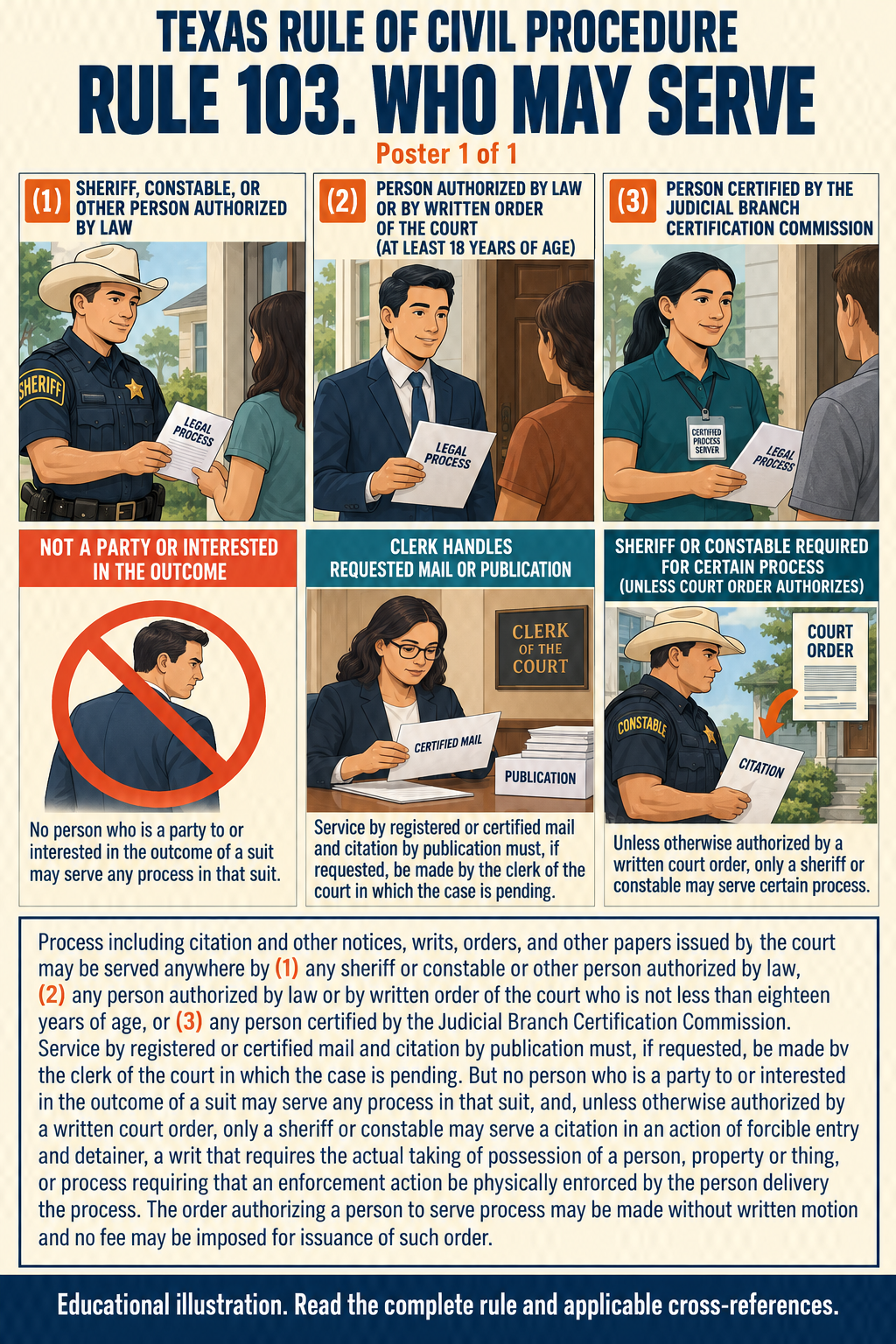
Read the assigned text for poster 1
Process including citation and other notices, writs, orders, and other papers issued by the court may be served anywhere by (1) any sheriff or constable or other person authorized by law, (2) any person authorized by law or by written order of the court who is not less than eighteen years of age, or (3) any person certified by the Judicial Branch Certification Commission. Service by registered or certified mail and citation by publication must, if requested, be made by the clerk of the court in which the case is pending. But no person who is a party to or interested in the outcome of a suit may serve any process in that suit, and, unless otherwise authorized by a written court order, only a sheriff or constable may serve a citation in an action of forcible entry and detainer, a writ that requires the actual taking of possession of a person, property or thing, or process requiring that an enforcement action be physically enforced by the person delivery the process. The order authorizing a person to serve process may be made without written motion and no fee may be imposed for issuance of such order.