
TRAP · Questions & sources
One question.
A clearer next step.
Explore the rules behind the task in front of you. Open a question to read its explanation and official sources.
80 questions
No matching questions. Try a broader topic or a rule number, or clear the search to browse every question.
Find a rule’s reading path
Every current TRAP rule has a reading destination below. This is a navigation index; the official rule supplies its complete requirements. Rule 50 is abolished.
TRAP 50 — abolished. TRAP 50 ↗
Understand what followsTRAP 51Understand original proceedingsTRAP 52Seek Supreme Court reviewTRAP 53Follow a record requestTRAP 54Prepare requested merits briefsTRAP 55Read the Supreme Court’s actionTRAP 56Check direct Supreme Court jurisdictionTRAP 57Follow a certified civil-law questionTRAP 58Read the Supreme Court’s actionTRAP 59Read the Supreme Court’s actionTRAP 60Read the Supreme Court’s actionTRAP 61Check a request for appellate damagesTRAP 62Read the Supreme Court’s actionTRAP 63Check Supreme Court rehearingTRAP 64Follow the Supreme Court judgmentTRAP 65Request discretionary criminal reviewTRAP 66Request discretionary criminal reviewTRAP 67Request discretionary criminal reviewTRAP 68Follow a grant of criminal reviewTRAP 69Follow a grant of criminal reviewTRAP 70Identify direct criminal reviewTRAP 71Check leave for an extraordinary writTRAP 72Choose the postconviction habeas procedureTRAP 73Follow a certified criminal-law questionTRAP 74Follow a grant of criminal reviewTRAP 75Follow a grant of criminal reviewTRAP 76Read the criminal high court’s resultTRAP 77Read the criminal high court’s resultTRAP 78Check whether rehearing is allowedTRAP 79Request discretionary criminal reviewTRAP 80Where should I begin after receiving an order?Identify the proceeding
When this matters
You received an order, judgment or notice and need a starting point.
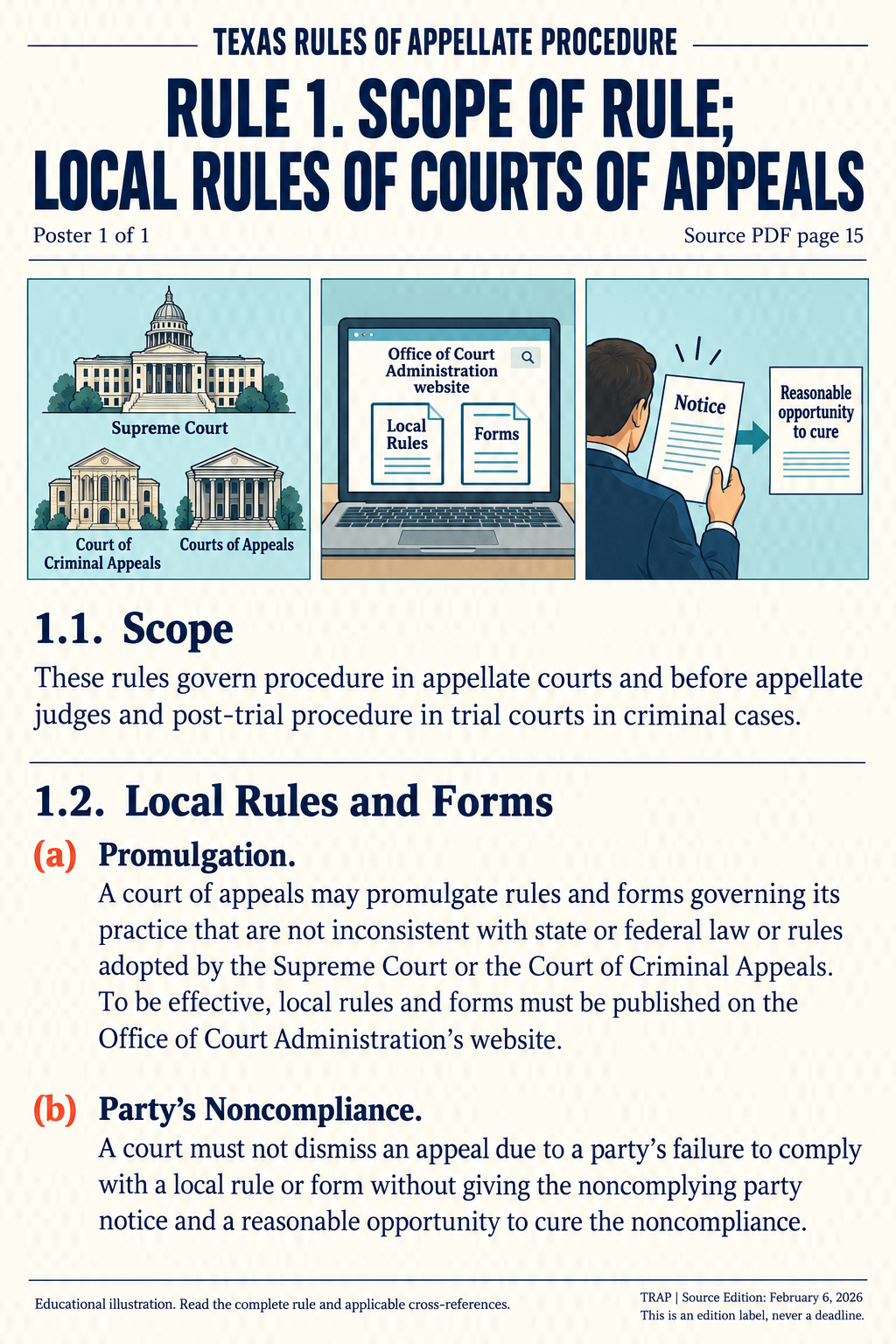
Begin with what happened, the court involved and the type of case. Choose the civil, criminal or original-proceeding route before reading a filing deadline. A trial-court order and an appellate decision lead to different next questions.
Have the signed order, judgment or court notice ready. The choices below organize reading; the applicable law determines whether a route is available.
See this in a diagram (2 available)
These illustrations cover related procedural points. Read the official sources below for the full requirements.
Read the official sources
Texas Rules of Appellate Procedure, February 6, 2026 edition. Check applicable amendments and court orders.
Am I the appellant, appellee or someone else?Know your role
When this matters
You are identifying who is asking for relief and who is responding.
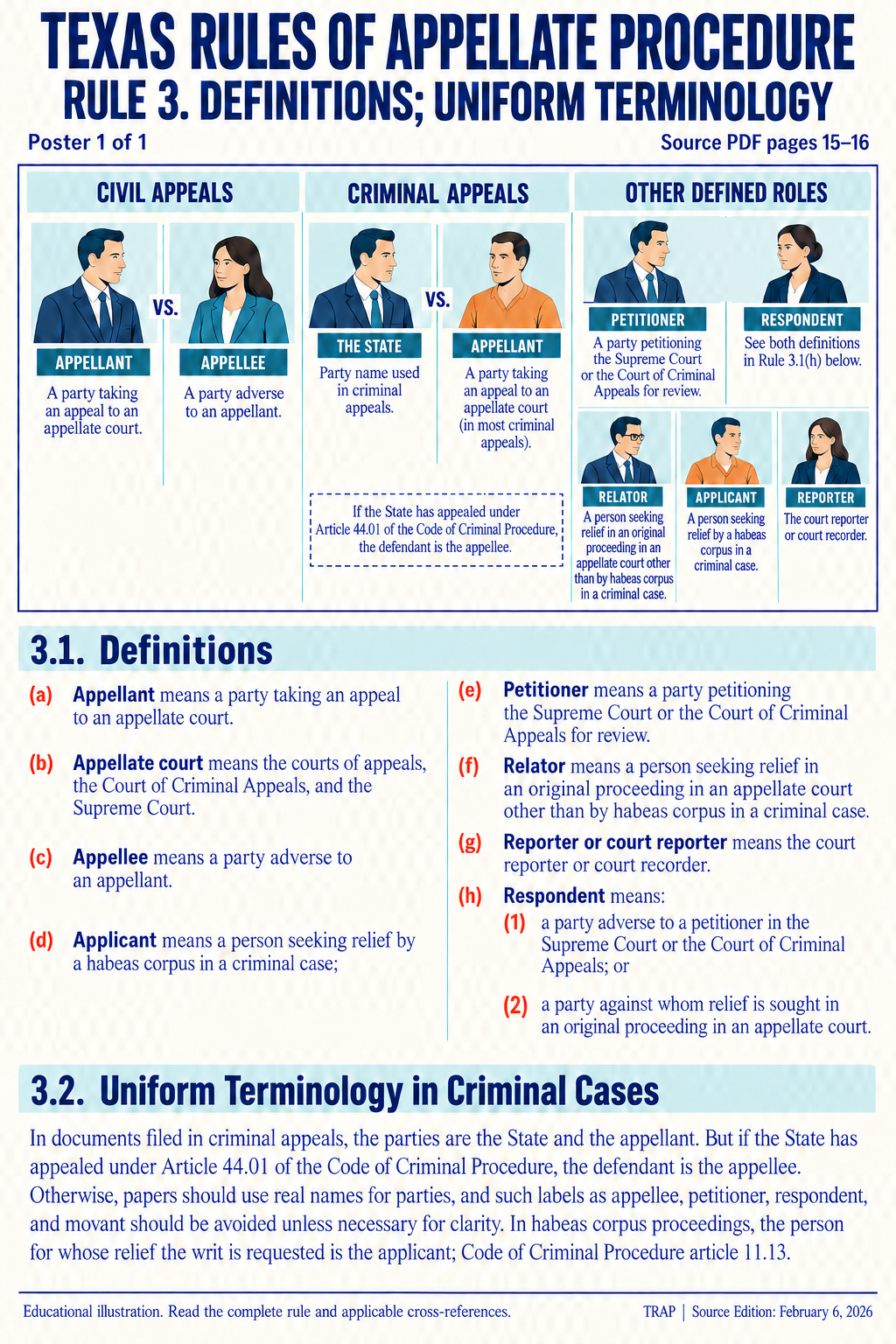
The appellant takes an appeal; the appellee is a party adverse to the appellant. A party seeking review in the Supreme Court is a petitioner. A person seeking extraordinary relief in an original proceeding is generally called the relator.
Use the terminology for your proceeding. Responding to another party’s appeal and seeking a change to the judgment raise different filing questions.
See this in a diagram (7 available)
These illustrations cover related procedural points. Read the official sources below for the full requirements.
Read the official sources
Texas Rules of Appellate Procedure, February 6, 2026 edition. Check applicable amendments and court orders.
What date starts the clock, and which timing rule applies?Check the civil appeal deadline
When this matters
You are identifying a civil notice-of-appeal deadline.
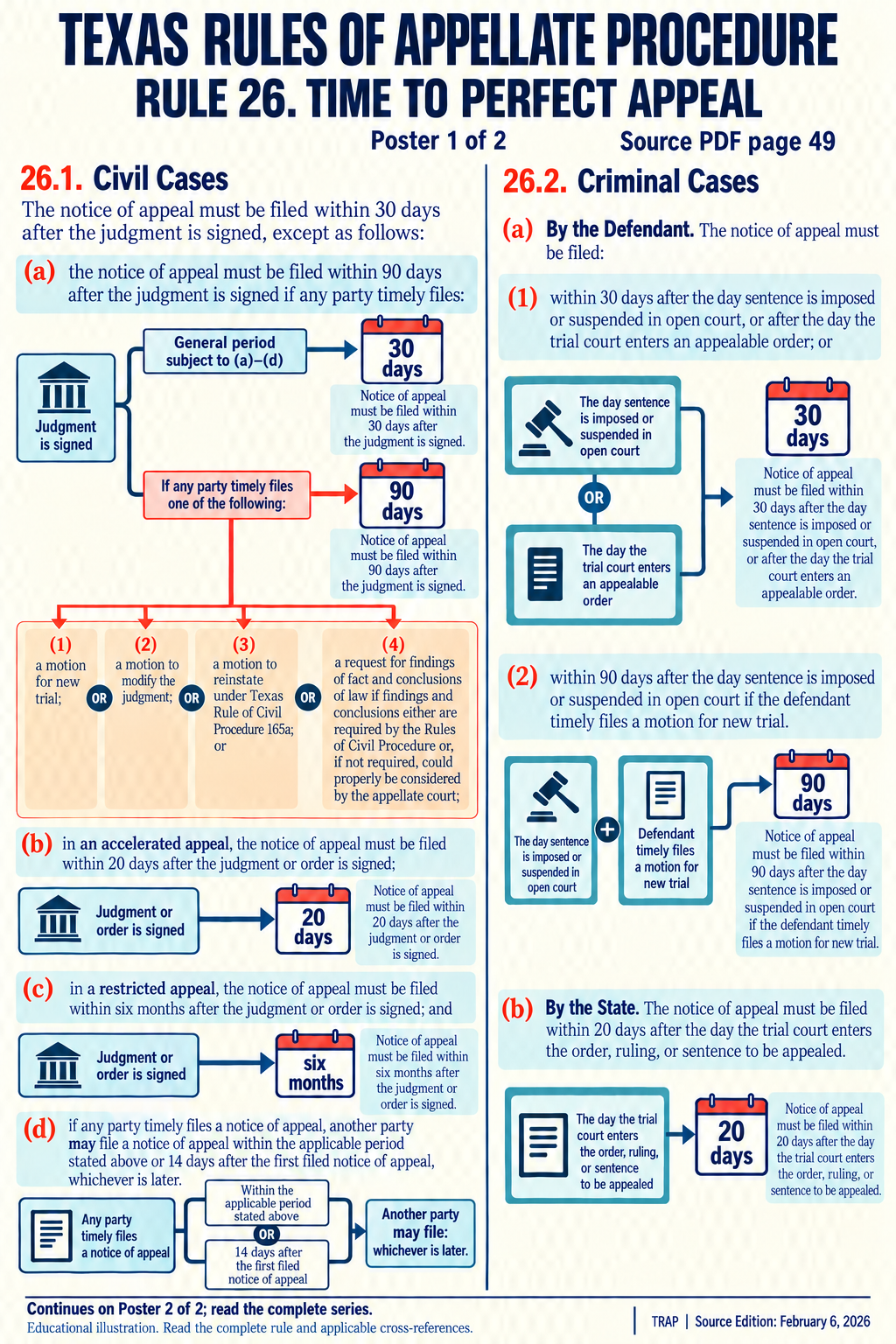
Identify the triggering event and the applicable type of appeal before reading a deadline. Rule 26.1 separates ordinary civil, accelerated and restricted appeals and addresses a later notice by another party. Rules 4 and 26.3 address particular timing and extension questions.
Check the signed judgment, qualifying postjudgment filings and any court order. Under Rule 28.1(b), post-trial motions do not extend the time to perfect an accelerated appeal. This guide does not calculate a filing deadline.
See this in a diagram (4 available)
These illustrations cover related procedural points. Read the official sources below for the full requirements.
Read the official sources
Texas Rules of Appellate Procedure, February 6, 2026 edition. Check applicable amendments and court orders.
Does the record show my complaint and the court’s ruling?Preserve the issue
When this matters
An issue arises in the trial court, or you are checking it before briefing.
To preserve a complaint, you generally need a timely, sufficiently specific request, objection or motion and a ruling, or a refusal to rule to which the complaining party objected. Preservation depends on the complaint and the applicable exceptions.
Locate the request and ruling in the record. Read the provisions on rulings by operation of law and civil nonjury sufficiency complaints; do not assume every issue needs the same step.
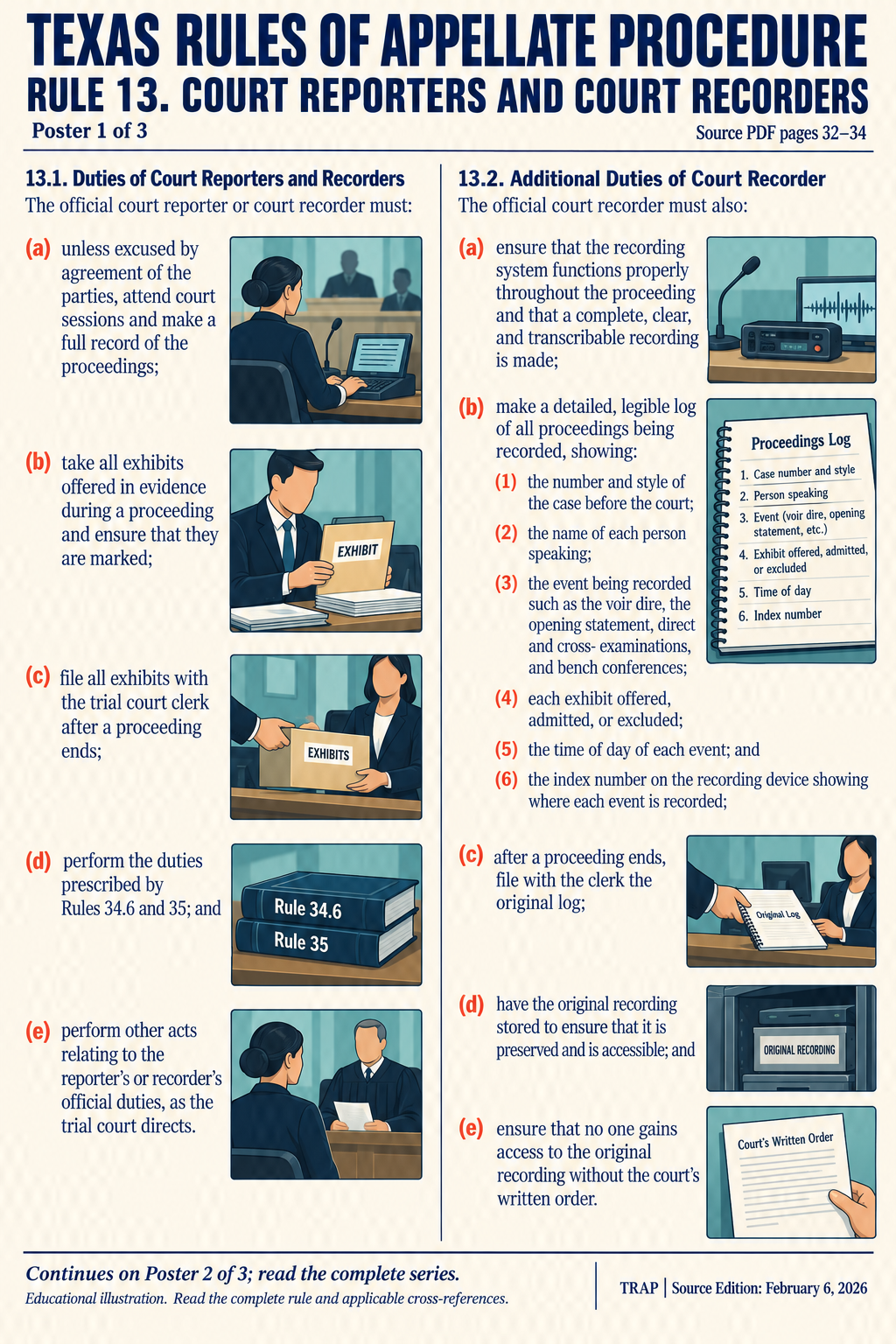
See this in a diagram (1 available)
These illustrations cover related procedural points. Read the official sources below for the full requirements.
Read the official sources
Texas Rules of Appellate Procedure, February 6, 2026 edition. Check applicable amendments and court orders.
Where does a civil notice of appeal go?Start the appeal
When this matters
You have identified an available civil appeal and need to perfect it.
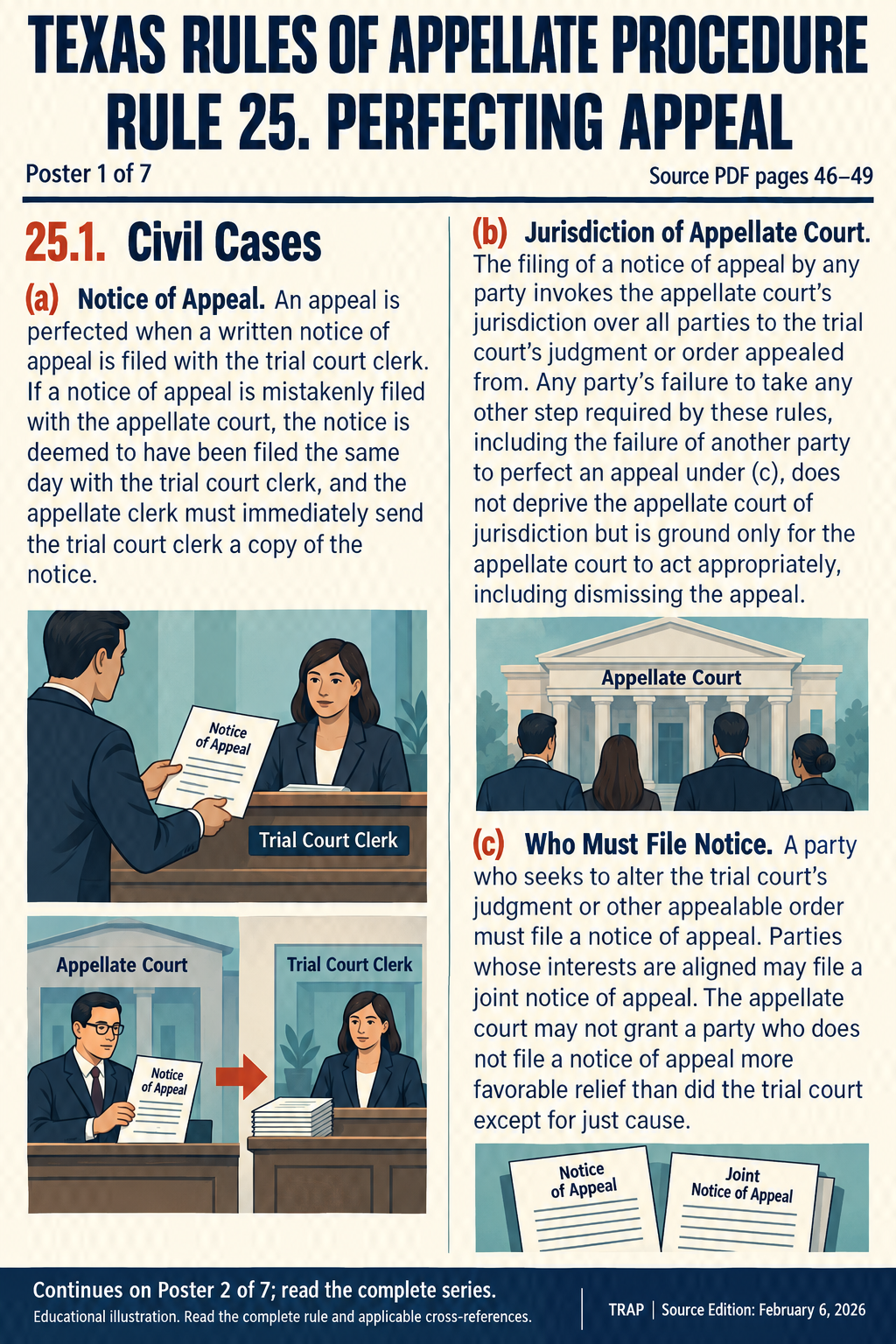
Perfect a civil appeal by filing a written notice with the trial court clerk. The rule identifies the contents, service and treatment of a notice mistakenly filed with the appellate court.
Check the correct court, order, party names and type of appeal. Read the notice requirements together with the timing provisions and any special procedure.
See this in a diagram (3 available)
These illustrations cover related procedural points. Read the official sources below for the full requirements.
Read the official sources
Texas Rules of Appellate Procedure, February 6, 2026 edition. Check applicable amendments and court orders.
Someone else appealed. What should I check first?Respond to an appeal
When this matters
Another party filed a civil notice of appeal.
Read the notice, identify the relief sought and locate the appellate case. Rule 38.2 addresses the appellee’s brief. If you seek to change the trial court’s judgment, Rule 25.1(c) addresses your own notice of appeal.
Distinguish defending the judgment from seeking more favorable relief. Rule 25.1(c) contains a just-cause qualification; check the applicable notice deadline under Rule 26.1.
See this in a diagram (3 available)
These illustrations cover related procedural points. Read the official sources below for the full requirements.
Read the official sources
Texas Rules of Appellate Procedure, February 6, 2026 edition. Check applicable amendments and court orders.
Where can I find the case number and court notices?Find the appellate case
When this matters
You need the appellate case number, a filing or a court notice.
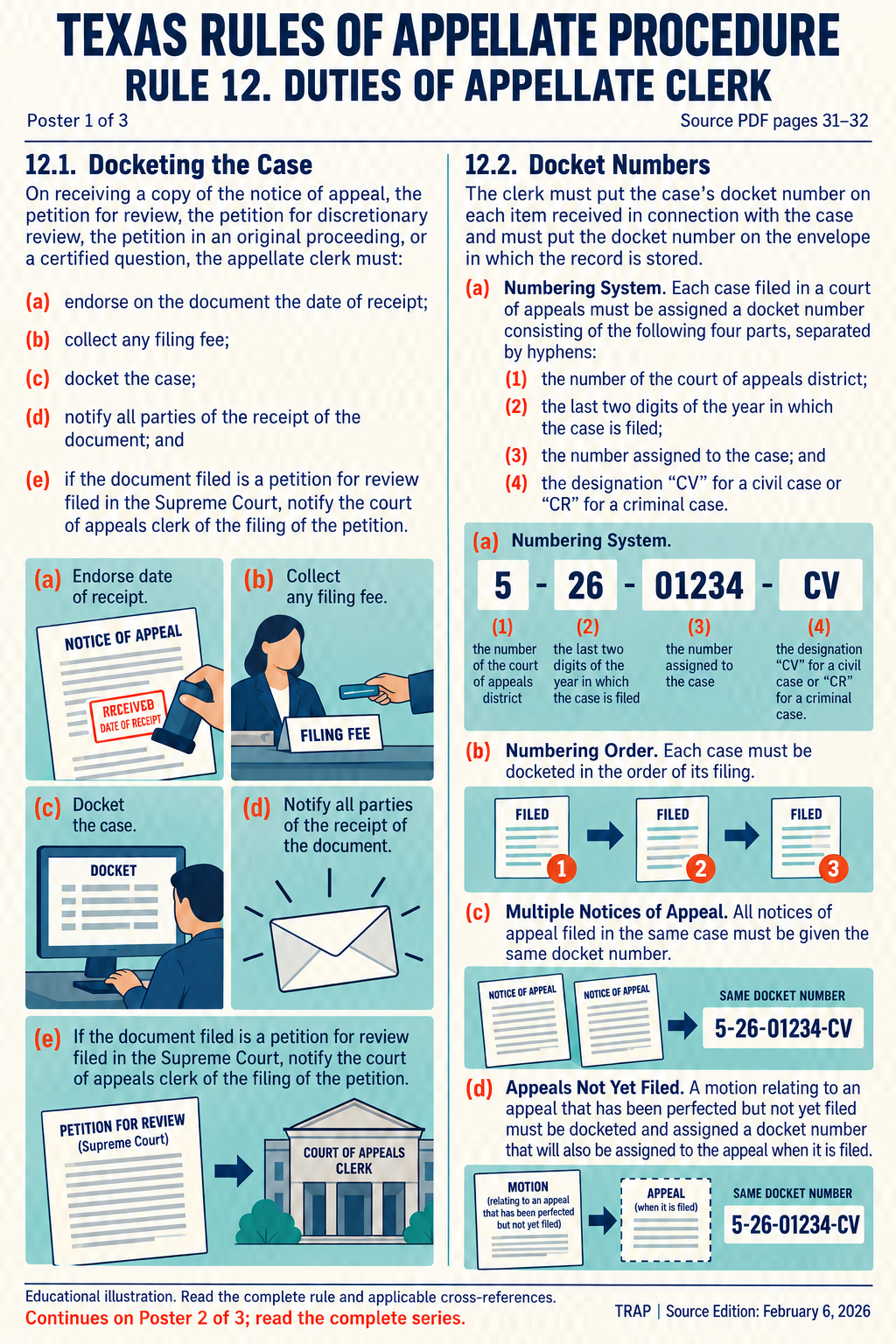
Rule 12 describes the appellate clerk’s docketing, case numbers and notices. The trial court clerk and the appellate clerk have different responsibilities; identify which court holds the filing you need.
Keep the appellate case number and current court notices with your papers. Use the court’s official instructions and check the destination before filing.
See this in a diagram (3 available)
These illustrations cover related procedural points. Read the official sources below for the full requirements.
Read the official sources
Texas Rules of Appellate Procedure, February 6, 2026 edition. Check applicable amendments and court orders.
What will the appellate court read from the trial court?Understand the record
When this matters
You are identifying the trial-court materials needed for a civil appeal.
The appellate record consists of the clerk’s record and, when necessary to the appeal, the reporter’s record. Rule 34 addresses their contents and alternatives, including agreed records and the civil appendix procedure in Rule 34.5a.
Identify the documents, hearings and exhibits relevant to the issues. Read the applicable procedure before choosing an alternative to the clerk’s record or requesting only part of the reporter’s record.
See this in a diagram (2 available)
These illustrations cover related procedural points. Read the official sources below for the full requirements.
Read the official sources
Texas Rules of Appellate Procedure, February 6, 2026 edition. Check applicable amendments and court orders.
Who prepares the record, and what must I arrange?Arrange the record
When this matters
You need to request and arrange preparation of the civil appellate record.
Rules 34 and 35 address requests, preparation and filing. The trial court clerk and reporter have filing responsibilities subject to the rule’s conditions, including payment, satisfactory payment arrangements or entitlement to proceed without payment.
Check the required request, which record is needed, fees or inability-to-pay procedure, and the applicable filing time. Do not treat filing the notice as completion of every record-related task.
See this in a diagram (2 available)
These illustrations cover related procedural points. Read the official sources below for the full requirements.
Read the official sources
Texas Rules of Appellate Procedure, February 6, 2026 edition. Check applicable amendments and court orders.
What if the record is incomplete, inaccurate or late?Check what is missing
When this matters
An item is missing, inaccurate, lost or late in the appellate record.
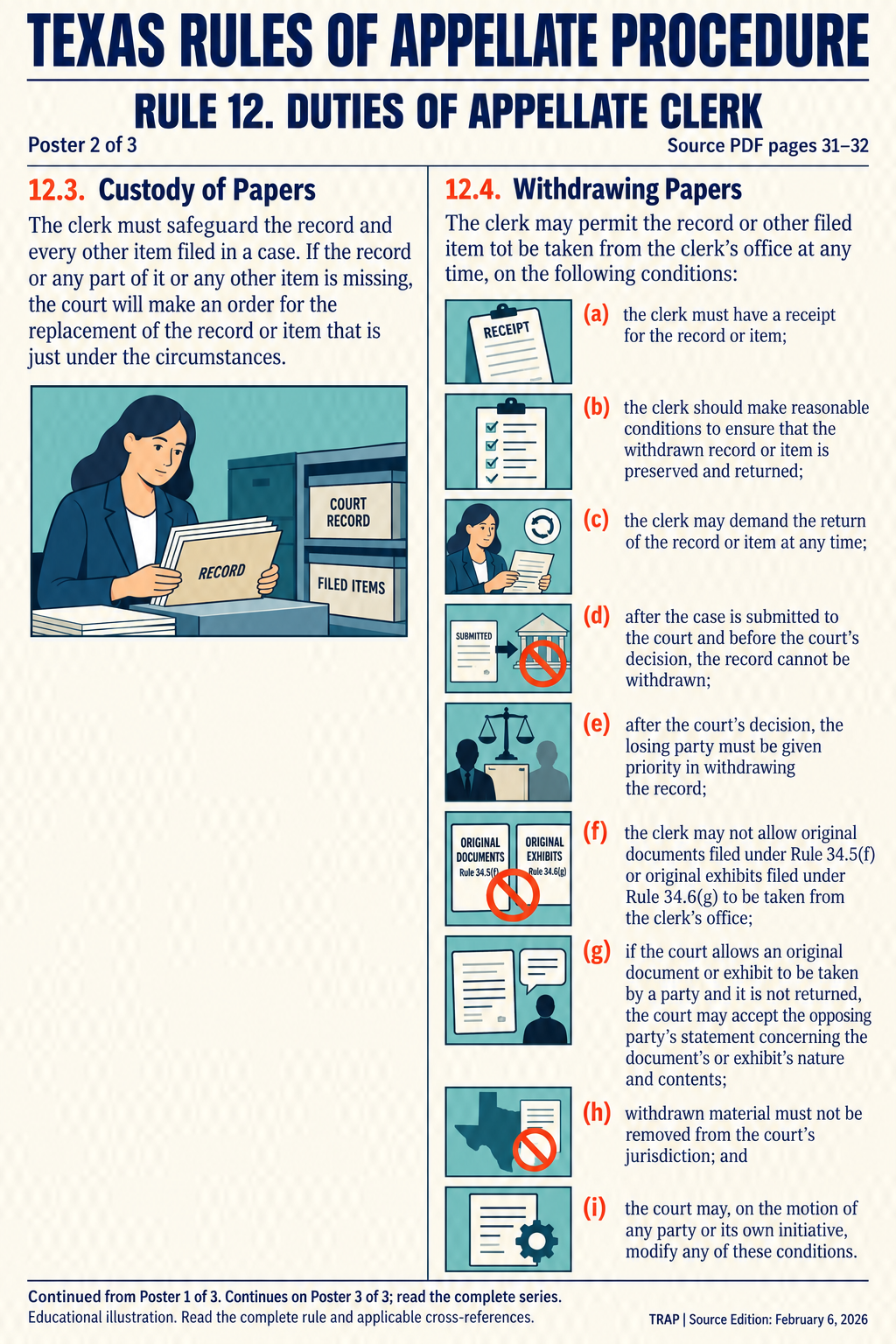
Rule 34 provides procedures for supplementation and correction. Rule 37 addresses problems with filing the record. A missing item, an inaccurate record and a lost or destroyed record raise different questions.
Identify the specific item and the problem before requesting a correction. Read the relevant subsection and any court notice; do not assume attaching a document to a brief makes it part of the appellate record.
See this in a diagram (1 available)
These illustrations cover related procedural points. Read the official sources below for the full requirements.
Read the official sources
Texas Rules of Appellate Procedure, February 6, 2026 edition. Check applicable amendments and court orders.
What belongs in an appellant’s brief?Prepare the appellant’s brief
When this matters
Your opening brief in the court of appeals is due under the applicable schedule.
Organize the appellant’s brief around the case, issues, facts, argument and requested relief, with record references and authorities where required. The court should be able to connect each issue to the record and the ruling being challenged.
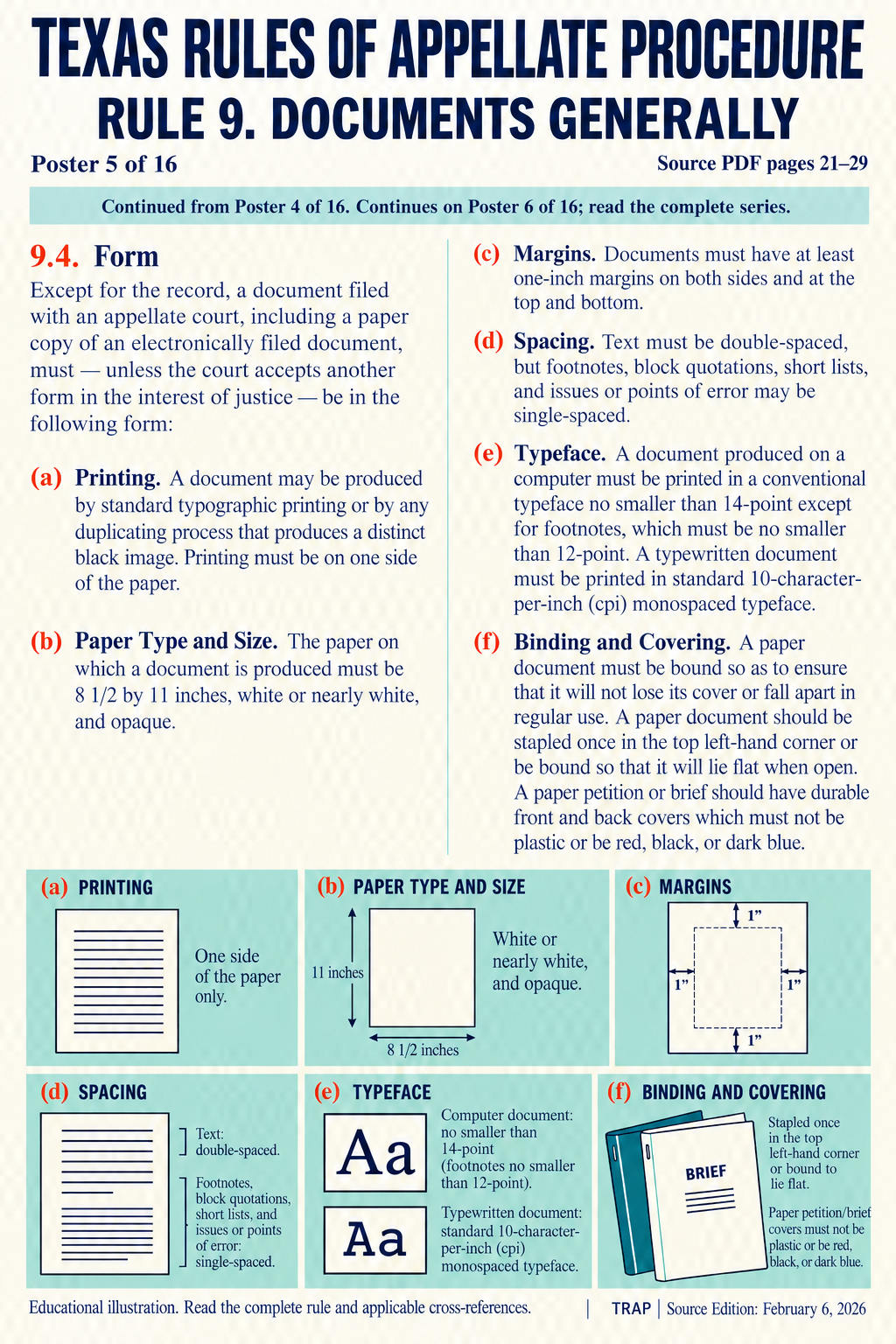
Use the full list of required sections. Check Rule 9 for document format and length, and Rule 38.6 for timing; a topic outline is not a completed brief checklist.
See this in a diagram (4 available)
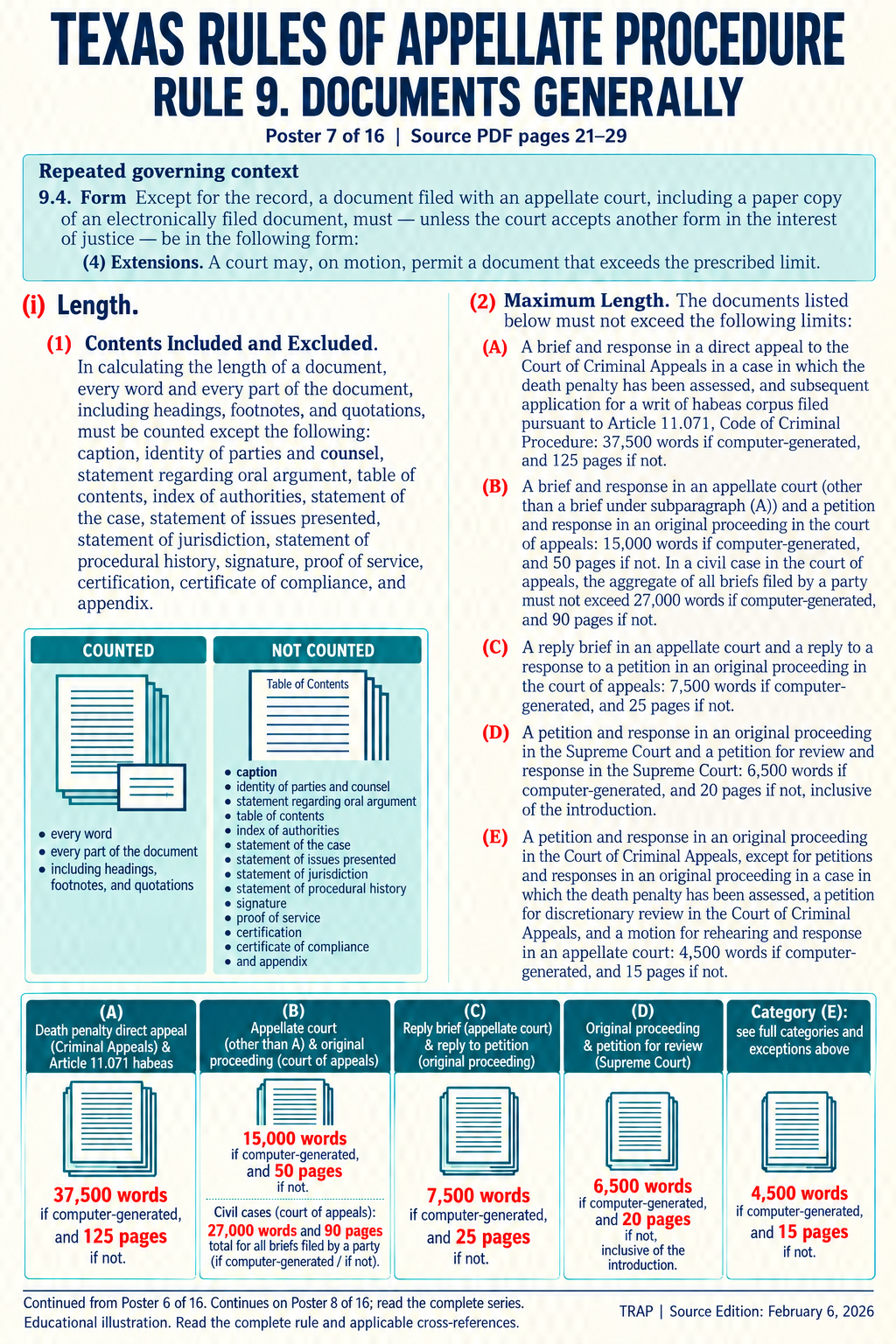
These illustrations explain document format or length. Read the brief or petition rule below for its required contents.
Read the official sources
Texas Rules of Appellate Procedure, February 6, 2026 edition. Check applicable amendments and court orders.
How do an appellee’s brief and a reply differ?Answer the other side
When this matters
You need to distinguish an appellee’s response from an appellant’s reply.
Rule 38.2 governs the appellee’s brief and its permitted differences from the appellant’s brief. Rule 38.3 permits an appellant to file a reply addressing any matter in the appellee’s brief.
Read the other party’s actual arguments and distinguish a response from a request to change the judgment. Check the timing provisions and any briefing order.
See this in a diagram (2 available)
These illustrations explain document format or length. Read the brief or petition rule below for its required contents.
Read the official sources
Texas Rules of Appellate Procedure, February 6, 2026 edition. Check applicable amendments and court orders.
Will there be oral argument?Prepare for submission
When this matters
You are requesting argument or preparing for an argument setting.
Request oral argument as the rule requires, then check whether the court sets argument or decides it is unnecessary. Argument should emphasize and clarify the written briefs and respond to the court’s questions.
Check the request requirement on the brief’s cover and any notice setting argument. A request does not guarantee argument. Keep the discussion tied to the issues and record.
See this in a diagram (2 available)
These illustrations cover related procedural points. Read the official sources below for the full requirements.
Read the official sources
Texas Rules of Appellate Procedure, February 6, 2026 edition. Check applicable amendments and court orders.
What does the court of appeals’ decision mean?Read the result
When this matters
The court of appeals issued a civil judgment and opinion.
Read the judgment and the opinion together. Rule 43 lists forms of disposition, including affirmance, modification, reversal and remand, reversal and rendition, vacatur and dismissal. The actual judgment controls what the court has ordered.
Identify which parties and issues the disposition covers, what remains to be done and when the decision was rendered. Keep rehearing, further review and mandate questions distinct.
See this in a diagram (1 available)
These illustrations cover related procedural points. Read the official sources below for the full requirements.
Read the official sources
Texas Rules of Appellate Procedure, February 6, 2026 edition. Check applicable amendments and court orders.
How do I read the rehearing options?Consider rehearing
When this matters
You are considering rehearing or en banc reconsideration of a civil decision.
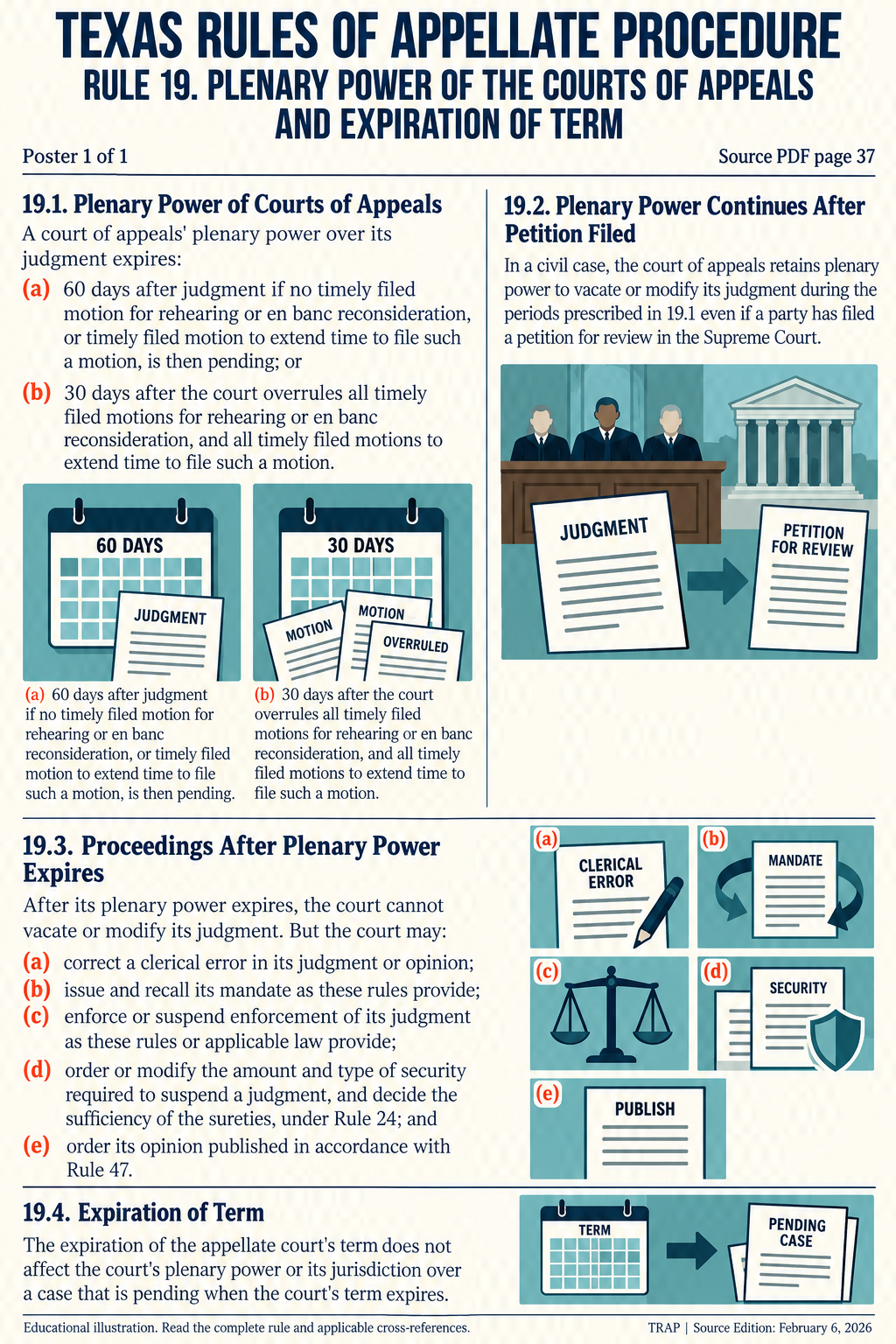
Choose whether you are asking for rehearing or en banc reconsideration in the court of appeals. These are distinct requests with requirements and timing provisions. Supreme Court rehearing is addressed separately in Rule 64.
Identify which court made the decision, the requested change and the applicable deadline. Check whether a later court action changes the relevant timing.
See this in a diagram (1 available)
These illustrations cover related procedural points. Read the official sources below for the full requirements.
Read the official sources
Texas Rules of Appellate Procedure, February 6, 2026 edition. Check applicable amendments and court orders.
How does a petition for review differ from an appeal?Seek Supreme Court review
When this matters
You seek Supreme Court review of a court-of-appeals civil judgment.
A petition for review asks the Supreme Court of Texas to review a court of appeals’ final judgment. Rule 56 addresses the Court’s action on a petition; review is not automatic. A petition and a later requested merits brief serve different purposes.
Read the petition’s contents, response and reply provisions and Rule 53.7 timing. Check whether the Court has requested a response or merits briefing rather than assuming every filing is required immediately.
See this in a diagram (2 available)
These illustrations explain document format or length. Read the brief or petition rule below for its required contents.
Read the official sources
Texas Rules of Appellate Procedure, February 6, 2026 edition. Check applicable amendments and court orders.
Do I need to respond to a petition for review?Respond in the Supreme Court
When this matters
A petition for review has been filed or the Supreme Court requested a response.
Rule 53.3 permits a response but provides that it need not be filed unless the Court requests one. Rule 53.7 addresses timing; Rule 55 concerns merits briefs requested by the Court.
Read any request from the Court and identify whether it asks for a petition response or merits briefing. A response to a petition is not the same document as an appellee’s brief in the court of appeals.
See this in a diagram (2 available)
These illustrations explain document format or length. Read the brief or petition rule below for its required contents.
Read the official sources
Texas Rules of Appellate Procedure, February 6, 2026 edition. Check applicable amendments and court orders.
What is the mandate, and how does it relate to the judgment?Understand what follows
When this matters
You need to understand the civil judgment’s effect after appellate review.
Rule 18 governs issuance and related mandate procedures. Rule 51 addresses enforcement of the appellate judgment. These questions are separate from whether a rehearing motion or petition for review should be filed.
Read the judgment, any later orders and the mandate provisions together. Check the actual status of the case before assuming that a decision is ready for enforcement.
See this in a diagram (1 available)
These illustrations cover related procedural points. Read the official sources below for the full requirements.
Read the official sources
Texas Rules of Appellate Procedure, February 6, 2026 edition. Check applicable amendments and court orders.
Can an order be reviewed before the case ends?Review before final judgment
When this matters
You want review before the trial-court case has ended.
Rule 28 addresses accelerated and permissive civil appeals, and Rule 29 addresses orders pending interlocutory appeal. The existence of an adverse interim ruling alone does not identify the available review route.
Check the statute or other authority allowing review and the type of order. A permissive appeal has its own permission procedure; an original proceeding is a separate route.
See this in a diagram (1 available)
These illustrations cover related procedural points. Read the official sources below for the full requirements.
Read the official sources
Texas Rules of Appellate Procedure, February 6, 2026 edition. Check applicable amendments and court orders.
What is different about a mandamus proceeding?Understand original proceedings
When this matters
You are considering a petition for extraordinary relief.
An original proceeding asks the appellate court for extraordinary relief. Rule 52 addresses the petition, parties, appendix, record and responses. A petition is filed with the appropriate appellate clerk; this is a separate procedure from a notice of appeal.
Identify the substantive authority and standards for the relief sought, as well as the proper court. Meeting the document requirements alone does not establish entitlement to extraordinary relief.
See this in a diagram (4 available)
These illustrations cover related procedural points. Read the official sources below for the full requirements.
Read the official sources
Texas Rules of Appellate Procedure, February 6, 2026 edition. Check applicable amendments and court orders.
What if action is needed before the court decides?Find the right urgent-relief procedure
When this matters
Action may be needed before the appellate court resolves the proceeding.
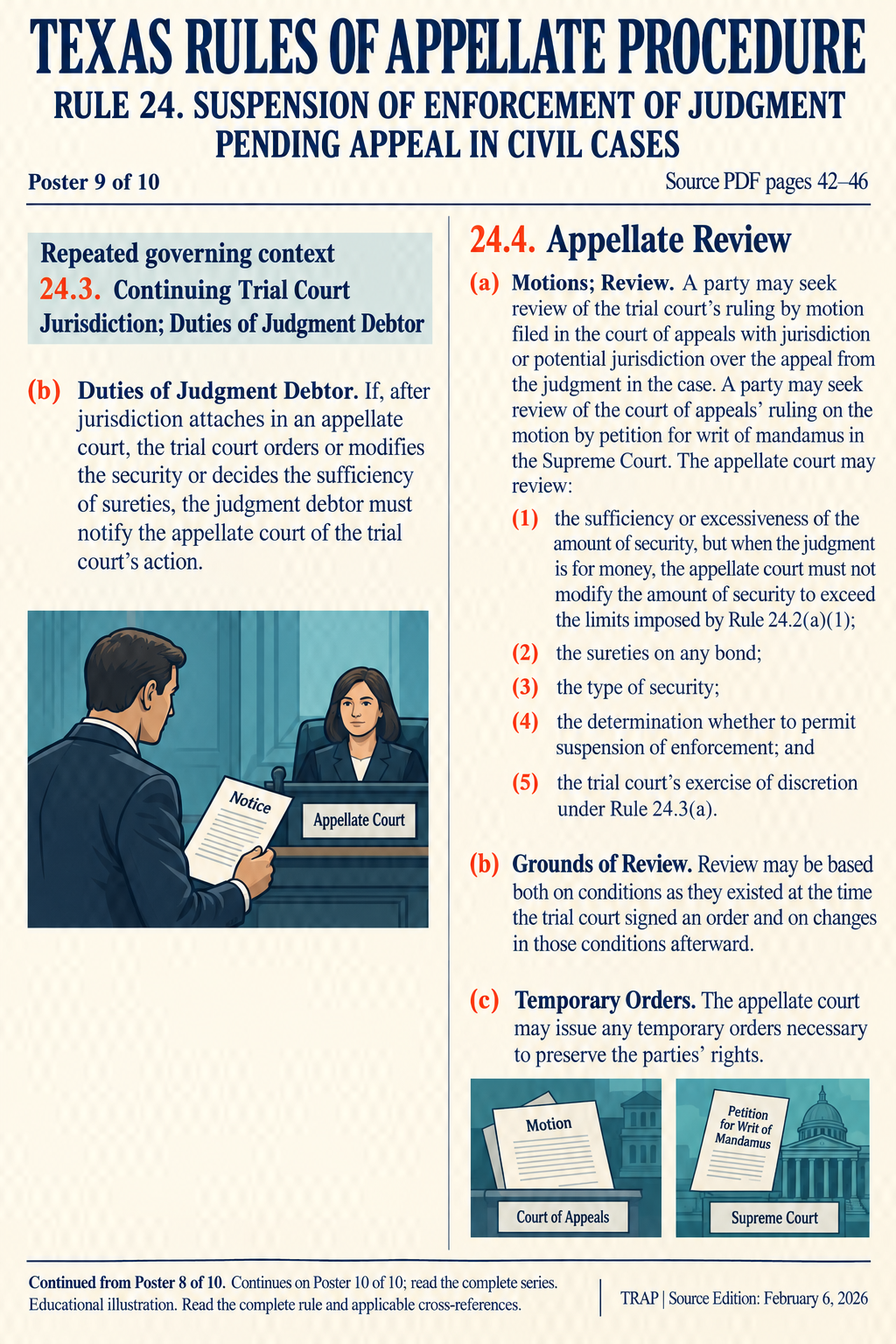
The applicable procedure depends on the proceeding. Rule 24 addresses suspension of enforcement of a civil judgment; Rule 29 addresses interlocutory appeals; Rule 52.10 addresses temporary relief in an original proceeding.
Identify the action to be stayed and the court with authority. Read notice, certificate, security and motion requirements for the applicable route. Do not assume a filing itself grants the requested stay.
See this in a diagram (4 available)
These illustrations cover specific security, motion or court-availability questions. They do not determine whether you are entitled to a stay.
Read the official sources
Texas Rules of Appellate Procedure, February 6, 2026 edition. Check applicable amendments and court orders.
Does filing an appeal stop enforcement of the judgment?Separate appeal from enforcement
When this matters
A civil judgment may be enforced while an appeal is pending.
Read Rule 24 separately from the notice-of-appeal rules. It provides methods for superseding a civil judgment, subject to its conditions and exceptions, and addresses security and review of related trial-court orders.
Identify the kind of judgment and applicable security or other procedure. Do not assume that filing a notice of appeal by itself suspends enforcement.
See this in a diagram (3 available)
These illustrations cover specific security, motion or court-availability questions. They do not determine whether you are entitled to a stay.
Read the official sources
Texas Rules of Appellate Procedure, February 6, 2026 edition. Check applicable amendments and court orders.
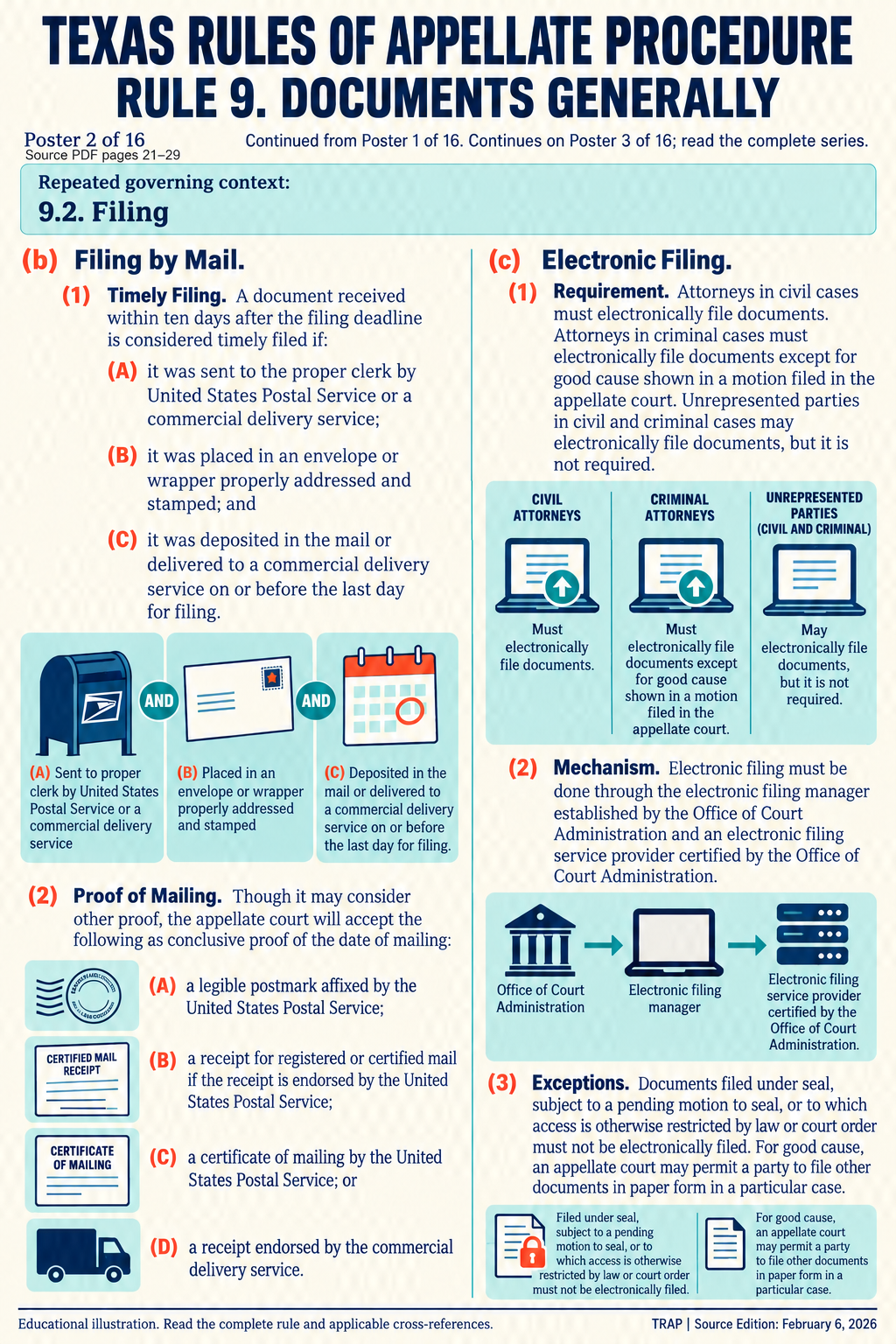
What should I check before filing a document?File, serve and protect information
When this matters
You are about to file or serve an appellate document.
Before submitting your document, check its signature, format, filing destination, service and privacy requirements. Filing a document with the court and serving other parties are separate requirements. The applicable privacy rules differ by proceeding and document.
Check the correct clerk, electronic-filing provisions, service, certification and any required redaction. Retain the filing receipt and read any notice identifying a defect.
See this in a diagram (7 available)
These illustrations cover related procedural points. Read the official sources below for the full requirements.
Read the official sources
Texas Rules of Appellate Procedure, February 6, 2026 edition. Check applicable amendments and court orders.
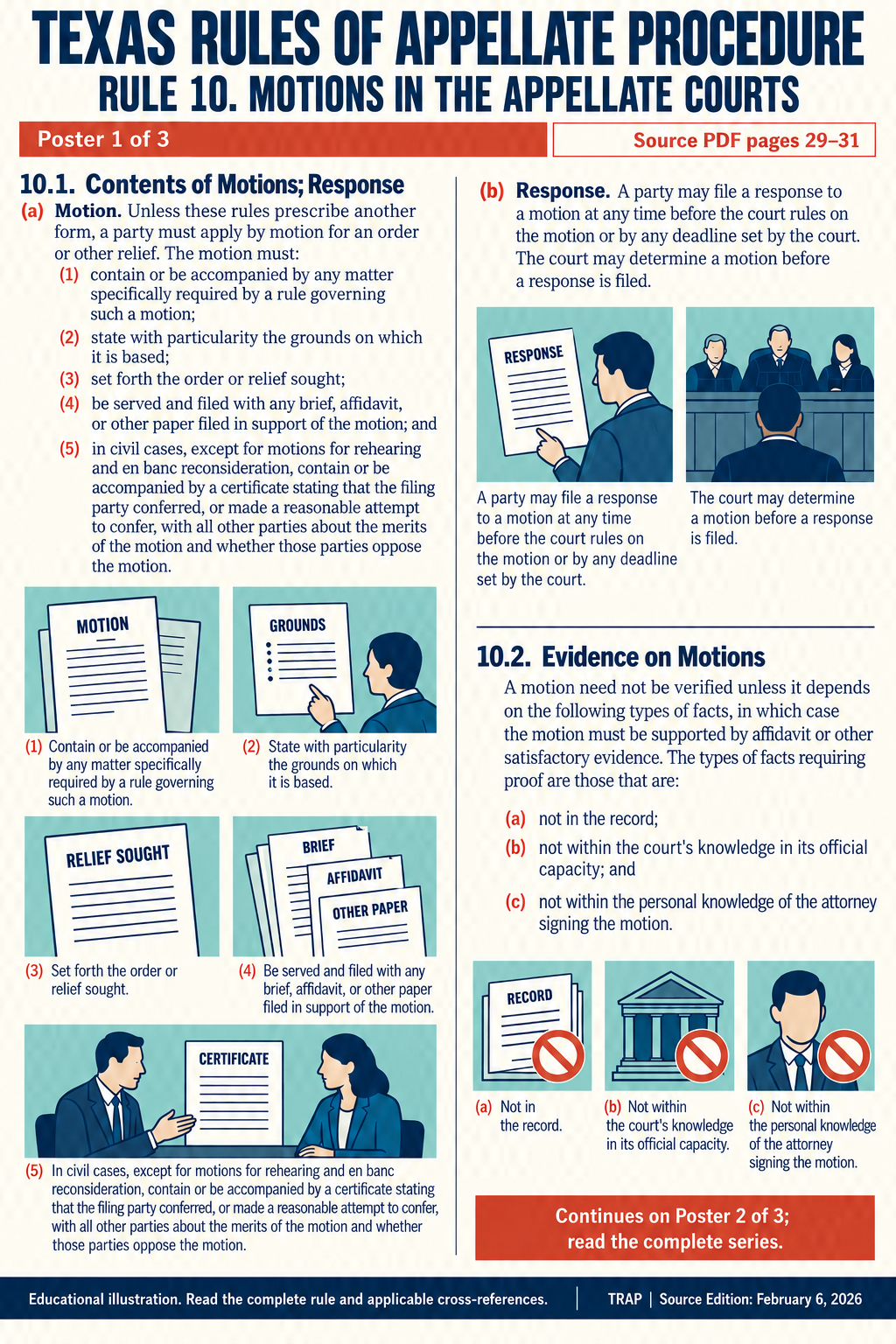
How do I request a procedural ruling?Ask the appellate court to act
When this matters
You need a procedural ruling from the appellate court.
Use a motion to ask the appellate court for a procedural ruling, stating the grounds and providing any required support. Rule 10 also includes provisions for motions to extend time.
Identify the relief, grounds and required support. Check conference, service and certificate requirements for the particular motion; submitting a request does not mean it has been granted.
See this in a diagram (2 available)
These illustrations cover related procedural points. Read the official sources below for the full requirements.
Read the official sources
Texas Rules of Appellate Procedure, February 6, 2026 edition. Check applicable amendments and court orders.
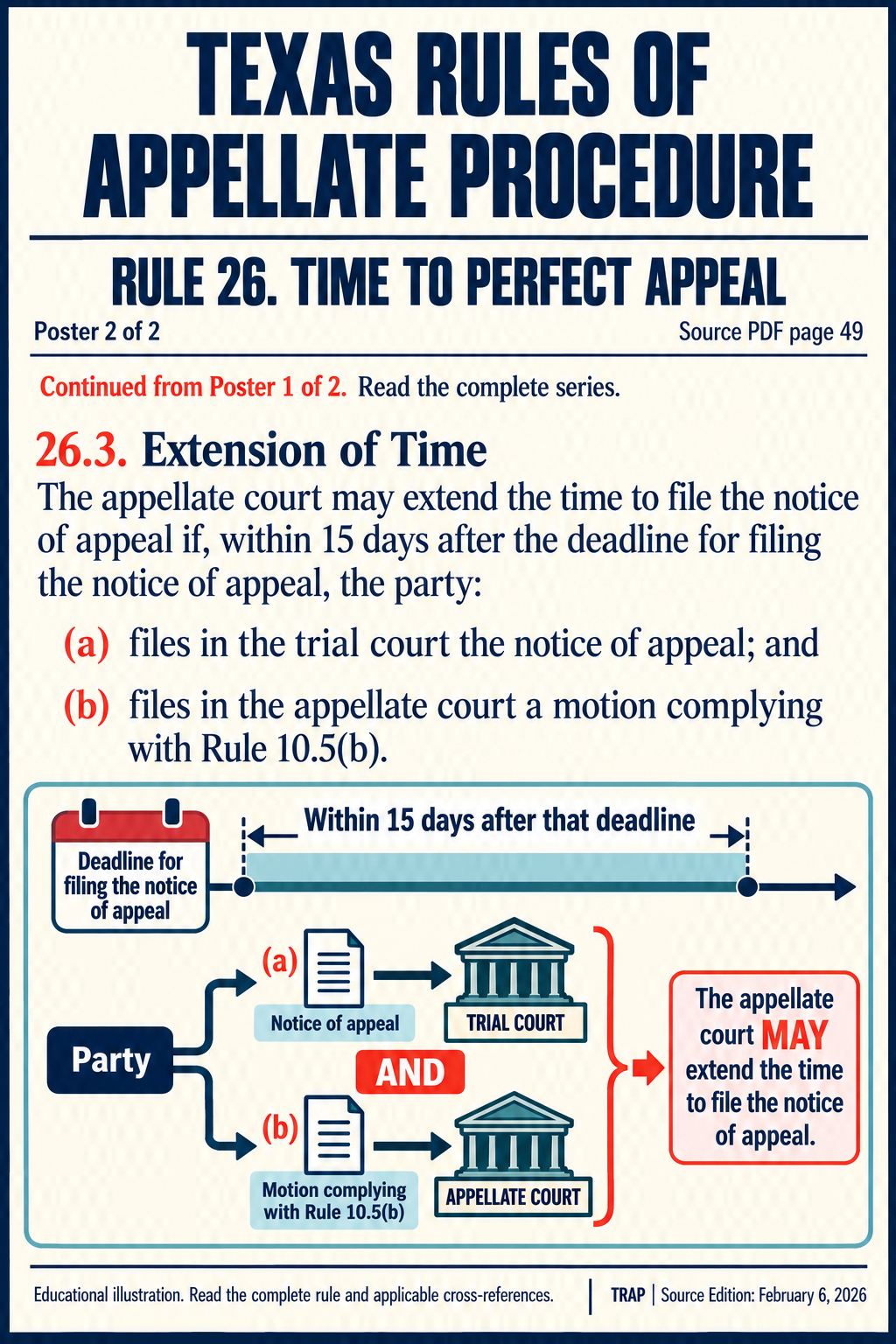
Can I ask for more time?Check extension requirements
When this matters
You may be unable to meet a particular filing deadline.
Different filings have different extension procedures. Rule 10.5 addresses particular motions; Rule 26.3 addresses an extension for the notice of appeal. Other provisions address record filing, briefing and petitions for review.
Read the provision for the exact filing. Rule 26.3 requires both the notice in the trial court and a complying motion in the appellate court within its specified extension period. Rule 2 does not permit altering the time to perfect a civil appeal.
See this in a diagram (2 available)
These illustrations cover related procedural points. Read the official sources below for the full requirements.
Read the official sources
Texas Rules of Appellate Procedure, February 6, 2026 edition. Check applicable amendments and court orders.
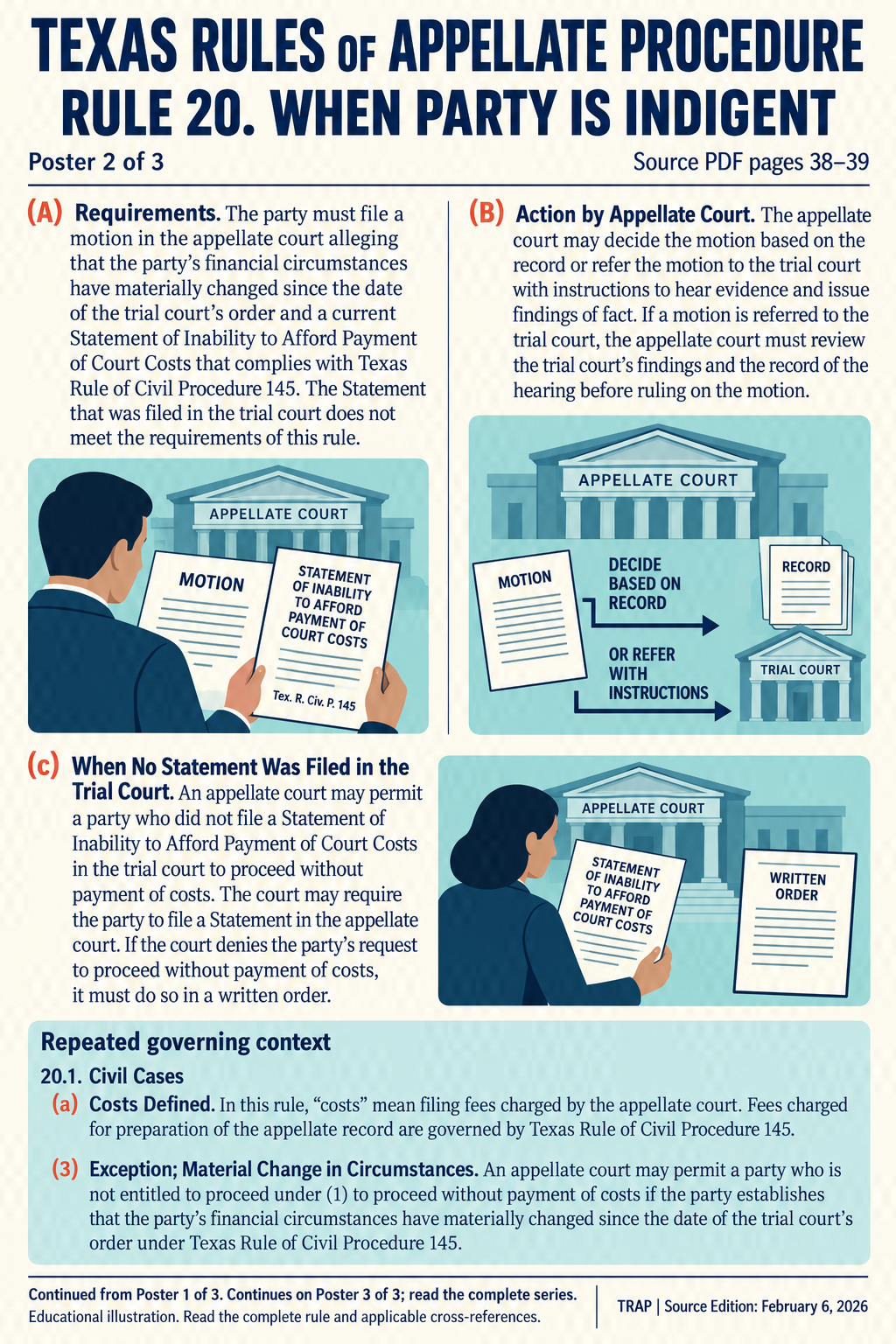
What if I cannot afford appellate costs?Understand costs
When this matters
You need to address advance payment of costs in a civil case.
If you cannot afford advance payment of civil appellate costs, check how your trial-court status carries forward or what to file if no statement was filed there. Rule 5 addresses appellate fees.
Identify the type of cost and any applicable statement, contest or court order. Review record-preparation costs alongside Rule 35 rather than assuming that every expense is treated alike.
See this in a diagram (2 available)
These illustrations cover related procedural points. Read the official sources below for the full requirements.
Read the official sources
Texas Rules of Appellate Procedure, February 6, 2026 edition. Check applicable amendments and court orders.
I am responding to an appeal. What belongs in my brief?Prepare the responding brief
When this matters
The appellant filed a brief and you are preparing the civil response.
Use the appellee’s brief to answer the appeal. Rule 38.2 follows Rule 38.1 with stated differences for parties and counsel, the case, issues, facts and appendix. When practicable, respond to the appellant’s issues in the order presented.
Read the full Rule 38.2, including its cross-point provisions when applicable. Check format, length, timing and court orders. If you seek a more favorable judgment, also check the notice-of-appeal requirements in Rule 25.1(c).
See this in a diagram (4 available)
These illustrations explain document format or length. Read the brief or petition rule below for its required contents.
Read the official sources
Texas Rules of Appellate Procedure, February 6, 2026 edition. Check applicable amendments and court orders.
I brought the appeal. How do I reply to the other side’s brief?Reply to the appellee’s brief
When this matters
The appellee filed a brief and you are considering a reply.
Use the appellant’s reply to address matters in the appellee’s brief. Rule 38.3 permits this reply, but the court may consider and decide the case before it is filed.
Answer the other side’s actual arguments, using the record and authority that support your response. Check Rule 38.6(c), document limits and any court order; this guide does not calculate a filing deadline.
See this in a diagram (2 available)
These illustrations explain document format or length. Read the brief or petition rule below for its required contents.
Read the official sources
Texas Rules of Appellate Procedure, February 6, 2026 edition. Check applicable amendments and court orders.
Which brief am I preparing?Choose the document
When this matters
You have reached briefing or received a court request for a brief.
Start with your role and the court’s request. An opening brief, a responding brief and a reply each have a different job. A petition asking a higher court to take a case is different from a merits brief.
Use the Next choices below to select your document. Keep the briefing notice and applicable schedule beside you.
Read the official sources
Texas Rules of Appellate Procedure, February 6, 2026 edition. Check applicable amendments and court orders.
Which court issued the decision I received?Identify the deciding court
When this matters
You have an appellate opinion, judgment or order.
The next procedure depends on the court and the kind of case. Read the court’s name and the operative order before choosing a rehearing or further-review rule.
Use the choices below. A decision on a petition and a decision on the merits can lead to different next steps.
Read the official sources
Texas Rules of Appellate Procedure, February 6, 2026 edition. Check applicable amendments and court orders.
What kind of civil review am I considering?Choose the civil review route
When this matters
A trial court has signed an order and you want appellate review.
Identify the order and the authority permitting review. Ordinary appeals, accelerated appeals, permissive appeals and restricted appeals have different entry requirements. An original proceeding is a separate request for extraordinary relief.
Read the signed order, whether it disposes of the case, any special statute and the relevant timing rule before choosing a route.
Read the official sources
Texas Rules of Appellate Procedure, February 6, 2026 edition. Check applicable amendments and court orders.
Does my civil appeal use an accelerated schedule?Recognize a faster timetable
When this matters
The order or applicable law places the appeal on an accelerated track.
Accelerated appeals include the categories specified in Rule 28.1. Parental termination and child-protection appeals have additional provisions in Rule 28.4. Post-trial motions do not extend the time to perfect an accelerated appeal.
Identify the precise category. Check notice, record, briefing and mandate timing for that category; do not copy the ordinary-appeal calendar.
See this in a diagram (1 available)
These illustrations cover related procedural points. Read the official sources below for the full requirements.
Read the official sources
Texas Rules of Appellate Procedure, February 6, 2026 edition. Check applicable amendments and court orders.
The order is not final. How does a permissive appeal start?Seek permission to appeal
When this matters
You are considering review under the permissive-appeal procedure.
Trial-court permission and the court of appeals’ acceptance are separate steps. Rule 28.3 governs the petition for permission, its contents, response, reply and the court’s decision. Permission is not established simply by filing an ordinary notice.
Check the authorizing statute, the signed permission order, the petition deadline and any amended order. If permission is granted, follow Rule 28.3(k) and the accelerated schedule.
Read the official sources
Texas Rules of Appellate Procedure, February 6, 2026 edition. Check applicable amendments and court orders.
I did not take part in the hearing. Is a restricted appeal the right route?Check the restricted-appeal route
When this matters
You are considering an appeal after not participating in the hearing that produced the judgment.
Rule 30 sets participation and prior-filing conditions for a restricted appeal. Rule 26.1(c) supplies the notice period. Nonparticipation alone does not establish that you meet every requirement for relief.
Check participation by you or counsel, postjudgment motions, requests for findings and any notice already filed. Review the applicable law as well as the rule before relying on this route.
See this in a diagram (1 available)
These illustrations cover related procedural points. Read the official sources below for the full requirements.
Read the official sources
Texas Rules of Appellate Procedure, February 6, 2026 edition. Check applicable amendments and court orders.
I filed early, or the trial court changed the order. What now?Check an early filing or changed order
When this matters
A notice was filed before the triggering event, or the appealed order changed.
Rule 27 treats premature notices differently in civil and criminal cases. It also addresses other premature steps and a modified or replacement civil order. A criminal notice filed before a finding of guilt or receipt of a jury verdict is not effective under Rule 27.1(b).
Compare the filing date with the relevant event and keep both versions of the order. Check whether a supplemental record or another filing is needed.
Read the official sources
Texas Rules of Appellate Procedure, February 6, 2026 edition. Check applicable amendments and court orders.
Should this appeal be in the Fifteenth Court of Appeals?Respond to a transfer question
When this matters
A party or court raises a transfer to or from the Fifteenth Court of Appeals.
Rule 27a provides a transfer process tied to the Fifteenth Court’s exclusive intermediate appellate jurisdiction. It distinguishes party motions, court-initiated transfers, responses and disagreement between courts. It does not govern good-cause docket-equalization transfers.
Read the jurisdictional law and transfer notice. Check where to file, whom to notify and the response deadline before acting.
Read the official sources
Texas Rules of Appellate Procedure, February 6, 2026 edition. Check applicable amendments and court orders.
I filed my notice. What information does the appellate court need?Complete the docketing information
When this matters
You have filed a notice of appeal.
The docketing statement gives the appellate court administrative information about the case. Rule 32 has separate civil and criminal provisions. It does not replace the notice of appeal or establish jurisdiction.
Use the current civil form or the required criminal information, file with the appellate court and correct or supplement information when needed.
See this in a diagram (3 available)
These illustrations cover related procedural points. Read the official sources below for the full requirements.
Read the official sources
Texas Rules of Appellate Procedure, February 6, 2026 edition. Check applicable amendments and court orders.
Does this appeal involve an administrative agency record?Identify the agency record
When this matters
The trial-court case reviewed an administrative agency decision.
Rule 36 applies to judicial review of state-agency decisions in contested cases under the Administrative Procedure Act. The agency record filed in the trial court may be included in the clerk’s or reporter’s record; the rule also provides for correcting it.
Check the rule’s scope and whether the agency record accurately reflects the contested-case proceedings. Read the correction procedure if the parties cannot agree.
Read the official sources
Texas Rules of Appellate Procedure, February 6, 2026 edition. Check applicable amendments and court orders.
The briefs are filed. Who decides the case, and when?Track submission and the deciding court
When this matters
The case is approaching submission or awaiting a decision.
The court may decide a case with or without oral argument. Rules 40 and 41 address priority, panels and en banc consideration in the courts of appeals. Filing the last brief does not promise an argument date or decision date.
Read the submission notice, any argument setting and any court order requiring more briefing.
Read the official sources
Texas Rules of Appellate Procedure, February 6, 2026 edition. Check applicable amendments and court orders.
Can the appeal end before a merits decision?Respond to dismissal or settlement
When this matters
The parties settle, an appellant seeks dismissal, or the court raises a dismissal issue.
Rule 42 distinguishes civil agreement or voluntary dismissal, criminal voluntary dismissal and involuntary dismissal in civil cases. The effect on the judgment, other parties and costs depends on the applicable provision and the court’s order.
Identify whether this is your request, an agreement or a court notice. Read the required signatures and response opportunity for the applicable procedure.
Read the official sources
Texas Rules of Appellate Procedure, February 6, 2026 edition. Check applicable amendments and court orders.
What must an error justify on appeal?Connect the error to the remedy
When this matters
You are deciding what relief to request or reading why relief was denied.
Preserving an issue and showing reversible error are different questions. Rule 44 distinguishes civil and criminal error standards and addresses correctable trial-court error. The requested remedy must fit the error and the record.
Identify the applicable standard, explain the effect of the error and connect it to the relief requested.
Read the official sources
Texas Rules of Appellate Procedure, February 6, 2026 edition. Check applicable amendments and court orders.
The other side calls the appeal frivolous. What should I read?Check a request for appellate damages
When this matters
Appellate damages are requested or the court raises that issue.
Rule 45 addresses damages for frivolous civil appeals in the court of appeals. Rule 62 addresses that subject in the Supreme Court of Texas. Read the applicable provision and any court notice before responding.
Distinguish disagreement with an argument from the grounds for appellate damages. Identify the court, requested relief and opportunity to respond.
Read the official sources
Texas Rules of Appellate Procedure, February 6, 2026 edition. Check applicable amendments and court orders.
What if the court suggests a remittitur?Understand a proposed damages reduction
When this matters
A civil appellate decision proposes or addresses a reduction in damages.
Rule 46 governs remittitur in the courts of appeals, including acceptance, remand and voluntary remittitur. The response and its effect depend on the court’s judgment and the provision involved.
Read the amount, conditions and timing in the decision. Determine how acceptance or nonacceptance affects the disposition before choosing a response.
Read the official sources
Texas Rules of Appellate Procedure, February 6, 2026 edition. Check applicable amendments and court orders.
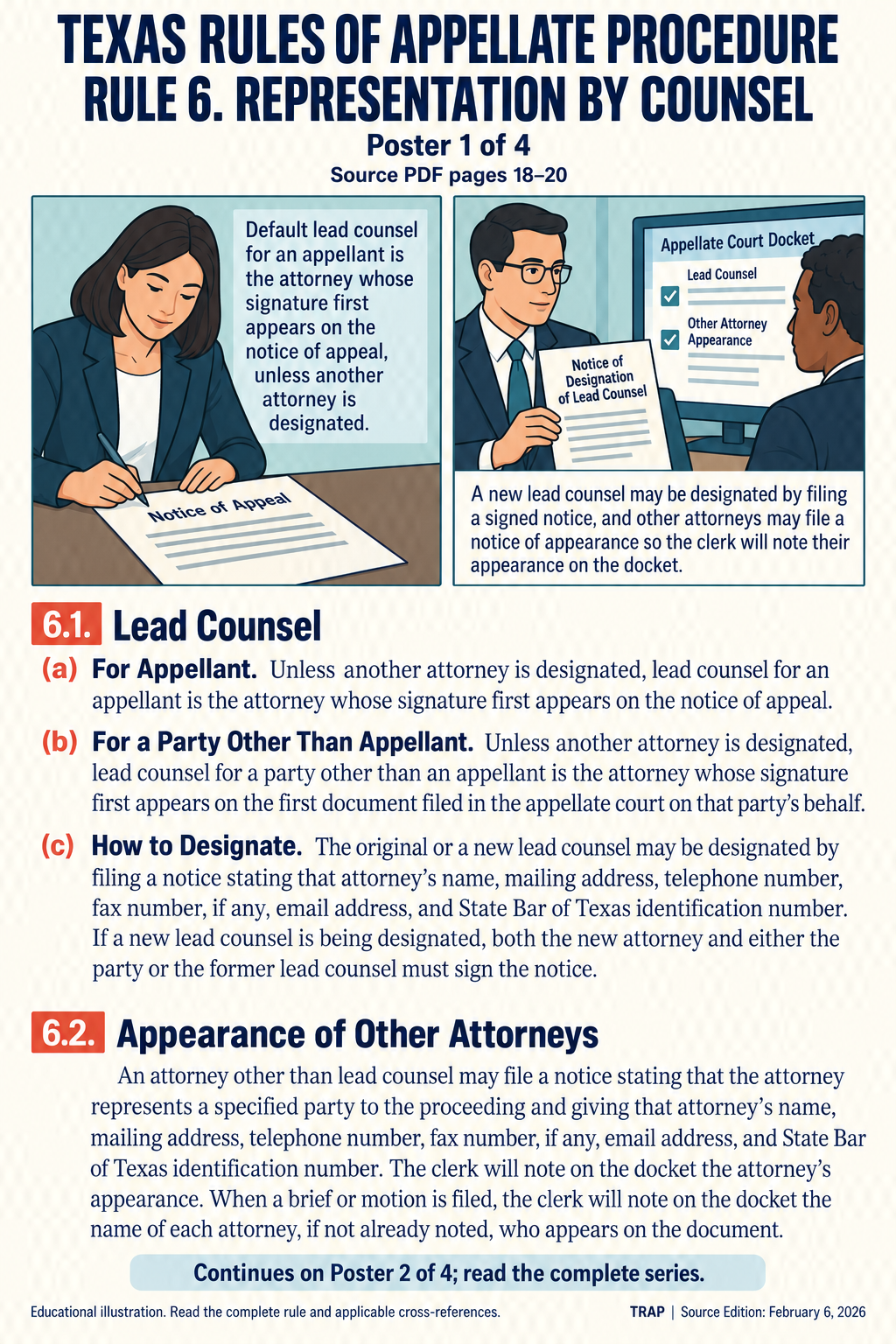
My lawyer or contact information changed. What needs updating?Keep representation current
When this matters
Counsel changes, withdraws or needs to identify who receives communications.
Keep the court informed about lead counsel, other appearances and who should receive communications; use the applicable procedure for nonrepresentation or withdrawal. A change in representation should be reflected through the applicable court procedure.
Identify lead counsel and the address for court notices. Read the notice, delivery and court-order requirements for the specific change.
See this in a diagram (4 available)
These illustrations cover related procedural points. Read the official sources below for the full requirements.
Read the official sources
Texas Rules of Appellate Procedure, February 6, 2026 edition. Check applicable amendments and court orders.
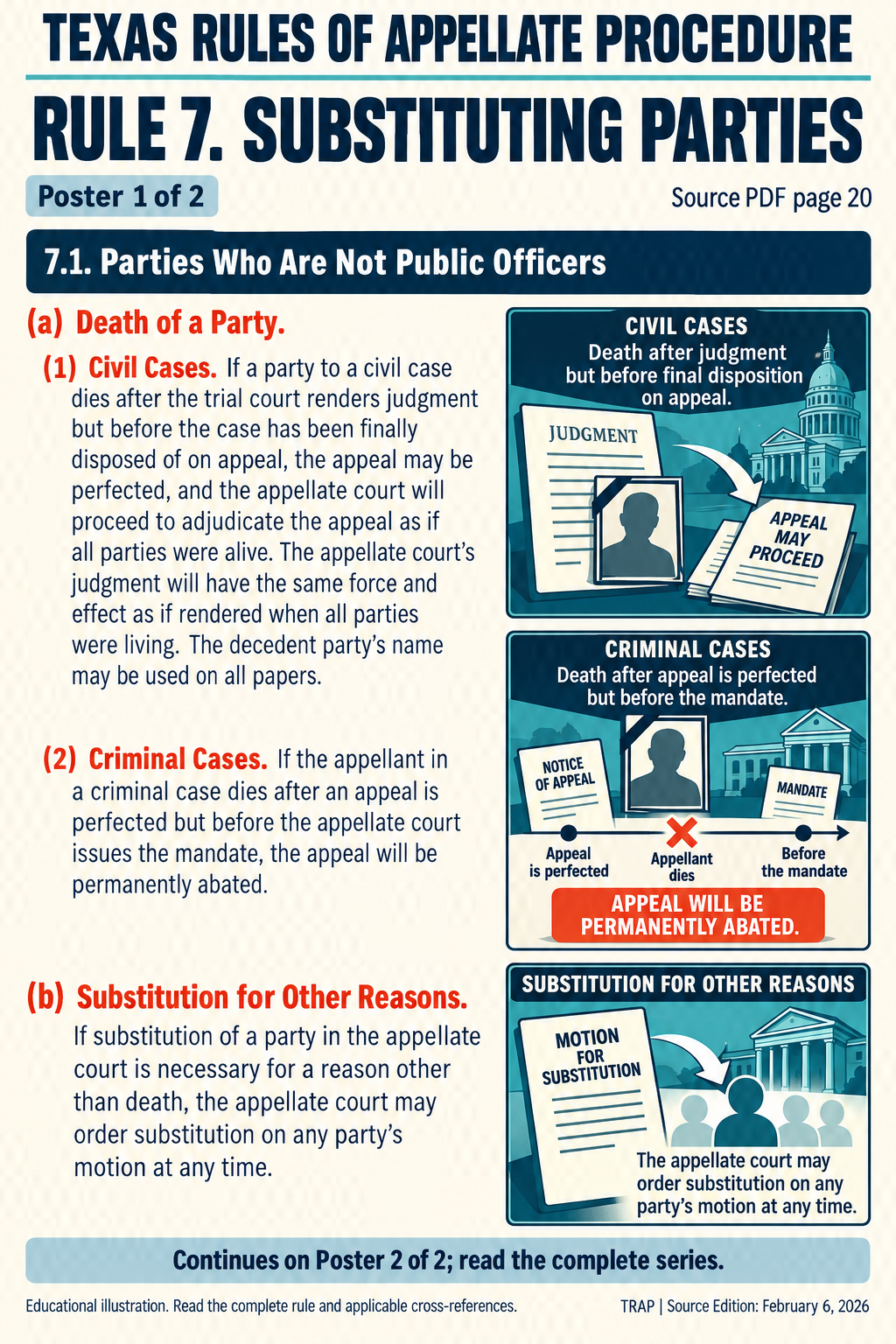
A party died or a public officer changed. What happens to the case?Respond to a change of party
When this matters
A party dies, a substitution is needed or a public officer leaves office.
Identify whether the change involves a party in a civil or criminal case or a public officer. The result is not the same for every death or substitution.
Identify the type of case, the party’s role and the relevant event. Read the applicable provision before assuming the case continues or ends.
See this in a diagram (2 available)
These illustrations cover related procedural points. Read the official sources below for the full requirements.
Read the official sources
Texas Rules of Appellate Procedure, February 6, 2026 edition. Check applicable amendments and court orders.
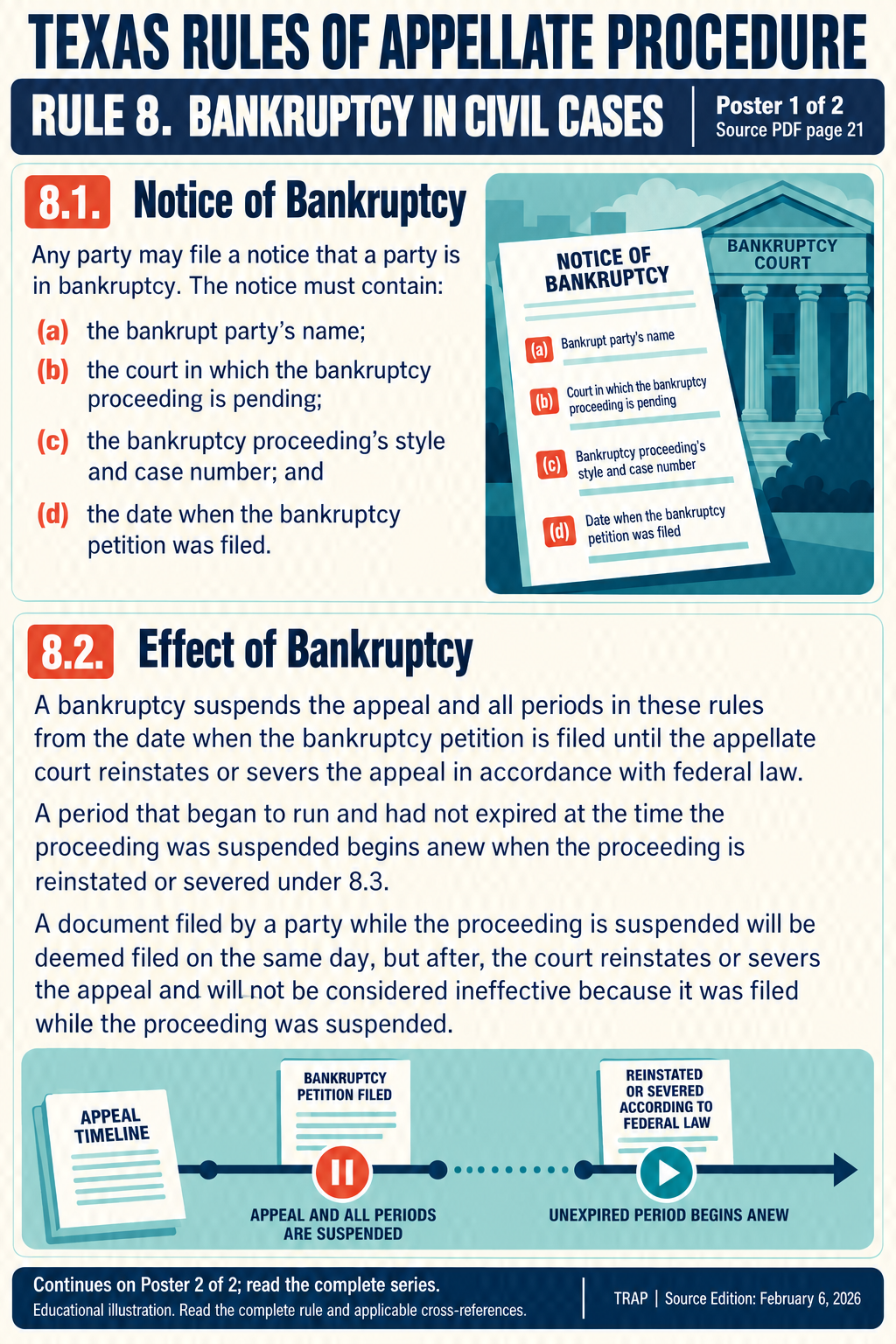
A party filed bankruptcy. What happens to this civil appeal?Respond to bankruptcy
When this matters
A bankruptcy proceeding may affect a pending civil appeal.
Notify the court of the bankruptcy and check the rules for suspension, reinstatement or severance. The bankruptcy filing can change what the appellate court and parties may do.
Check the bankruptcy proceeding, file the required notice and read the conditions for reinstatement or severance. Do not treat an existing appellate schedule as unchanged.
See this in a diagram (2 available)
These illustrations cover related procedural points. Read the official sources below for the full requirements.
Read the official sources
Texas Rules of Appellate Procedure, February 6, 2026 edition. Check applicable amendments and court orders.
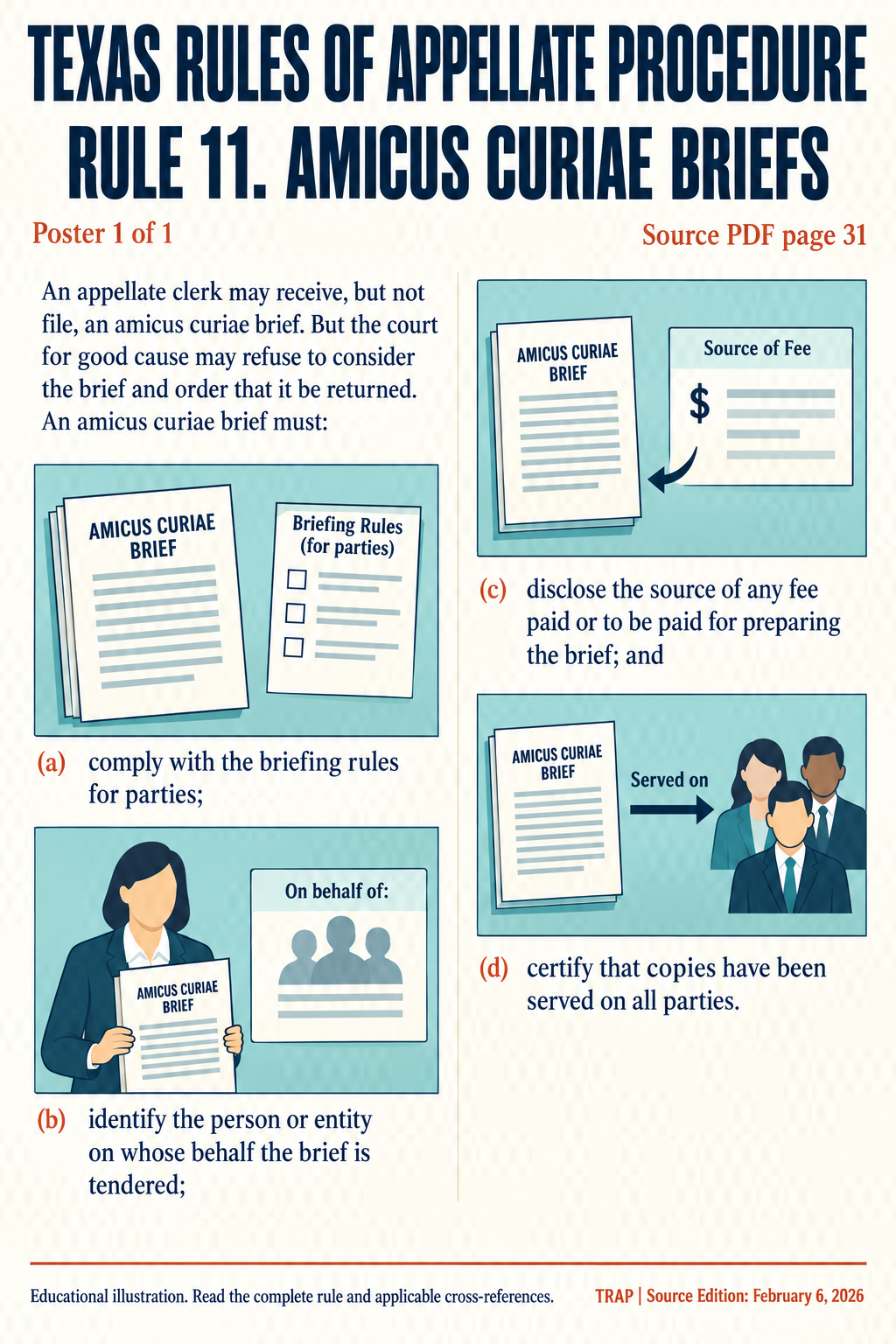
I am not a party. How can an amicus brief be considered?Participate as a friend of the court
When this matters
A nonparty wants to provide a brief to assist the court.
Rule 11 requires compliance with the parties’ briefing rules, identification of the person or entity on whose behalf the brief is tendered, disclosure of preparation fees and certification of service. The court may refuse to consider the brief for good cause.
Read the rule’s requirements, the applicable court schedule and any order. In the Court of Criminal Appeals, also check service on the State Prosecuting Attorney.
See this in a diagram (1 available)
These illustrations cover related procedural points. Read the official sources below for the full requirements.
Read the official sources
Texas Rules of Appellate Procedure, February 6, 2026 edition. Check applicable amendments and court orders.
May I record or broadcast an appellate proceeding?Request permission to record
When this matters
You want to record or broadcast a court proceeding.
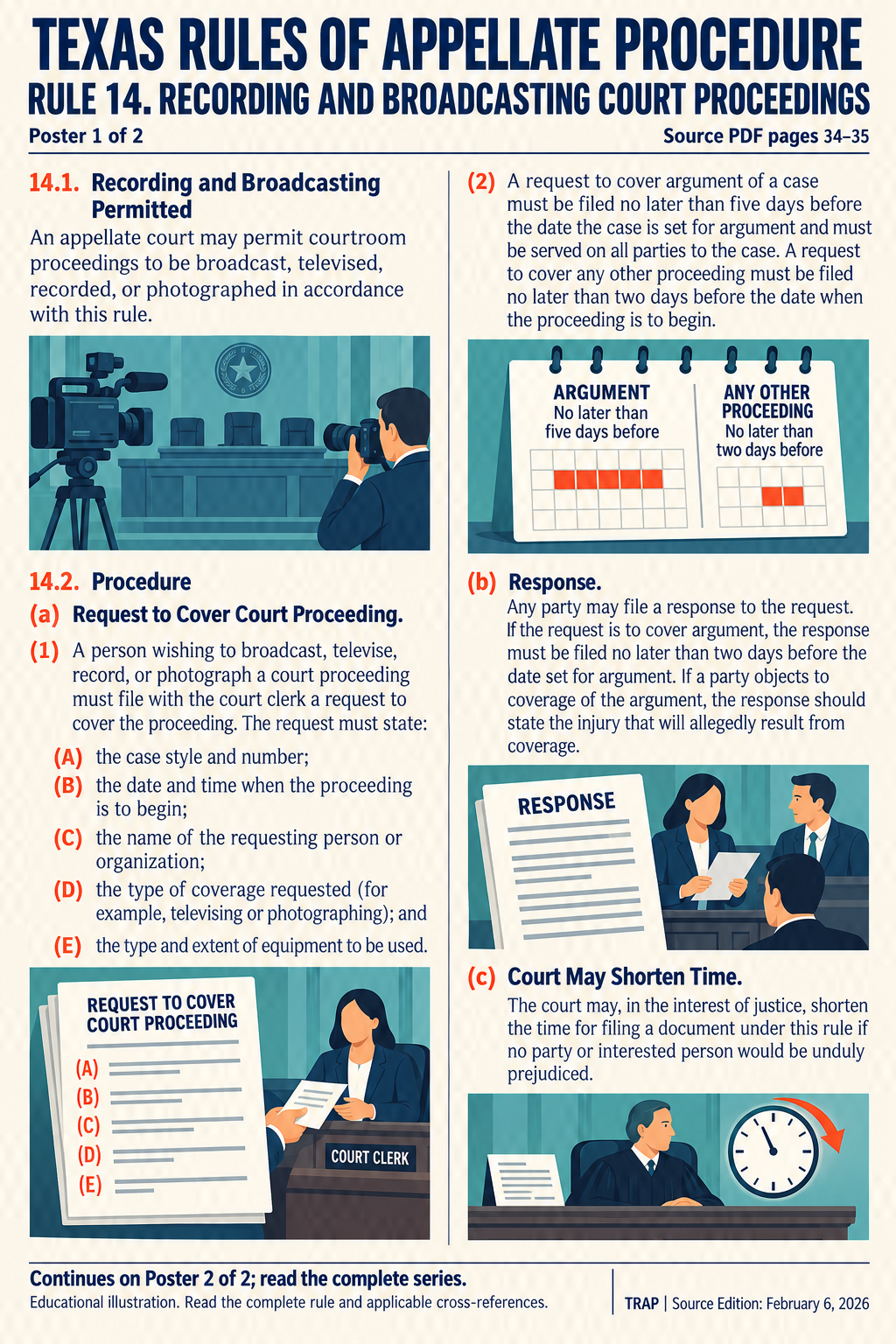
Rule 14 requires the court’s permission and provides a request-and-response procedure and conditions for coverage. The presence of a public hearing does not itself grant permission to record.
Read the request requirements, timing, equipment restrictions and the court’s decision before recording.
See this in a diagram (2 available)
These illustrations cover related procedural points. Read the official sources below for the full requirements.
Read the official sources
Texas Rules of Appellate Procedure, February 6, 2026 edition. Check applicable amendments and court orders.
The court issued a writ or process. What happens next?Understand an appellate writ
When this matters
An appellate court issues a writ or other process.
Rule 15 addresses issuance, service, return and circumstances involving actual knowledge or appearance. A request for a writ and an issued writ are different stages.
Read the actual writ, identify whom it directs and check the service and return requirements.
Read the official sources
Texas Rules of Appellate Procedure, February 6, 2026 edition. Check applicable amendments and court orders.
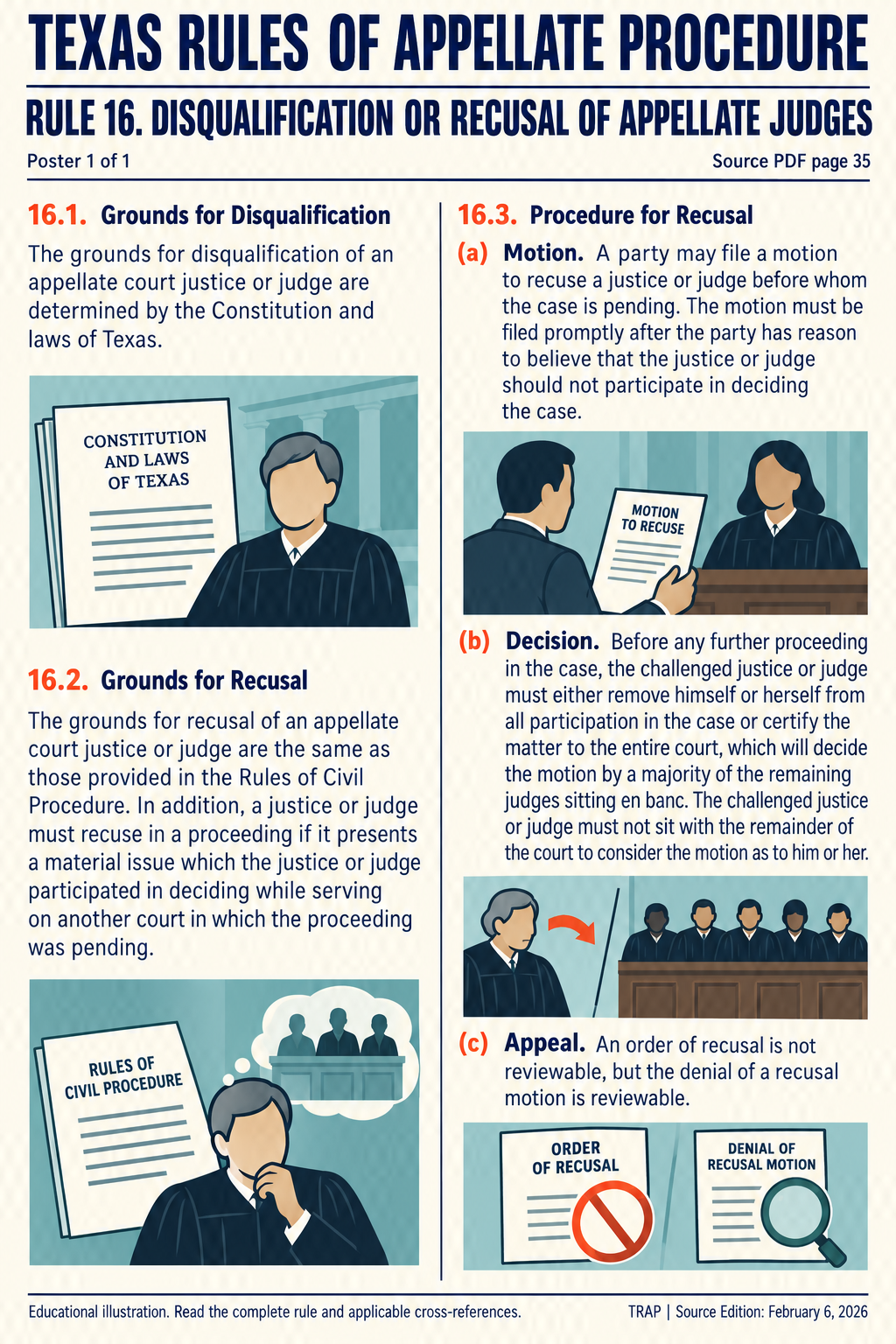
How do I raise an appellate judge’s disqualification or recusal?Raise a judicial-disqualification issue
When this matters
A specific basis for disqualification or recusal needs to be addressed.
Rule 16 distinguishes disqualification from recusal and gives the procedure for a recusal motion. Disagreement with a ruling does not by itself identify a ground under this rule.
Identify the applicable ground and supporting facts. Check motion timing and the court’s decision procedure.
See this in a diagram (1 available)
These illustrations cover related procedural points. Read the official sources below for the full requirements.
Read the official sources
Texas Rules of Appellate Procedure, February 6, 2026 edition. Check applicable amendments and court orders.
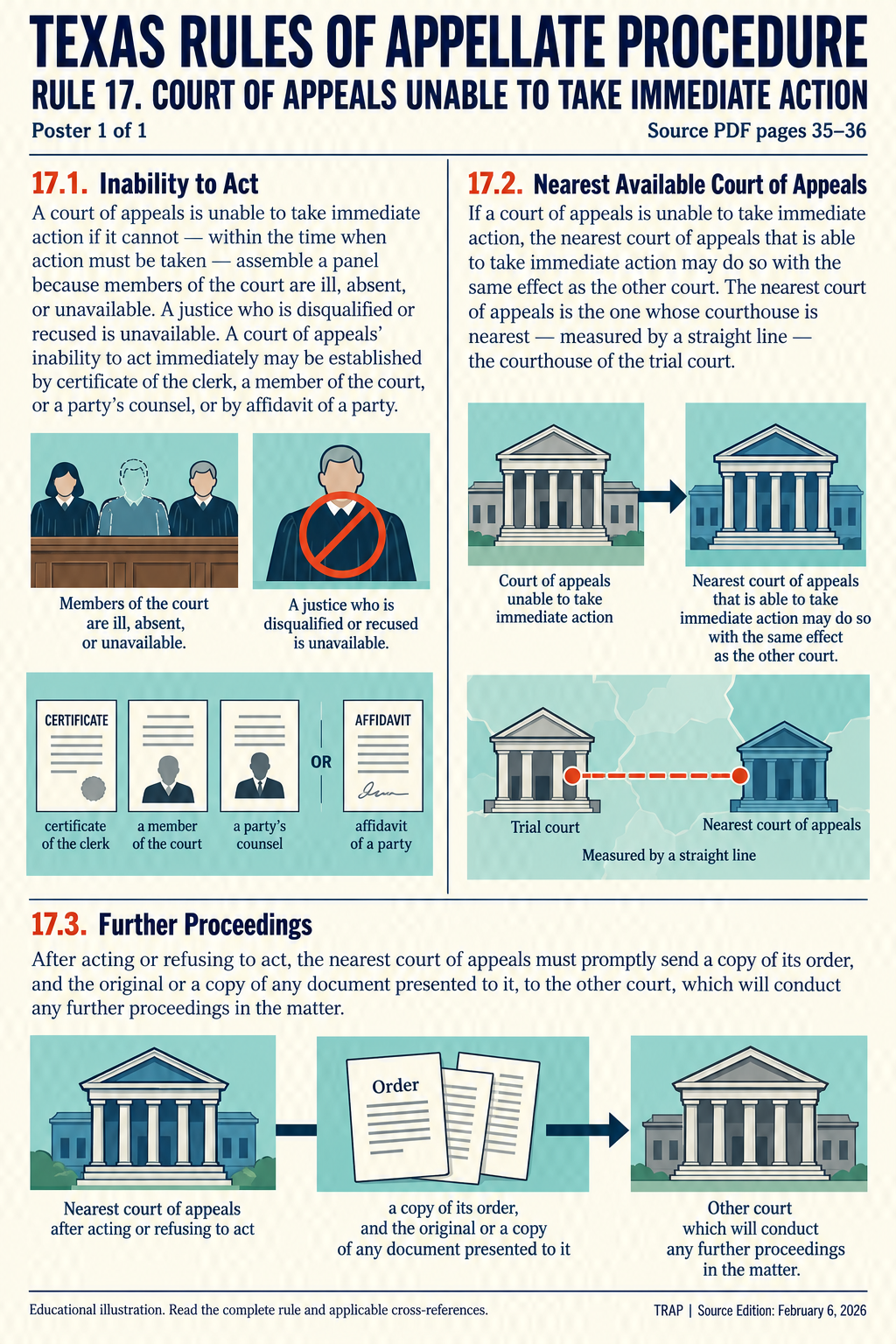
What if the court cannot act on an urgent matter?Identify the court that can act
When this matters
Immediate action is necessary and the court of appeals is unable to act within the rule’s conditions.
Rule 17 provides a limited procedure involving the nearest available court of appeals. It addresses inability to act and further proceedings; it is not a general choice of a different court.
Read the precise conditions, required explanation and notification procedure before seeking action elsewhere.
See this in a diagram (1 available)
These illustrations cover related procedural points. Read the official sources below for the full requirements.
Read the official sources
Texas Rules of Appellate Procedure, February 6, 2026 edition. Check applicable amendments and court orders.
The Supreme Court requested the record. Who sends it?Follow a record request
When this matters
The Supreme Court of Texas requests the appellate record.
The court of appeals clerk forwards the record when the Supreme Court requests it. A petition’s appendix and the appellate record are distinct.
Read the request, identify the record and confirm the clerk’s transmission process.
Read the official sources
Texas Rules of Appellate Procedure, February 6, 2026 edition. Check applicable amendments and court orders.
The Supreme Court asked for briefs on the merits. What changes?Prepare requested merits briefs
When this matters
The Supreme Court of Texas has requested merits briefing.
Prepare the petitioner’s brief, respondent’s brief or reply that the Court’s request calls for. Follow the request and the applicable sequence; a petition for review does not serve as every later merits filing.
Identify your role, the court’s schedule and the required sections. Check the record references and document limits.
See this in a diagram (2 available)
These illustrations cover related procedural points. Read the official sources below for the full requirements.
Read the official sources
Texas Rules of Appellate Procedure, February 6, 2026 edition. Check applicable amendments and court orders.
The Supreme Court acted. What did it decide?Read the Supreme Court’s action
When this matters
You received a petition order, judgment or opinion from the Supreme Court of Texas.
Read whether the Court acted on the petition or decided the merits. Rules 56 and 60 describe different actions and judgments; Rules 61 and 63 address reversible error and opinions. A request for argument is governed by the submission procedure in Rule 59.
Identify the actual disposition, what remains pending and the date. Keep rehearing and mandate questions separate.
Read the official sources
Texas Rules of Appellate Procedure, February 6, 2026 edition. Check applicable amendments and court orders.
Can I ask the Supreme Court to reconsider?Check Supreme Court rehearing
When this matters
The Supreme Court of Texas has rendered the order or judgment you want reconsidered.
Rule 64 governs rehearing in the Supreme Court, including timing, contents, response and further motions. A direct appeal has the specific rehearing provision in Rule 57.6(b).
Identify the proceeding and order first, then read the applicable rehearing provision and any extension requirement.
Read the official sources
Texas Rules of Appellate Procedure, February 6, 2026 edition. Check applicable amendments and court orders.
What happens after Supreme Court review finishes?Follow the Supreme Court judgment
When this matters
The Supreme Court’s judgment is ready for the applicable mandate and enforcement steps.
Rules 18 and 65 address mandate and enforcement following the Supreme Court’s judgment. What happens next depends on whether the judgment requires proceedings below or another specified action.
Read the judgment, later orders and mandate together. Identify the court responsible for the next ordered act.
Read the official sources
Texas Rules of Appellate Procedure, February 6, 2026 edition. Check applicable amendments and court orders.
Does the law allow a direct appeal to the Supreme Court?Check direct Supreme Court jurisdiction
When this matters
You believe a statute and the Constitution authorize review directly from the trial court.
Rule 57 applies to authorized direct appeals. It provides for the notice in the trial court, a jurisdictional statement in the Supreme Court and the Court’s preliminary jurisdiction decision. It is not a shortcut available for every civil judgment.
Identify the authorizing law. Check the notice and jurisdictional-statement requirements and the restriction on pursuing a court-of-appeals appeal while the direct appeal is pending.
Read the official sources
Texas Rules of Appellate Procedure, February 6, 2026 edition. Check applicable amendments and court orders.
A federal appellate court certified a Texas-law question. What follows?Follow a certified civil-law question
When this matters
A federal appellate court has certified a question to the Supreme Court of Texas.
Rule 58 governs certification, the Supreme Court’s decision whether to answer, briefing, argument and the answer returned to the certifying court. The certification comes from the court; it is not a party’s ordinary petition for review.
Read the certification order and acceptance notice. Follow the certified-question briefing and rehearing provisions.
Read the official sources
Texas Rules of Appellate Procedure, February 6, 2026 edition. Check applicable amendments and court orders.
What kind of criminal review do I need to understand?Choose the criminal procedure
When this matters
You are considering review in a criminal case.
A direct appeal from a conviction, an appeal involving habeas corpus or bail, discretionary review and a postconviction habeas application follow different procedures. Begin with the order, sentence and court involved.
Identify the right of appeal, any plea-bargain restrictions and certification, and whether a special direct-review provision applies.
Read the official sources
Texas Rules of Appellate Procedure, February 6, 2026 edition. Check applicable amendments and court orders.
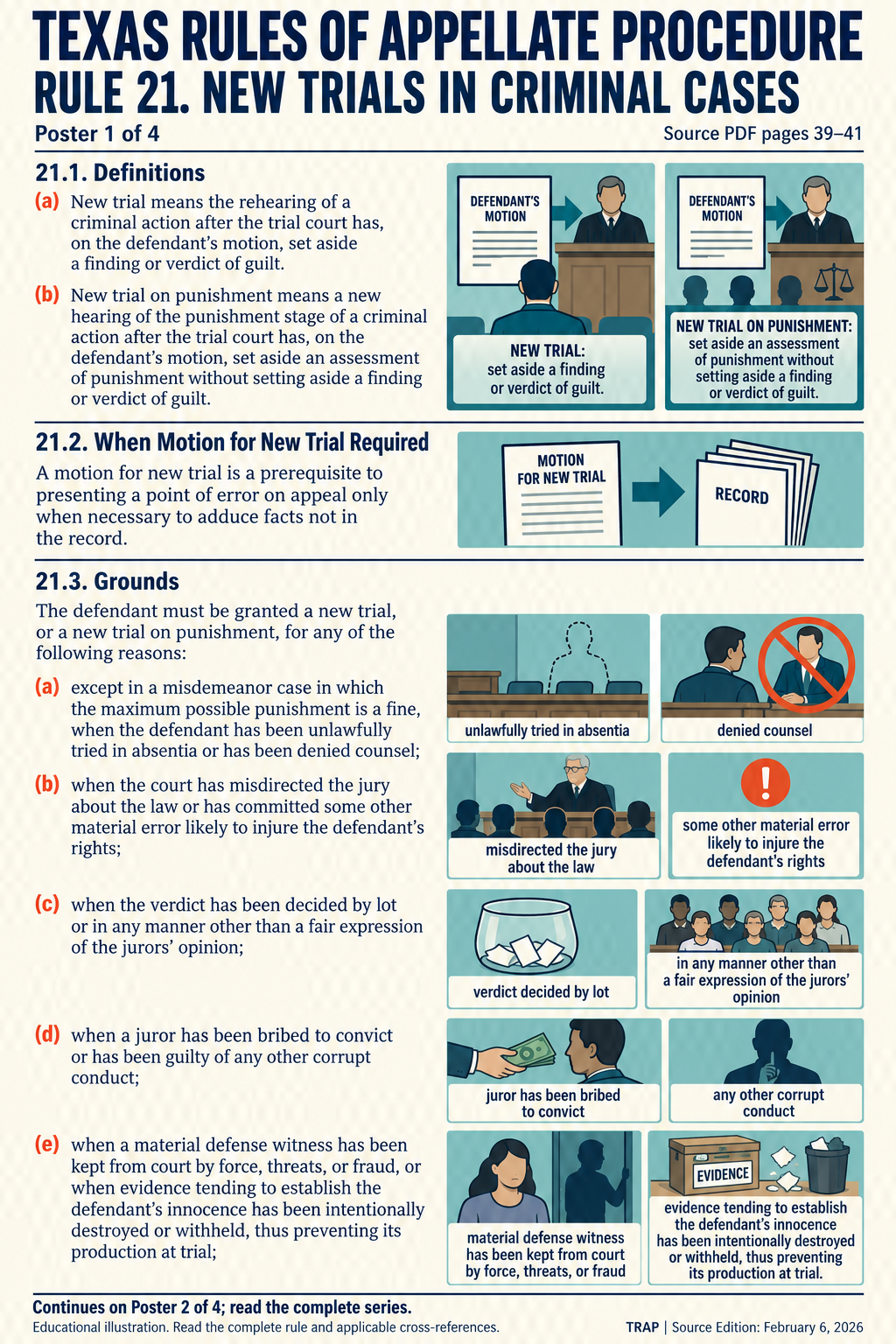
Do I need a criminal post-trial motion before the appeal proceeds?Check trial-court motions promptly
When this matters
Sentence has been imposed or suspended, or a post-trial issue requires action.
Rules 21 and 22 separately govern a new trial and arrest of judgment in criminal cases. Filing, presentment and the court’s ruling are distinct requirements. A new-trial motion may be needed to develop facts not already in the record.
Read the grounds, trigger, filing and presentment rules, and ruling period. Check the effect of a timely new-trial motion on the notice deadline; do not assume every motion has that effect.
See this in a diagram (5 available)
These illustrations cover related procedural points. Read the official sources below for the full requirements.
Read the official sources
Texas Rules of Appellate Procedure, February 6, 2026 edition. Check applicable amendments and court orders.
The criminal judgment needs a nunc pro tunc correction. What should I read?Check a criminal judgment correction
When this matters
A correction to a criminal judgment or sentence is being considered.
Rule 23 addresses a failure to render judgment and pronounce sentence, subject to its conditions concerning a new trial, arrest of judgment and an appeal. It also addresses credit on the sentence.
Identify the proposed correction and read the rule and applicable law. Do not assume Rule 23 supplies a general procedure for changing every alleged error in a judgment.
Read the official sources
Texas Rules of Appellate Procedure, February 6, 2026 edition. Check applicable amendments and court orders.
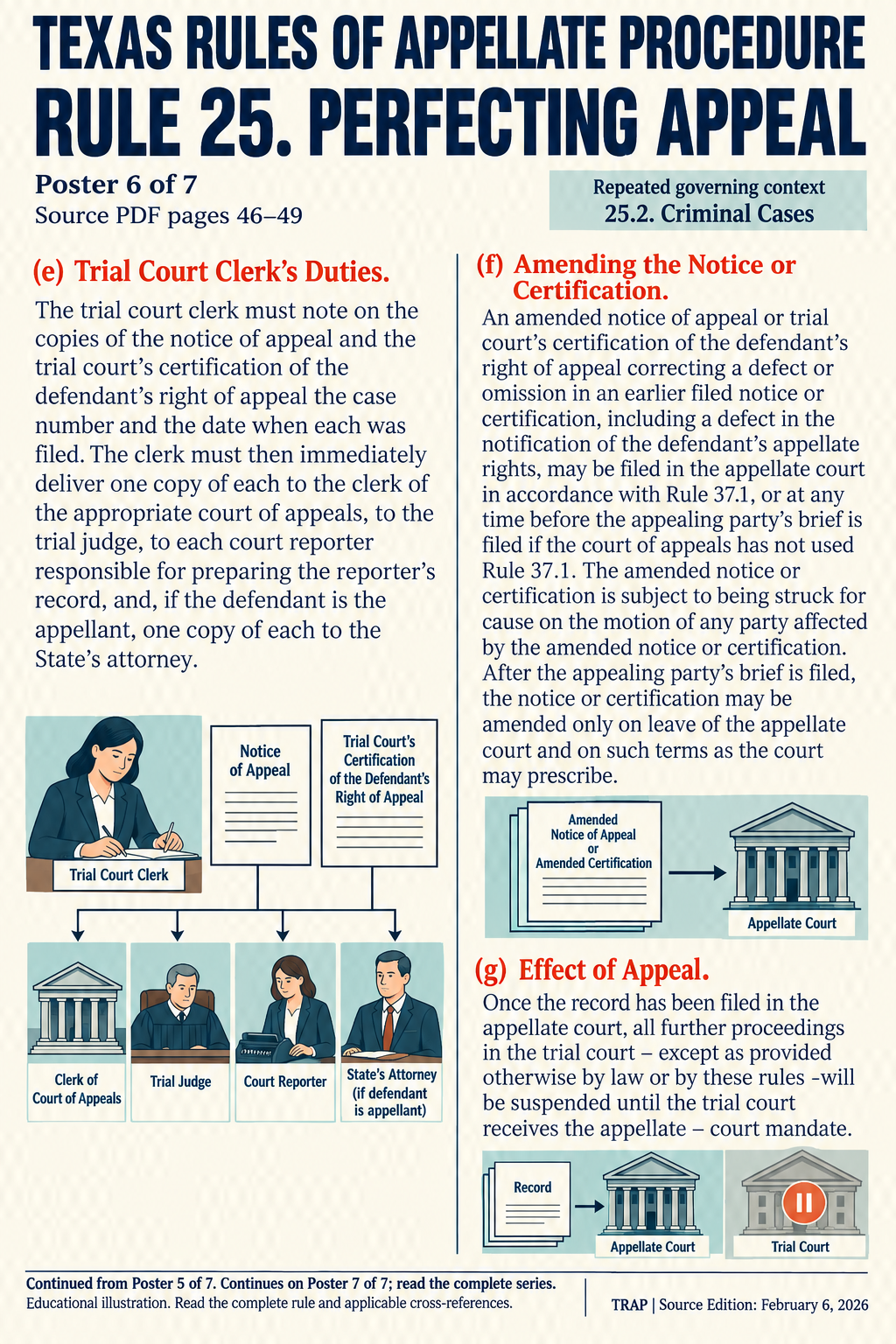
What must I check before filing a criminal notice of appeal?Start the criminal appeal
When this matters
You intend to appeal a criminal judgment or appealable order.
Check the notice and certification of the defendant’s right of appeal, including restrictions for particular cases. Rule 26.2 supplies the criminal timing rules; Rule 26.3 addresses extensions.
Check the right of appeal, certification, correct clerk and triggering event. Read any plea-bargain restrictions and the rule applicable to the party taking the appeal.
See this in a diagram (3 available)
These illustrations cover related procedural points. Read the official sources below for the full requirements.
Read the official sources
Texas Rules of Appellate Procedure, February 6, 2026 edition. Check applicable amendments and court orders.
How do I get the criminal record before the reviewing court?Arrange the criminal record
When this matters
A criminal appeal is being prepared.
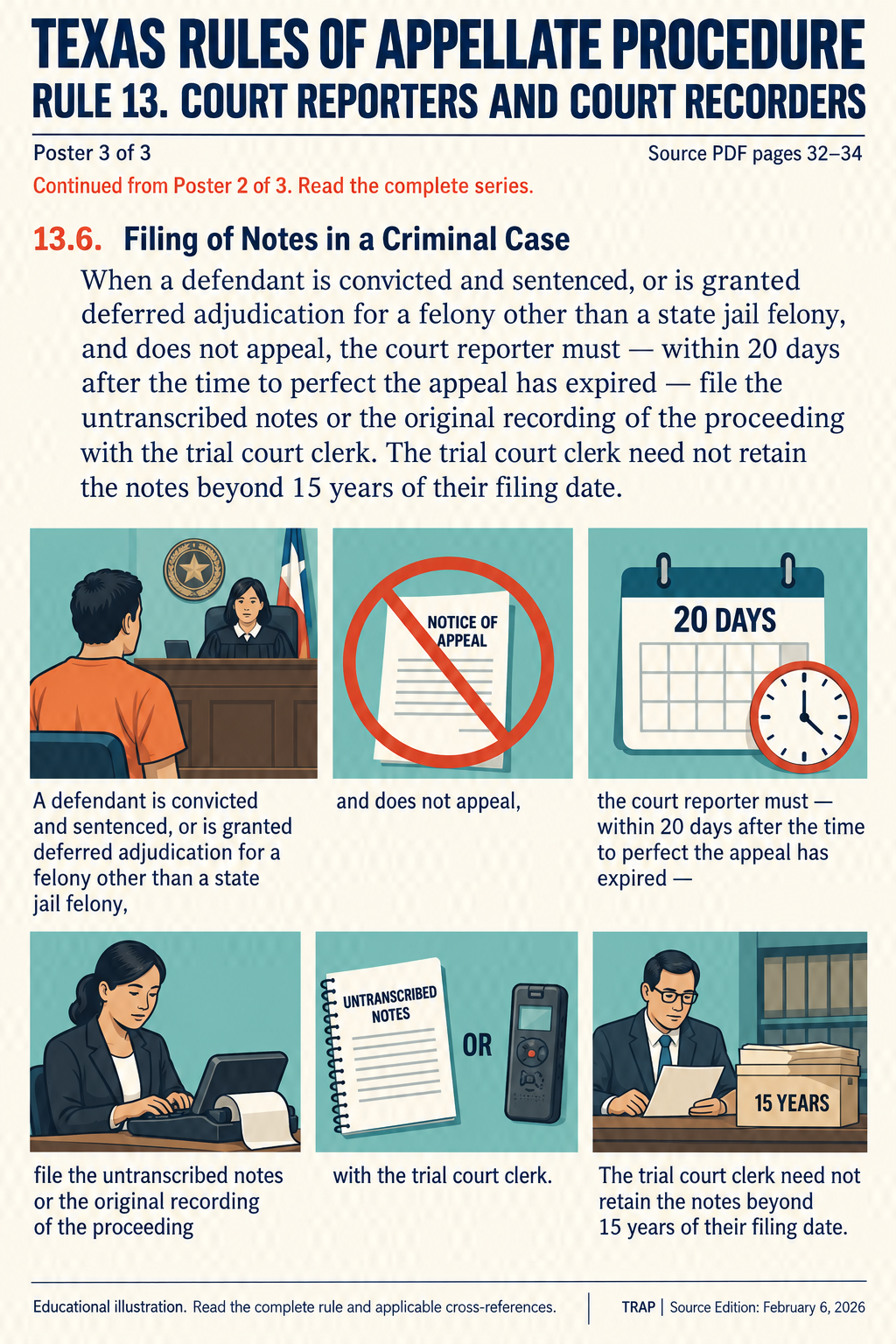
Rules 13, 34, 35 and 37 address the reporter, record contents, requests, filing and defects. Rule 20.2 provides a procedure when an appellant cannot pay for the appellate record.
Identify the necessary hearings and exhibits, make the required requests and address payment or inability to pay. Follow any notice of a missing record or certification.
See this in a diagram (2 available)
These illustrations cover related procedural points. Read the official sources below for the full requirements.
Read the official sources
Texas Rules of Appellate Procedure, February 6, 2026 edition. Check applicable amendments and court orders.
How do I prepare or answer a brief in a criminal appeal?Prepare criminal appellate briefs
When this matters
The criminal appeal has reached briefing.
Rules 38 and 9 govern briefs and document requirements, with criminal-specific provisions. Identify whether you are preparing the appellant’s brief, the responding brief or a reply. Special direct appeals and later discretionary review have additional rules.
Read the requirements for your role and court, including the consequences of a missing brief. Keep the argument tied to preserved issues, the record and the applicable error standard.
See this in a diagram (6 available)
These illustrations cover related procedural points. Read the official sources below for the full requirements.
Read the official sources
Texas Rules of Appellate Procedure, February 6, 2026 edition. Check applicable amendments and court orders.
The court of appeals decided my criminal case. What comes next?Read a criminal appellate decision
When this matters
A court of appeals has issued a criminal judgment and opinion.
Read the disposition and the issues resolved. Rehearing in the court of appeals is governed by Rule 49; discretionary review is sought in the Court of Criminal Appeals. Enforcement and mandate have their own provisions.
Keep the judgment, opinion and notice date. Choose the applicable next question rather than treating every review option as a required step.
Read the official sources
Texas Rules of Appellate Procedure, February 6, 2026 edition. Check applicable amendments and court orders.
Should I ask the court of appeals to reconsider the criminal decision?Check court-of-appeals rehearing
When this matters
You are considering rehearing or en banc reconsideration in the court of appeals.
Rule 49 governs these requests in the court of appeals. It is different from rehearing in the Court of Criminal Appeals under Rule 79. Read the effect of a timely request on the discretionary-review timetable.
Identify the court and the decision, then check contents, timing and the relationship to a petition for discretionary review.
Read the official sources
Texas Rules of Appellate Procedure, February 6, 2026 edition. Check applicable amendments and court orders.
How do I ask the Court of Criminal Appeals to review the decision?Request discretionary criminal review
When this matters
A court of appeals has decided a criminal case and you seek further review.
Review is discretionary. Rules 66 and 68 explain the grounds and petition procedure, including contents, response, reply and timing. Rule 67 also permits the Court to grant review on its own initiative.
Identify a reason for review, the filing deadline, the correct clerk and required service, including the State Prosecuting Attorney. Do not wait for the Court to act on its own instead of checking your deadline.
See this in a diagram (2 available)
These illustrations cover related procedural points. Read the official sources below for the full requirements.
Read the official sources
Texas Rules of Appellate Procedure, February 6, 2026 edition. Check applicable amendments and court orders.
Someone filed a petition for discretionary review. How do I respond?Respond to a criminal review petition
When this matters
A petition for discretionary review has been filed in the Court of Criminal Appeals.
Rule 68 governs a response and reply at the petition stage. Rule 69 describes the Court’s action. A petition-stage response is different from the merits brief required if review is granted.
Read the petition, current orders, response timing and service requirements. Check whether you also seek review on a separate ground.
Read the official sources
Texas Rules of Appellate Procedure, February 6, 2026 edition. Check applicable amendments and court orders.
The Court of Criminal Appeals granted review. What do I do?Follow a grant of criminal review
When this matters
Discretionary review has been granted by petition or on the Court’s initiative.
After review is granted, prepare the merits brief required for your role under Rule 70. Rules 75 and 76 address submission and argument. Read the grant and briefing schedule to identify the issues and your role.
Prepare the required merits brief, comply with service requirements and monitor the submission notice. Oral argument depends on the Court’s designation.
Read the official sources
Texas Rules of Appellate Procedure, February 6, 2026 edition. Check applicable amendments and court orders.
The Court of Criminal Appeals acted. What does the result require?Read the criminal high court’s result
When this matters
The Court of Criminal Appeals has issued an opinion, order or judgment.
Rules 77 and 78 address opinions and judgments. Rule 79 limits rehearing and prohibits certain motions, including a motion to rehear a grant of discretionary review or the specified denial or dismissal of postconviction habeas relief.
Identify the exact order before considering rehearing. A refused petition has different rehearing grounds from a merits judgment.
Read the official sources
Texas Rules of Appellate Procedure, February 6, 2026 edition. Check applicable amendments and court orders.
May I request rehearing in the Court of Criminal Appeals?Check whether rehearing is allowed
When this matters
You are considering a rehearing request after that Court’s action.
Rule 79 governs timing, contents, permitted grounds, extensions and limits on further motions. Read its prohibitions before preparing a motion. The Court’s ability to reconsider on its own does not create permission to file a prohibited motion.
Identify the order, permitted grounds and applicable filing period. For a denial of leave in an extraordinary matter, also read Rule 72.2.
Read the official sources
Texas Rules of Appellate Procedure, February 6, 2026 edition. Check applicable amendments and court orders.
What happens when criminal appellate review ends?Follow the criminal judgment
When this matters
Review has concluded or the court has issued an enforceable mandate or order.
Rules 18 and 51.2 address mandate and enforcement in criminal cases. Rule 31 contains special mandate provisions for the proceedings it covers. Read the actual judgment and later orders.
Identify the court responsible for carrying out the judgment and any proceedings ordered on remand.
Read the official sources
Texas Rules of Appellate Procedure, February 6, 2026 edition. Check applicable amendments and court orders.
Am I appealing a habeas, bail or extradition order?Identify a special criminal appeal
When this matters
You seek review of a criminal habeas corpus, bail or extradition ruling.
Rule 31 has special procedures for these appeals. It distinguishes a challenge to a conviction or placement on community supervision from other habeas or bail proceedings, and includes separate provisions for denial of bail under the Texas Constitution.
Identify the exact order and governing subsection. Check the correct reviewing court, record and briefing schedule, and any special mandate procedure.
Read the official sources
Texas Rules of Appellate Procedure, February 6, 2026 edition. Check applicable amendments and court orders.
Does this criminal case go directly to the Court of Criminal Appeals?Identify direct criminal review
When this matters
A direct-review provision may apply to the criminal judgment or bail order.
Rule 71 covers specified death-penalty cases and noncapital denial of bail under Article I, Section 11a. It directs record and brief filing to the Court of Criminal Appeals and specifies modifications to ordinary requirements.
Check the authorizing provision, the court named in the rule and the required record and briefs. Other bail-denial categories require their own review under Rule 31.
Read the official sources
Texas Rules of Appellate Procedure, February 6, 2026 edition. Check applicable amendments and court orders.
I seek an extraordinary writ in the Court of Criminal Appeals. How does it start?Check leave for an extraordinary writ
When this matters
You are considering an original extraordinary matter in the Court of Criminal Appeals.
Rule 72 requires a motion for leave to accompany the original petition or specified motion. If leave is denied, it does not permit a motion for rehearing or reconsideration. This differs from an original proceeding governed by Rule 52 in another appellate court.
Identify the Court’s jurisdiction, the writ, the required leave motion and the supporting materials. Do not confuse this route with a postconviction application under Rule 73.
Read the official sources
Texas Rules of Appellate Procedure, February 6, 2026 edition. Check applicable amendments and court orders.
I am seeking postconviction habeas relief. Where do I begin?Choose the postconviction habeas procedure
When this matters
You seek collateral relief from a criminal conviction under the applicable habeas statute.
Rule 73 governs specified postconviction applications, including prescribed forms, required grounds and supporting facts, verification and processing in the convicting court. The statute determines the appropriate procedure; this is separate from a direct appeal or discretionary-review petition.
Identify the governing Code of Criminal Procedure article and current prescribed form. Read the filing location, verification and record requirements before submitting an application.
Read the official sources
Texas Rules of Appellate Procedure, February 6, 2026 edition. Check applicable amendments and court orders.
A federal appellate court certified a criminal-law question. What follows?Follow a certified criminal-law question
When this matters
A federal appellate court has certified a Texas criminal-law question.
Rule 74 governs certification, the Court of Criminal Appeals’ choice to answer, briefing, argument, rehearing and transmission of the answer. The process begins with a court certification, not an ordinary appeal filed by a party.
Read the certification order and acceptance notice; follow the certified-question schedule and return to the certifying proceeding after the answer.
Read the official sources
Texas Rules of Appellate Procedure, February 6, 2026 edition. Check applicable amendments and court orders.
I received a mandamus petition. What do I check?Respond to an original petition
When this matters
An original proceeding names you as a real party in interest or other participant.
Rule 52 distinguishes the participants, a response, a reply, the supporting record and the court’s action. Read any request for a response and any temporary-relief order separately from the petition itself.
Identify your role, the relief sought, the court’s request and the applicable response timing.
See this in a diagram (2 available)
These illustrations cover related procedural points. Read the official sources below for the full requirements.
Read the official sources
Texas Rules of Appellate Procedure, February 6, 2026 edition. Check applicable amendments and court orders.
The court ruled on the original proceeding. What follows?Read an original-proceeding order
When this matters
The appellate court has issued an order or opinion on an original petition.
Rule 52 addresses denial, interim action, granting relief and rehearing. Read the operative order to identify whether relief is temporary, conditional or final and who must act.
Separate a temporary order from the disposition of the petition. Check any required act, timing and the applicable rehearing provision.
Read the official sources
Texas Rules of Appellate Procedure, February 6, 2026 edition. Check applicable amendments and court orders.
What should I keep after this reading path ends?Follow the disposition
When this matters
You have reached a disposition, returned to the lower court or completed the current procedural step.
Keep the operative judgment, opinion, mandate and later orders together. A remand may require further trial-court proceedings; a dismissal or settlement may end the appeal earlier. A later order may create a new procedural question.
Identify what the court actually ordered and return to the relevant stage if another step arises. These reading paths do not resolve rights or deadlines outside TRAP.
Read the official sources
Texas Rules of Appellate Procedure, February 6, 2026 edition. Check applicable amendments and court orders.