
TRAP · Illustrated procedures
See what to do.
Keep the source close.
Choose the procedural question you want to understand. Open an illustration when you need it.
146 verified illustrations are available. Other TRAP rules remain unillustrated here; consult the complete official rules.
Original illustrations and assigned rule text shared with OurObjection. Source edition: February 6, 2026.
No matching illustrations. Try a broader task or clear the search.
Find the rules that apply to your court
Find the rules that apply to your courtPoster 1 of 1
Read this illustration’s source text and context
Assigned rule text
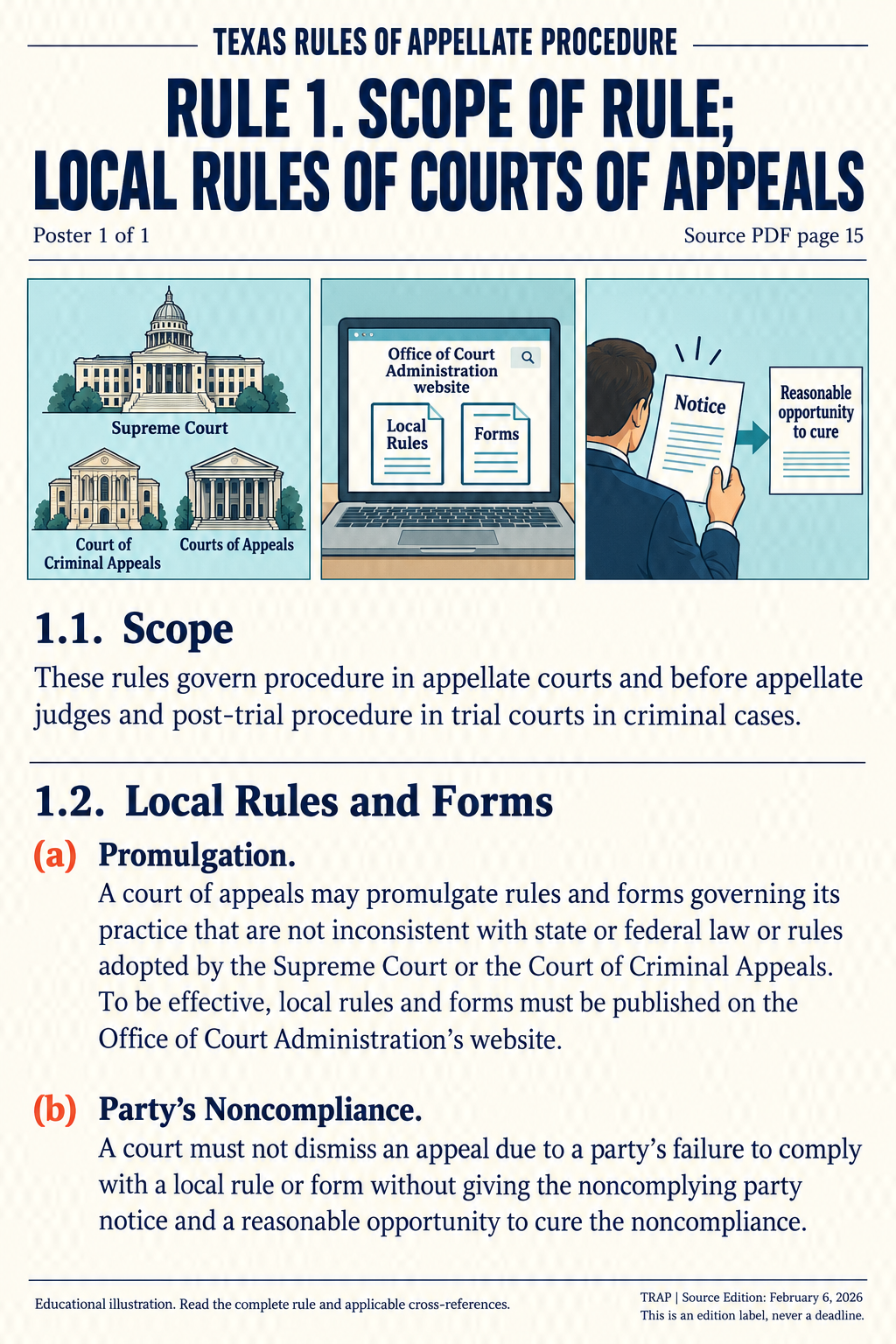
1.1. Scope These rules govern procedure in appellate courts and before appellate judges and post-trial procedure in trial courts in criminal cases.
1.2. Local Rules and Forms
(a) Promulgation. A court of appeals may promulgate rules and forms governing its practice that are not inconsistent with state or federal law or rules adopted by the Supreme Court or the Court of Criminal Appeals. To be effective, local rules and forms must be published on the Office of Court Administration’s website.
(b) Party’s Noncompliance. A court must not dismiss an appeal due to a party’s failure to comply with a local rule or form without giving the noncomplying party notice and a reasonable opportunity to cure the noncompliance.
Read the official rule for the full text and applicable scope.
Official TRAP 1 ↗Check what the court can change
Check what the court can changePoster 1 of 1
Read this illustration’s source text and context
Assigned rule text
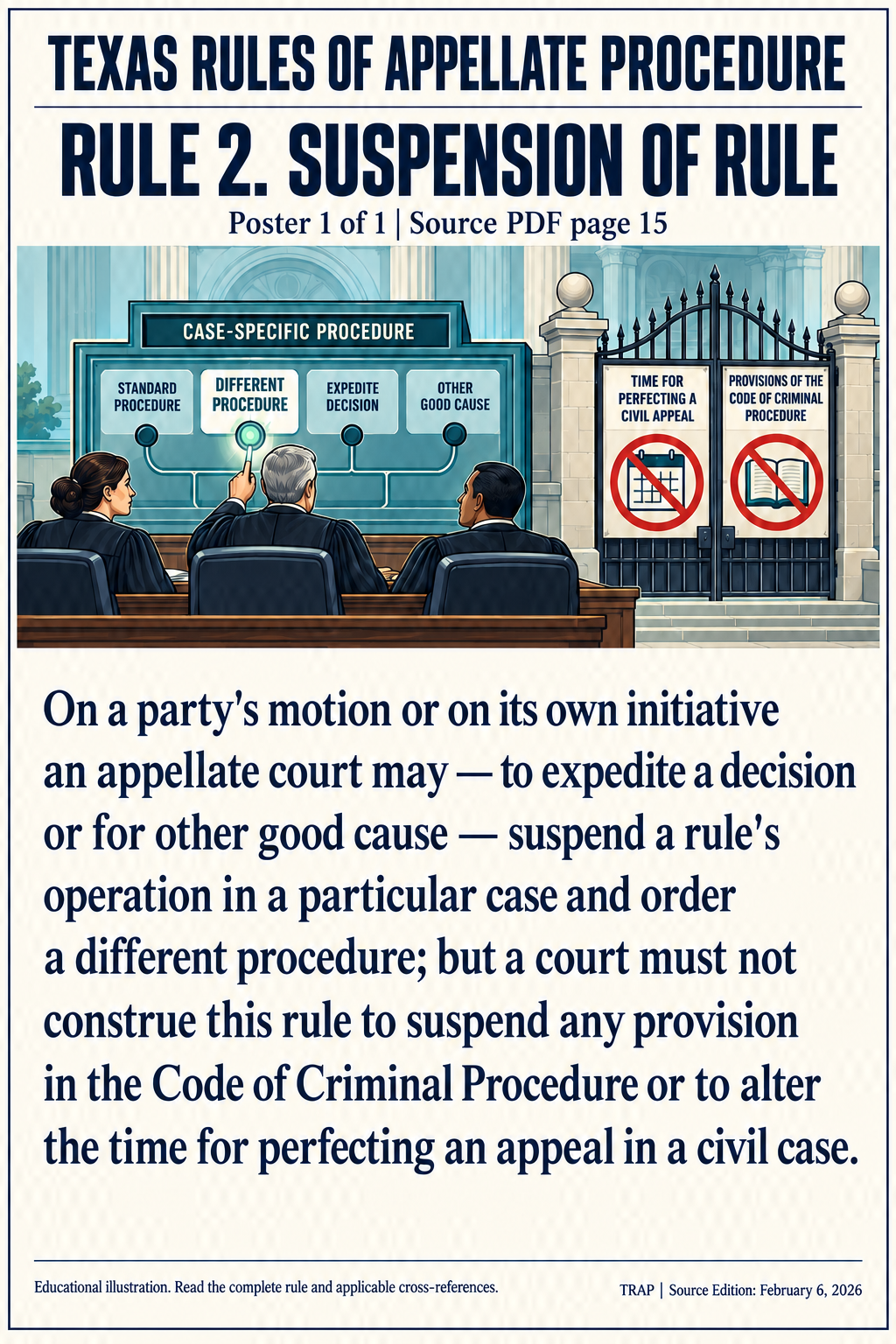
On a party's motion or on its own initiative an appellate court may — to expedite a decision or for other good cause — suspend a rule's operation in a particular case and order a different procedure; but a court must not construe this rule to suspend any provision in the Code of Criminal Procedure or to alter the time for perfecting an appeal in a civil case.
Read the official rule for the full text and applicable scope.
Official TRAP 2 ↗Identify your role in the appeal
Identify your role in the appealPoster 1 of 1
Read this illustration’s source text and context
Assigned rule text
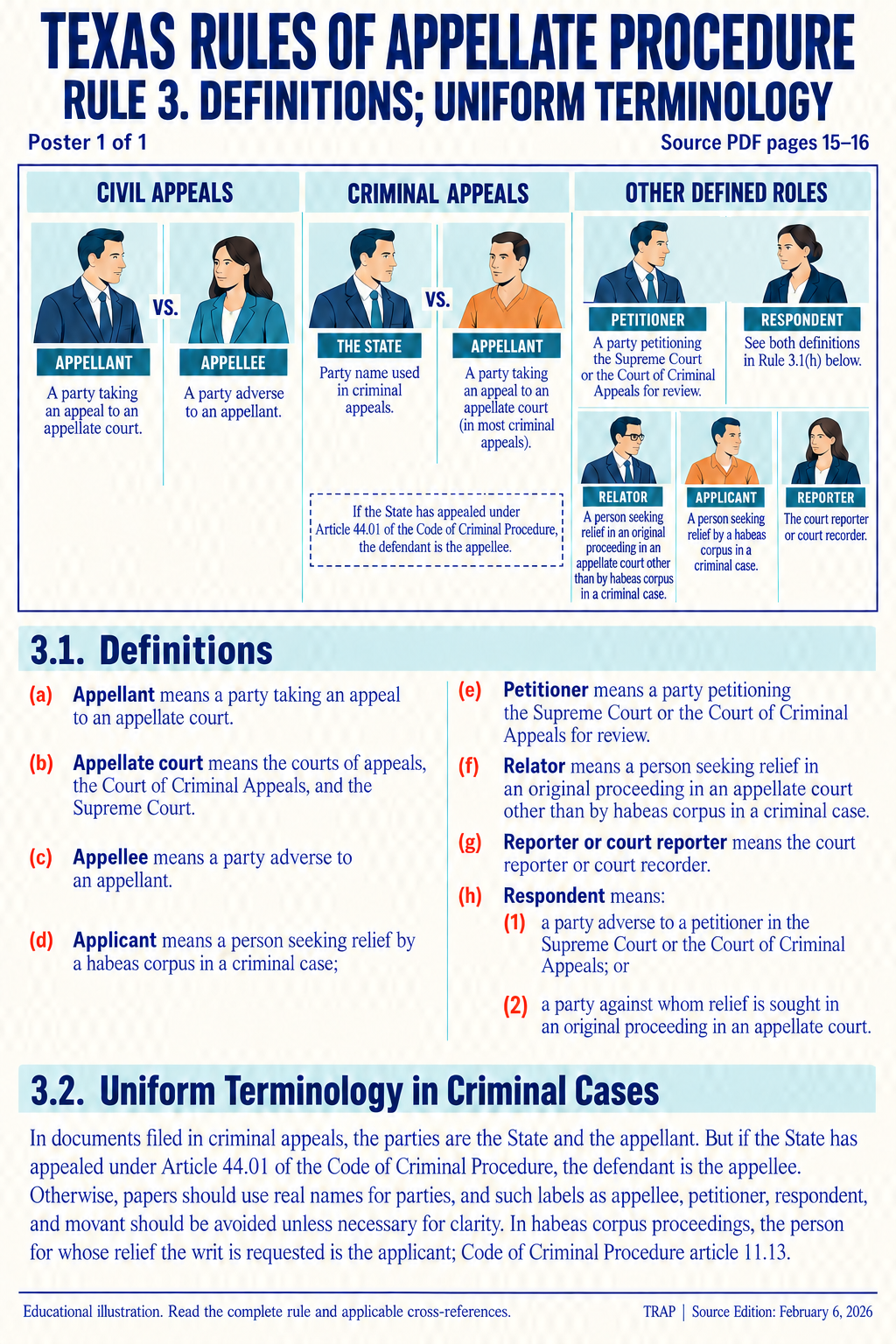
3.1. Definitions
(a) Appellant means a party taking an appeal to an appellate court.
(b) Appellate court means the courts of appeals, the Court of Criminal Appeals, and the Supreme Court.
(c) Appellee means a party adverse to an appellant.
(d) Applicant means a person seeking relief by a habeas corpus in a criminal case;
(e) Petitioner means a party petitioning the Supreme Court or the Court of Criminal Appeals for review.
(f) Relator means a person seeking relief in an original proceeding in an appellate court other than by habeas corpus in a criminal case.
(g) Reporter or court reporter means the court reporter or court recorder.
(h) Respondent means:
(1) a party adverse to a petitioner in the Supreme Court or the Court of Criminal Appeals; or
(2) a party against whom relief is sought in an original proceeding in an appellate court.
3.2. Uniform Terminology in Criminal Cases In documents filed in criminal appeals, the parties are the State and the appellant. But if the State has appealed under Article 44.01 of the Code of Criminal Procedure, the defendant is the appellee. Otherwise, papers should use real names for parties, and such labels as appellee, petitioner, respondent, and movant should be avoided unless necessary for clarity. In habeas corpus proceedings, the person for whose relief the writ is requested is the applicant; Code of Criminal Procedure article 11.13.
Read the official rule for the full text and applicable scope.
Official TRAP 3 ↗Work out when time starts and how it is counted
Count days and identify the last dayPoster 1 of 6
Read this illustration’s source text and context
Assigned rule text
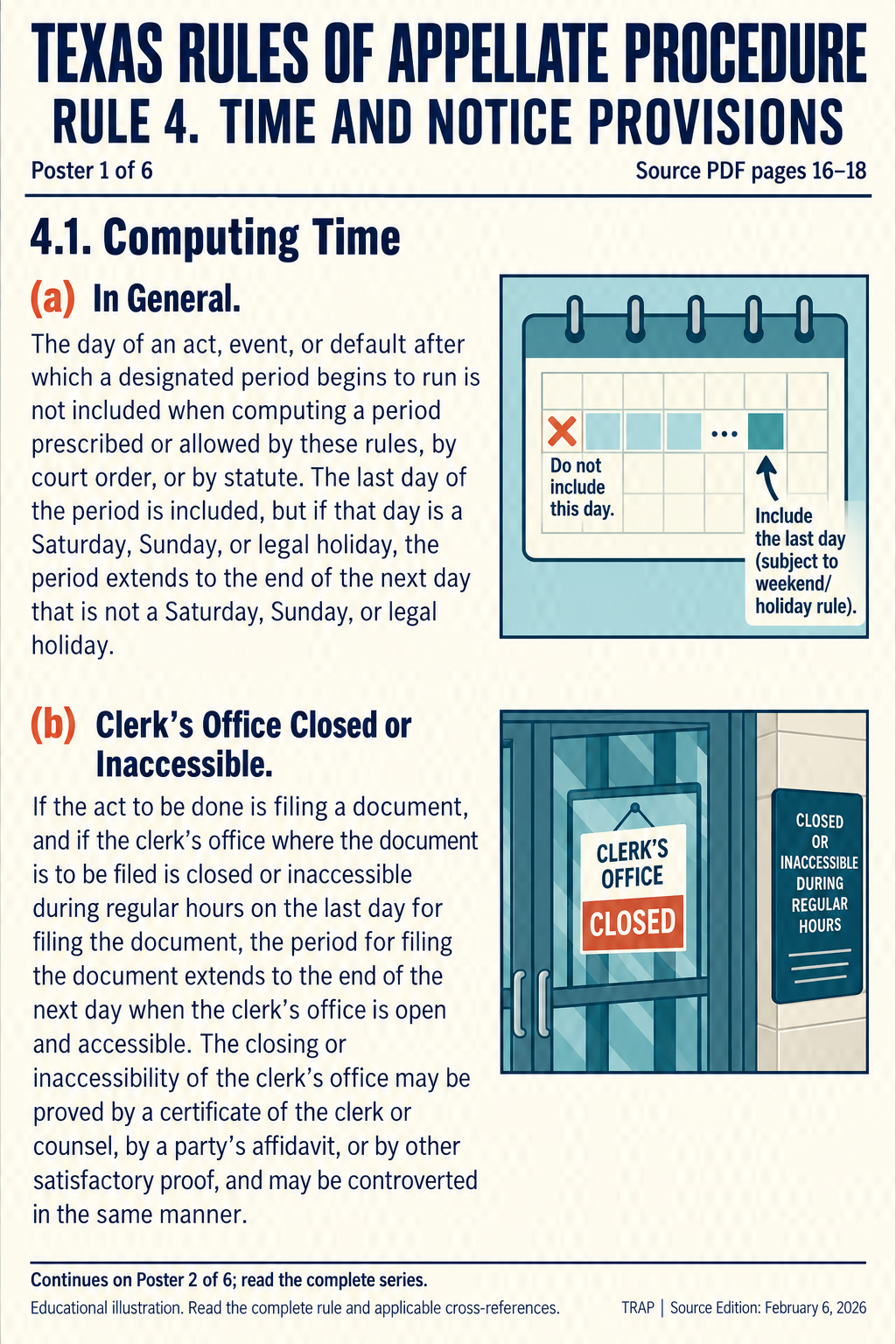
4.1. Computing Time
(a) In General. The day of an act, event, or default after which a designated period begins to run is not included when computing a period prescribed or allowed by these rules, by court order, or by statute. The last day of the period is included, but if that day is a Saturday, Sunday, or legal holiday, the period extends to the end of the next day that is not a Saturday, Sunday, or legal holiday.
(b) Clerk's Office Closed or Inaccessible. If the act to be done is filing a document, and if the clerk's office where the document is to be filed is closed or inaccessible during regular hours on the last day for filing the document, the period for filing the document extends to the end of the next day when the clerk's office is open and accessible. The closing or inaccessibility of the clerk's office may be proved by a certificate of the clerk or counsel, by a party's affidavit, or by other satisfactory proof, and may be controverted in the same manner.
Continues on Poster 2 of 6; read the complete series. Read the official rule for the full text and applicable scope.
Official TRAP 4 ↗Check delayed notice of a civil judgmentPoster 2 of 6
Read this illustration’s source text and context
Assigned rule text
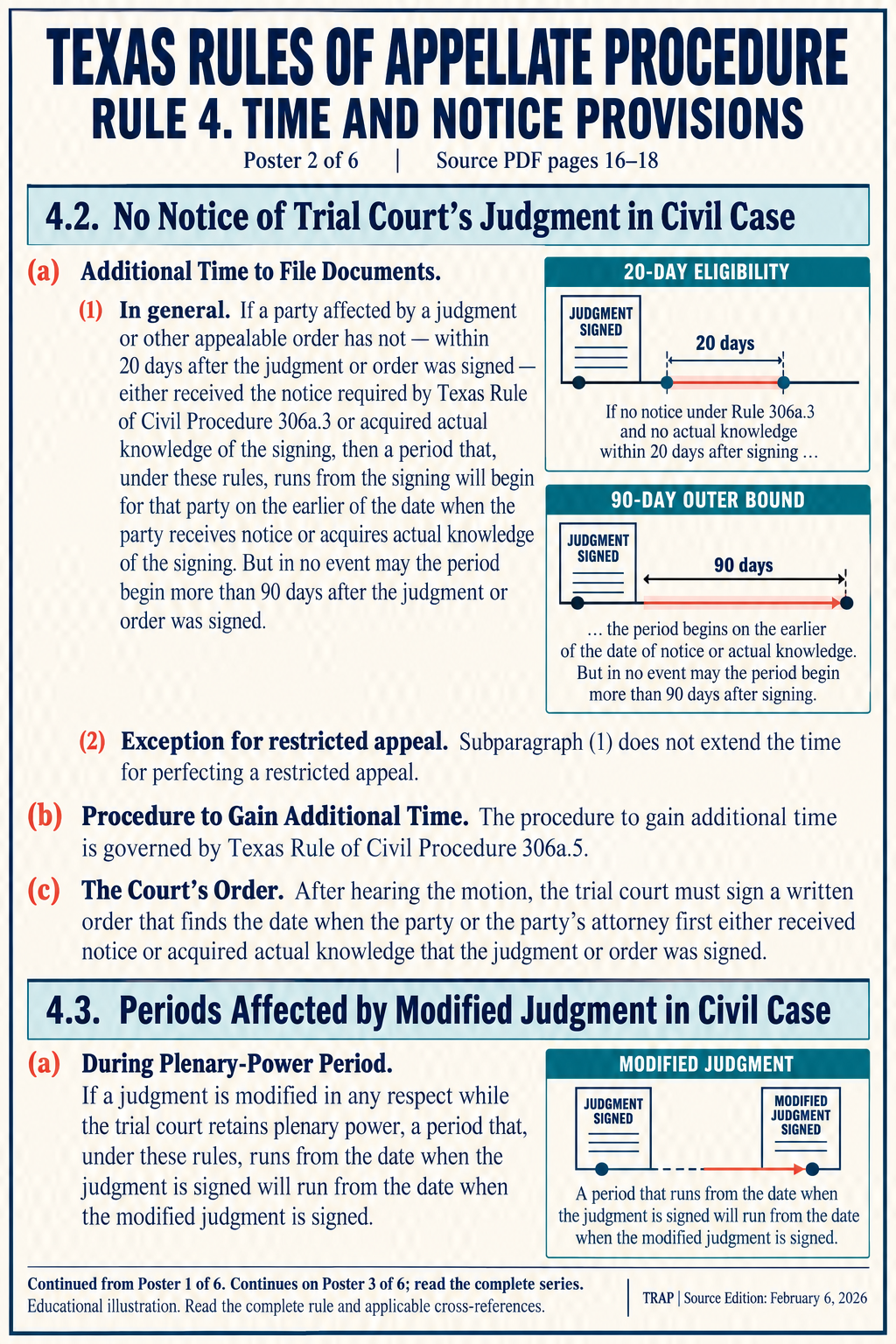
4.2. No Notice of Trial Court’s Judgment in Civil Case
(a) Additional Time to File Documents.
(1) In general. If a party affected by a judgment or other appealable order has not — within 20 days after the judgment or order was signed — either received the notice required by Texas Rule of Civil Procedure 306a.3 or acquired actual knowledge of the signing, then a period that, under these rules, runs from the signing will begin for that party on the earlier of the date when the party receives notice or acquires actual knowledge of the signing. But in no event may the period begin more than 90 days after the judgment or order was signed.
(2) Exception for restricted appeal. Subparagraph (1) does not extend the time for perfecting a restricted appeal.
(b) Procedure to Gain Additional Time. The procedure to gain additional time is governed by Texas Rule of Civil Procedure 306a.5.
(c) The Court’s Order. After hearing the motion, the trial court must sign a written order that finds the date when the party or the party’s attorney first either received notice or acquired actual knowledge that the judgment or order was signed.
4.3. Periods Affected by Modified Judgment in Civil Case
(a) During Plenary-Power Period. If a judgment is modified in any respect while the trial court retains plenary power, a period that, under these rules, runs from the date when the judgment is signed will run from the date when the modified judgment is signed.
Continued from Poster 1 of 6. Continues on Poster 3 of 6; read the complete series. Read the official rule for the full text and applicable scope.
Official TRAP 4 ↗TIME AND NOTICE PROVISIONS — poster 3Poster 3 of 6
Read assigned source text
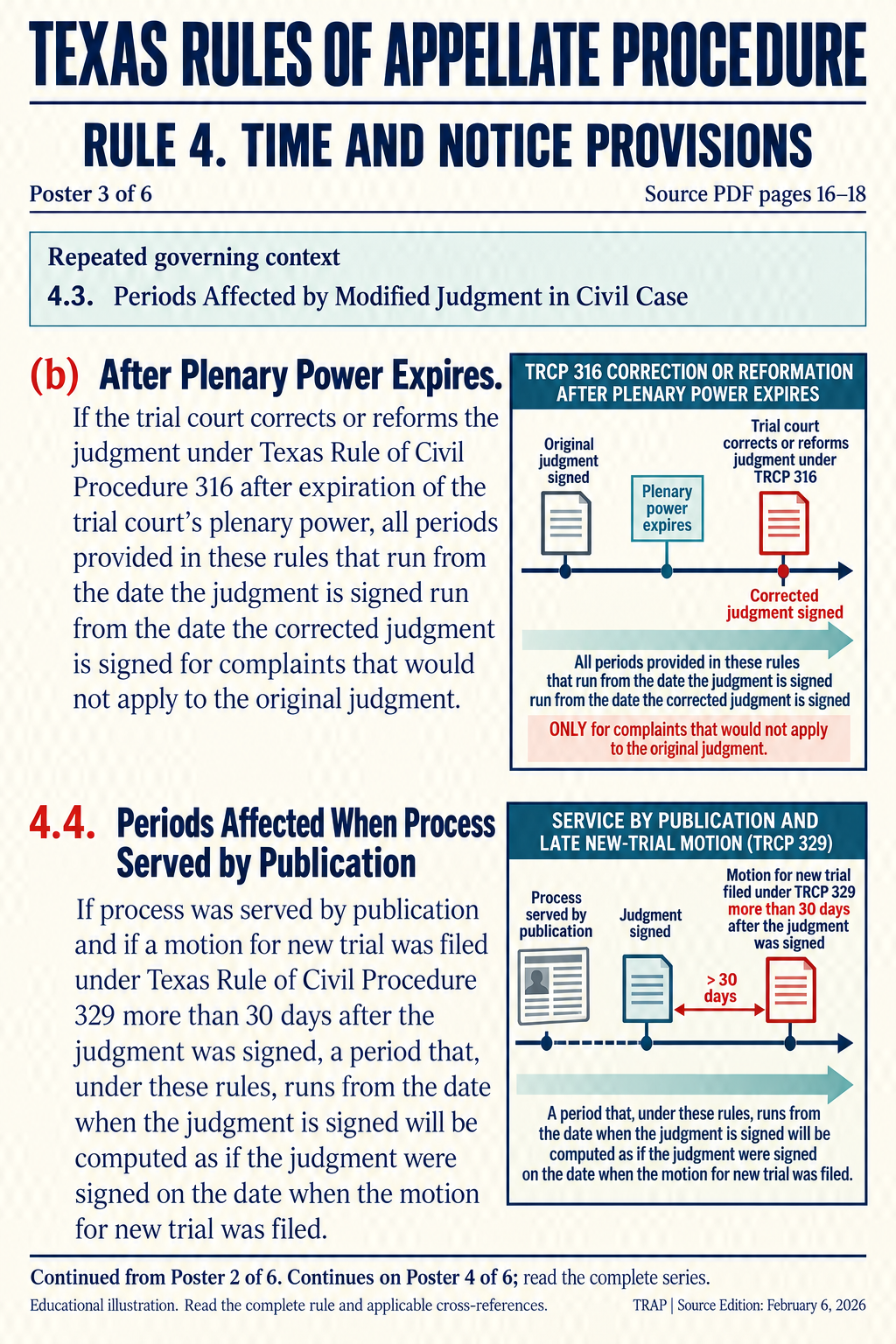
(b) After Plenary Power Expires. If the trial court corrects or reforms the judgment under Texas Rule of Civil Procedure 316 after expiration of the trial court’s plenary power, all periods provided in these rules that run from the date the judgment is signed run from the date the corrected judgment is signed for complaints that would not apply to the original judgment.
4.4. Periods Affected When Process Served by Publication If process was served by publication and if a motion for new trial was filed under Texas Rule of Civil Procedure 329 more than 30 days after the judgment was signed, a period that, under these rules, runs from the date when the judgment is signed will be computed as if the judgment were signed on the date when the motion for new trial was filed.
TIME AND NOTICE PROVISIONS — poster 4Poster 4 of 6
Read assigned source text
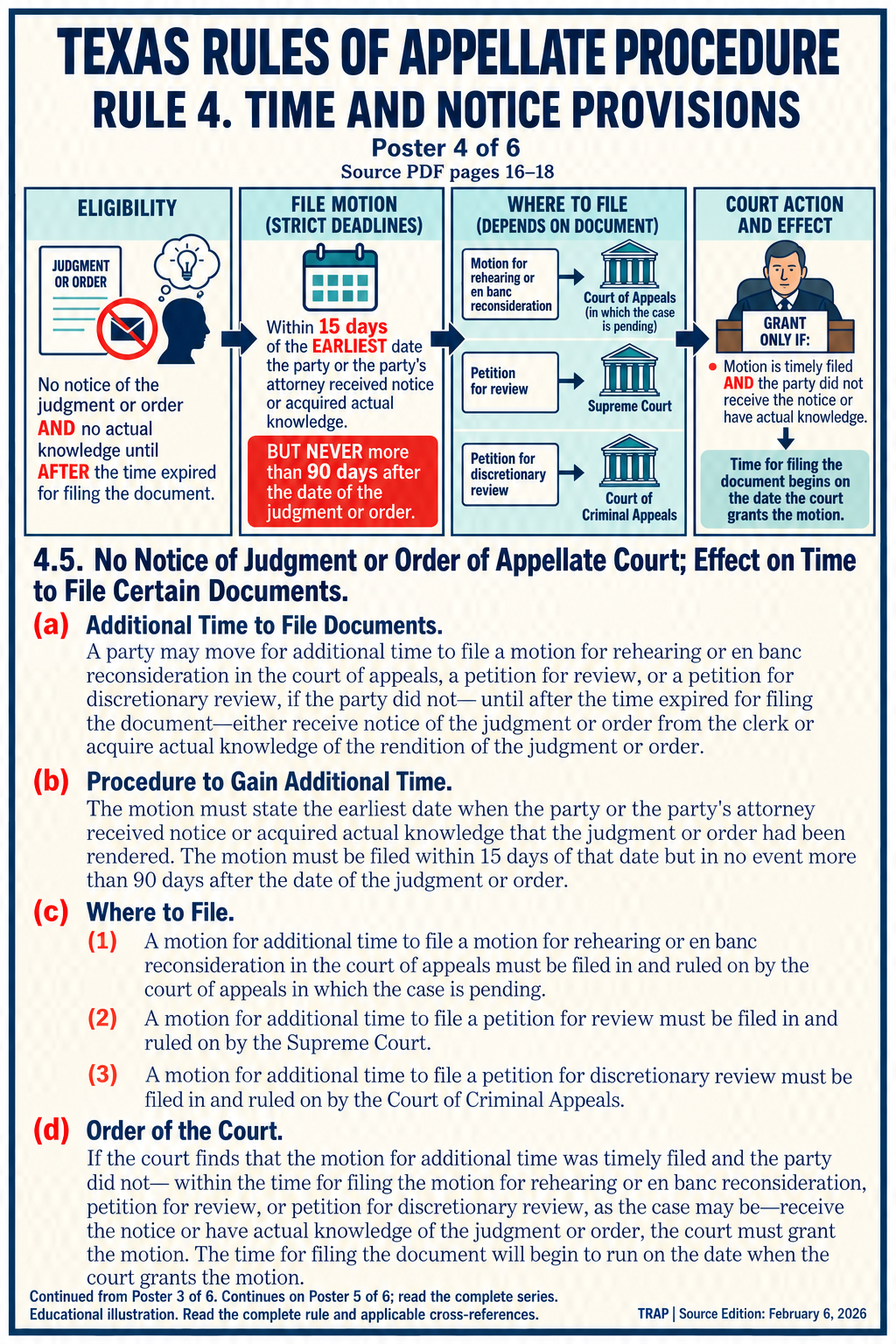
4.5. No Notice of Judgment or Order of Appellate Court; Effect on Time to File Certain Documents.
(a) Additional Time to File Documents. A party may move for additional time to file a motion for rehearing or en banc reconsideration in the court of appeals, a petition for review, or a petition for discretionary review, if the party did not— until after the time expired for filing the document—either receive notice of the judgment or order from the clerk or acquire actual knowledge of the rendition of the judgment or order.
(b) Procedure to Gain Additional Time. The motion must state the earliest date when the party or the party's attorney received notice or acquired actual knowledge that the judgment or order had been rendered. The motion must be filed within 15 days of that date but in no event more than 90 days after the date of the judgment or order.
(c) Where to File.
(1) A motion for additional time to file a motion for rehearing or en banc reconsideration in the court of appeals must be filed in and ruled on by the court of appeals in which the case is pending.
(2) A motion for additional time to file a petition for review must be filed in and ruled on by the Supreme Court.
(3) A motion for additional time to file a petition for discretionary review must be filed in and ruled on by the Court of Criminal Appeals.
(d) Order of the Court. If the court finds that the motion for additional time was timely filed and the party did not— within the time for filing the motion for rehearing or en banc reconsideration, petition for review, or petition for discretionary review, as the case may be—receive the notice or have actual knowledge of the judgment or order, the court must grant the motion. The time for filing the document will begin to run on the date when the court grants the motion.
TIME AND NOTICE PROVISIONS — poster 5Poster 5 of 6
Read assigned source text
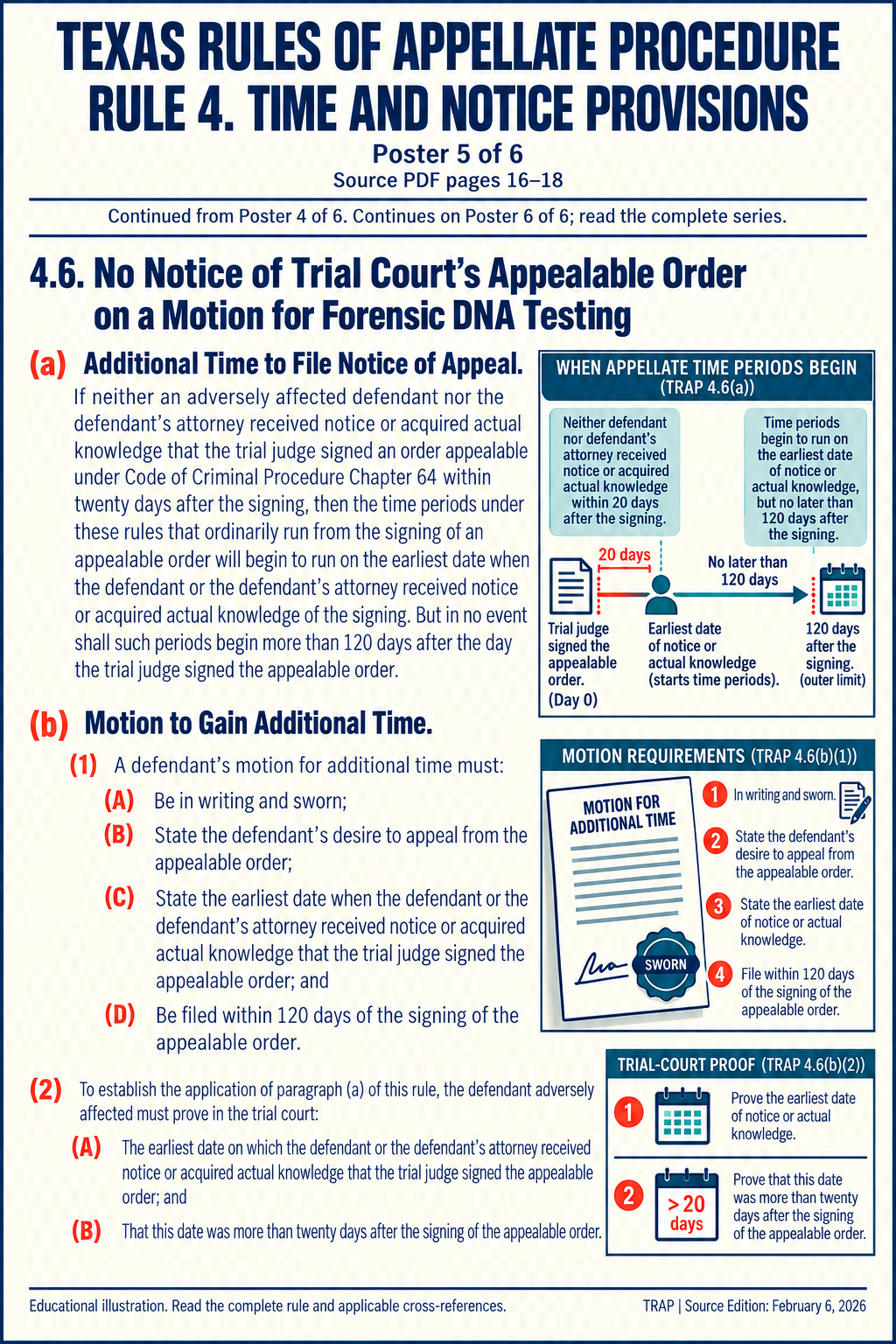
4.6. No Notice of Trial Court’s Appealable Order on a Motion for Forensic DNA Testing
(a) Additional Time to File Notice of Appeal. If neither an adversely affected defendant nor the defendant’s attorney received notice or acquired actual knowledge that the trial judge signed an order appealable under Code of Criminal Procedure Chapter 64 within twenty days after the signing, then the time periods under these rules that ordinarily run from the signing of an appealable order will begin to run on the earliest date when the defendant or the defendant’s attorney received notice or acquired actual knowledge of the signing. But in no event shall such periods begin more than 120 days after the day the trial judge signed the appealable order.
(b) Motion to Gain Additional Time.
(1) A defendant’s motion for additional time must:
(A) Be in writing and sworn;
(B) State the defendant’s desire to appeal from the appealable order;
(C) State the earliest date when the defendant or the defendant’s attorney received notice or acquired actual knowledge that the trial judge signed the appealable order; and
(D) Be filed within 120 days of the signing of the appealable order.
(2) To establish the application of paragraph (a) of this rule, the defendant adversely affected must prove in the trial court:
(A) The earliest date on which the defendant or the defendant’s attorney received notice or acquired actual knowledge that the trial judge signed the appealable order; and
(B) That this date was more than twenty days after the signing of the appealable order.
Understand the order and notice steps in a criminal DNA-testing casePoster 6 of 6
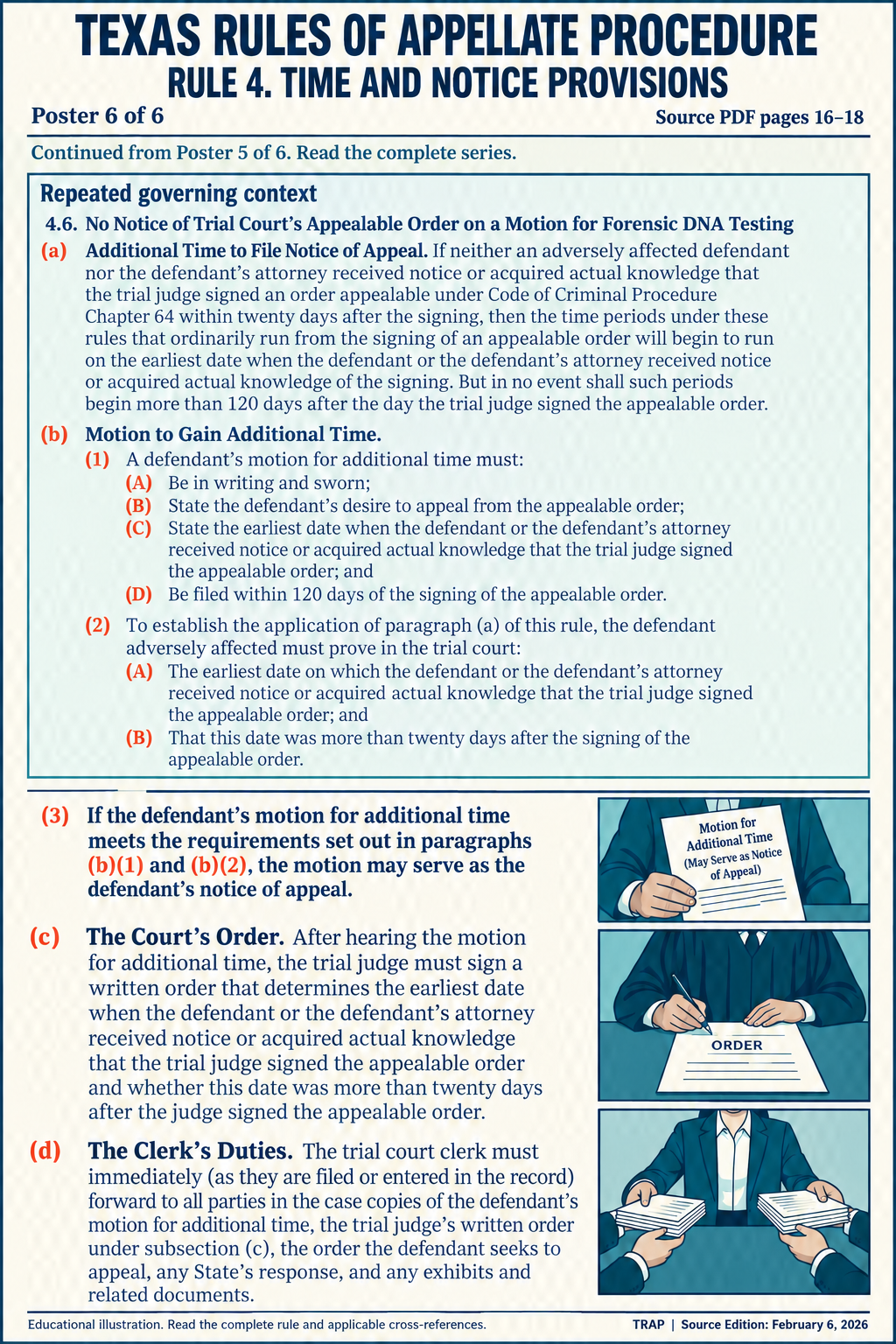
Read this illustration’s source text and context
Governing context
4.6. No Notice of Trial Court’s Appealable Order on a Motion for Forensic DNA Testing
(a) Additional Time to File Notice of Appeal. If neither an adversely affected defendant nor the defendant’s attorney received notice or acquired actual knowledge that the trial judge signed an order appealable under Code of Criminal Procedure Chapter 64 within twenty days after the signing, then the time periods under these rules that ordinarily run from the signing of an appealable order will begin to run on the earliest date when the defendant or the defendant’s attorney received notice or acquired actual knowledge of the signing. But in no event shall such periods begin more than 120 days after the day the trial judge signed the appealable order.
(b) Motion to Gain Additional Time.
(1) A defendant’s motion for additional time must:
(A) Be in writing and sworn;
(B) State the defendant’s desire to appeal from the appealable order;
(C) State the earliest date when the defendant or the defendant’s attorney received notice or acquired actual knowledge that the trial judge signed the appealable order; and
(D) Be filed within 120 days of the signing of the appealable order.
(2) To establish the application of paragraph (a) of this rule, the defendant adversely affected must prove in the trial court:
(A) The earliest date on which the defendant or the defendant’s attorney received notice or acquired actual knowledge that the trial judge signed the appealable order; and
(B) That this date was more than twenty days after the signing of the appealable order.
Assigned rule text
(3) If the defendant’s motion for additional time meets the requirements set out in paragraphs (b)(1) and (b)(2), the motion may serve as the defendant’s notice of appeal.
(c) The Court’s Order. After hearing the motion for additional time, the trial judge must sign a written order that determines the earliest date when the defendant or the defendant’s attorney received notice or acquired actual knowledge that the trial judge signed the appealable order and whether this date was more than twenty days after the judge signed the appealable order.
(d) The Clerk’s Duties. The trial court clerk must immediately (as they are filed or entered in the record) forward to all parties in the case copies of the defendant’s motion for additional time, the trial judge’s written order under subsection (c), the order the defendant seeks to appeal, any State’s response, and any exhibits and related documents.
Continued from Poster 5 of 6. Read the complete series. Read the official rule for the full text and applicable scope.
Official TRAP 4 ↗Rule 6. Representation By Counsel
Identify lead counselPoster 1 of 4
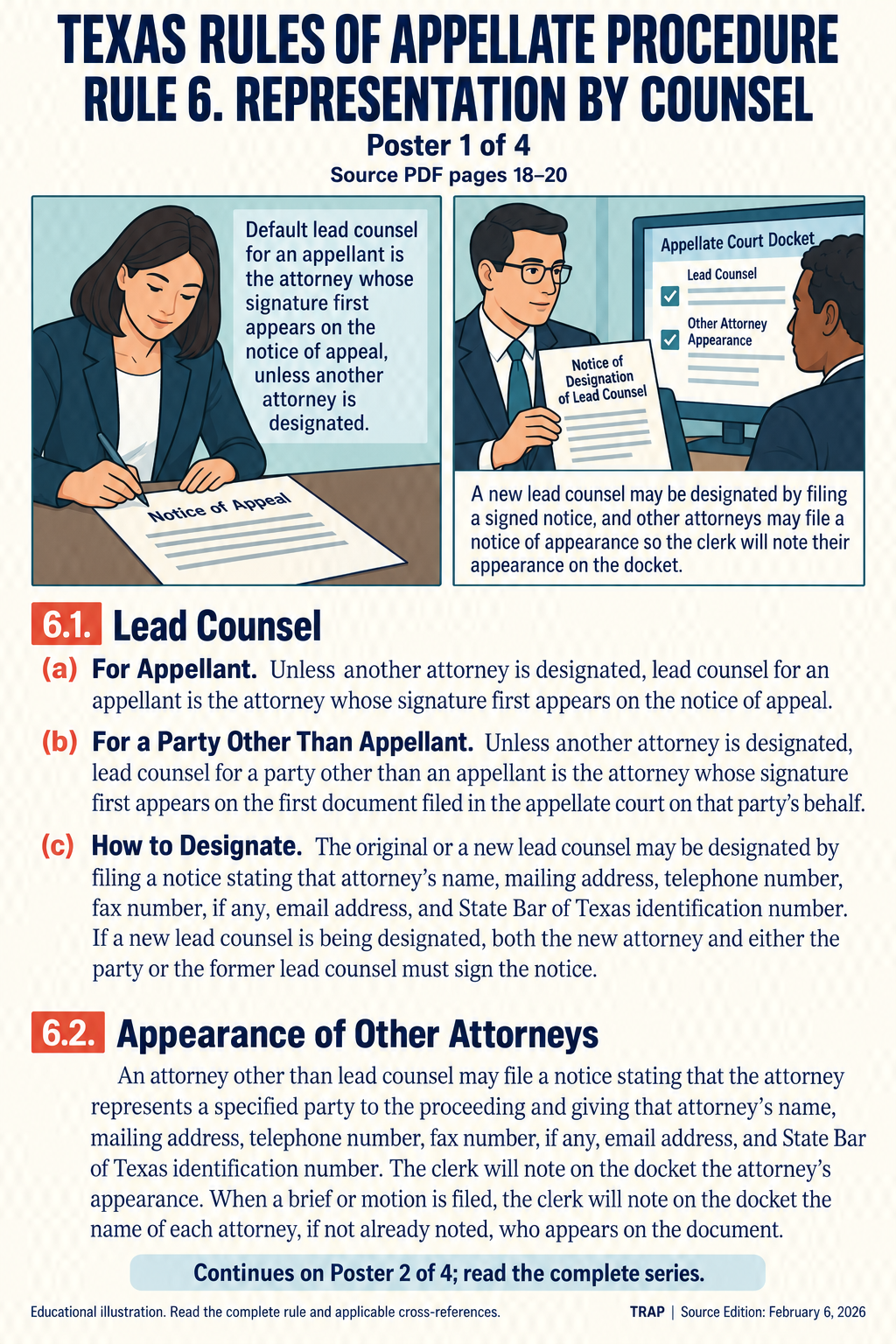
Read assigned text for Rule 6 poster 1
Assigned rule text
6.1. Lead Counsel
(a) For Appellant. Unless another attorney is designated, lead counsel for an appellant is the attorney whose signature first appears on the notice of appeal.
(b) For a Party Other Than Appellant. Unless another attorney is designated, lead counsel for a party other than an appellant is the attorney whose signature first appears on the first document filed in the appellate court on that party's behalf.
(c) How to Designate. The original or a new lead counsel may be designated by filing a notice stating that attorney's name, mailing address, telephone number, fax number, if any, email address, and State Bar of Texas identification number. If a new lead counsel is being designated, both the new attorney and either the party or the former lead counsel must sign the notice.
6.2. Appearance of Other Attorneys An attorney other than lead counsel may file a notice stating that the attorney represents a specified party to the proceeding and giving that attorney's name, mailing address, telephone number, fax number, if any, email address, and State Bar of Texas identification number. The clerk will note on the docket the attorney's appearance. When a brief or motion is filed, the clerk will note on the docket the name of each attorney, if not already noted, who appears on the document.
Continues on Poster 2 of 4; read the complete series.
Send court communications to the right peoplePoster 2 of 4
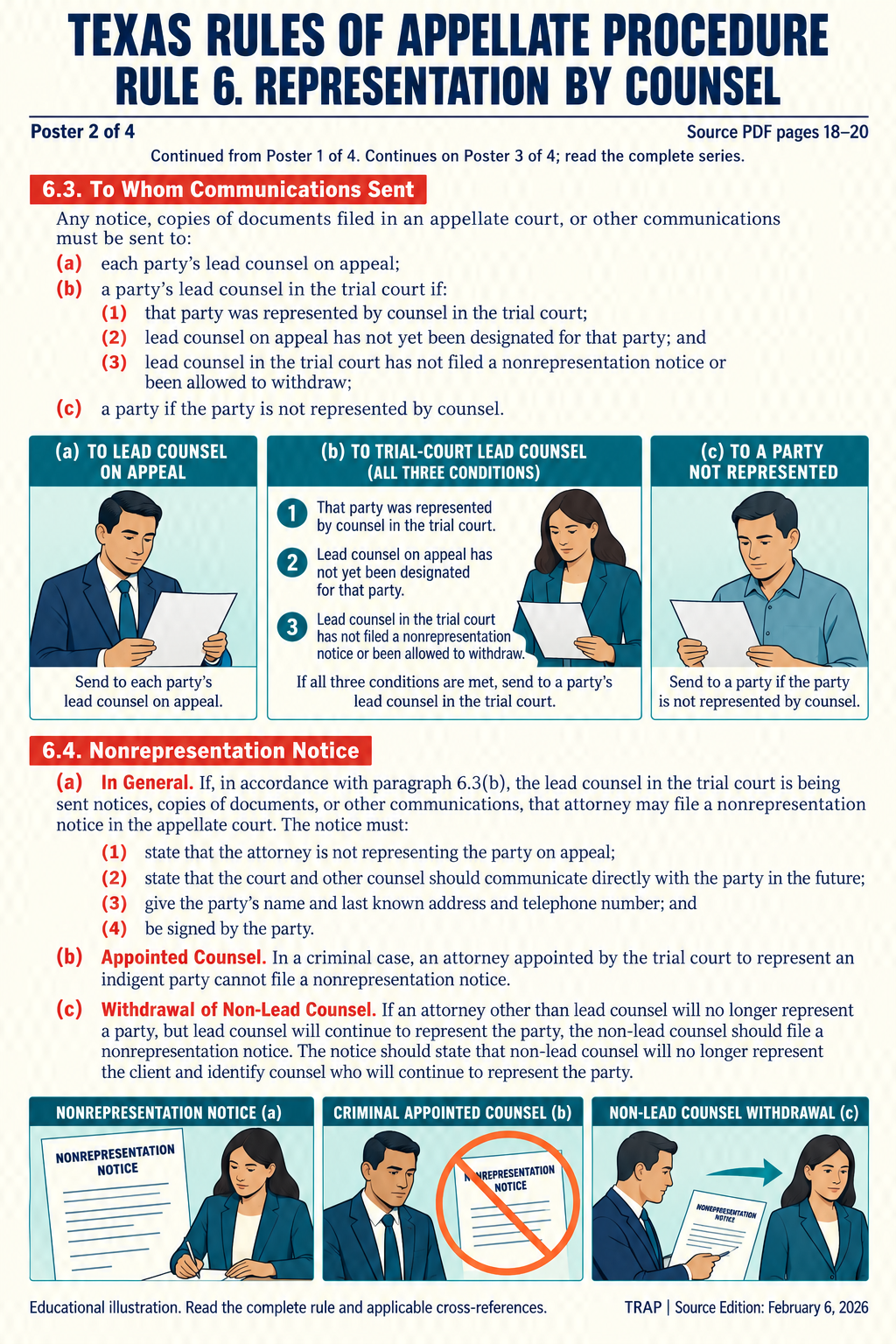
Read assigned text for Rule 6 poster 2
Assigned rule text
6.3. To Whom Communications Sent Any notice, copies of documents filed in an appellate court, or other communications must be sent to:
(a) each party’s lead counsel on appeal;
(b) a party’s lead counsel in the trial court if:
(1) that party was represented by counsel in the trial court;
(2) lead counsel on appeal has not yet been designated for that party; and
(3) lead counsel in the trial court has not filed a nonrepresentation notice or been allowed to withdraw;
(c) a party if the party is not represented by counsel.
6.4. Nonrepresentation Notice
(a) In General. If, in accordance with paragraph 6.3(b), the lead counsel in the trial court is being sent notices, copies of documents, or other communications, that attorney may file a nonrepresentation notice in the appellate court. The notice must:
(1) state that the attorney is not representing the party on appeal;
(2) state that the court and other counsel should communicate directly with the party in the future;
(3) give the party’s name and last known address and telephone number; and
(4) be signed by the party.
(b) Appointed Counsel. In a criminal case, an attorney appointed by the trial court to represent an indigent party cannot file a nonrepresentation notice.
(c) Withdrawal of Non-Lead Counsel. If an attorney other than lead counsel will no longer represent a party, but lead counsel will continue to represent the party, the non-lead counsel should file a nonrepresentation notice. The notice should state that non-lead counsel will no longer represent the client and identify counsel who will continue to represent the party.
Continued from Poster 1 of 4. Continues on Poster 3 of 4; read the complete series.
Read the requirements for counsel to withdrawPoster 3 of 4
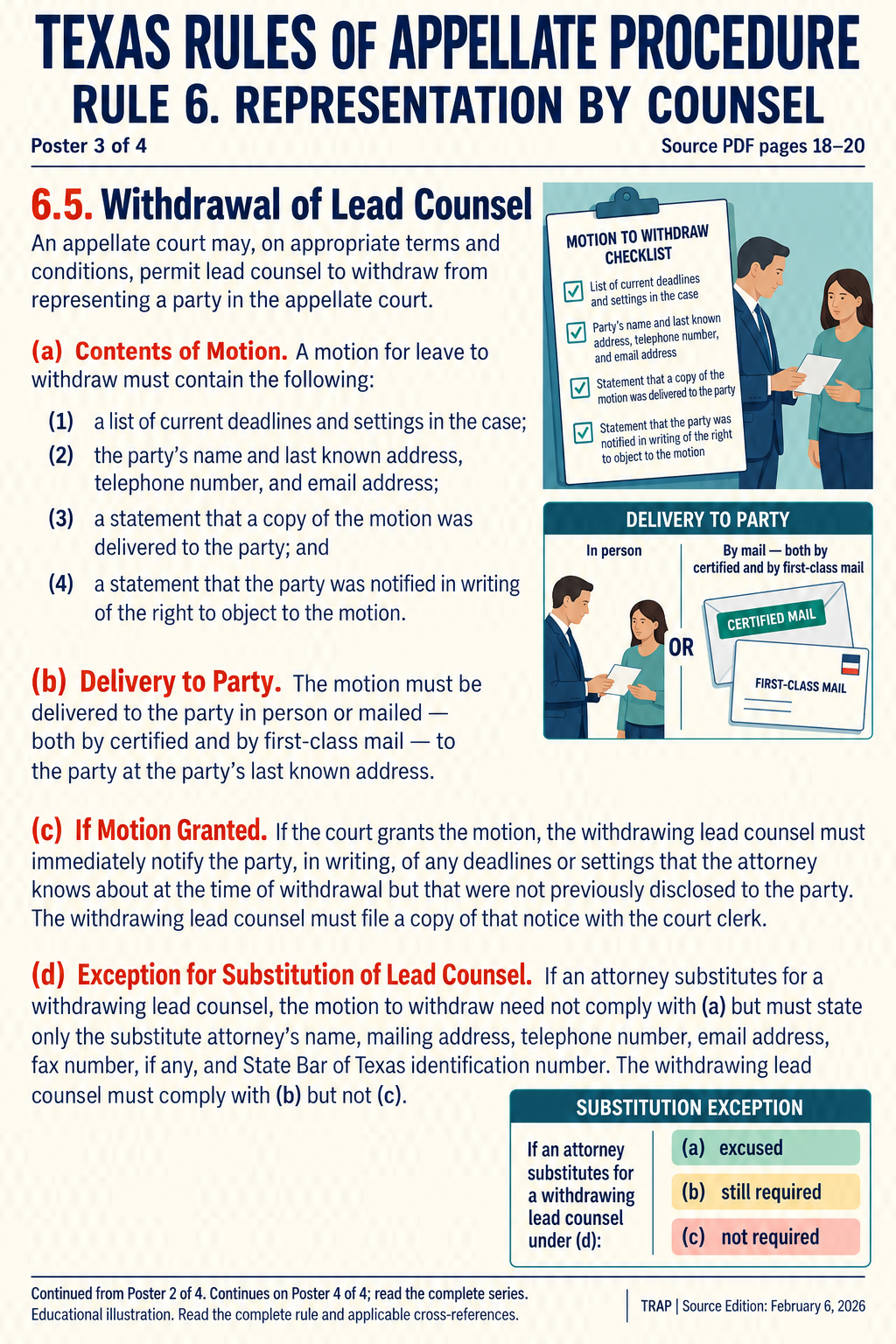
Read assigned text for Rule 6 poster 3
Assigned rule text
6.5. Withdrawal of Lead Counsel An appellate court may, on appropriate terms and conditions, permit lead counsel to withdraw from representing a party in the appellate court.
(a) Contents of Motion. A motion for leave to withdraw must contain the following:
(1) a list of current deadlines and settings in the case;
(2) the party’s name and last known address, telephone number, and email address;
(3) a statement that a copy of the motion was delivered to the party; and
(4) a statement that the party was notified in writing of the right to object to the motion.
(b) Delivery to Party. The motion must be delivered to the party in person or mailed — both by certified and by first-class mail — to the party at the party’s last known address.
(c) If Motion Granted. If the court grants the motion, the withdrawing lead counsel must immediately notify the party, in writing, of any deadlines or settings that the attorney knows about at the time of withdrawal but that were not previously disclosed to the party. The withdrawing lead counsel must file a copy of that notice with the court clerk.
(d) Exception for Substitution of Lead Counsel. If an attorney substitutes for a withdrawing lead counsel, the motion to withdraw need not comply with (a) but must state only the substitute attorney’s name, mailing address, telephone number, email address, fax number, if any, and State Bar of Texas identification number. The withdrawing lead counsel must comply with (b) but not (c).
Continued from Poster 2 of 4. Continues on Poster 4 of 4; read the complete series.
Put an agreement in writingPoster 4 of 4
Read assigned text for Rule 6 poster 4
Assigned rule text
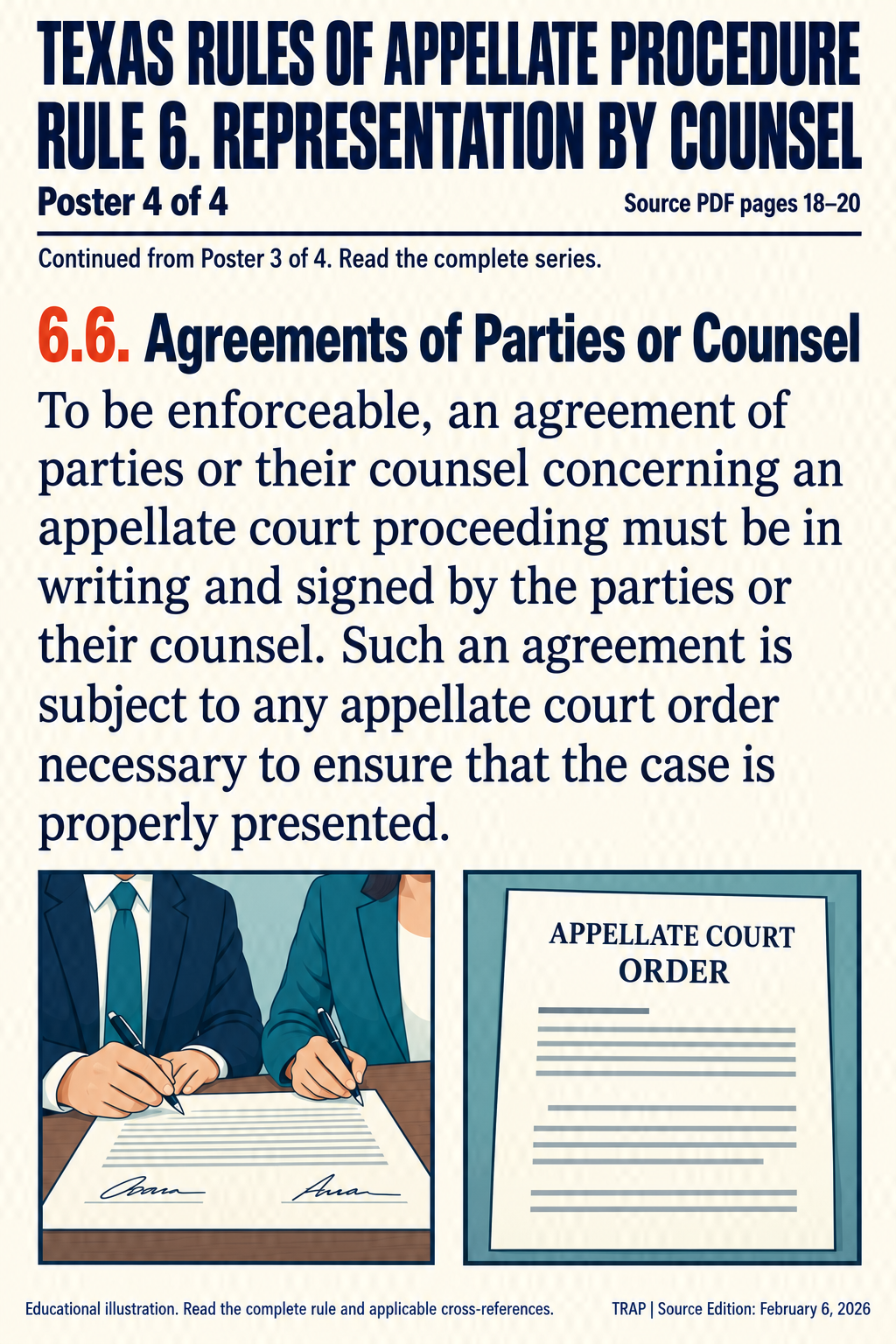
6.6. Agreements of Parties or Counsel To be enforceable, an agreement of parties or their counsel concerning an appellate court proceeding must be in writing and signed by the parties or their counsel. Such an agreement is subject to any appellate court order necessary to ensure that the case is properly presented.
Continued from Poster 3 of 4. Read the complete series.
Rule 7. Substituting Parties
Check what changes when a party diesPoster 1 of 2
Read assigned text for Rule 7 poster 1
Assigned rule text
7.1. Parties Who Are Not Public Officers
(a) Death of a Party.
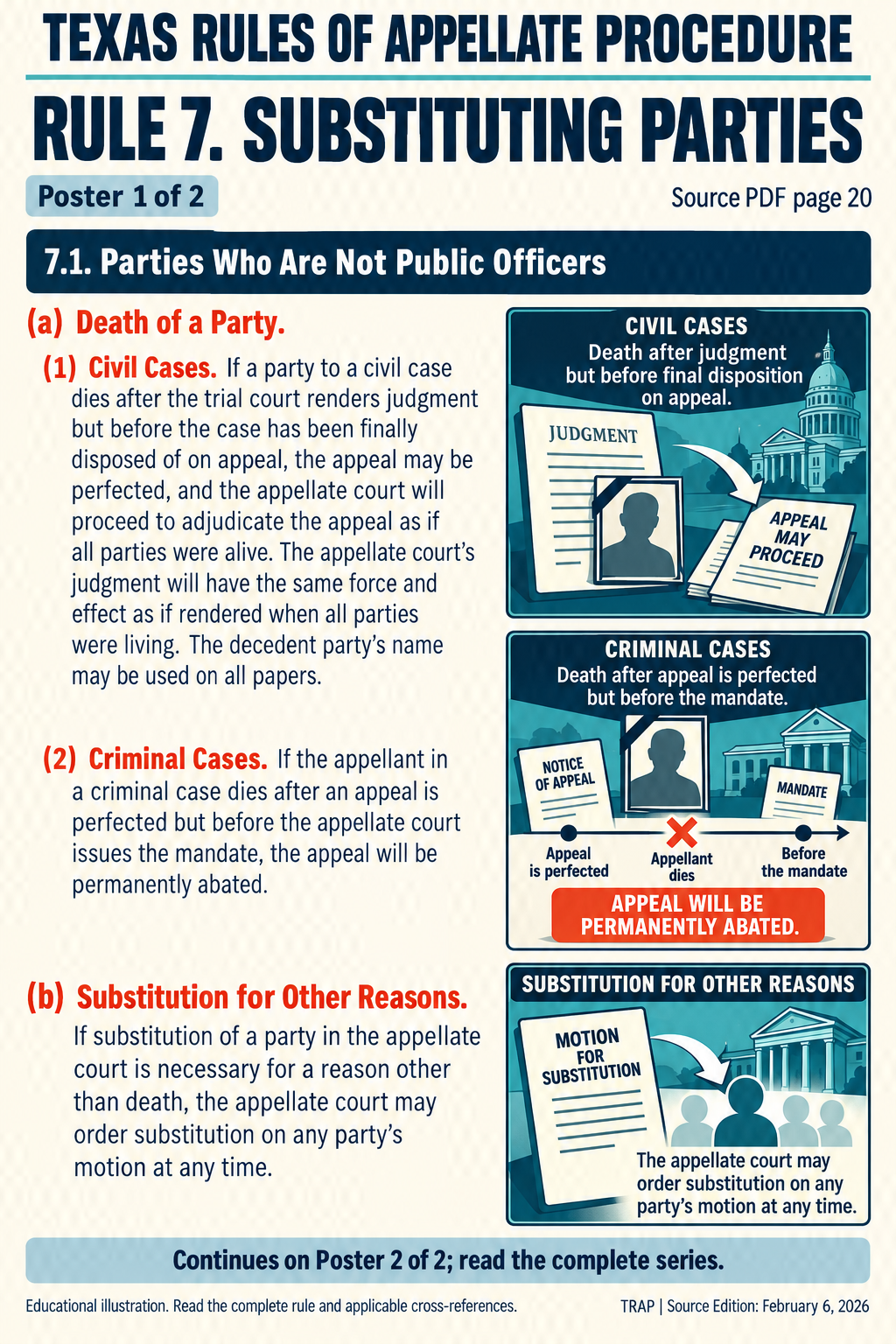
(1) Civil Cases. If a party to a civil case dies after the trial court renders judgment but before the case has been finally disposed of on appeal, the appeal may be perfected, and the appellate court will proceed to adjudicate the appeal as if all parties were alive. The appellate court's judgment will have the same force and effect as if rendered when all parties were living. The decedent party's name may be used on all papers.
(2) Criminal Cases. If the appellant in a criminal case dies after an appeal is perfected but before the appellate court issues the mandate, the appeal will be permanently abated.
(b) Substitution for Other Reasons. If substitution of a party in the appellate court is necessary for a reason other than death, the appellate court may order substitution on any party's motion at any time.
Continues on Poster 2 of 2; read the complete series.
Identify a public officer’s successorPoster 2 of 2
Read assigned text for Rule 7 poster 2
Assigned rule text
7.2. Public Officers
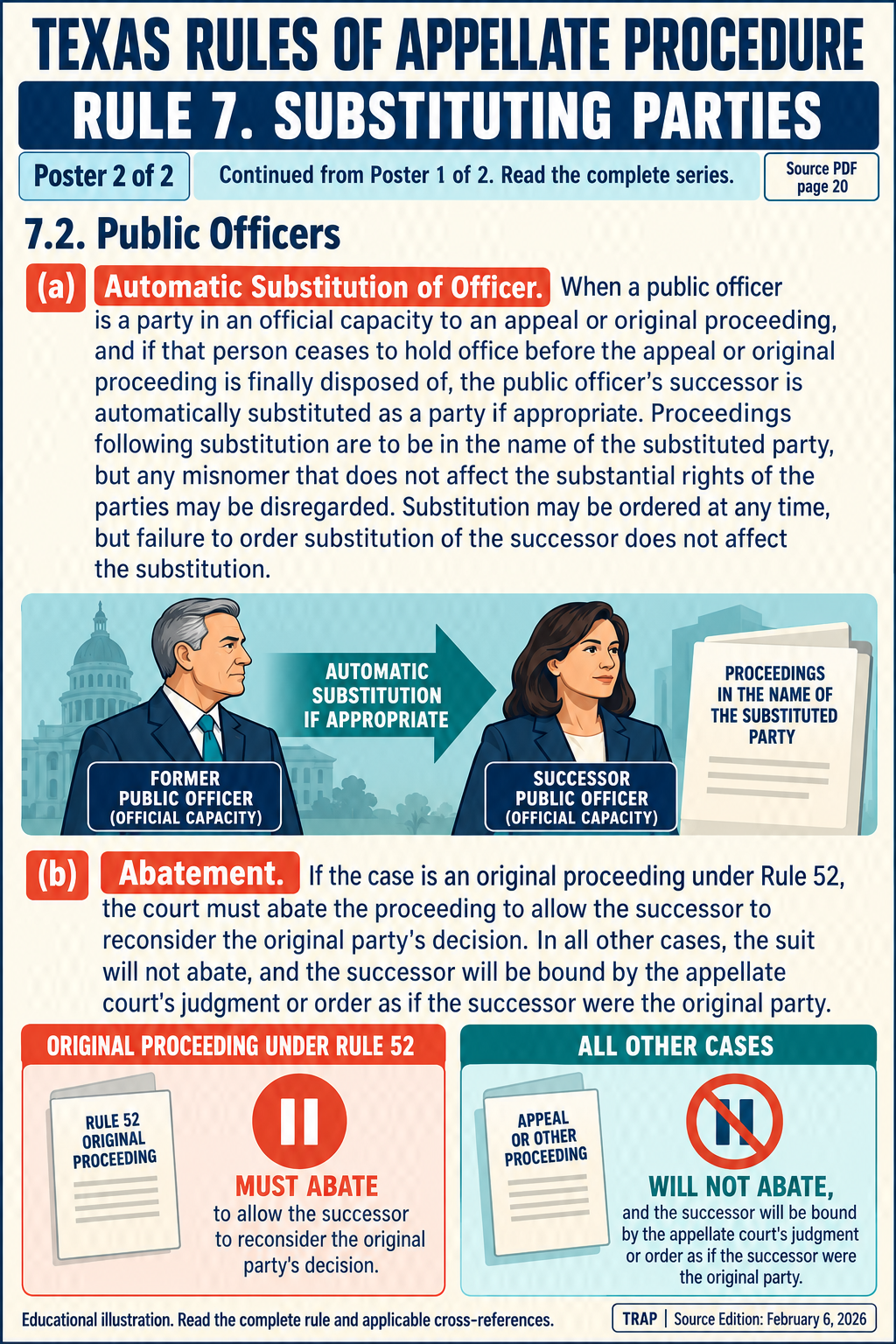
(a) Automatic Substitution of Officer. When a public officer is a party in an official capacity to an appeal or original proceeding, and if that person ceases to hold office before the appeal or original proceeding is finally disposed of, the public officer’s successor is automatically substituted as a party if appropriate. Proceedings following substitution are to be in the name of the substituted party, but any misnomer that does not affect the substantial rights of the parties may be disregarded. Substitution may be ordered at any time, but failure to order substitution of the successor does not affect the substitution.
(b) Abatement. If the case is an original proceeding under Rule 52, the court must abate the proceeding to allow the successor to reconsider the original party's decision. In all other cases, the suit will not abate, and the successor will be bound by the appellate court's judgment or order as if the successor were the original party.
Continued from Poster 1 of 2. Read the complete series.
Rule 8. Bankruptcy In Civil Cases
Notify the court of bankruptcyPoster 1 of 2
Read assigned text for Rule 8 poster 1
Assigned rule text
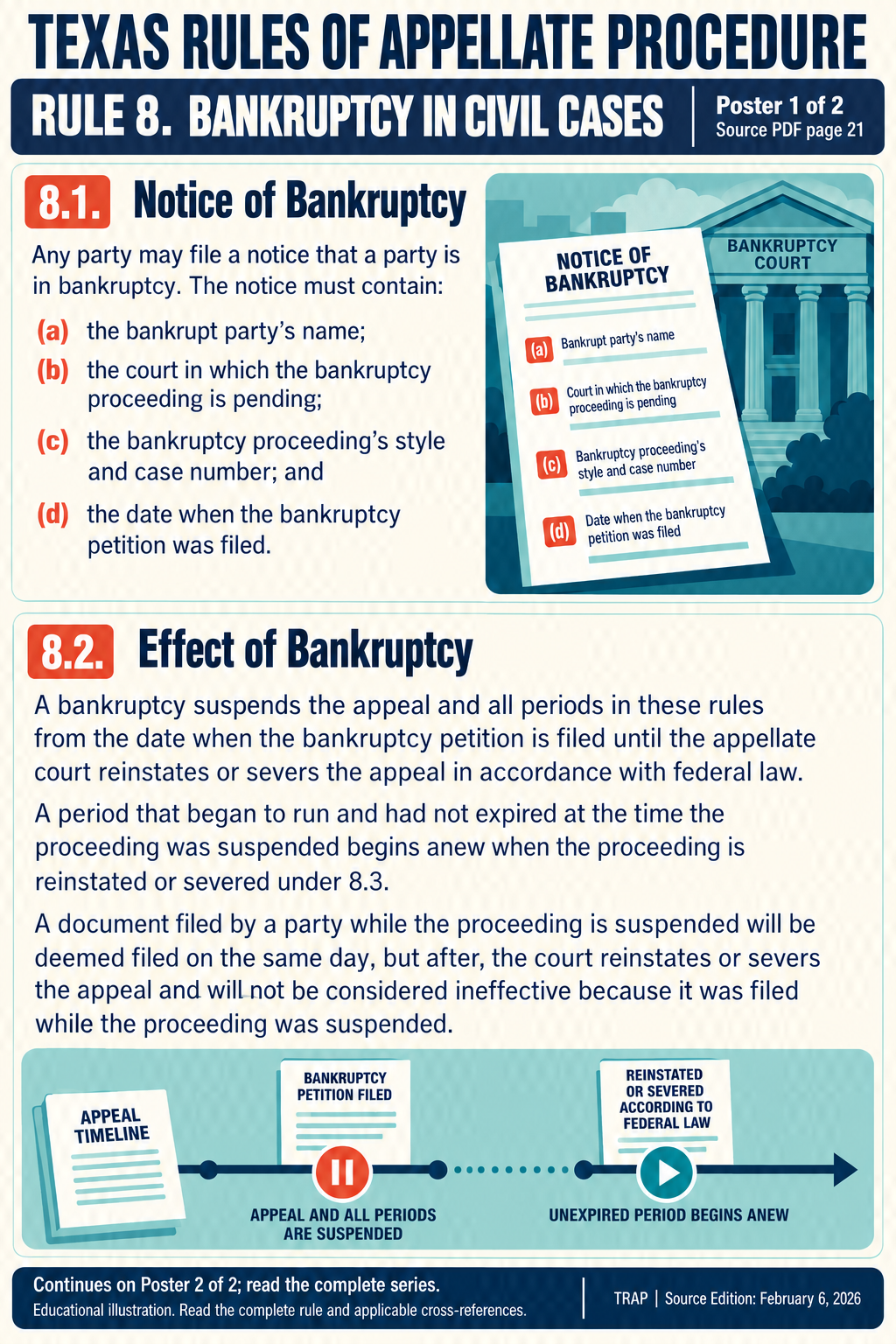
8.1. Notice of Bankruptcy Any party may file a notice that a party is in bankruptcy. The notice must contain:
(a) the bankrupt party’s name;
(b) the court in which the bankruptcy proceeding is pending;
(c) the bankruptcy proceeding’s style and case number; and
(d) the date when the bankruptcy petition was filed.
8.2. Effect of Bankruptcy A bankruptcy suspends the appeal and all periods in these rules from the date when the bankruptcy petition is filed until the appellate court reinstates or severs the appeal in accordance with federal law. A period that began to run and had not expired at the time the proceeding was suspended begins anew when the proceeding is reinstated or severed under 8.3. A document filed by a party while the proceeding is suspended will be deemed filed on the same day, but after, the court reinstates or severs the appeal and will not be considered ineffective because it was filed while the proceeding was suspended.
Continues on Poster 2 of 2; read the complete series.
Request reinstatement or severance after bankruptcyPoster 2 of 2
Read assigned text for Rule 8 poster 2
Assigned rule text
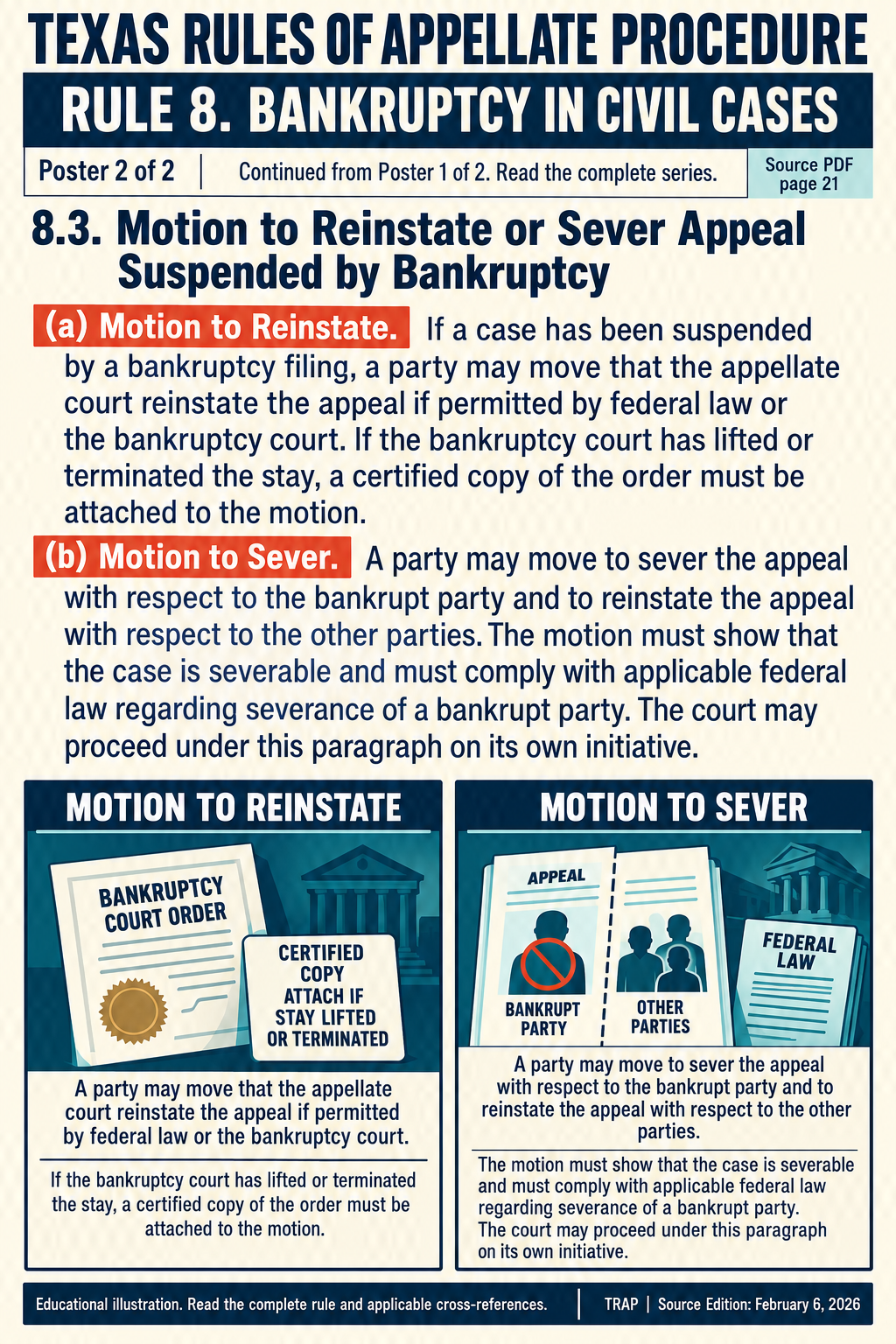
8.3. Motion to Reinstate or Sever Appeal Suspended by Bankruptcy
(a) Motion to Reinstate. If a case has been suspended by a bankruptcy filing, a party may move that the appellate court reinstate the appeal if permitted by federal law or the bankruptcy court. If the bankruptcy court has lifted or terminated the stay, a certified copy of the order must be attached to the motion.
(b) Motion to Sever. A party may move to sever the appeal with respect to the bankrupt party and to reinstate the appeal with respect to the other parties. The motion must show that the case is severable and must comply with applicable federal law regarding severance of a bankrupt party. The court may proceed under this paragraph on its own initiative.
Continued from Poster 1 of 2. Read the complete series.
Rule 9. Documents Generally
Rule 9. Documents Generally — poster 1Poster 1 of 16
Read assigned text for Rule 9 poster 1
Assigned rule text
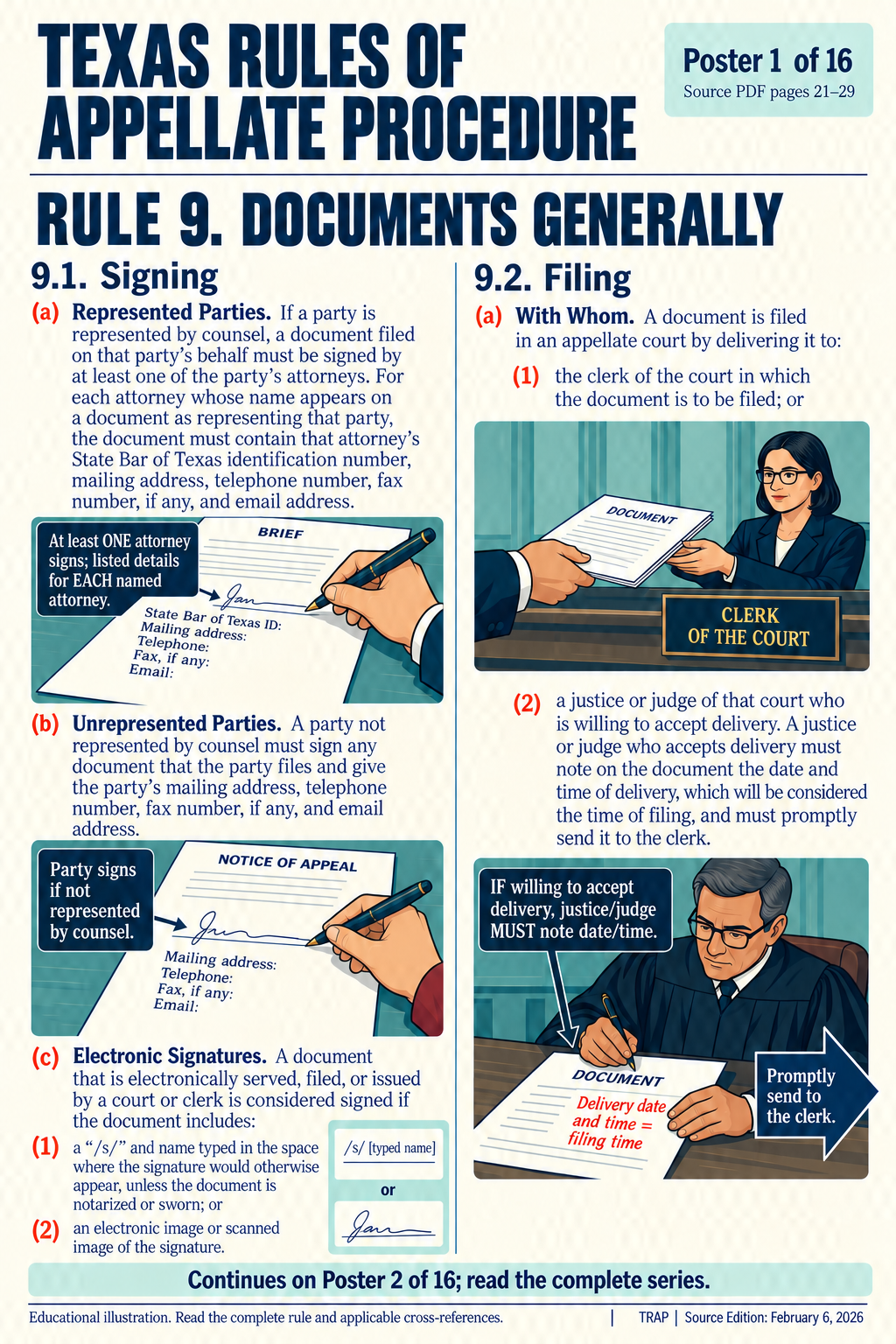
9.1. Signing
(a) Represented Parties. If a party is represented by counsel, a document filed on that party's behalf must be signed by at least one of the party's attorneys. For each attorney whose name appears on a document as representing that party, the document must contain that attorney's State Bar of Texas identification number, mailing address, telephone number, fax number, if any, and email address.
(b) Unrepresented Parties. A party not represented by counsel must sign any document that the party files and give the party’s mailing address, telephone number, fax number, if any, and email address.
(c) Electronic Signatures. A document that is electronically served, filed, or issued by a court or clerk is considered signed if the document includes:
(1) a “/s/” and name typed in the space where the signature would otherwise appear, unless the document is notarized or sworn; or
(2) an electronic image or scanned image of the signature.
9.2. Filing
(a) With Whom. A document is filed in an appellate court by delivering it to:
(1) the clerk of the court in which the document is to be filed; or
(2) a justice or judge of that court who is willing to accept delivery. A justice or judge who accepts delivery must note on the document the date and time of delivery, which will be considered the time of filing, and must promptly send it to the clerk.
Continues on Poster 2 of 16; read the complete series.
Check mailing and electronic-filing requirementsPoster 2 of 16
Read assigned text for Rule 9 poster 2
Assigned rule text
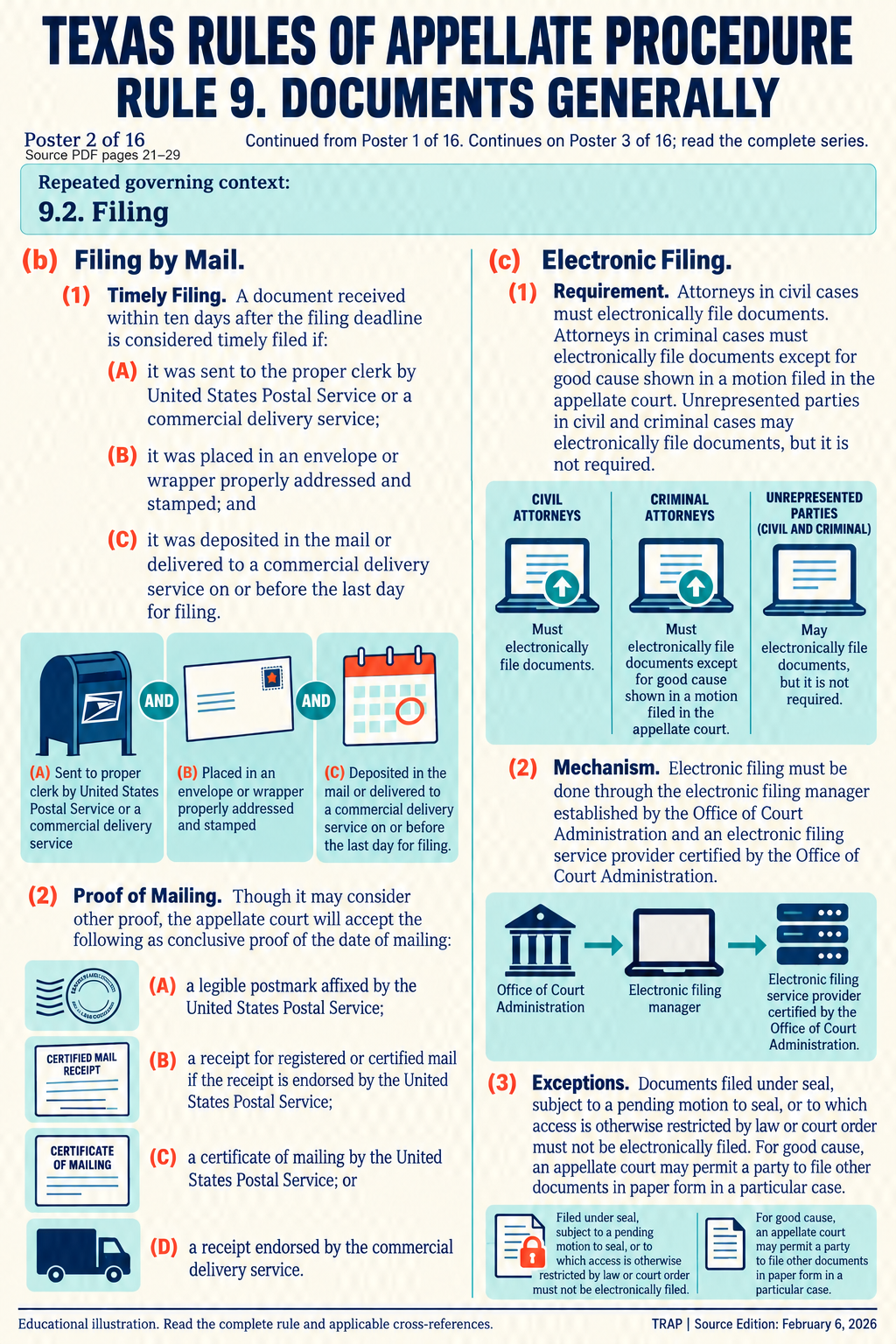
(b) Filing by Mail.
(1) Timely Filing. A document received within ten days after the filing deadline is considered timely filed if:
(A) it was sent to the proper clerk by United States Postal Service or a commercial delivery service;
(B) it was placed in an envelope or wrapper properly addressed and stamped; and
(C) it was deposited in the mail or delivered to a commercial delivery service on or before the last day for filing.
(2) Proof of Mailing. Though it may consider other proof, the appellate court will accept the following as conclusive proof of the date of mailing:
(A) a legible postmark affixed by the United States Postal Service;
(B) a receipt for registered or certified mail if the receipt is endorsed by the United States Postal Service;
(C) a certificate of mailing by the United States Postal Service; or
(D) a receipt endorsed by the commercial delivery service.
(c) Electronic Filing.
(1) Requirement. Attorneys in civil cases must electronically file documents. Attorneys in criminal cases must electronically file documents except for good cause shown in a motion filed in the appellate court. Unrepresented parties in civil and criminal cases may electronically file documents, but it is not required.
(2) Mechanism. Electronic filing must be done through the electronic filing manager established by the Office of Court Administration and an electronic filing service provider certified by the Office of Court Administration.
(3) Exceptions. Documents filed under seal, subject to a pending motion to seal, or to which access is otherwise restricted by law or court order must not be electronically filed. For good cause, an appellate court may permit a party to file other documents in paper form in a particular case.
Repeated governing context
9.2. Filing
Continued from Poster 1 of 16. Continues on Poster 3 of 16; read the complete series.
Check when an electronic filing is timelyPoster 3 of 16
Read assigned text for Rule 9 poster 3
Assigned rule text
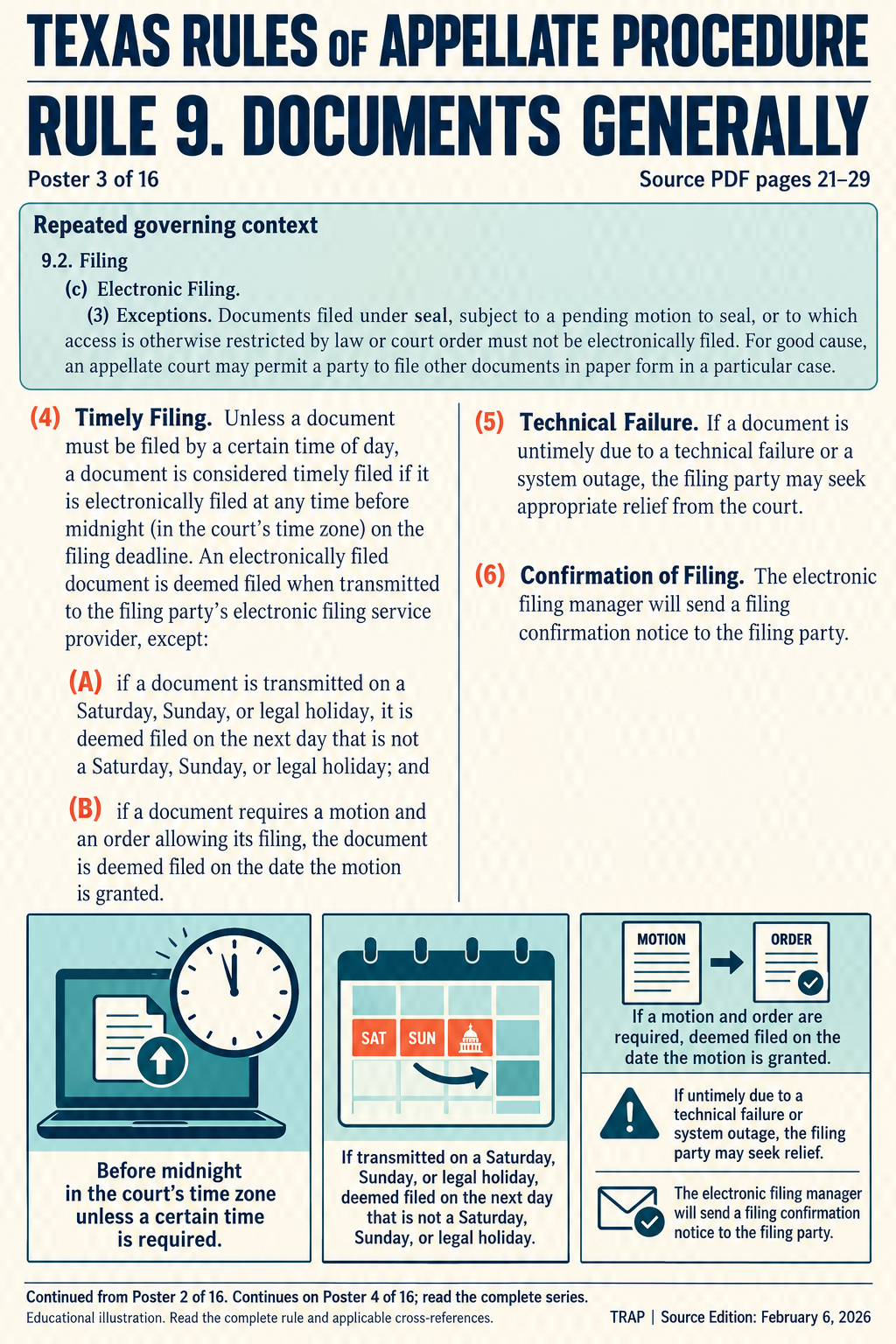
(4) Timely Filing. Unless a document must be filed by a certain time of day, a document is considered timely filed if it is electronically filed at any time before midnight (in the court’s time zone) on the filing deadline. An electronically filed document is deemed filed when transmitted to the filing party’s electronic filing service provider, except:
(A) if a document is transmitted on a Saturday, Sunday, or legal holiday, it is deemed filed on the next day that is not a Saturday, Sunday, or legal holiday; and
(B) if a document requires a motion and an order allowing its filing, the document is deemed filed on the date the motion is granted.
(5) Technical Failure. If a document is untimely due to a technical failure or a system outage, the filing party may seek appropriate relief from the court.
(6) Confirmation of Filing. The electronic filing manager will send a filing confirmation notice to the filing party.
Repeated governing context
9.2. Filing
(c) Electronic Filing.
(3) Exceptions. Documents filed under seal, subject to a pending motion to seal, or to which access is otherwise restricted by law or court order must not be electronically filed. For good cause, an appellate court may permit a party to file other documents in paper form in a particular case.
Continued from Poster 2 of 16. Continues on Poster 4 of 16; read the complete series.
Receive electronic court documents and prepare copiesPoster 4 of 16
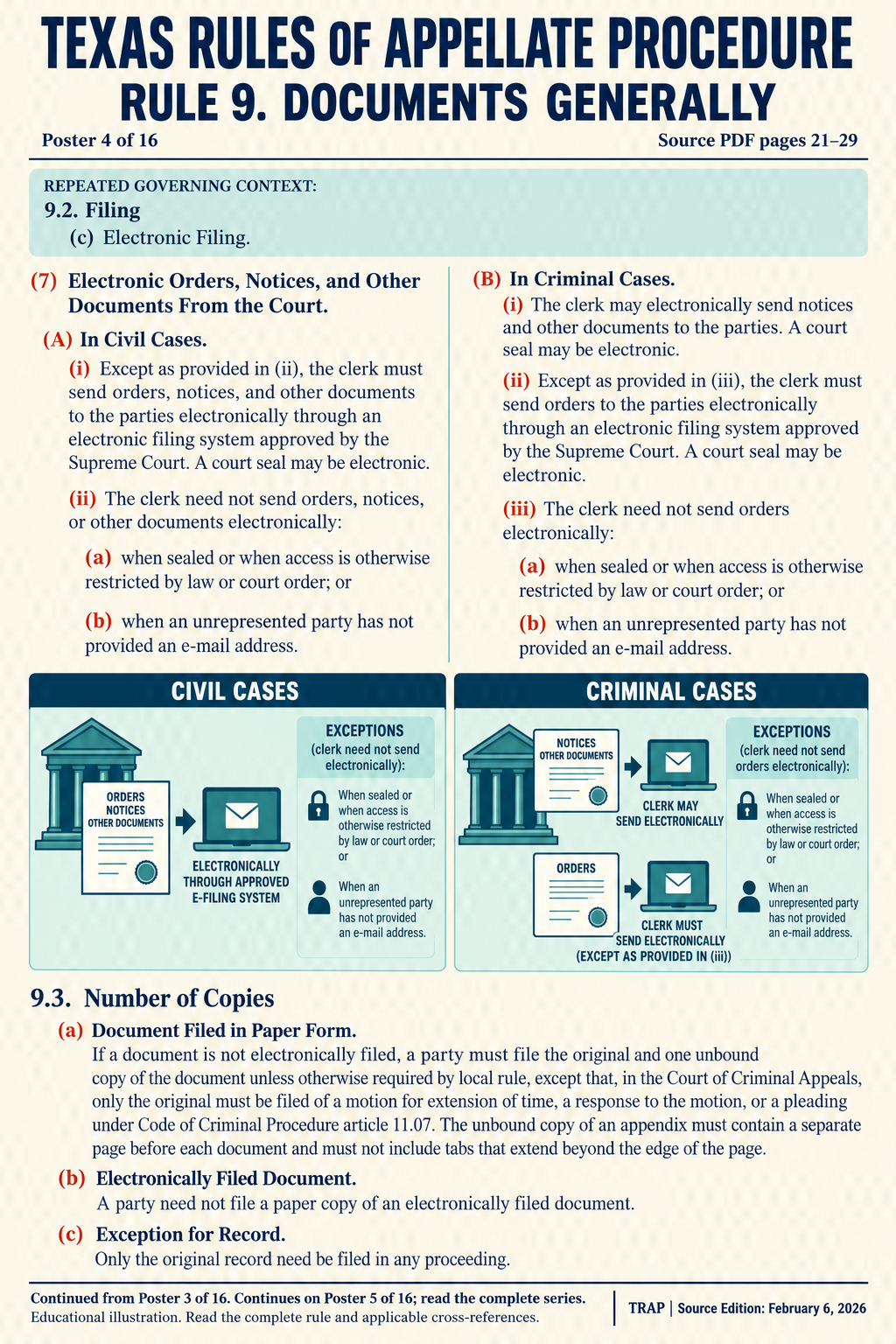
Read assigned text for Rule 9 poster 4
Assigned rule text
(7) Electronic Orders, Notices, and Other Documents From the Court.
(A) In Civil Cases.
(i) Except as provided in (ii), the clerk must send orders, notices, and other documents to the parties electronically through an electronic filing system approved by the Supreme Court. A court seal may be electronic. (ii) The clerk need not send orders, notices, or other documents electronically:
(a) when sealed or when access is otherwise restricted by law or court order; or
(b) when an unrepresented party has not provided an e-mail address.
(B) In Criminal Cases.
(i) The clerk may electronically send notices and other documents to the parties. A court seal may be electronic. (ii) Except as provided in (iii), the clerk must send orders to the parties electronically through an electronic filing system approved by the Supreme Court. A court seal may be electronic. (iii) The clerk need not send orders electronically:
(a) when sealed or when access is otherwise restricted by law or court order; or
(b) when an unrepresented party has not provided an e-mail address.
9.3. Number of Copies
(a) Document Filed in Paper Form. If a document is not electronically filed, a party must file the original and one unbound copy of the document unless otherwise required by local rule, except that, in the Court of Criminal Appeals, only the original must be filed of a motion for extension of time, a response to the motion, or a pleading under Code of Criminal Procedure article 11.07. The unbound copy of an appendix must contain a separate page before each document and must not include tabs that extend beyond the edge of the page.
(b) Electronically Filed Document. A party need not file a paper copy of an electronically filed document.
(c) Exception for Record. Only the original record need be filed in any proceeding.
Repeated governing context
9.2. Filing
(c) Electronic Filing.
Continued from Poster 3 of 16. Continues on Poster 5 of 16; read the complete series.
Format the document for filingPoster 5 of 16
Read assigned text for Rule 9 poster 5
Assigned rule text
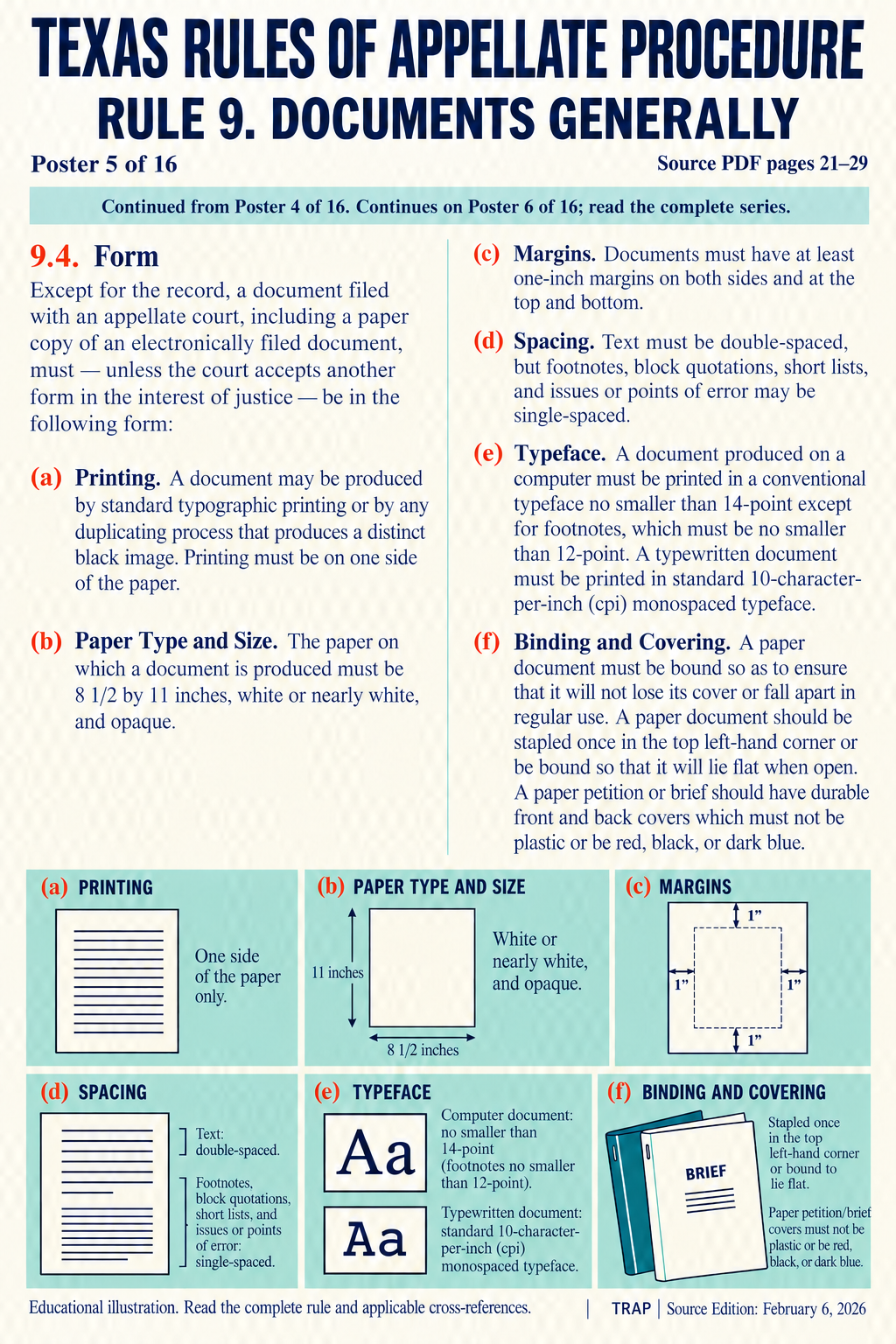
9.4. Form Except for the record, a document filed with an appellate court, including a paper copy of an electronically filed document, must — unless the court accepts another form in the interest of justice — be in the following form:
(a) Printing. A document may be produced by standard typographic printing or by any duplicating process that produces a distinct black image. Printing must be on one side of the paper.
(b) Paper Type and Size. The paper on which a document is produced must be 8 1/2 by 11 inches, white or nearly white, and opaque.
(c) Margins. Documents must have at least one-inch margins on both sides and at the top and bottom.
(d) Spacing. Text must be double-spaced, but footnotes, block quotations, short lists, and issues or points of error may be single-spaced.
(e) Typeface. A document produced on a computer must be printed in a conventional typeface no smaller than 14-point except for footnotes, which must be no smaller than 12-point. A typewritten document must be printed in standard 10-character-per-inch (cpi) monospaced typeface.
(f) Binding and Covering. A paper document must be bound so as to ensure that it will not lose its cover or fall apart in regular use. A paper document should be stapled once in the top left-hand corner or be bound so that it will lie flat when open. A paper petition or brief should have durable front and back covers which must not be plastic or be red, black, or dark blue.
Continued from Poster 4 of 16. Continues on Poster 6 of 16; read the complete series.
Prepare the cover and appendixPoster 6 of 16
Read assigned text for Rule 9 poster 6
Assigned rule text
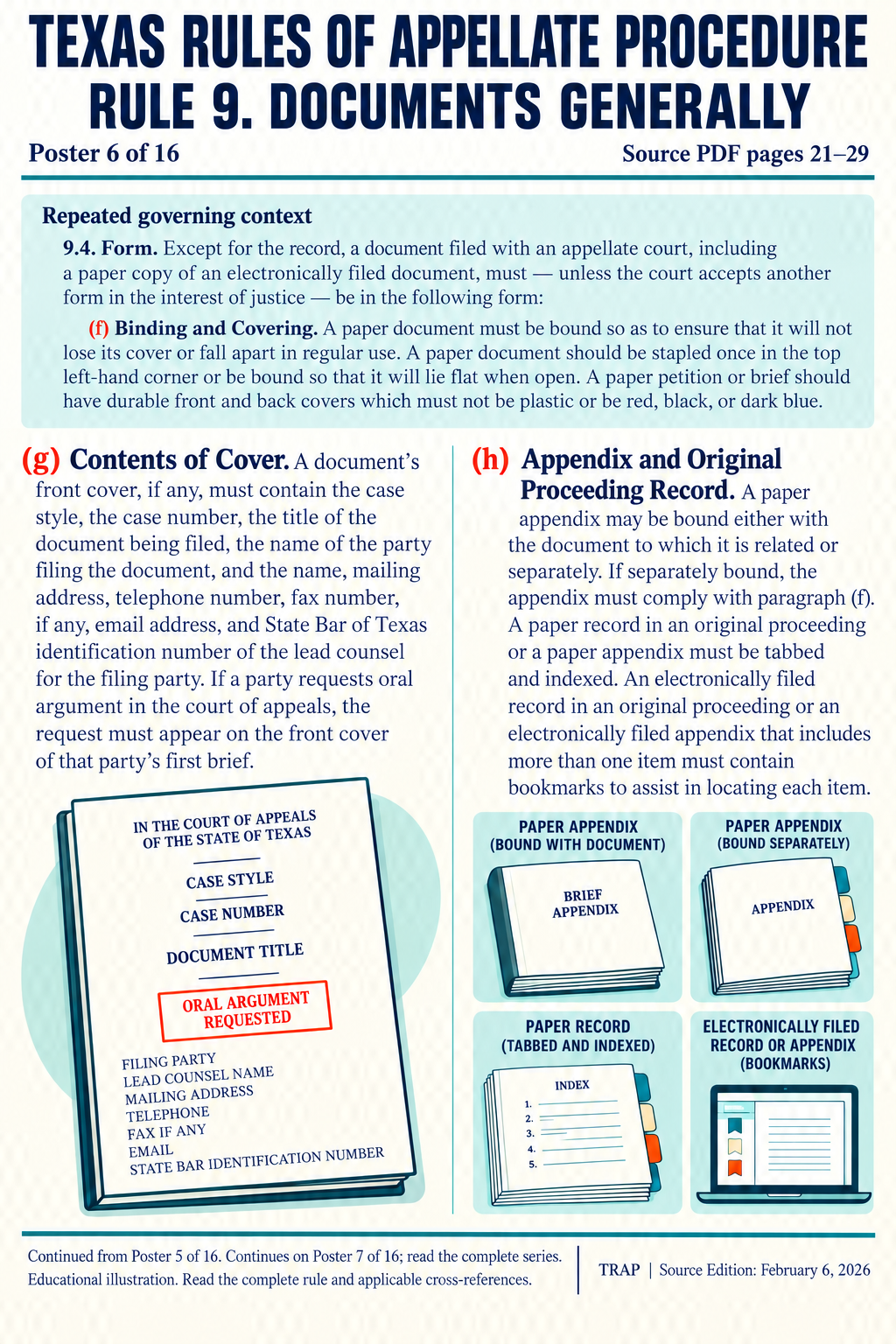
(g) Contents of Cover. A document's front cover, if any, must contain the case style, the case number, the title of the document being filed, the name of the party filing the document, and the name, mailing address, telephone number, fax number, if any, email address, and State Bar of Texas identification number of the lead counsel for the filing party. If a party requests oral argument in the court of appeals, the request must appear on the front cover of that party’s first brief.
(h) Appendix and Original Proceeding Record. A paper appendix may be bound either with the document to which it is related or separately. If separately bound, the appendix must comply with paragraph (f). A paper record in an original proceeding or a paper appendix must be tabbed and indexed. An electronically filed record in an original proceeding or an electronically filed appendix that includes more than one item must contain bookmarks to assist in locating each item.
Repeated governing context
9.4. Form Except for the record, a document filed with an appellate court, including a paper copy of an electronically filed document, must — unless the court accepts another form in the interest of justice — be in the following form:
(f) Binding and Covering. A paper document must be bound so as to ensure that it will not lose its cover or fall apart in regular use. A paper document should be stapled once in the top left-hand corner or be bound so that it will lie flat when open. A paper petition or brief should have durable front and back covers which must not be plastic or be red, black, or dark blue.
Continued from Poster 5 of 16. Continues on Poster 7 of 16; read the complete series.
Check document length and what countsPoster 7 of 16
Read assigned text for Rule 9 poster 7
Assigned rule text
(i) Length.
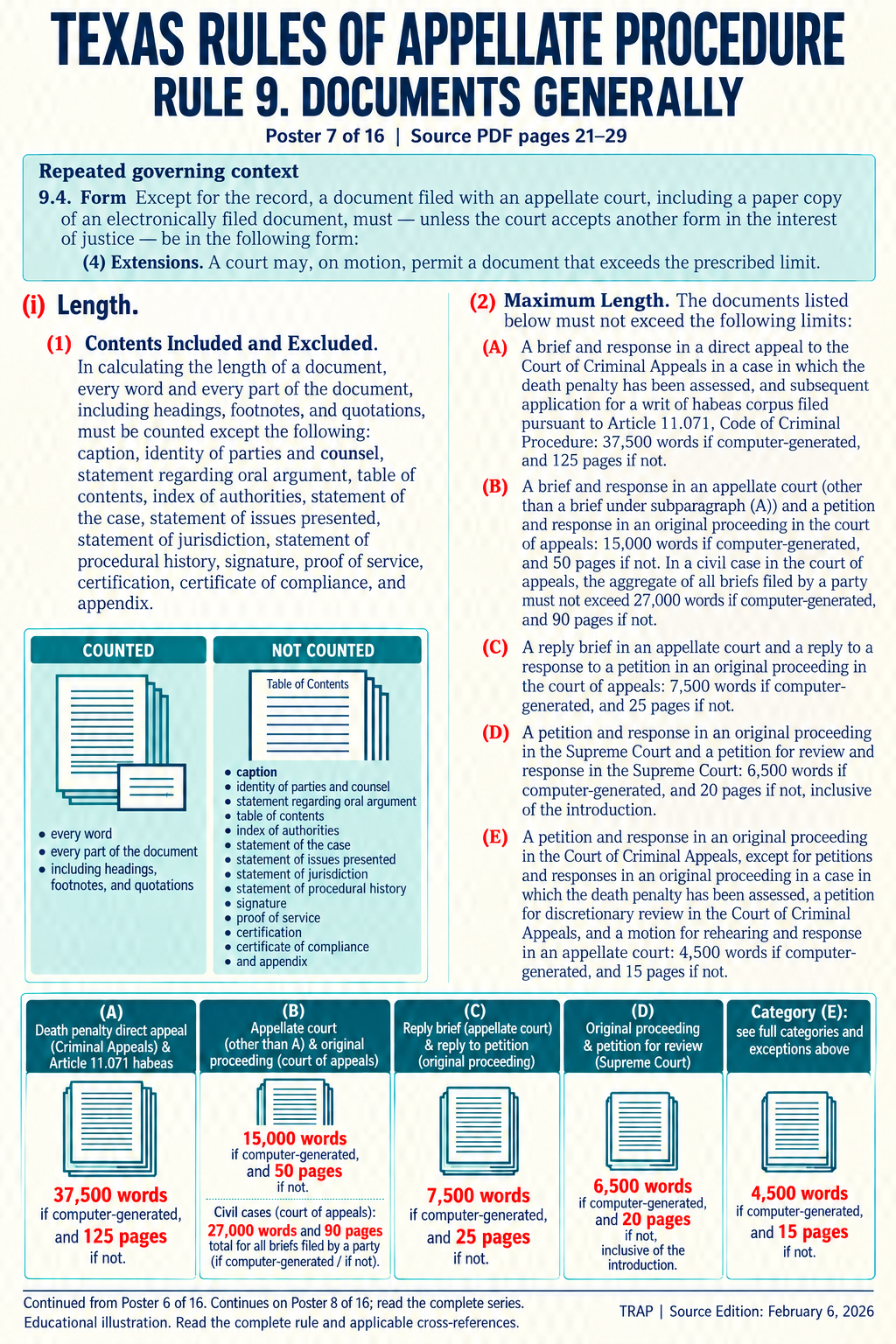
(1) Contents Included and Excluded. In calculating the length of a document, every word and every part of the document, including headings, footnotes, and quotations, must be counted except the following: caption, identity of parties and counsel, statement regarding oral argument, table of contents, index of authorities, statement of the case, statement of issues presented, statement of jurisdiction, statement of procedural history, signature, proof of service, certification, certificate of compliance, and appendix.
(2) Maximum Length. The documents listed below must not exceed the following limits:
(A) A brief and response in a direct appeal to the Court of Criminal Appeals in a case in which the death penalty has been assessed, and subsequent application for a writ of habeas corpus filed pursuant to Article 11.071, Code of Criminal Procedure: 37,500 words if computer-generated, and 125 pages if not.
(B) A brief and response in an appellate court (other than a brief under subparagraph (A)) and a petition and response in an original proceeding in the court of appeals: 15,000 words if computer-generated, and 50 pages if not. In a civil case in the court of appeals, the aggregate of all briefs filed by a party must not exceed 27,000 words if computer-generated, and 90 pages if not.
(C) A reply brief in an appellate court and a reply to a response to a petition in an original proceeding in the court of appeals: 7,500 words if computer-generated, and 25 pages if not.
(D) A petition and response in an original proceeding in the Supreme Court and a petition for review and response in the Supreme Court: 6,500 words if computer-generated, and 20 pages if not, inclusive of the introduction.
(E) A petition and response in an original proceeding in the Court of Criminal Appeals, except for petitions and responses in an original proceeding in a case in which the death penalty has been assessed, a petition for discretionary review in the Court of Criminal Appeals, and a motion for rehearing and response in an appellate court: 4,500 words if computer-generated, and 15 pages if not.
Repeated governing context
9.4. Form Except for the record, a document filed with an appellate court, including a paper copy of an electronically filed document, must — unless the court accepts another form in the interest of justice — be in the following form:
(4) Extensions. A court may, on motion, permit a document that exceeds the prescribed limit.
Continued from Poster 6 of 16. Continues on Poster 8 of 16; read the complete series.
Check remaining length limits and the certificatePoster 8 of 16
Read assigned text for Rule 9 poster 8
Assigned rule text
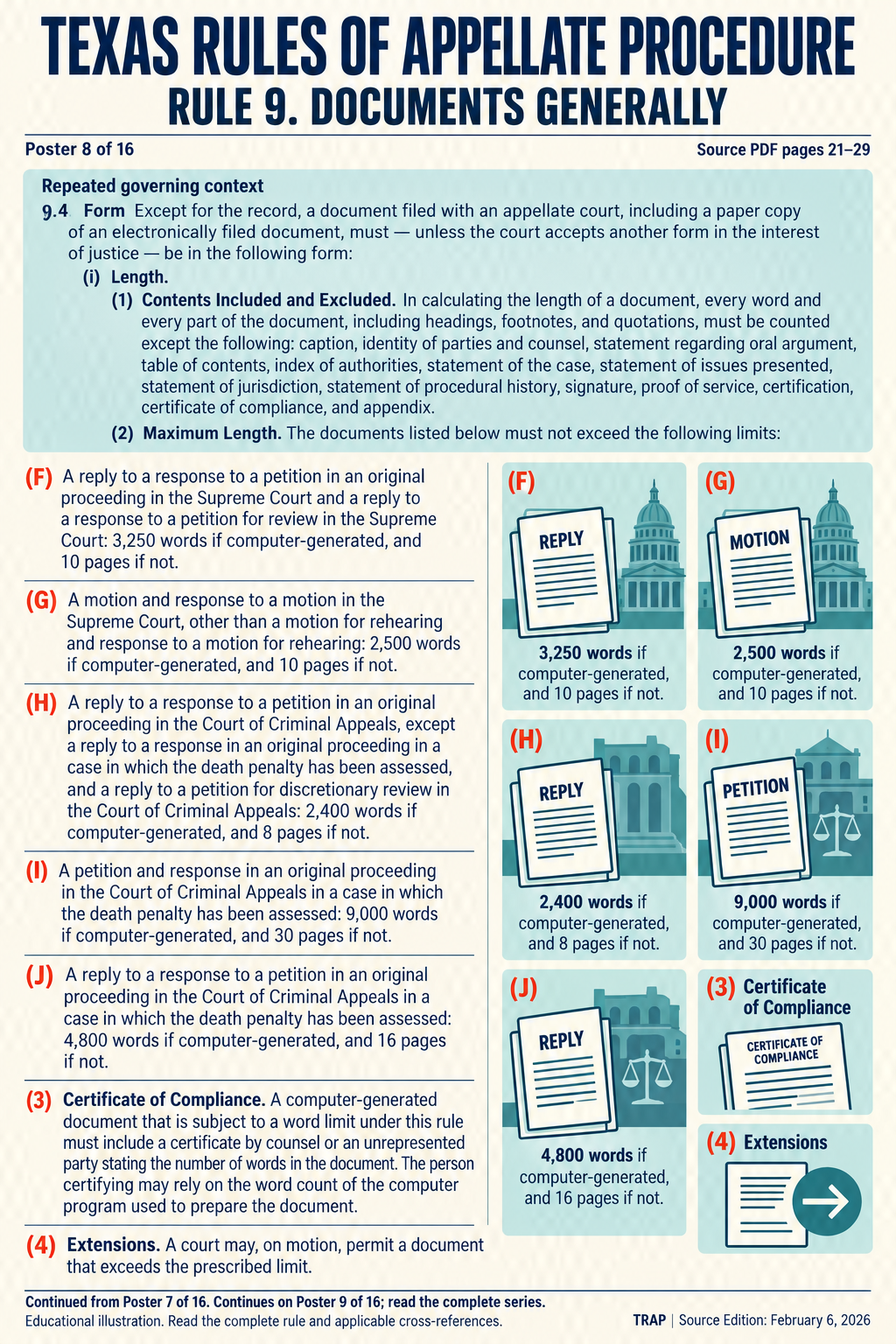
(F) A reply to a response to a petition in an original proceeding in the Supreme Court and a reply to a response to a petition for review in the Supreme Court: 3,250 words if computer-generated, and 10 pages if not.
(G) A motion and response to a motion in the Supreme Court, other than a motion for rehearing and response to a motion for rehearing: 2,500 words if computer-generated, and 10 pages if not.
(H) A reply to a response to a petition in an original proceeding in the Court of Criminal Appeals, except a reply to a response in an original proceeding in a case in which the death penalty has been assessed, and a reply to a petition for discretionary review in the Court of Criminal Appeals: 2,400 words if computer-generated, and 8 pages if not.
(I) A petition and response in an original proceeding in the Court of Criminal Appeals in a case in which the death penalty has been assessed: 9,000 words if computer-generated, and 30 pages if not.
(J) A reply to a response to a petition in an original proceeding in the Court of Criminal Appeals in a case in which the death penalty has been assessed: 4,800 words if computer-generated, and 16 pages if not.
(3) Certificate of Compliance. A computer-generated document that is subject to a word limit under this rule must include a certificate by counsel or an unrepresented party stating the number of words in the document. The person certifying may rely on the word count of the computer program used to prepare the document.
(4) Extensions. A court may, on motion, permit a document that exceeds the prescribed limit.
Repeated governing context
9.4. Form Except for the record, a document filed with an appellate court, including a paper copy of an electronically filed document, must — unless the court accepts another form in the interest of justice — be in the following form:
(i) Length.
(1) Contents Included and Excluded. In calculating the length of a document, every word and every part of the document, including headings, footnotes, and quotations, must be counted except the following: caption, identity of parties and counsel, statement regarding oral argument, table of contents, index of authorities, statement of the case, statement of issues presented, statement of jurisdiction, statement of procedural history, signature, proof of service, certification, certificate of compliance, and appendix.
(2) Maximum Length. The documents listed below must not exceed the following limits:
Continued from Poster 7 of 16. Continues on Poster 9 of 16; read the complete series.
Rule 9. Documents Generally — poster 9Poster 9 of 16
Read assigned text for Rule 9 poster 9
Assigned rule text
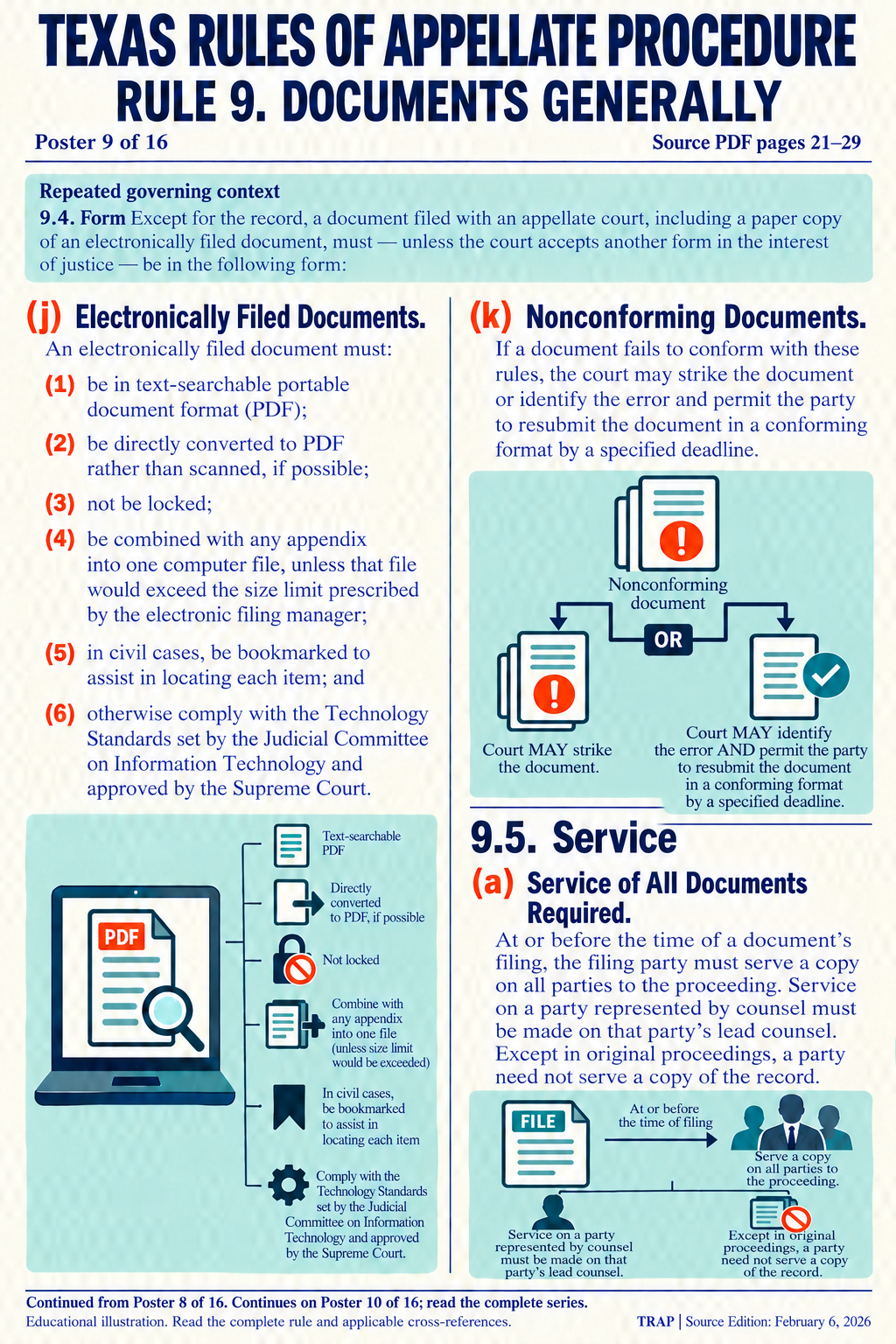
(j) Electronically Filed Documents. An electronically filed document must:
(1) be in text-searchable portable document format (PDF);
(2) be directly converted to PDF rather than scanned, if possible;
(3) not be locked;
(4) be combined with any appendix into one computer file, unless that file would exceed the size limit prescribed by the electronic filing manager;
(5) in civil cases, be bookmarked to assist in locating each item; and
(6) otherwise comply with the Technology Standards set by the Judicial Committee on Information Technology and approved by the Supreme Court.
(k) Nonconforming Documents. If a document fails to conform with these rules, the court may strike the document or identify the error and permit the party to resubmit the document in a conforming format by a specified deadline.
9.5. Service
(a) Service of All Documents Required. At or before the time of a document's filing, the filing party must serve a copy on all parties to the proceeding. Service on a party represented by counsel must be made on that party’s lead counsel. Except in original proceedings, a party need not serve a copy of the record.
Repeated governing context
9.4. Form Except for the record, a document filed with an appellate court, including a paper copy of an electronically filed document, must — unless the court accepts another form in the interest of justice — be in the following form:
Continued from Poster 8 of 16. Continues on Poster 10 of 16; read the complete series.
Serve the document using the applicable methodPoster 10 of 16
Read assigned text for Rule 9 poster 10
Assigned rule text
(b) Manner of Service.
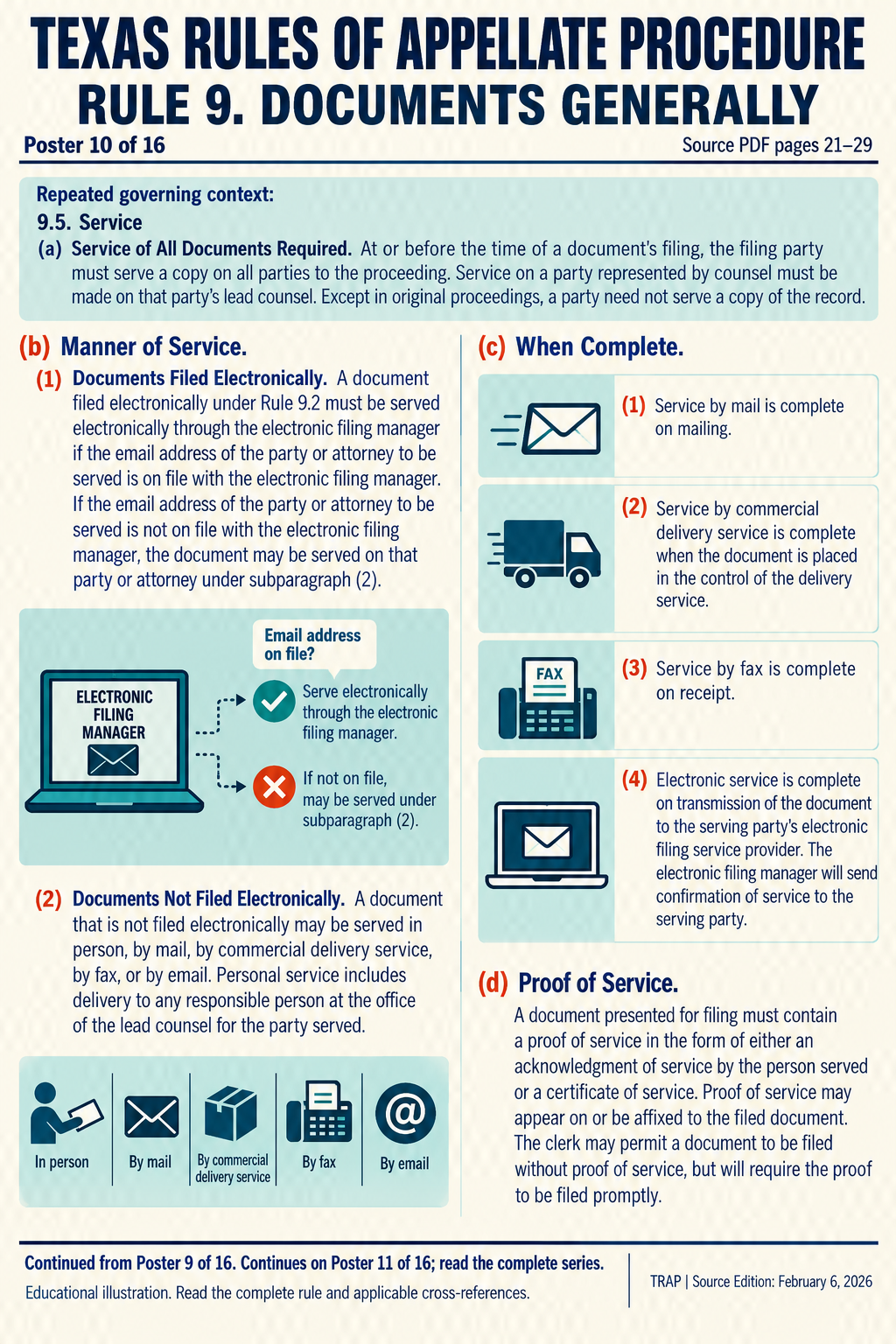
(1) Documents Filed Electronically. A document filed electronically under Rule 9.2 must be served electronically through the electronic filing manager if the email address of the party or attorney to be served is on file with the electronic filing manager. If the email address of the party or attorney to be served is not on file with the electronic filing manager, the document may be served on that party or attorney under subparagraph (2).
(2) Documents Not Filed Electronically. A document that is not filed electronically may be served in person, by mail, by commercial delivery service, by fax, or by email. Personal service includes delivery to any responsible person at the office of the lead counsel for the party served.
(c) When Complete.
(1) Service by mail is complete on mailing.
(2) Service by commercial delivery service is complete when the document is placed in the control of the delivery service.
(3) Service by fax is complete on receipt.
(4) Electronic service is complete on transmission of the document to the serving party's electronic filing service provider. The electronic filing manager will send confirmation of service to the serving party.
(d) Proof of Service. A document presented for filing must contain a proof of service in the form of either an acknowledgment of service by the person served or a certificate of service. Proof of service may appear on or be affixed to the filed document. The clerk may permit a document to be filed without proof of service, but will require the proof to be filed promptly.
Repeated governing context
9.5. Service
(a) Service of All Documents Required. At or before the time of a document's filing, the filing party must serve a copy on all parties to the proceeding. Service on a party represented by counsel must be made on that party’s lead counsel. Except in original proceedings, a party need not serve a copy of the record.
Continued from Poster 9 of 16. Continues on Poster 11 of 16; read the complete series.
Document service and protect a child’s identityPoster 11 of 16
Read assigned text for Rule 9 poster 11
Assigned rule text
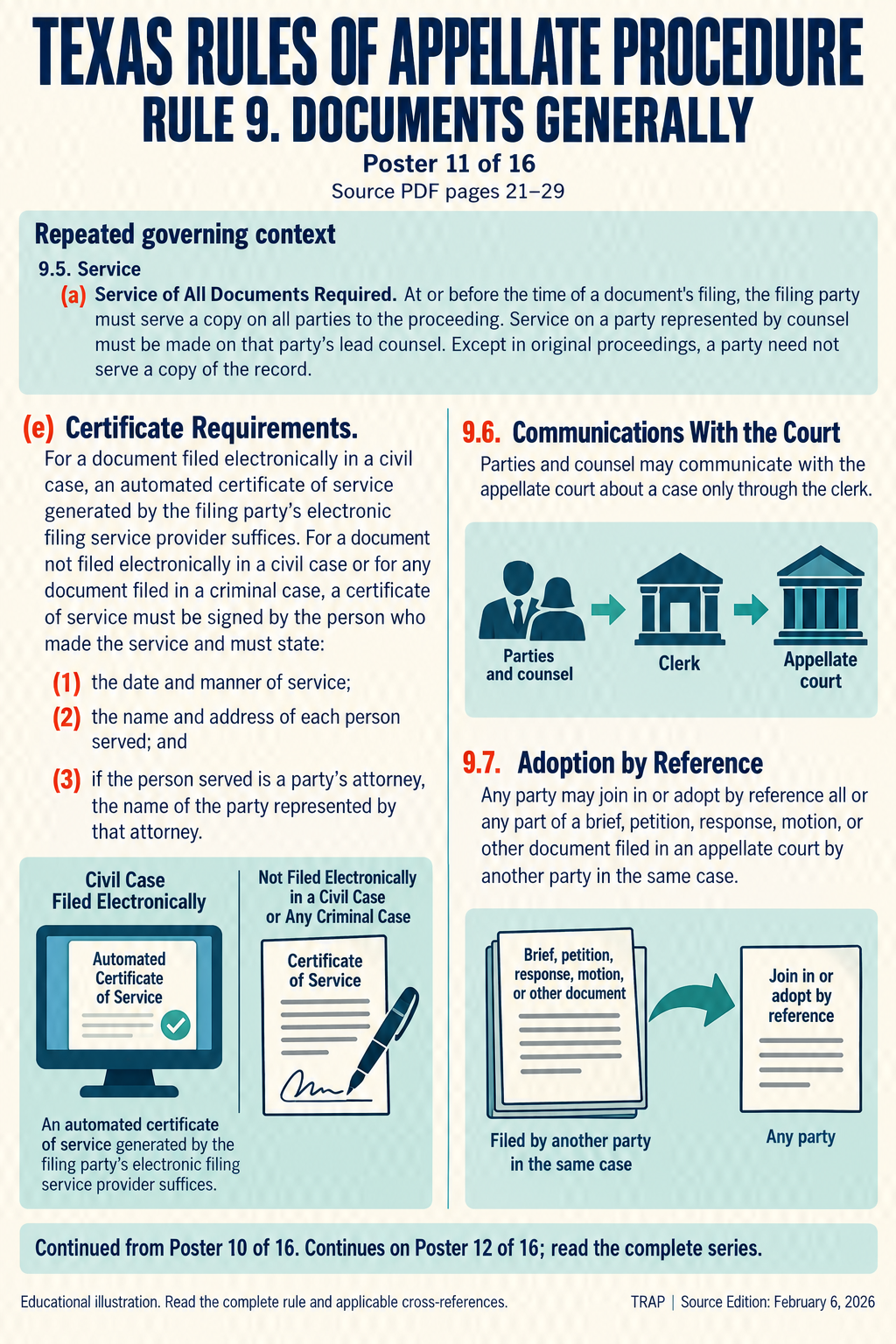
(e) Certificate Requirements. For a document filed electronically in a civil case, an automated certificate of service generated by the filing party’s electronic filing service provider suffices. For a document not filed electronically in a civil case or for any document filed in a criminal case, a certificate of service must be signed by the person who made the service and must state:
(1) the date and manner of service;
(2) the name and address of each person served; and
(3) if the person served is a party's attorney, the name of the party represented by that attorney.
9.6. Communications With the Court Parties and counsel may communicate with the appellate court about a case only through the clerk.
9.7. Adoption by Reference Any party may join in or adopt by reference all or any part of a brief, petition, response, motion, or other document filed in an appellate court by another party in the same case.
Repeated governing context
9.5. Service
(a) Service of All Documents Required. At or before the time of a document's filing, the filing party must serve a copy on all parties to the proceeding. Service on a party represented by counsel must be made on that party’s lead counsel. Except in original proceedings, a party need not serve a copy of the record.
Continued from Poster 10 of 16. Continues on Poster 12 of 16; read the complete series.
Rule 9. Documents Generally — poster 12Poster 12 of 16
Read assigned text for Rule 9 poster 12
Assigned rule text
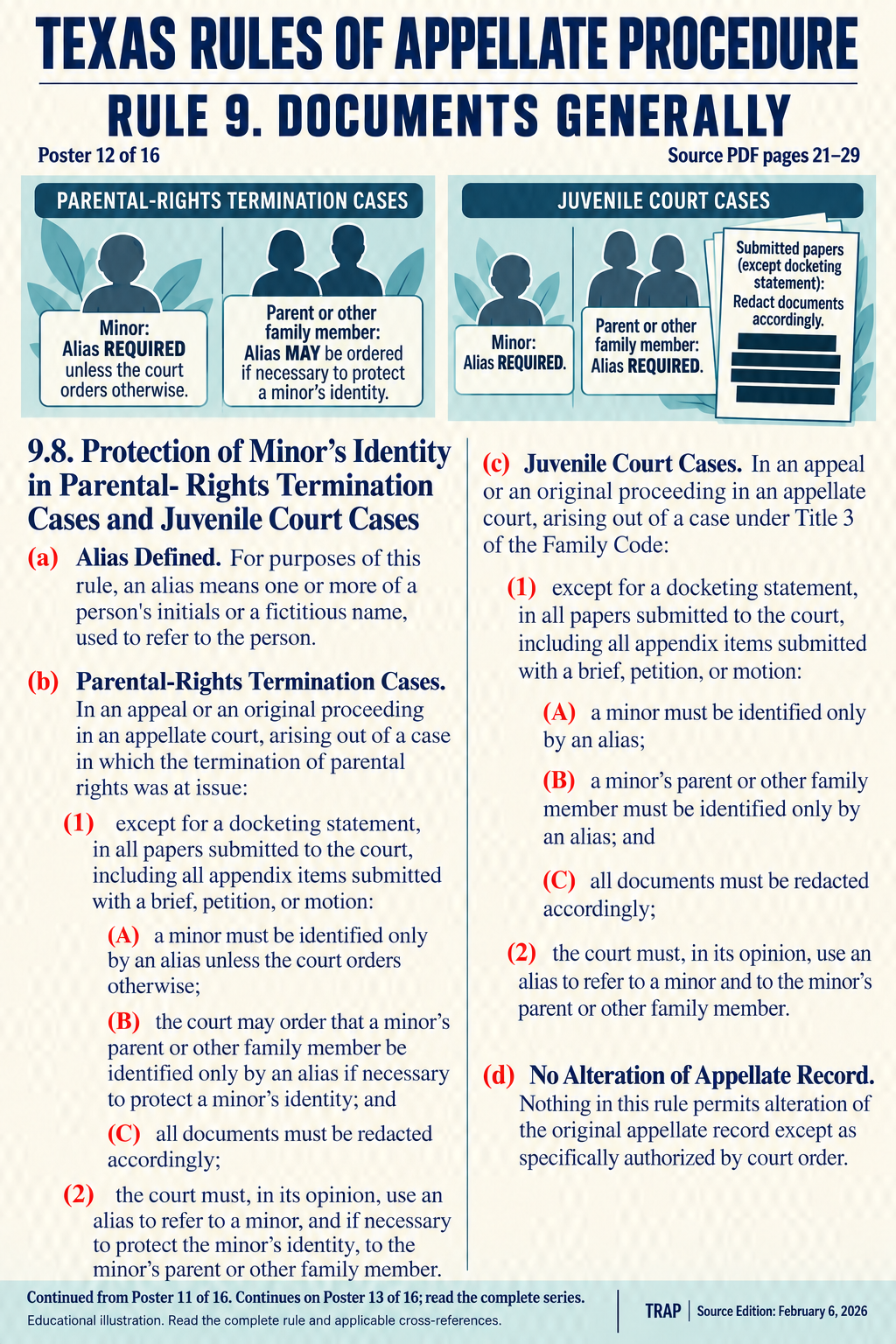
9.8. Protection of Minor's Identity in Parental- Rights Termination Cases and Juvenile Court Cases
(a) Alias Defined. For purposes of this rule, an alias means one or more of a person's initials or a fictitious name, used to refer to the person.
(b) Parental-Rights Termination Cases. In an appeal or an original proceeding in an appellate court, arising out of a case in which the termination of parental rights was at issue:
(1) except for a docketing statement, in all papers submitted to the court, including all appendix items submitted with a brief, petition, or motion:
(A) a minor must be identified only by an alias unless the court orders otherwise;
(B) the court may order that a minor's parent or other family member be identified only by an alias if necessary to protect a minor's identity; and
(C) all documents must be redacted accordingly;
(2) the court must, in its opinion, use an alias to refer to a minor, and if necessary to protect the minor's identity, to the minor's parent or other family member.
(c) Juvenile Court Cases. In an appeal or an original proceeding in an appellate court, arising out of a case under Title 3 of the Family Code:
(1) except for a docketing statement, in all papers submitted to the court, including all appendix items submitted with a brief, petition, or motion:
(A) a minor must be identified only by an alias;
(B) a minor's parent or other family member must be identified only by an alias; and
(C) all documents must be redacted accordingly;
(2) the court must, in its opinion, use an alias to refer to a minor and to the minor's parent or other family member.
(d) No Alteration of Appellate Record. Nothing in this rule permits alteration of the original appellate record except as specifically authorized by court order.
Continued from Poster 11 of 16. Continues on Poster 13 of 16; read the complete series.
Redact sensitive information in a civil filingPoster 13 of 16
Read assigned text for Rule 9 poster 13
Assigned rule text
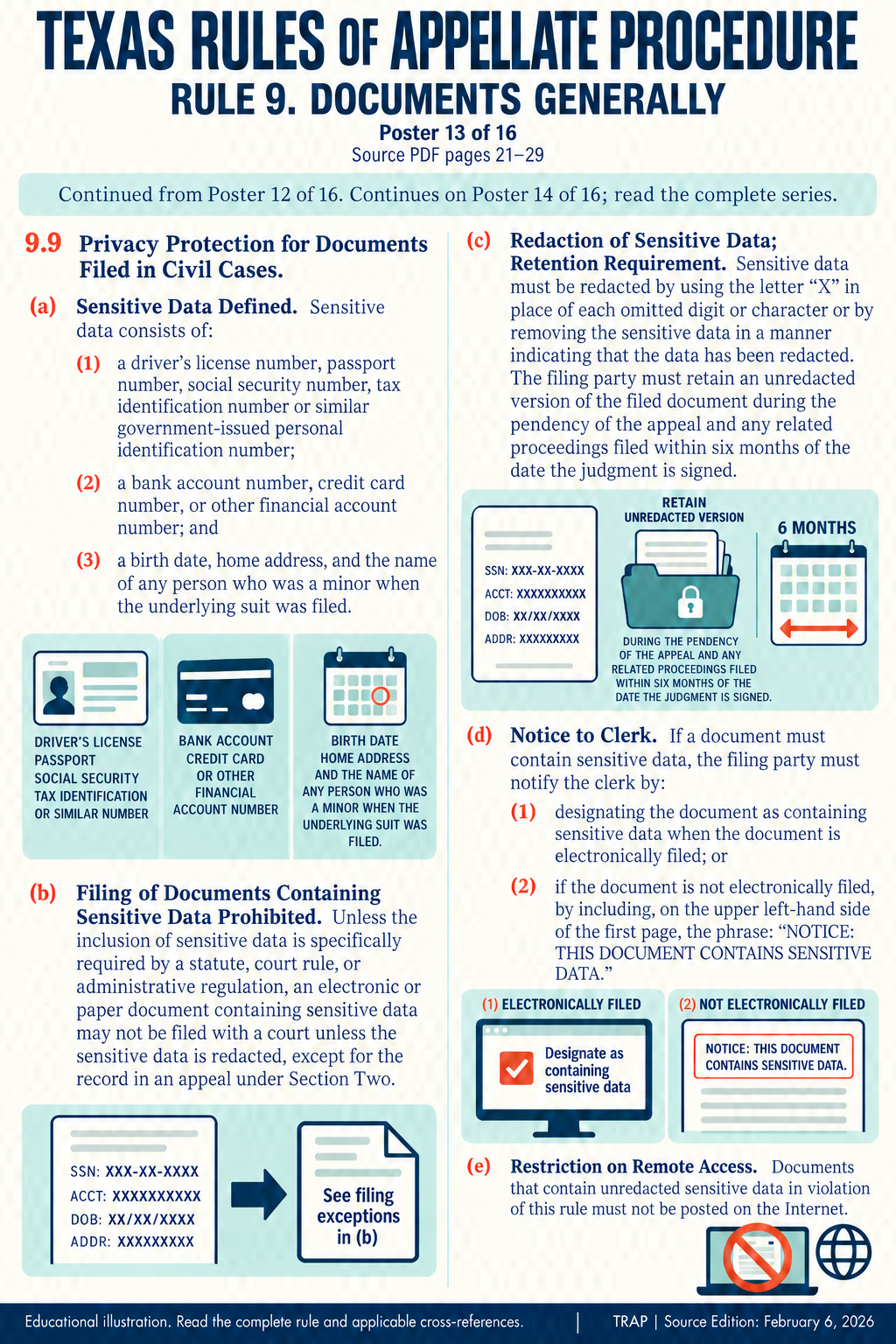
9.9 Privacy Protection for Documents Filed in Civil Cases.
(a) Sensitive Data Defined. Sensitive data consists of:
(1) a driver's license number, passport number, social security number, tax identification number or similar government-issued personal identification number;
(2) a bank account number, credit card number, or other financial account number; and
(3) a birth date, home address, and the name of any person who was a minor when the underlying suit was filed.
(b) Filing of Documents Containing Sensitive Data Prohibited. Unless the inclusion of sensitive data is specifically required by a statute, court rule, or administrative regulation, an electronic or paper document containing sensitive data may not be filed with a court unless the sensitive data is redacted, except for the record in an appeal under Section Two.
(c) Redaction of Sensitive Data; Retention Requirement. Sensitive data must be redacted by using the letter “X” in place of each omitted digit or character or by removing the sensitive data in a manner indicating that the data has been redacted. The filing party must retain an unredacted version of the filed document during the pendency of the appeal and any related proceedings filed within six months of the date the judgment is signed.
(d) Notice to Clerk. If a document must contain sensitive data, the filing party must notify the clerk by:
(1) designating the document as containing sensitive data when the document is electronically filed; or
(2) if the document is not electronically filed, by including, on the upper left-hand side of the first page, the phrase: “NOTICE: THIS DOCUMENT CONTAINS SENSITIVE DATA.”
(e) Restriction on Remote Access. Documents that contain unredacted sensitive data in violation of this rule must not be posted on the Internet.
Continued from Poster 12 of 16. Continues on Poster 14 of 16; read the complete series.
Identify sensitive data in a criminal filingPoster 14 of 16
Read assigned text for Rule 9 poster 14
Assigned rule text
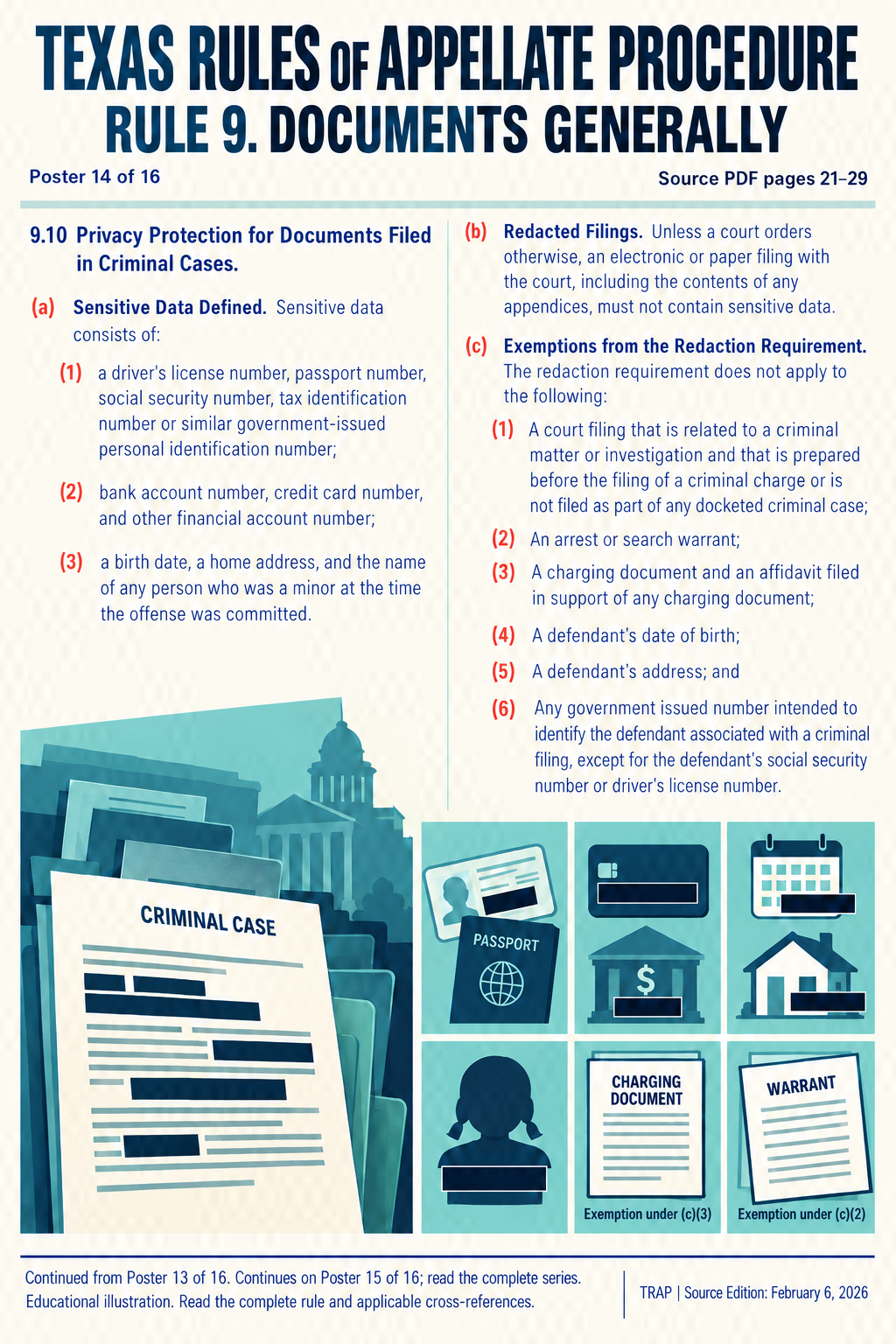
9.10 Privacy Protection for Documents Filed in Criminal Cases.
(a) Sensitive Data Defined. Sensitive data consists of:
(1) a driver's license number, passport number, social security number, tax identification number or similar government-issued personal identification number;
(2) bank account number, credit card number, and other financial account number;
(3) a birth date, a home address, and the name of any person who was a minor at the time the offense was committed.
(b) Redacted Filings. Unless a court orders otherwise, an electronic or paper filing with the court, including the contents of any appendices, must not contain sensitive data.
(c) Exemptions from the Redaction Requirement. The redaction requirement does not apply to the following:
(1) A court filing that is related to a criminal matter or investigation and that is prepared before the filing of a criminal charge or is not filed as part of any docketed criminal case;
(2) An arrest or search warrant;
(3) A charging document and an affidavit filed in support of any charging document;
(4) A defendant’s date of birth;
(5) A defendant’s address; and
(6) Any government issued number intended to identify the defendant associated with a criminal filing, except for the defendant’s social security number or driver’s license number.
Continued from Poster 13 of 16. Continues on Poster 15 of 16; read the complete series.
Rule 9. Documents Generally — poster 15Poster 15 of 16
Read assigned text for Rule 9 poster 15
Assigned rule text
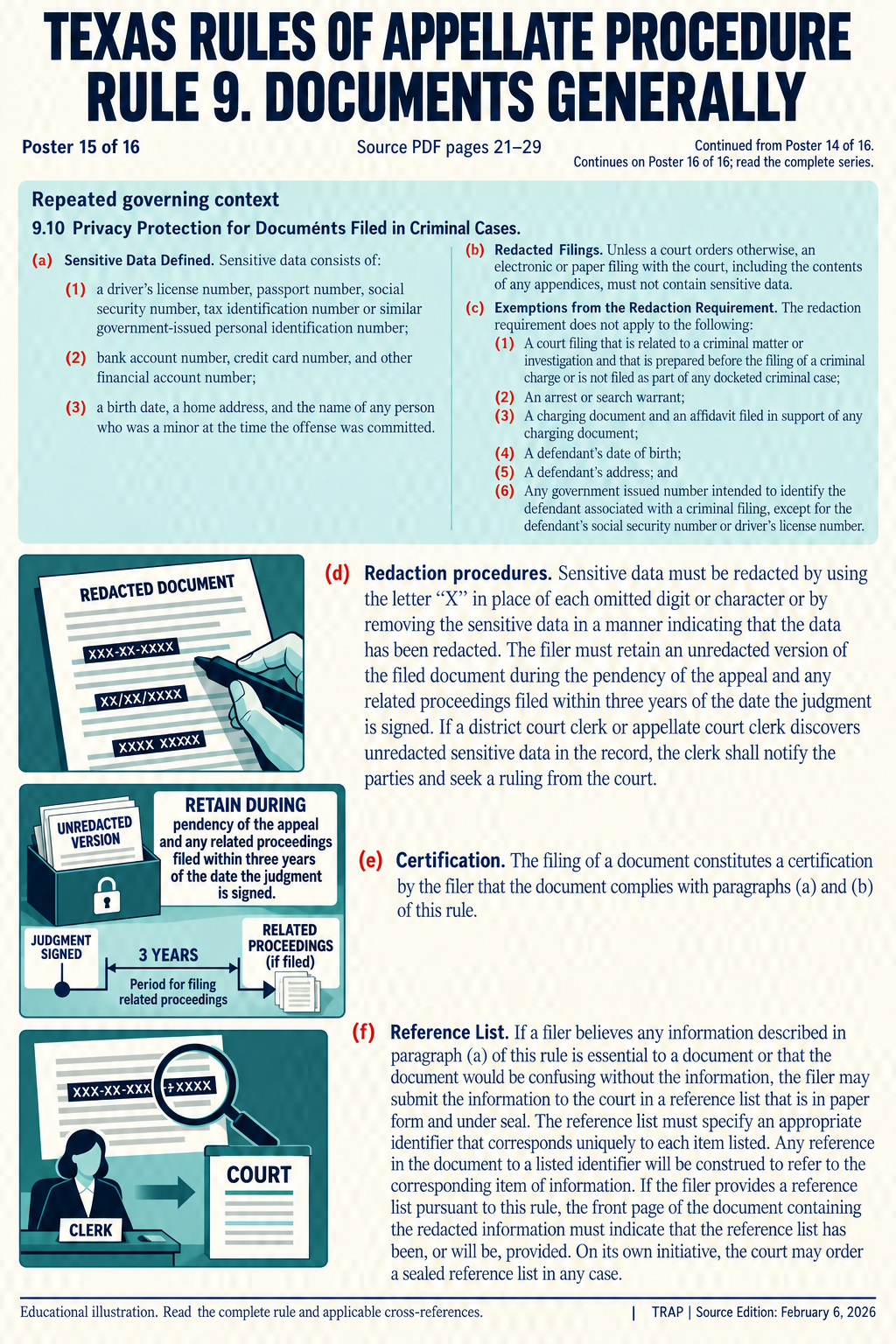
(d) Redaction procedures. Sensitive data must be redacted by using the letter “X” in place of each omitted digit or character or by removing the sensitive data in a manner indicating that the data has been redacted. The filer must retain an unredacted version of the filed document during the pendency of the appeal and any related proceedings filed within three years of the date the judgment is signed. If a district court clerk or appellate court clerk discovers unredacted sensitive data in the record, the clerk shall notify the parties and seek a ruling from the court.
(e) Certification. The filing of a document constitutes a certification by the filer that the document complies with paragraphs (a) and (b) of this rule.
(f) Reference List. If a filer believes any information described in paragraph (a) of this rule is essential to a document or that the document would be confusing without the information, the filer may submit the information to the court in a reference list that is in paper form and under seal. The reference list must specify an appropriate identifier that corresponds uniquely to each item listed. Any reference in the document to a listed identifier will be construed to refer to the corresponding item of information. If the filer provides a reference list pursuant to this rule, the front page of the document containing the redacted information must indicate that the reference list has been, or will be, provided. On its own initiative, the court may order a sealed reference list in any case.
Repeated governing context
9.10 Privacy Protection for Documents Filed in Criminal Cases.
(a) Sensitive Data Defined. Sensitive data consists of:
(1) a driver's license number, passport number, social security number, tax identification number or similar government-issued personal identification number;
(2) bank account number, credit card number, and other financial account number;
(3) a birth date, a home address, and the name of any person who was a minor at the time the offense was committed.
(b) Redacted Filings. Unless a court orders otherwise, an electronic or paper filing with the court, including the contents of any appendices, must not contain sensitive data.
(c) Exemptions from the Redaction Requirement. The redaction requirement does not apply to the following:
(1) A court filing that is related to a criminal matter or investigation and that is prepared before the filing of a criminal charge or is not filed as part of any docketed criminal case;
(2) An arrest or search warrant;
(3) A charging document and an affidavit filed in support of any charging document;
(4) A defendant’s date of birth;
(5) A defendant’s address; and
(6) Any government issued number intended to identify the defendant associated with a criminal filing, except for the defendant’s social security number or driver’s license number.
Continued from Poster 14 of 16. Continues on Poster 16 of 16; read the complete series.
Handle sealed material in a criminal filingPoster 16 of 16
Read assigned text for Rule 9 poster 16
Assigned rule text
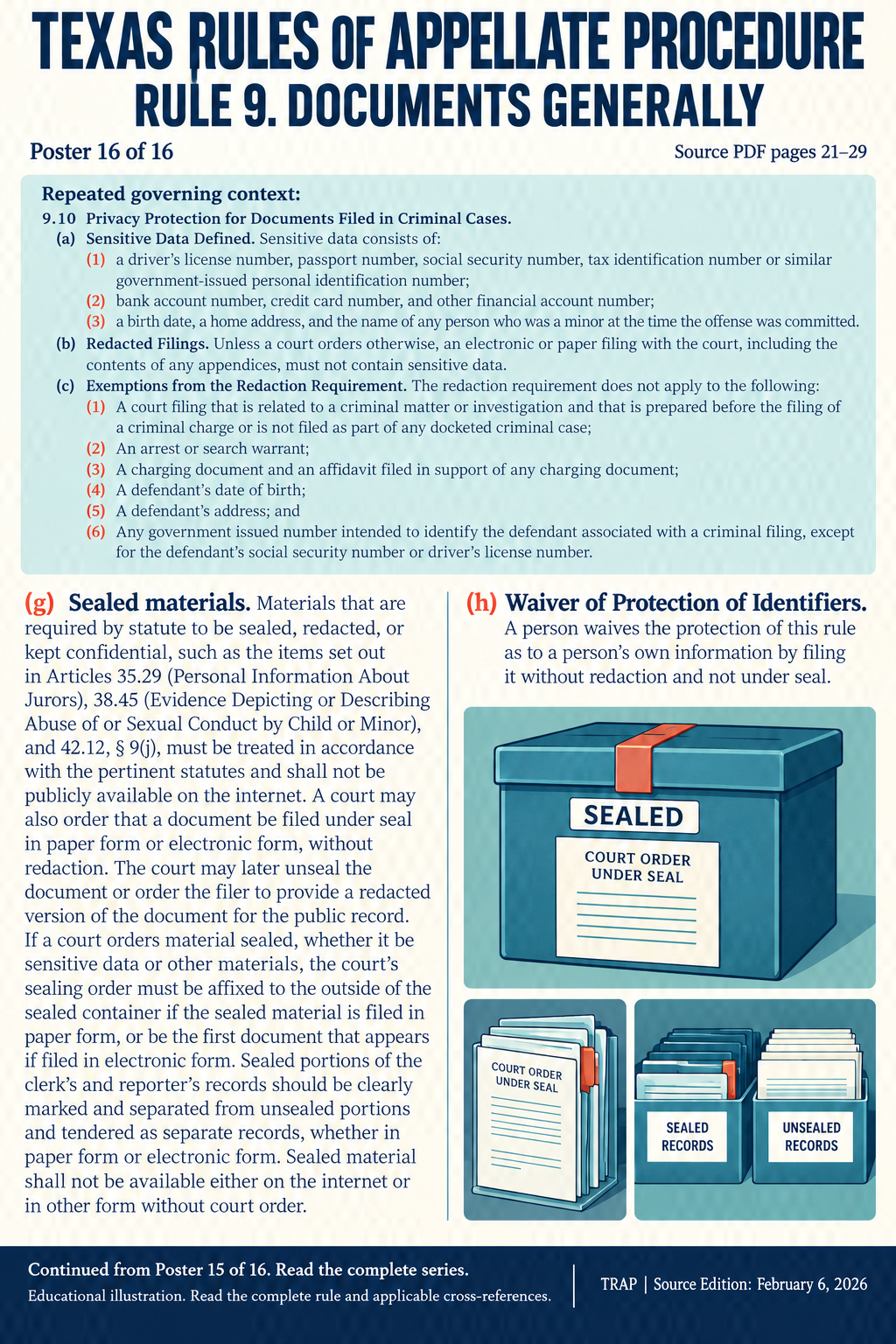
(g) Sealed materials. Materials that are required by statute to be sealed, redacted, or kept confidential, such as the items set out in Articles 35.29 (Personal Information About Jurors), 38.45 (Evidence Depicting or Describing Abuse of or Sexual Conduct by Child or Minor), and 42.12, § 9(j), must be treated in accordance with the pertinent statutes and shall not be publicly available on the internet. A court may also order that a document be filed under seal in paper form or electronic form, without redaction. The court may later unseal the document or order the filer to provide a redacted version of the document for the public record. If a court orders material sealed, whether it be sensitive data or other materials, the court's sealing order must be affixed to the outside of the sealed container if the sealed material is filed in paper form, or be the first document that appears if filed in electronic form. Sealed portions of the clerk's and reporter's records should be clearly marked and separated from unsealed portions and tendered as separate records, whether in paper form or electronic form. Sealed material shall not be available either on the internet or in other form without court order.
(h) Waiver of Protection of Identifiers. A person waives the protection of this rule as to a person’s own information by filing it without redaction and not under seal.
Repeated governing context
9.10 Privacy Protection for Documents Filed in Criminal Cases.
(a) Sensitive Data Defined. Sensitive data consists of:
(1) a driver's license number, passport number, social security number, tax identification number or similar government-issued personal identification number;
(2) bank account number, credit card number, and other financial account number;
(3) a birth date, a home address, and the name of any person who was a minor at the time the offense was committed.
(b) Redacted Filings. Unless a court orders otherwise, an electronic or paper filing with the court, including the contents of any appendices, must not contain sensitive data.
(c) Exemptions from the Redaction Requirement. The redaction requirement does not apply to the following:
(1) A court filing that is related to a criminal matter or investigation and that is prepared before the filing of a criminal charge or is not filed as part of any docketed criminal case;
(2) An arrest or search warrant;
(3) A charging document and an affidavit filed in support of any charging document;
(4) A defendant’s date of birth;
(5) A defendant’s address; and
(6) Any government issued number intended to identify the defendant associated with a criminal filing, except for the defendant’s social security number or driver’s license number.
Continued from Poster 15 of 16. Read the complete series.
Rule 10. Motions In The Appellate Courts
Prepare a motion and responsePoster 1 of 3
Read assigned text for Rule 10 poster 1
Assigned rule text
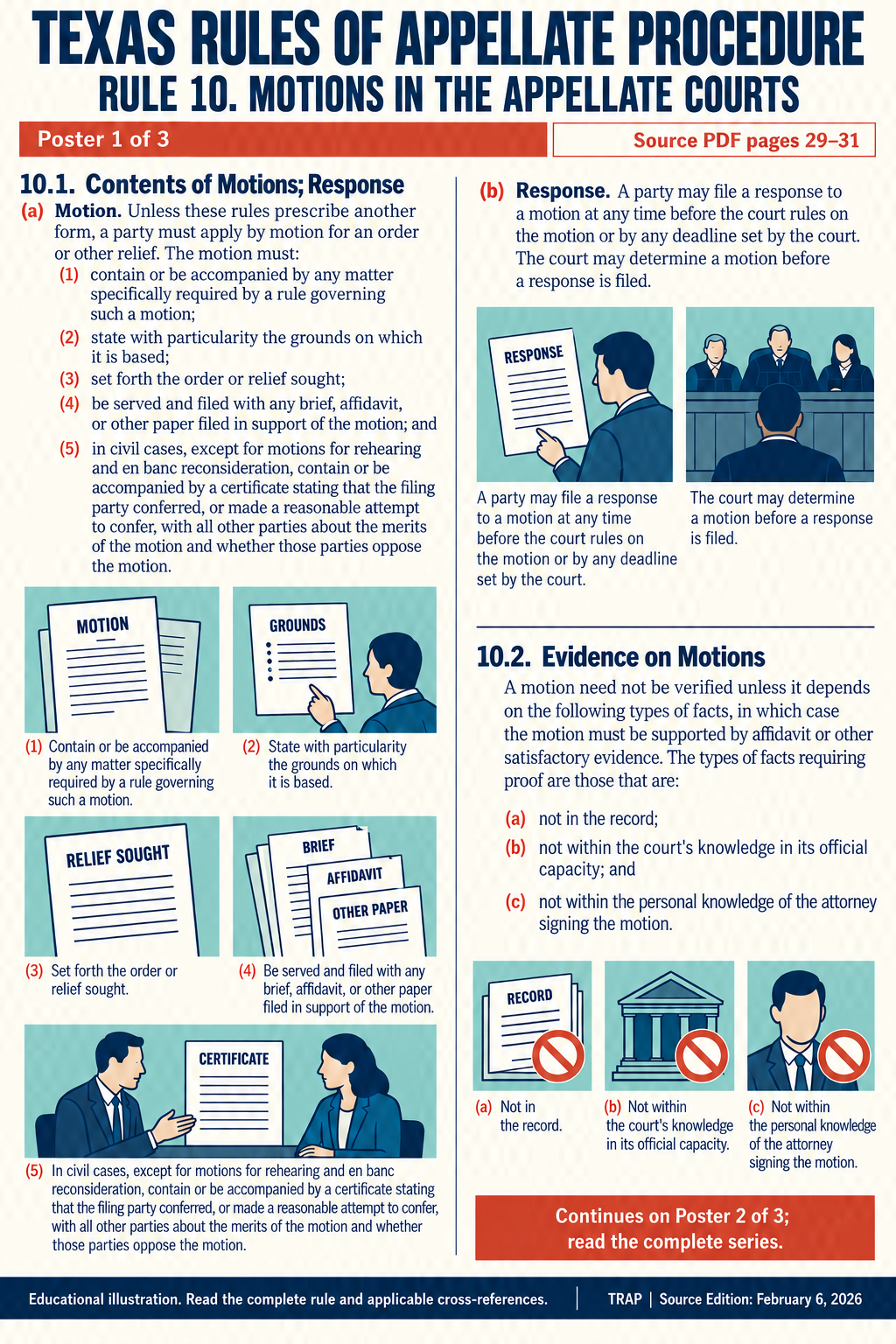
10.1. Contents of Motions; Response
(a) Motion. Unless these rules prescribe another form, a party must apply by motion for an order or other relief. The motion must:
(1) contain or be accompanied by any matter specifically required by a rule governing such a motion;
(2) state with particularity the grounds on which it is based;
(3) set forth the order or relief sought;
(4) be served and filed with any brief, affidavit, or other paper filed in support of the motion; and
(5) in civil cases, except for motions for rehearing and en banc reconsideration, contain or be accompanied by a certificate stating that the filing party conferred, or made a reasonable attempt to confer, with all other parties about the merits of the motion and whether those parties oppose the motion.
(b) Response. A party may file a response to a motion at any time before the court rules on the motion or by any deadline set by the court. The court may determine a motion before a response is filed.
10.2. Evidence on Motions A motion need not be verified unless it depends on the following types of facts, in which case the motion must be supported by affidavit or other satisfactory evidence. The types of facts requiring proof are those that are:
(a) not in the record;
(b) not within the court's knowledge in its official capacity; and
(c) not within the personal knowledge of the attorney signing the motion.
Continues on Poster 2 of 3; read the complete series.
Understand how the court considers a motionPoster 2 of 3
Read assigned text for Rule 10 poster 2
Assigned rule text
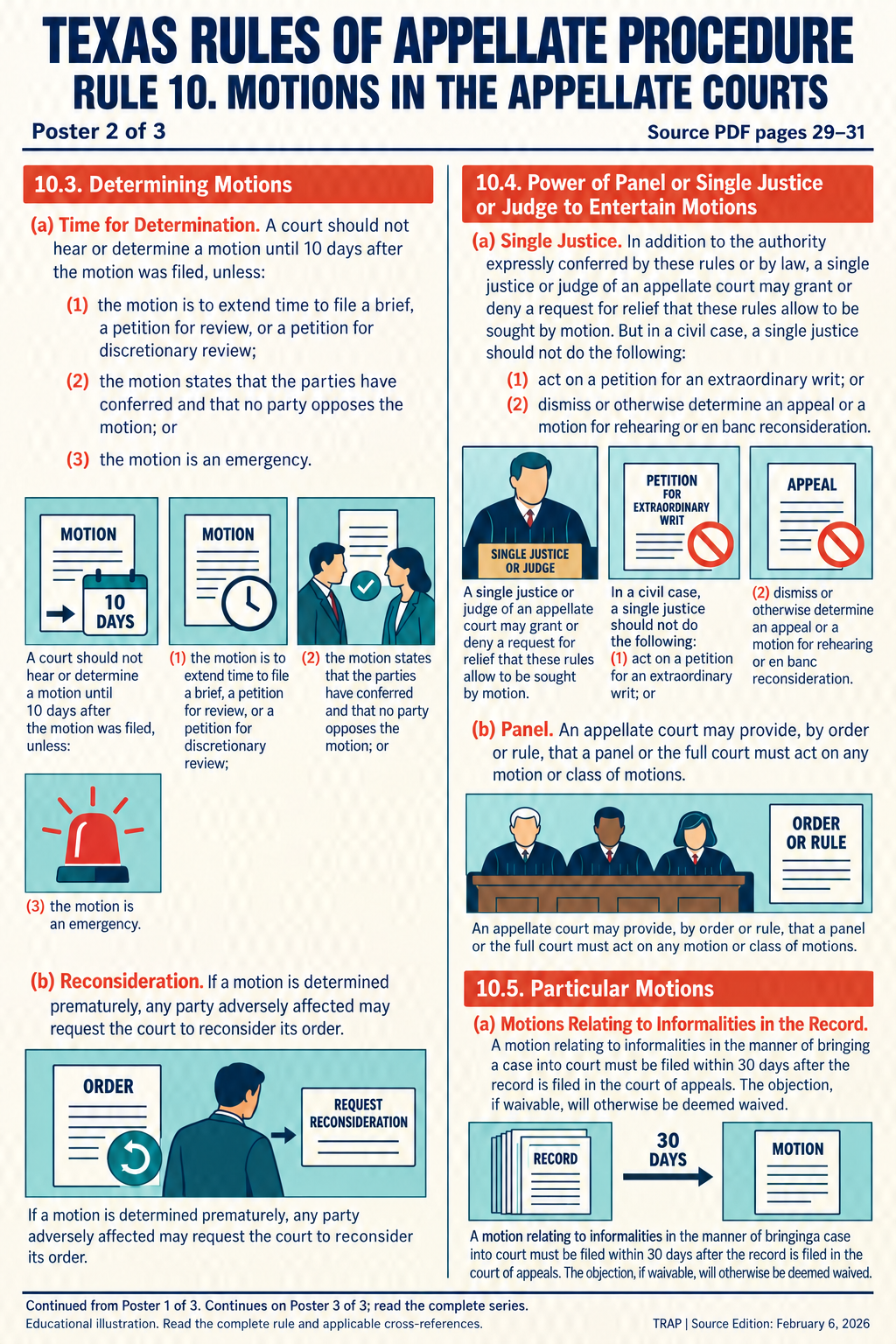
10.3. Determining Motions
(a) Time for Determination. A court should not hear or determine a motion until 10 days after the motion was filed, unless:
(1) the motion is to extend time to file a brief, a petition for review, or a petition for discretionary review;
(2) the motion states that the parties have conferred and that no party opposes the motion; or
(3) the motion is an emergency.
(b) Reconsideration. If a motion is determined prematurely, any party adversely affected may request the court to reconsider its order.
10.4. Power of Panel or Single Justice or Judge to Entertain Motions
(a) Single Justice. In addition to the authority expressly conferred by these rules or by law, a single justice or judge of an appellate court may grant or deny a request for relief that these rules allow to be sought by motion. But in a civil case, a single justice should not do the following:
(1) act on a petition for an extraordinary writ; or
(2) dismiss or otherwise determine an appeal or a motion for rehearing or en banc reconsideration.
(b) Panel. An appellate court may provide, by order or rule, that a panel or the full court must act on any motion or class of motions.
10.5. Particular Motions
(a) Motions Relating to Informalities in the Record. A motion relating to informalities in the manner of bringing a case into court must be filed within 30 days after the record is filed in the court of appeals. The objection, if waivable, will otherwise be deemed waived.
Continued from Poster 1 of 3. Continues on Poster 3 of 3; read the complete series.
Rule 10. Motions In The Appellate Courts — poster 3Poster 3 of 3
Read assigned text for Rule 10 poster 3
Assigned rule text
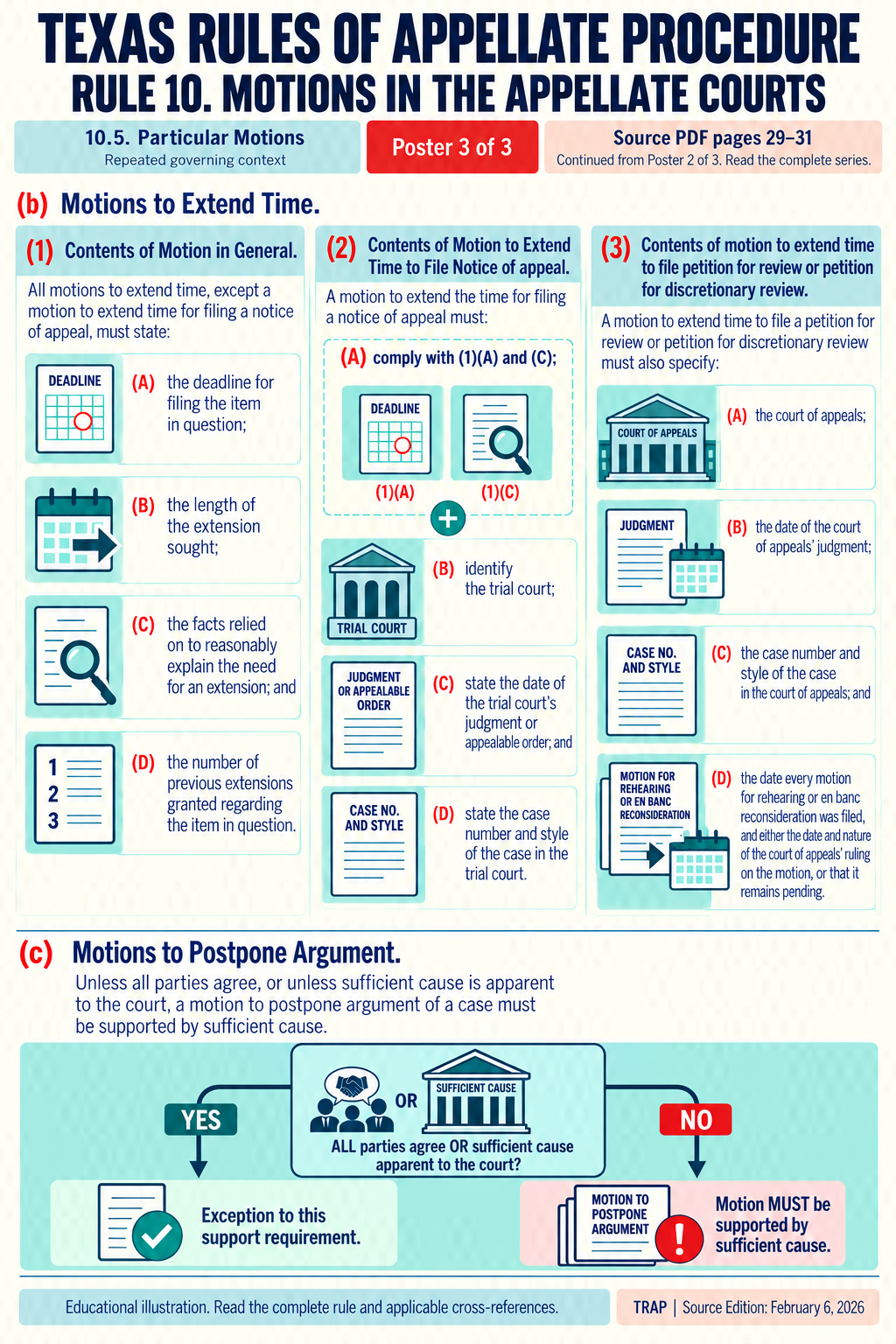
(b) Motions to Extend Time.
(1) Contents of Motion in General. All motions to extend time, except a motion to extend time for filing a notice of appeal, must state:
(A) the deadline for filing the item in question;
(B) the length of the extension sought;
(C) the facts relied on to reasonably explain the need for an extension; and
(D) the number of previous extensions granted regarding the item in question.
(2) Contents of Motion to Extend Time to File Notice of appeal. A motion to extend the time for filing a notice of appeal must:
(A) comply with (1)(A) and (C);
(B) identify the trial court;
(C) state the date of the trial court’s judgment or appealable order; and
(D) state the case number and style of the case in the trial court.
(3) Contents of motion to extend time to file petition for review or petition for discretionary review. A motion to extend time to file a petition for review or petition for discretionary review must also specify:
(A) the court of appeals;
(B) the date of the court of appeals’ judgment;
(C) the case number and style of the case in the court of appeals; and
(D) the date every motion for rehearing or en banc reconsideration was filed, and either the date and nature of the court of appeals' ruling on the motion, or that it remains pending.
(c) Motions to Postpone Argument. Unless all parties agree, or unless sufficient cause is apparent to the court, a motion to postpone argument of a case must be supported by sufficient cause.
Repeated governing context
10.5. Particular Motions
Continued from Poster 2 of 3. Read the complete series.
Rule 11. Amicus Curiae Briefs
Understand a friend-of-the-court briefPoster 1 of 1
Read assigned text for Rule 11 poster 1
Assigned rule text
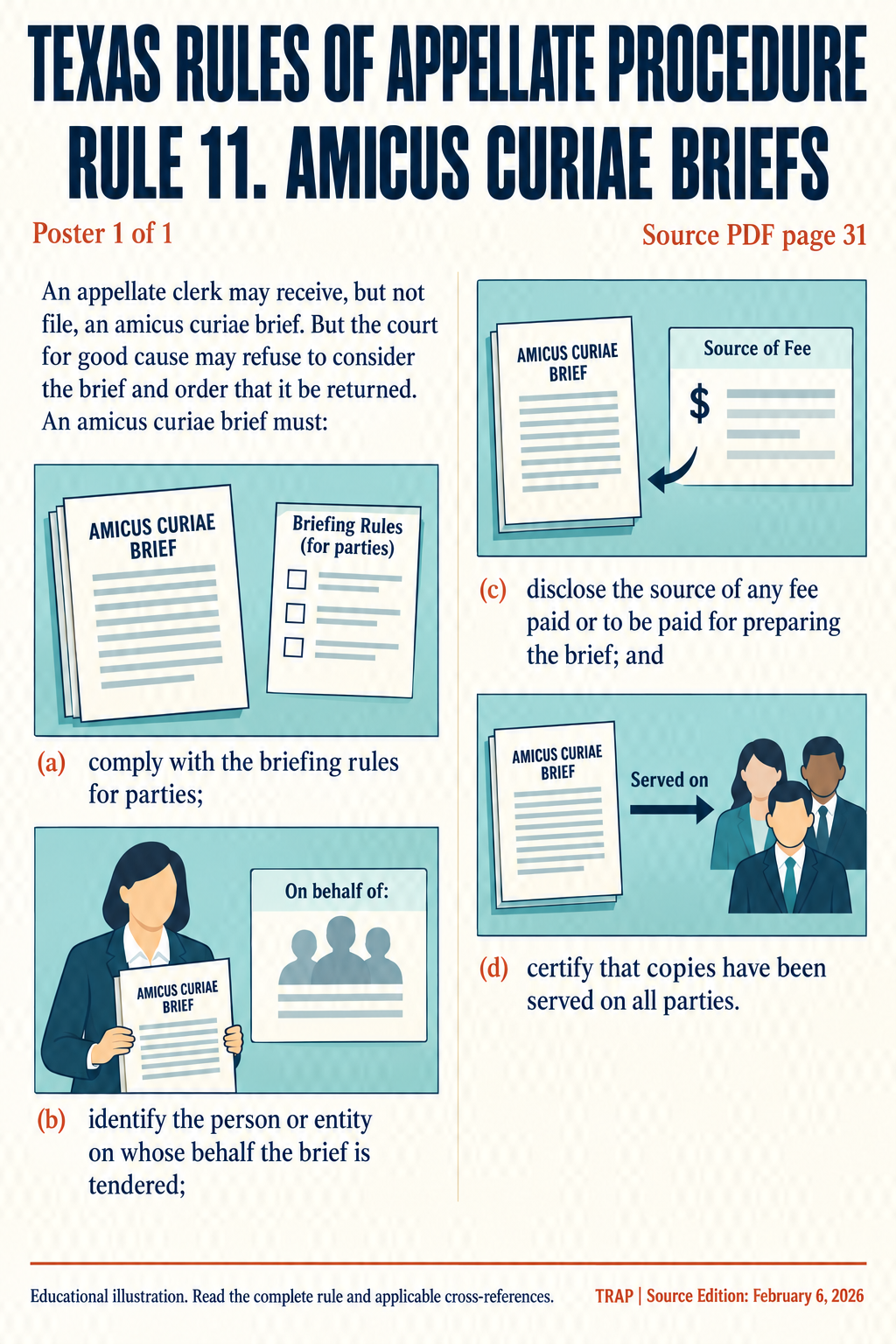
An appellate clerk may receive, but not file, an amicus curiae brief. But the court for good cause may refuse to consider the brief and order that it be returned. An amicus curiae brief must:
(a) comply with the briefing rules for parties;
(b) identify the person or entity on whose behalf the brief is tendered;
(c) disclose the source of any fee paid or to be paid for preparing the brief; and
(d) certify that copies have been served on all parties.
Rule 12. Duties Of Appellate Clerk
Find the docket and case numberPoster 1 of 3
Read assigned text for Rule 12 poster 1
Assigned rule text
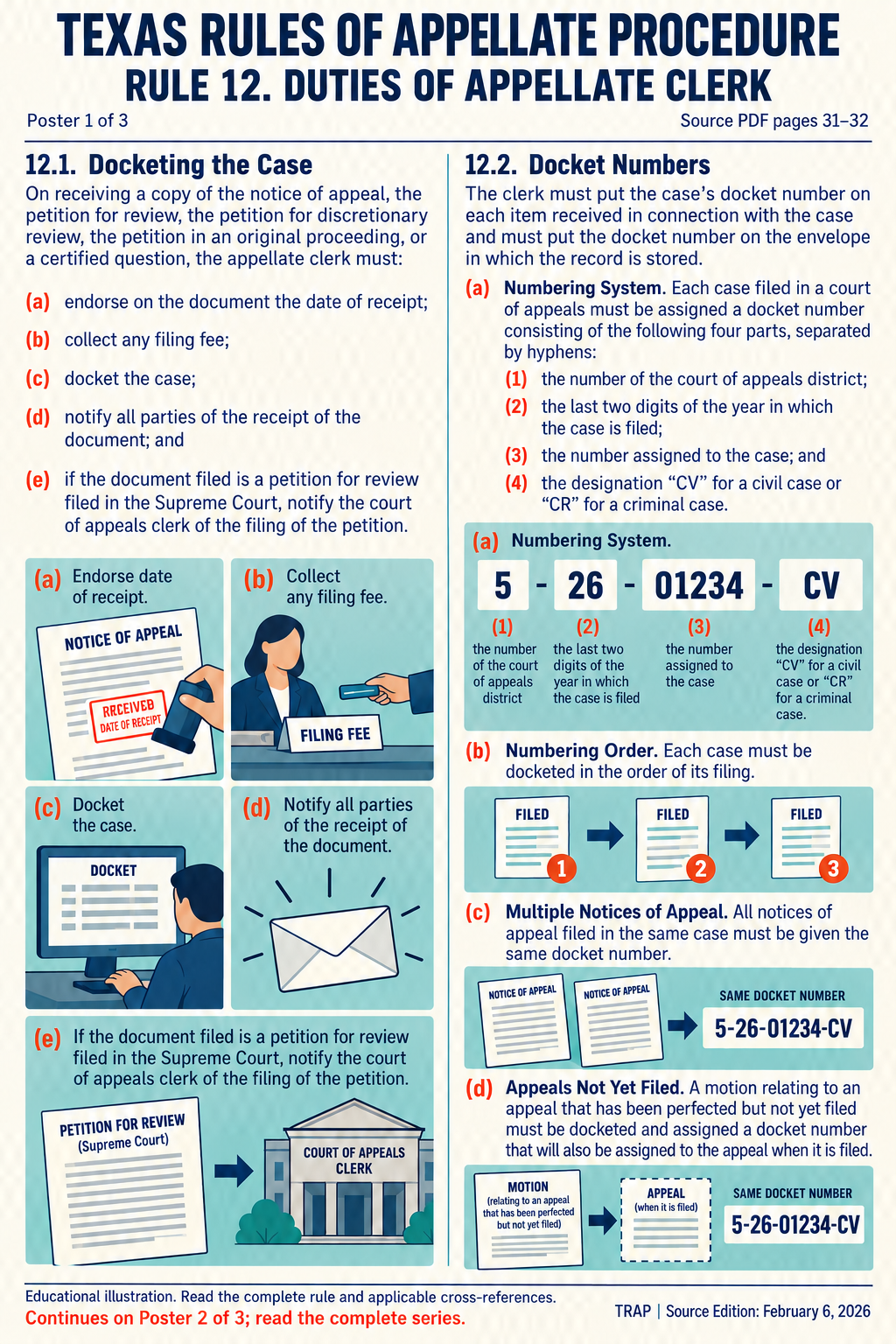
12.1. Docketing the Case On receiving a copy of the notice of appeal, the petition for review, the petition for discretionary review, the petition in an original proceeding, or a certified question, the appellate clerk must:
(a) endorse on the document the date of receipt;
(b) collect any filing fee;
(c) docket the case;
(d) notify all parties of the receipt of the document; and
(e) if the document filed is a petition for review filed in the Supreme Court, notify the court of appeals clerk of the filing of the petition.
12.2. Docket Numbers The clerk must put the case's docket number on each item received in connection with the case and must put the docket number on the envelope in which the record is stored.
(a) Numbering System. Each case filed in a court of appeals must be assigned a docket number consisting of the following four parts, separated by hyphens:
(1) the number of the court of appeals district;
(2) the last two digits of the year in which the case is filed;
(3) the number assigned to the case; and
(4) the designation “CV” for a civil case or “CR” for a criminal case.
(b) Numbering Order. Each case must be docketed in the order of its filing.
(c) Multiple Notices of Appeal. All notices of appeal filed in the same case must be given the same docket number.
(d) Appeals Not Yet Filed. A motion relating to an appeal that has been perfected but not yet filed must be docketed and assigned a docket number that will also be assigned to the appeal when it is filed.
Continues on Poster 2 of 3; read the complete series.
Check custody and withdrawal of filed materialsPoster 2 of 3
Read assigned text for Rule 12 poster 2
Assigned rule text
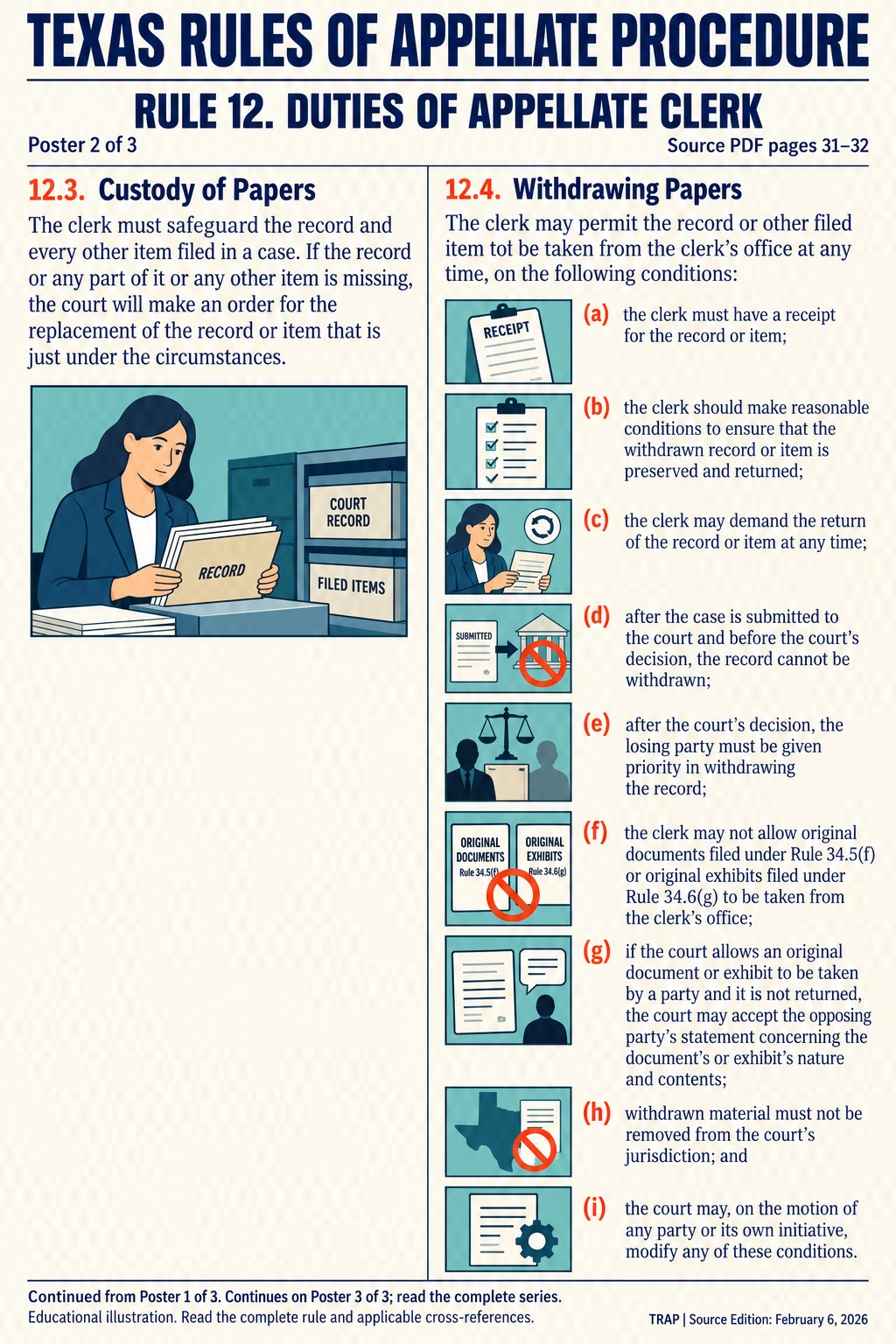
12.3. Custody of Papers The clerk must safeguard the record and every other item filed in a case. If the record or any part of it or any other item is missing, the court will make an order for the replacement of the record or item that is just under the circumstances.
12.4. Withdrawing Papers The clerk may permit the record or other filed item to be taken from the clerk’s office at any time, on the following conditions:
(a) the clerk must have a receipt for the record or item;
(b) the clerk should make reasonable conditions to ensure that the withdrawn record or item is preserved and returned;
(c) the clerk may demand the return of the record or item at any time;
(d) after the case is submitted to the court and before the court’s decision, the record cannot be withdrawn;
(e) after the court’s decision, the losing party must be given priority in withdrawing the record;
(f) the clerk may not allow original documents filed under Rule 34.5(f) or original exhibits filed under Rule 34.6(g) to be taken from the clerk’s office;
(g) if the court allows an original document or exhibit to be taken by a party and it is not returned, the court may accept the opposing party’s statement concerning the document’s or exhibit’s nature and contents;
(h) withdrawn material must not be removed from the court’s jurisdiction; and
(i) the court may, on the motion of any party or its own initiative, modify any of these conditions.
Continued from Poster 1 of 3. Continues on Poster 3 of 3; read the complete series.
Understand clerk notices and paymentsPoster 3 of 3
Read assigned text for Rule 12 poster 3
Assigned rule text
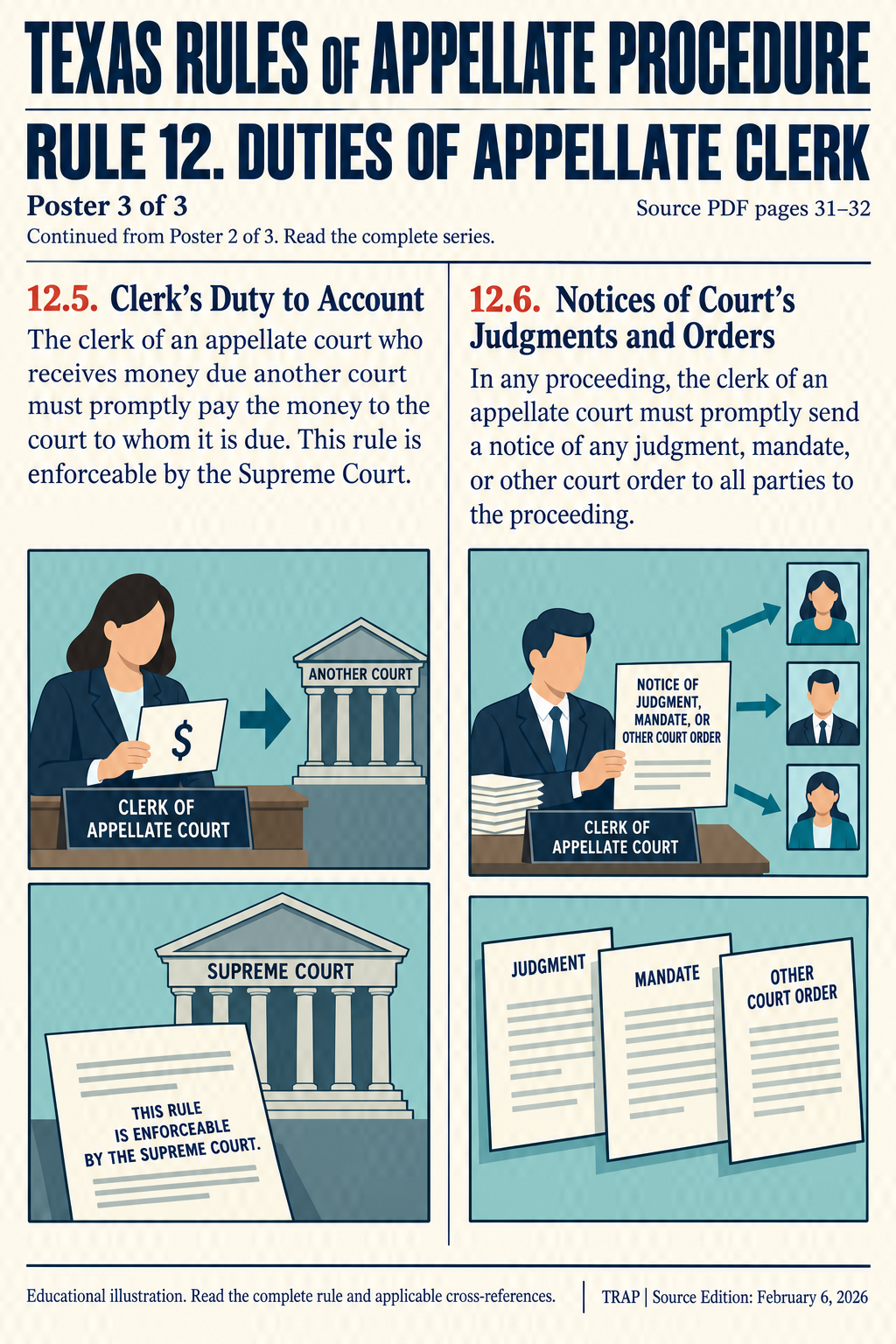
12.5. Clerk's Duty to Account The clerk of an appellate court who receives money due another court must promptly pay the money to the court to whom it is due. This rule is enforceable by the Supreme Court.
12.6. Notices of Court’s Judgments and Orders In any proceeding, the clerk of an appellate court must promptly send a notice of any judgment, mandate, or other court order to all parties to the proceeding.
Continued from Poster 2 of 3. Read the complete series.
Rule 13. Court Reporters And Court Recorders
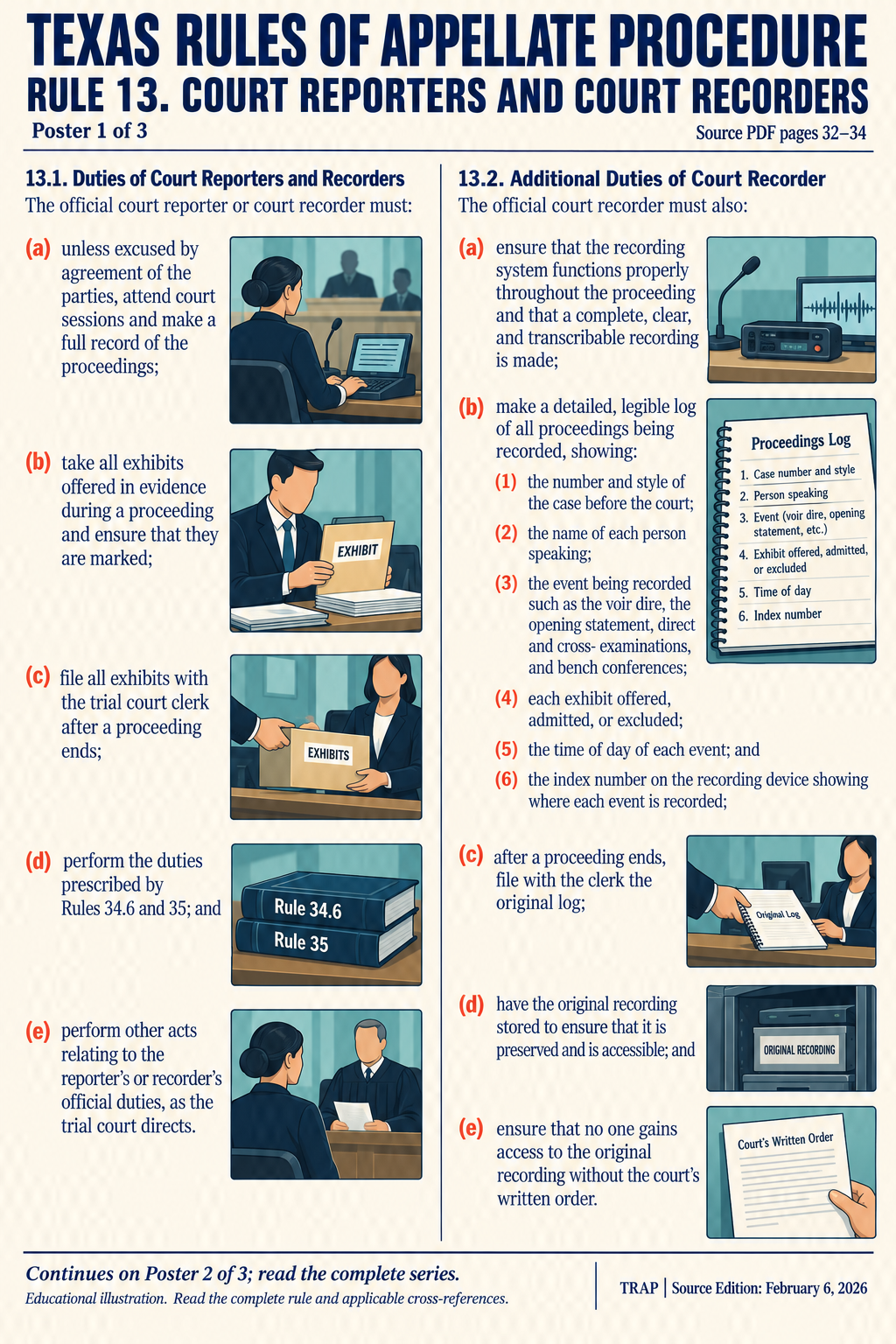
Understand what the reporter records and preservesPoster 1 of 3
Read assigned text for Rule 13 poster 1
Assigned rule text
13.1. Duties of Court Reporters and Recorders The official court reporter or court recorder must:
(a) unless excused by agreement of the parties, attend court sessions and make a full record of the proceedings;
(b) take all exhibits offered in evidence during a proceeding and ensure that they are marked;
(c) file all exhibits with the trial court clerk after a proceeding ends;
(d) perform the duties prescribed by Rules 34.6 and 35; and
(e) perform other acts relating to the reporter's or recorder's official duties, as the trial court directs.
13.2. Additional Duties of Court Recorder The official court recorder must also:
(a) ensure that the recording system functions properly throughout the proceeding and that a complete, clear, and transcribable recording is made;
(b) make a detailed, legible log of all proceedings being recorded, showing:
(1) the number and style of the case before the court;
(2) the name of each person speaking;
(3) the event being recorded such as the voir dire, the opening statement, direct and cross- examinations, and bench conferences;
(4) each exhibit offered, admitted, or excluded;
(5) the time of day of each event; and
(6) the index number on the recording device showing where each event is recorded;
(c) after a proceeding ends, file with the clerk the original log;
(d) have the original recording stored to ensure that it is preserved and is accessible; and
(e) ensure that no one gains access to the original recording without the court's written order.
Continues on Poster 2 of 3; read the complete series.
Rule 13. Court Reporters And Court Recorders — poster 2Poster 2 of 3
Read assigned text for Rule 13 poster 2
Assigned rule text
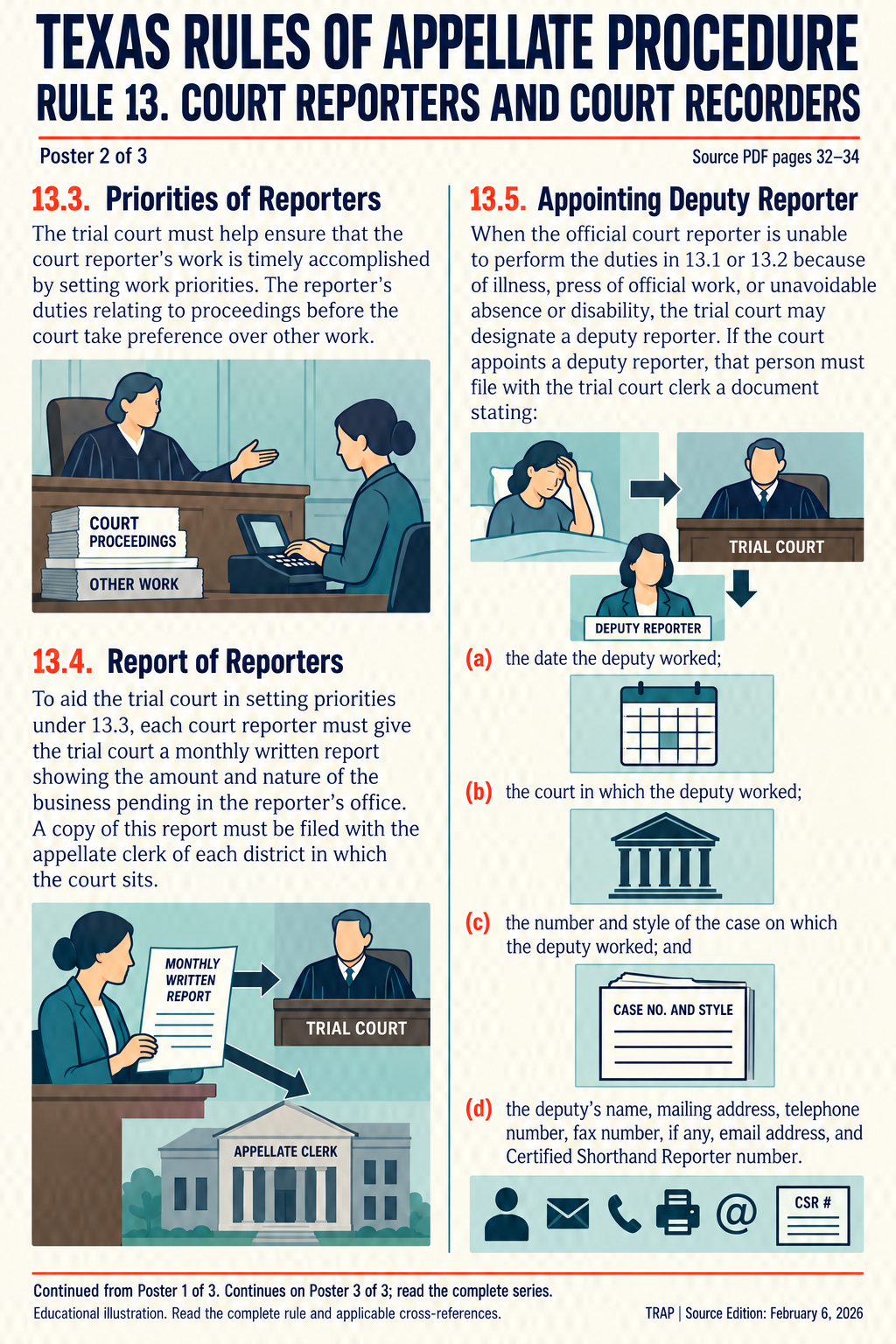
13.3. Priorities of Reporters The trial court must help ensure that the court reporter's work is timely accomplished by setting work priorities. The reporter's duties relating to proceedings before the court take preference over other work.
13.4. Report of Reporters To aid the trial court in setting priorities under 13.3, each court reporter must give the trial court a monthly written report showing the amount and nature of the business pending in the reporter's office. A copy of this report must be filed with the appellate clerk of each district in which the court sits.
13.5. Appointing Deputy Reporter When the official court reporter is unable to perform the duties in 13.1 or 13.2 because of illness, press of official work, or unavoidable absence or disability, the trial court may designate a deputy reporter. If the court appoints a deputy reporter, that person must file with the trial court clerk a document stating:
(a) the date the deputy worked;
(b) the court in which the deputy worked;
(c) the number and style of the case on which the deputy worked; and
(d) the deputy’s name, mailing address, telephone number, fax number, if any, email address, and Certified Shorthand Reporter number.
Continued from Poster 1 of 3. Continues on Poster 3 of 3; read the complete series.
Read criminal-case note-filing requirementsPoster 3 of 3
Read assigned text for Rule 13 poster 3
Assigned rule text
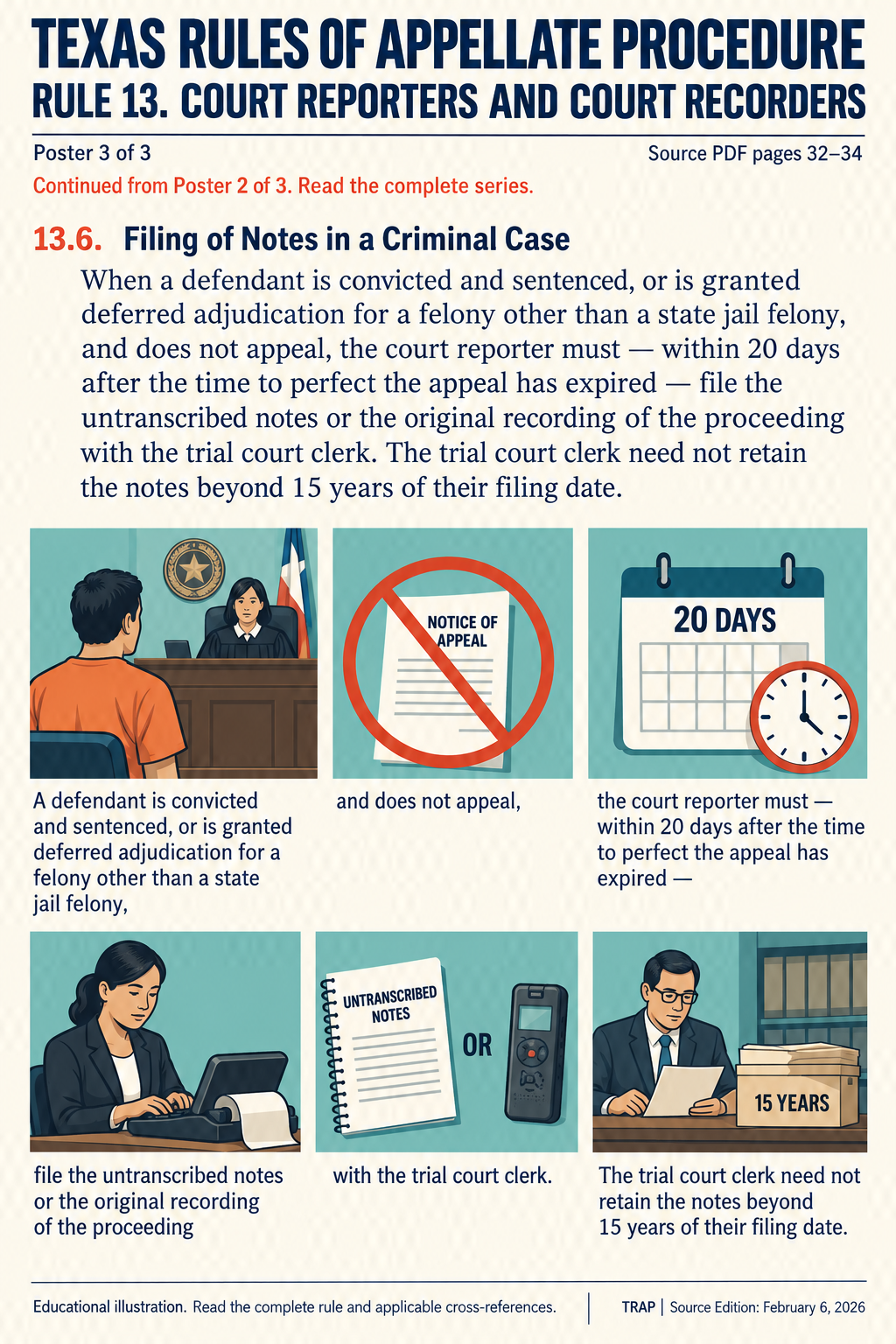
13.6. Filing of Notes in a Criminal Case When a defendant is convicted and sentenced, or is granted deferred adjudication for a felony other than a state jail felony, and does not appeal, the court reporter must — within 20 days after the time to perfect the appeal has expired — file the untranscribed notes or the original recording of the proceeding with the trial court clerk. The trial court clerk need not retain the notes beyond 15 years of their filing date.
Continued from Poster 2 of 3. Read the complete series.
Rule 14. Recording And Broadcasting Court Proceedings
Request permission before recording proceedingsPoster 1 of 2
Read assigned text for Rule 14 poster 1
Assigned rule text
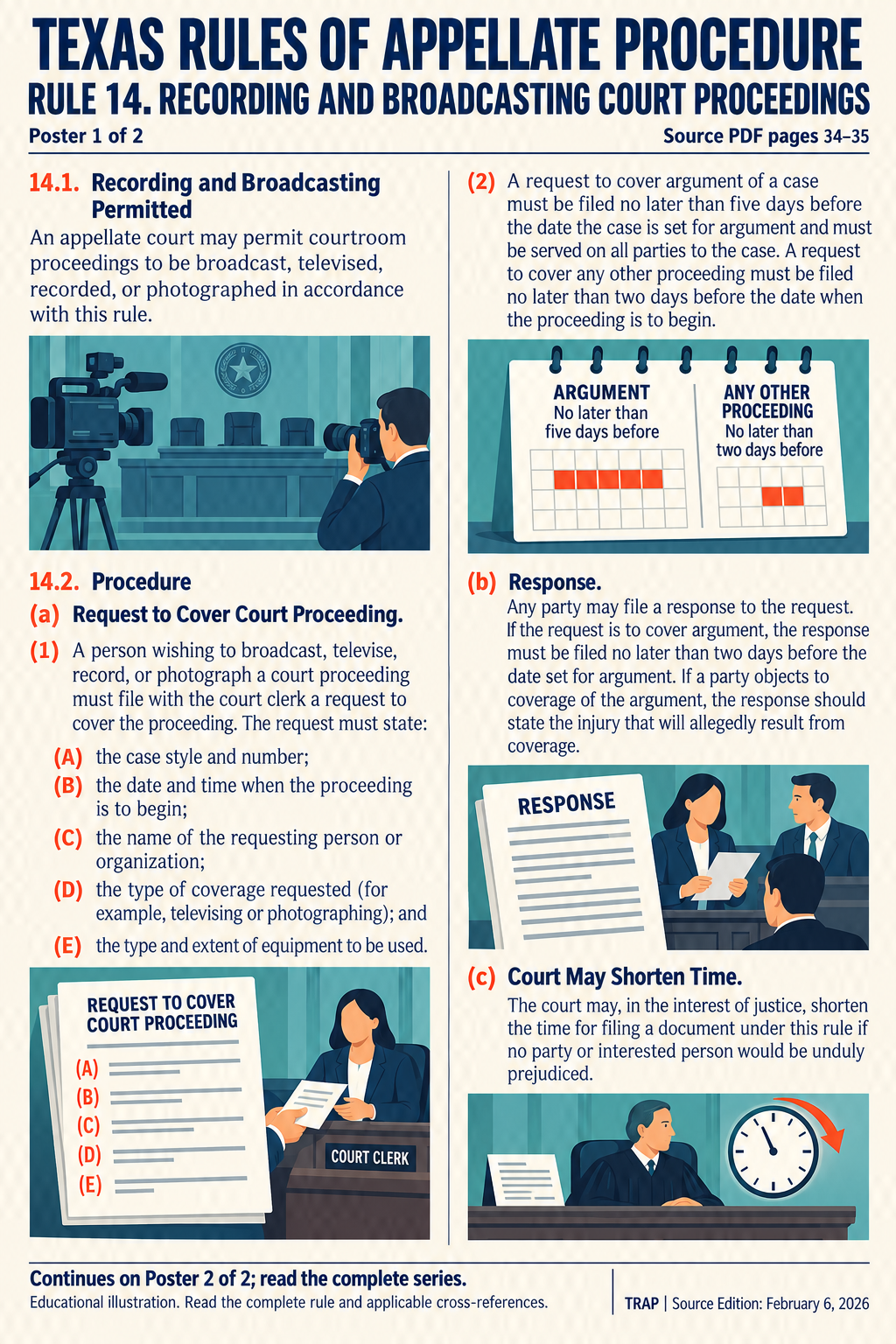
14.1. Recording and Broadcasting Permitted An appellate court may permit courtroom proceedings to be broadcast, televised, recorded, or photographed in accordance with this rule.
14.2. Procedure
(a) Request to Cover Court Proceeding.
(1) A person wishing to broadcast, televise, record, or photograph a court proceeding must file with the court clerk a request to cover the proceeding. The request must state:
(A) the case style and number;
(B) the date and time when the proceeding is to begin;
(C) the name of the requesting person or organization;
(D) the type of coverage requested (for example, televising or photographing); and
(E) the type and extent of equipment to be used.
(2) A request to cover argument of a case must be filed no later than five days before the date the case is set for argument and must be served on all parties to the case. A request to cover any other proceeding must be filed no later than two days before the date when the proceeding is to begin.
(b) Response. Any party may file a response to the request. If the request is to cover argument, the response must be filed no later than two days before the date set for argument. If a party objects to coverage of the argument, the response should state the injury that will allegedly result from coverage.
(c) Court May Shorten Time. The court may, in the interest of justice, shorten the time for filing a document under this rule if no party or interested person would be unduly prejudiced.
Continues on Poster 2 of 2; read the complete series.
Read the court’s coverage conditionsPoster 2 of 2
Read assigned text for Rule 14 poster 2
Assigned rule text
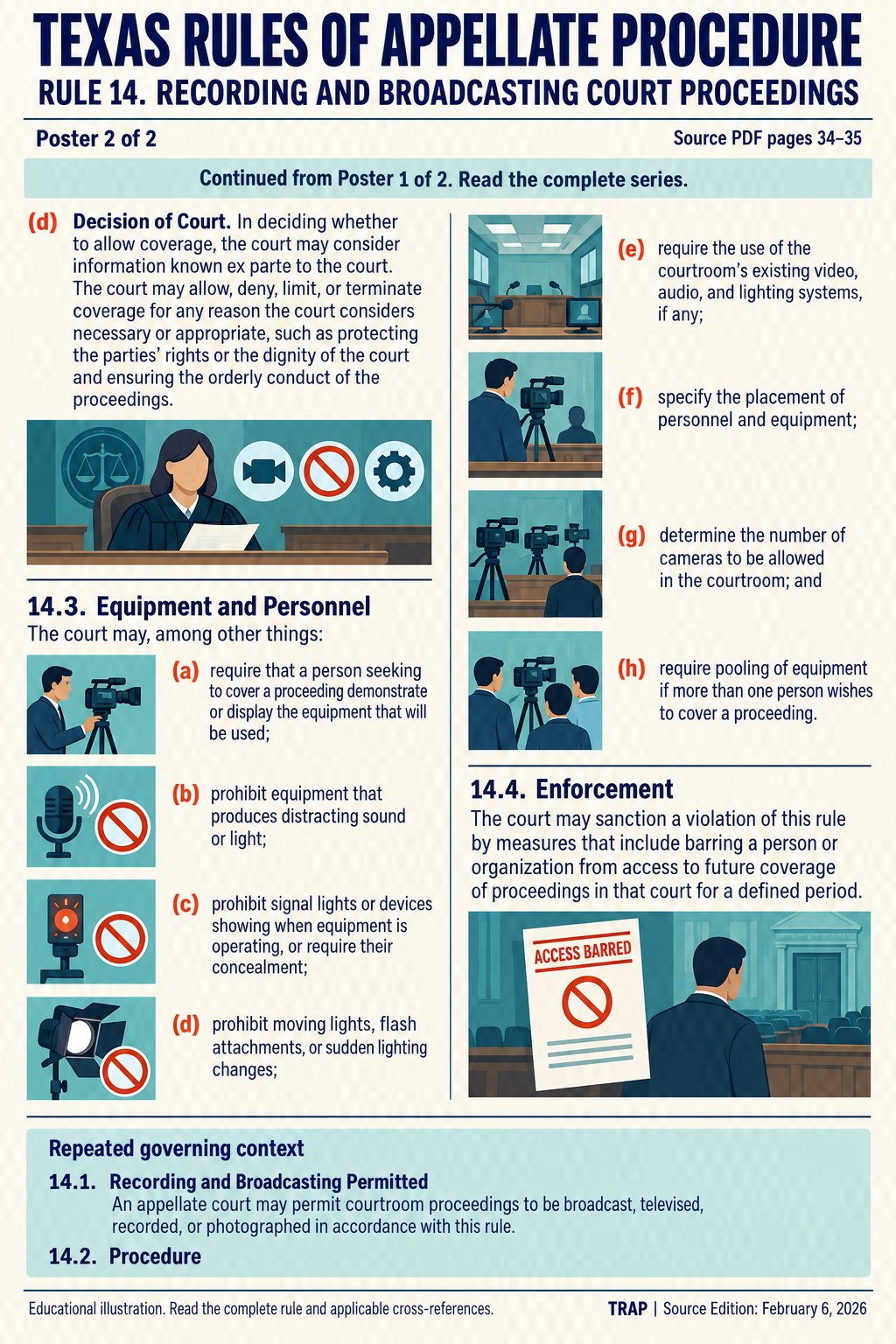
(d) Decision of Court. In deciding whether to allow coverage, the court may consider information known ex parte to the court. The court may allow, deny, limit, or terminate coverage for any reason the court considers necessary or appropriate, such as protecting the parties' rights or the dignity of the court and ensuring the orderly conduct of the proceedings.
14.3. Equipment and Personnel The court may, among other things:
(a) require that a person seeking to cover a proceeding demonstrate or display the equipment that will be used;
(b) prohibit equipment that produces distracting sound or light;
(c) prohibit signal lights or devices showing when equipment is operating, or require their concealment;
(d) prohibit moving lights, flash attachments, or sudden lighting changes;
(e) require the use of the courtroom's existing video, audio, and lighting systems, if any;
(f) specify the placement of personnel and equipment;
(g) determine the number of cameras to be allowed in the courtroom; and
(h) require pooling of equipment if more than one person wishes to cover a proceeding.
14.4. Enforcement The court may sanction a violation of this rule by measures that include barring a person or organization from access to future coverage of proceedings in that court for a defined period.
Repeated governing context
14.1. Recording and Broadcasting Permitted An appellate court may permit courtroom proceedings to be broadcast, televised, recorded, or photographed in accordance with this rule.
14.2. Procedure
Continued from Poster 1 of 2. Read the complete series.
Rule 16. Disqualification Or Recusal Of Appellate Judges
Understand a request for a judge to step asidePoster 1 of 1
Read assigned text for Rule 16 poster 1
Assigned rule text
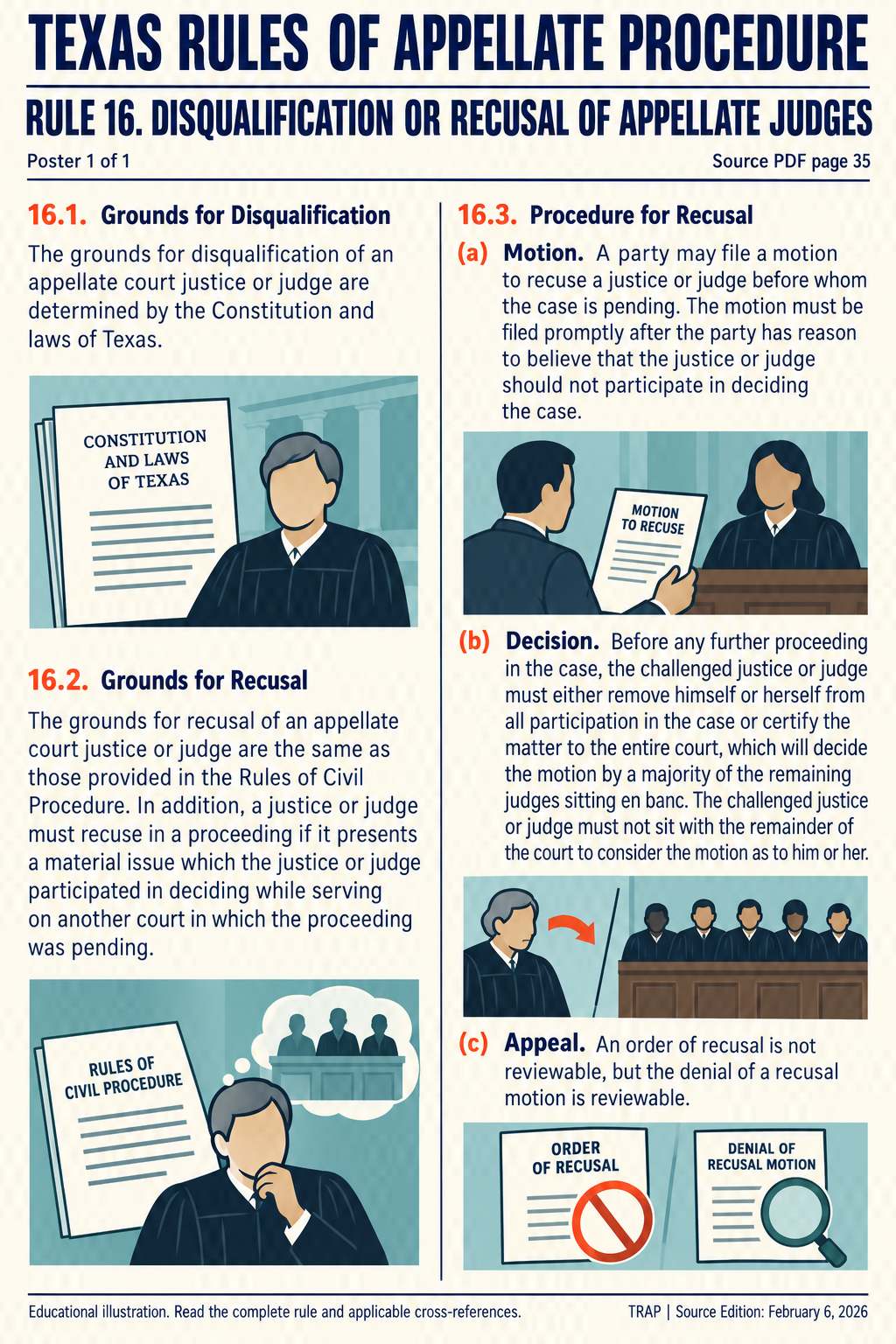
16.1. Grounds for Disqualification The grounds for disqualification of an appellate court justice or judge are determined by the Constitution and laws of Texas.
16.2. Grounds for Recusal The grounds for recusal of an appellate court justice or judge are the same as those provided in the Rules of Civil Procedure. In addition, a justice or judge must recuse in a proceeding if it presents a material issue which the justice or judge participated in deciding while serving on another court in which the proceeding was pending.
16.3. Procedure for Recusal
(a) Motion. A party may file a motion to recuse a justice or judge before whom the case is pending. The motion must be filed promptly after the party has reason to believe that the justice or judge should not participate in deciding the case.
(b) Decision. Before any further proceeding in the case, the challenged justice or judge must either remove himself or herself from all participation in the case or certify the matter to the entire court, which will decide the motion by a majority of the remaining judges sitting en banc. The challenged justice or judge must not sit with the remainder of the court to consider the motion as to him or her.
(c) Appeal. An order of recusal is not reviewable, but the denial of a recusal motion is reviewable.
Rule 17. Court Of Appeals Unable To Take Immediate Action
Find the procedure when the court cannot act in timePoster 1 of 1
Read assigned text for Rule 17 poster 1
Assigned rule text
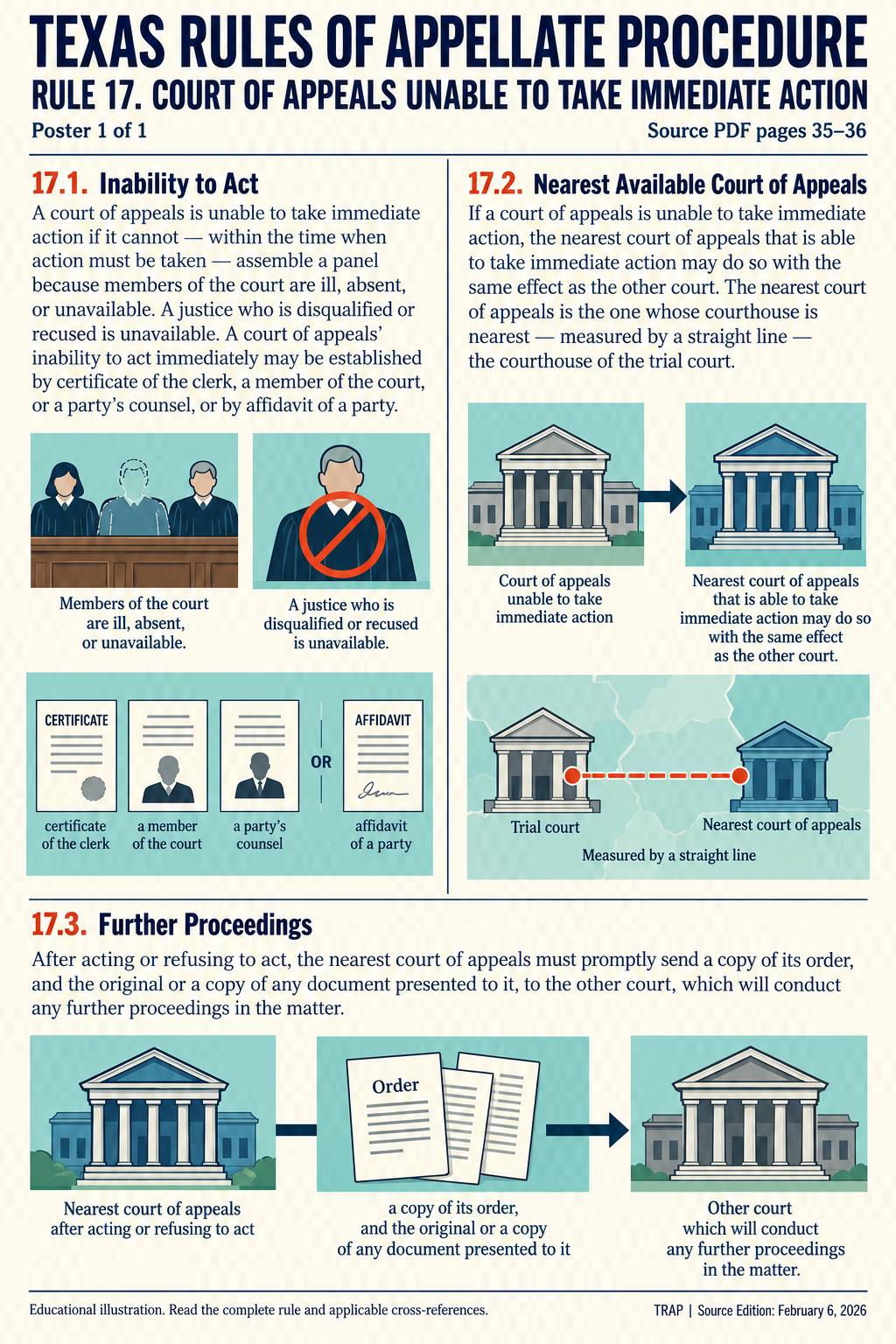
17.1. Inability to Act A court of appeals is unable to take immediate action if it cannot — within the time when action must be taken — assemble a panel because members of the court are ill, absent, or unavailable. A justice who is disqualified or recused is unavailable. A court of appeals’ inability to act immediately may be established by certificate of the clerk, a member of the court, or a party’s counsel, or by affidavit of a party.
17.2. Nearest Available Court of Appeals If a court of appeals is unable to take immediate action, the nearest court of appeals that is able to take immediate action may do so with the same effect as the other court. The nearest court of appeals is the one whose courthouse is nearest — measured by a straight line — the courthouse of the trial court.
17.3. Further Proceedings After acting or refusing to act, the nearest court of appeals must promptly send a copy of its order, and the original or a copy of any document presented to it, to the other court, which will conduct any further proceedings in the matter.
Rule 19. Plenary Power Of The Courts Of Appeals And Expiration Of Term
Check the court’s power after judgmentPoster 1 of 1
Read assigned text for Rule 19 poster 1
Assigned rule text
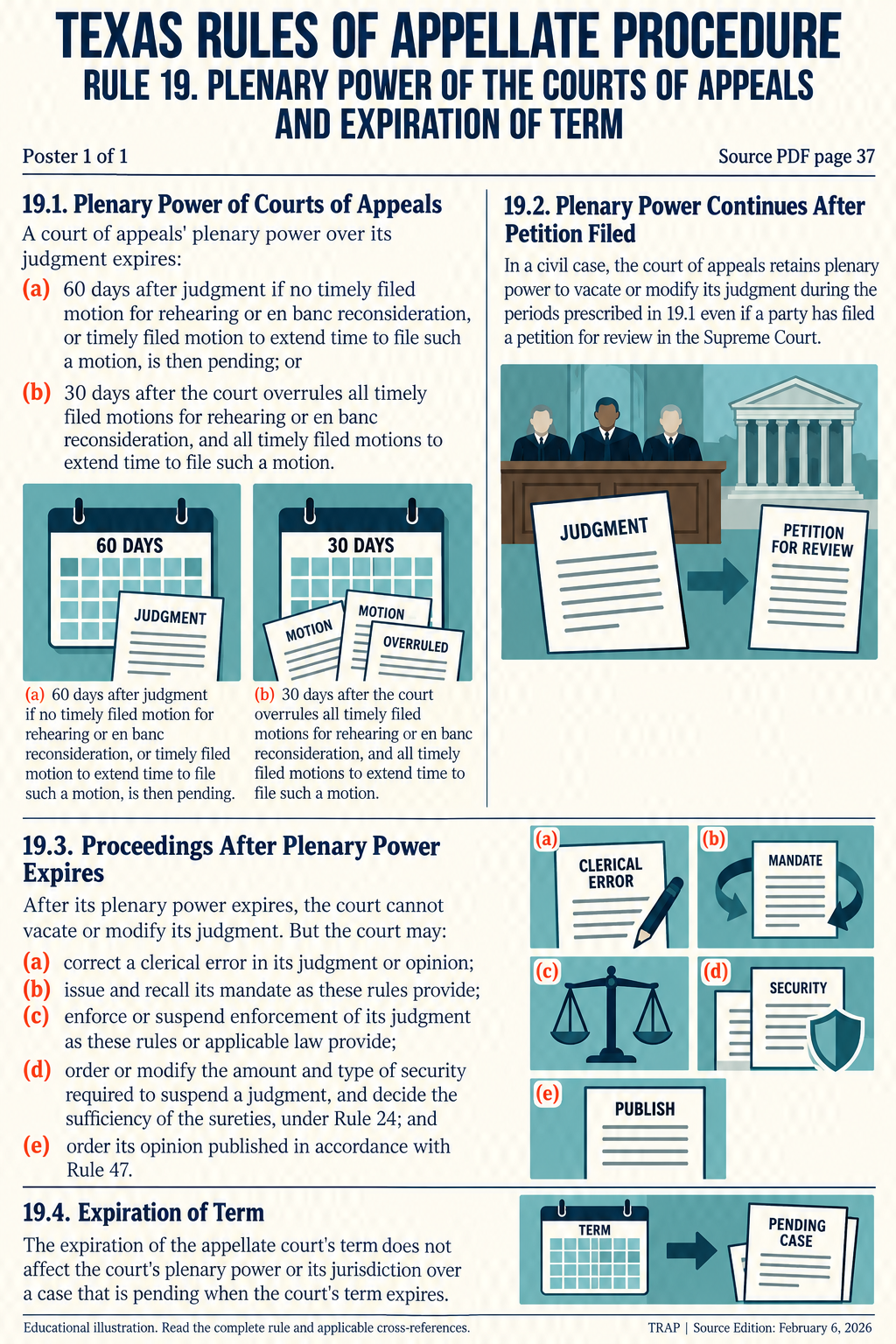
19.1. Plenary Power of Courts of Appeals A court of appeals' plenary power over its judgment expires:
(a) 60 days after judgment if no timely filed motion for rehearing or en banc reconsideration, or timely filed motion to extend time to file such a motion, is then pending; or
(b) 30 days after the court overrules all timely filed motions for rehearing or en banc reconsideration, and all timely filed motions to extend time to file such a motion.
19.2. Plenary Power Continues After Petition Filed In a civil case, the court of appeals retains plenary power to vacate or modify its judgment during the periods prescribed in 19.1 even if a party has filed a petition for review in the Supreme Court.
19.3. Proceedings After Plenary Power Expires After its plenary power expires, the court cannot vacate or modify its judgment. But the court may:
(a) correct a clerical error in its judgment or opinion;
(b) issue and recall its mandate as these rules provide;
(c) enforce or suspend enforcement of its judgment as these rules or applicable law provide;
(d) order or modify the amount and type of security required to suspend a judgment, and decide the sufficiency of the sureties, under Rule 24; and
(e) order its opinion published in accordance with Rule 47.
19.4. Expiration of Term The expiration of the appellate court's term does not affect the court's plenary power or its jurisdiction over a case that is pending when the court's term expires.
Rule 20. When Party Is Indigent
Rule 20. When Party Is Indigent — poster 1Poster 1 of 3
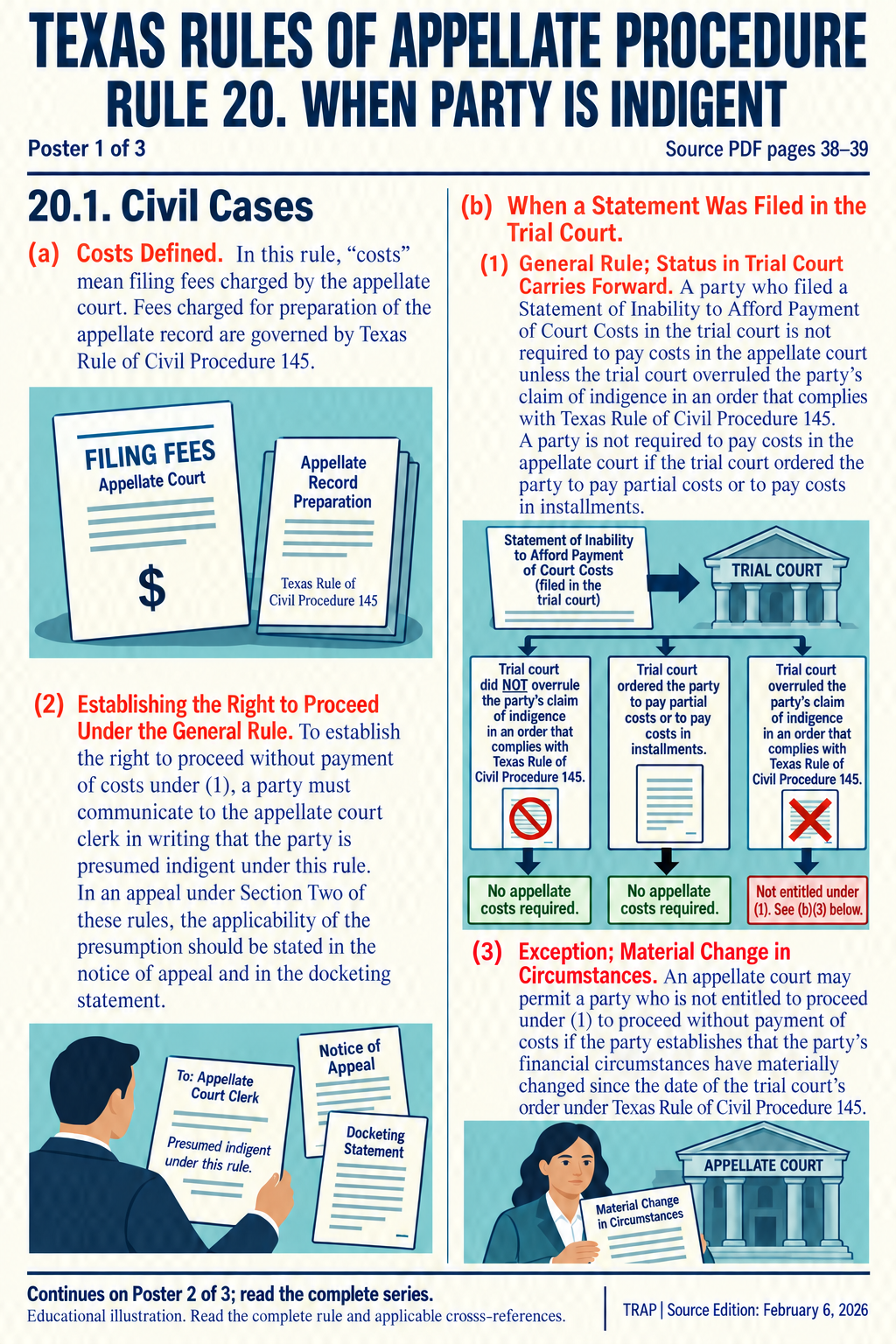
Read assigned text for Rule 20 poster 1
Assigned rule text
20.1. Civil Cases
(a) Costs Defined. In this rule, “costs” mean filing fees charged by the appellate court. Fees charged for preparation of the appellate record are governed by Texas Rule of Civil Procedure 145.
(b) When a Statement Was Filed in the Trial Court.
(1) General Rule; Status in Trial Court Carries Forward. A party who filed a Statement of Inability to Afford Payment of Court Costs in the trial court is not required to pay costs in the appellate court unless the trial court overruled the party’s claim of indigence in an order that complies with Texas Rule of Civil Procedure 145. A party is not required to pay costs in the appellate court if the trial court ordered the party to pay partial costs or to pay costs in installments.
(2) Establishing the Right to Proceed Under the General Rule. To establish the right to proceed without payment of costs under (1), a party must communicate to the appellate court clerk in writing that the party is presumed indigent under this rule. In an appeal under Section Two of these rules, the applicability of the presumption should be stated in the notice of appeal and in the docketing statement.
(3) Exception; Material Change in Circumstances. An appellate court may permit a party who is not entitled to proceed under (1) to proceed without payment of costs if the party establishes that the party’s financial circumstances have materially changed since the date of the trial court’s order under Texas Rule of Civil Procedure 145.
Continues on Poster 2 of 3; read the complete series.
Request relief from appellate filing costsPoster 2 of 3
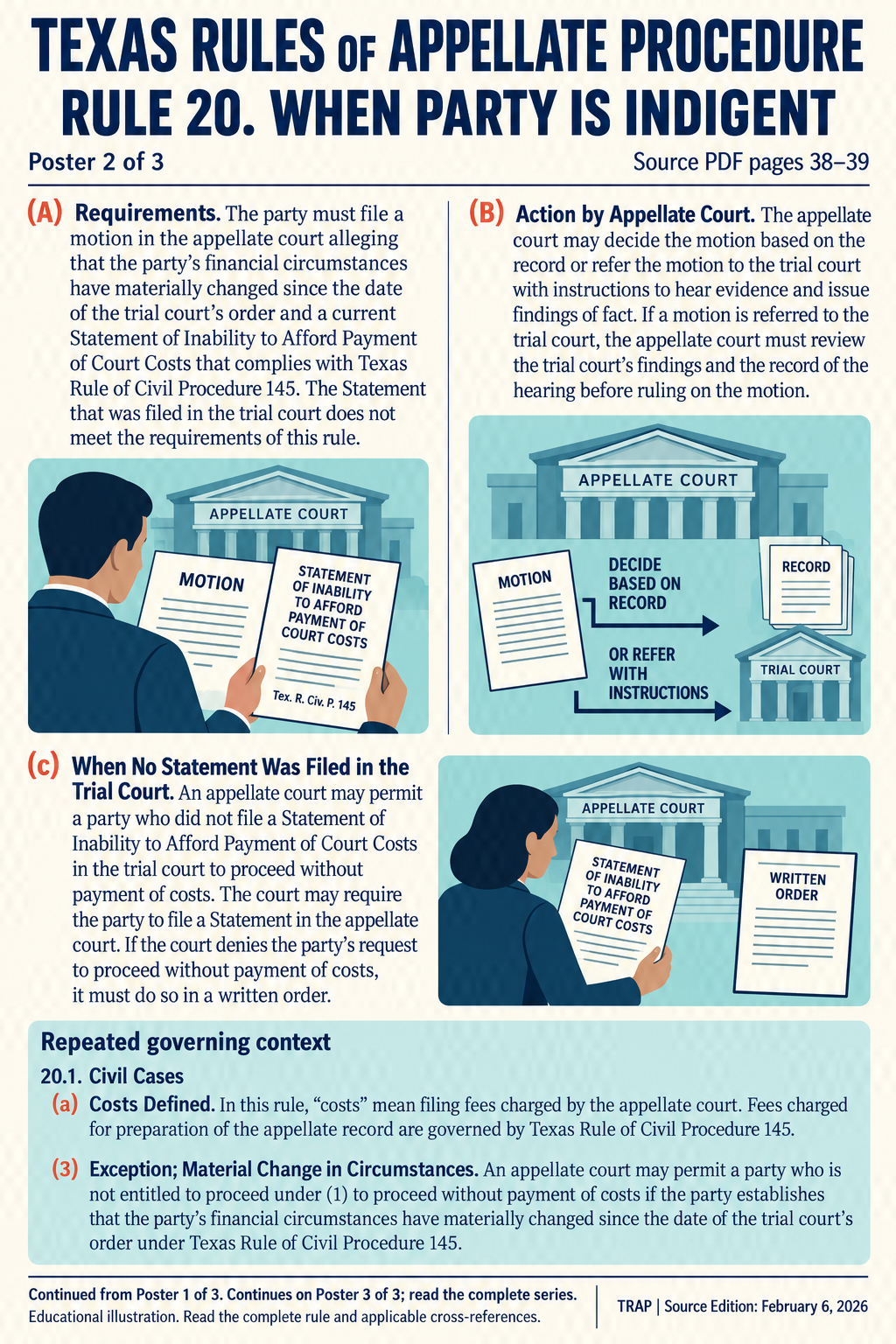
Read assigned text for Rule 20 poster 2
Assigned rule text
(A) Requirements. The party must file a motion in the appellate court alleging that the party’s financial circumstances have materially changed since the date of the trial court’s order and a current Statement of Inability to Afford Payment of Court Costs that complies with Texas Rule of Civil Procedure 145. The Statement that was filed in the trial court does not meet the requirements of this rule.
(B) Action by Appellate Court. The appellate court may decide the motion based on the record or refer the motion to the trial court with instructions to hear evidence and issue findings of fact. If a motion is referred to the trial court, the appellate court must review the trial court’s findings and the record of the hearing before ruling on the motion.
(c) When No Statement Was Filed in the Trial Court. An appellate court may permit a party who did not file a Statement of Inability to Afford Payment of Court Costs in the trial court to proceed without payment of costs. The court may require the party to file a Statement in the appellate court. If the court denies the party’s request to proceed without payment of costs, it must do so in a written order.
Repeated governing context
20.1. Civil Cases
(a) Costs Defined. In this rule, “costs” mean filing fees charged by the appellate court. Fees charged for preparation of the appellate record are governed by Texas Rule of Civil Procedure 145.
(3) Exception; Material Change in Circumstances. An appellate court may permit a party who is not entitled to proceed under (1) to proceed without payment of costs if the party establishes that the party’s financial circumstances have materially changed since the date of the trial court’s order under Texas Rule of Civil Procedure 145.
Continued from Poster 1 of 3. Continues on Poster 3 of 3; read the complete series.
Request a criminal appellate record without paymentPoster 3 of 3
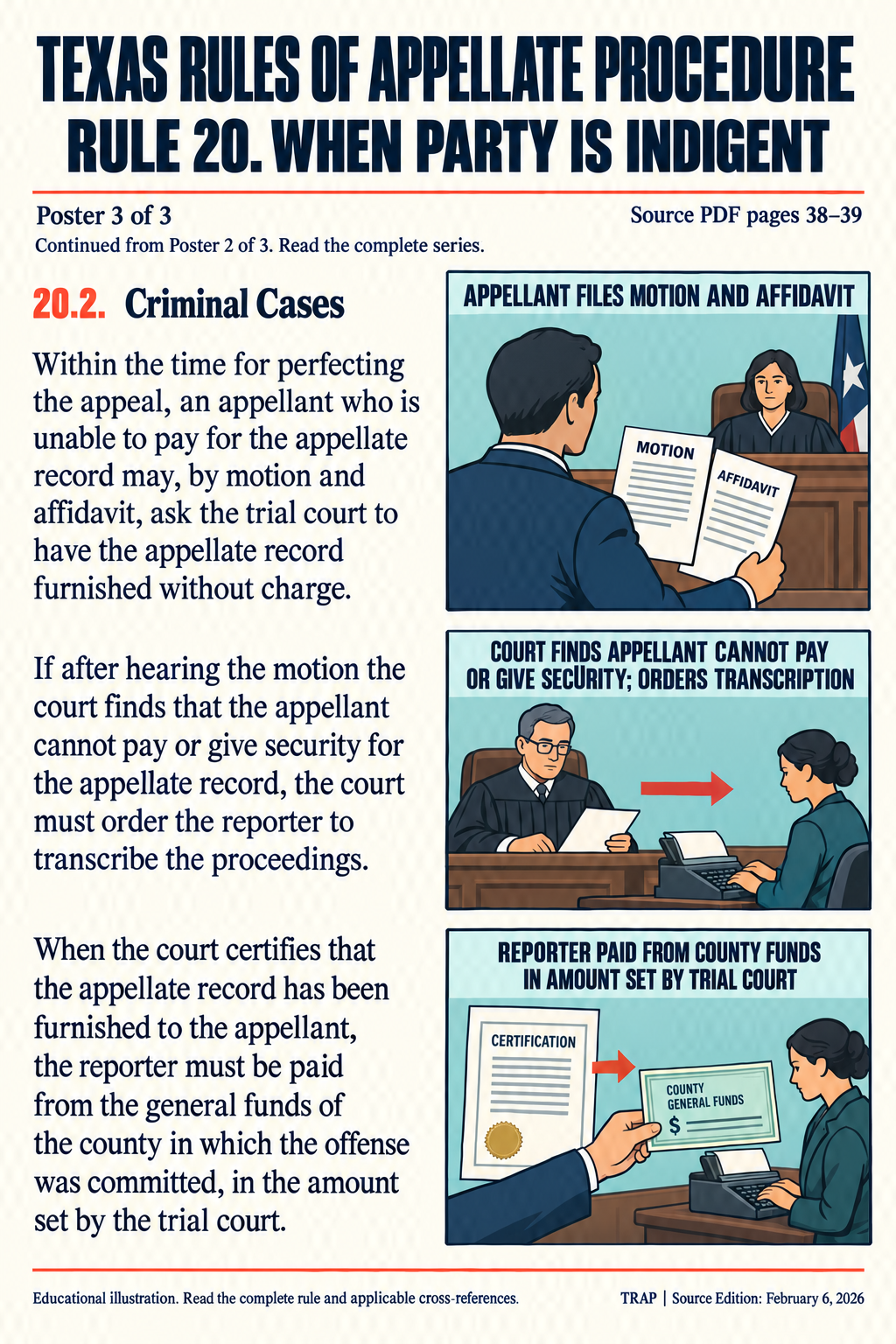
Read assigned text for Rule 20 poster 3
Assigned rule text
20.2. Criminal Cases Within the time for perfecting the appeal, an appellant who is unable to pay for the appellate record may, by motion and affidavit, ask the trial court to have the appellate record furnished without charge. If after hearing the motion the court finds that the appellant cannot pay or give security for the appellate record, the court must order the reporter to transcribe the proceedings. When the court certifies that the appellate record has been furnished to the appellant, the reporter must be paid from the general funds of the county in which the offense was committed, in the amount set by the trial court.
Continued from Poster 2 of 3. Read the complete series.
Rule 21. New Trials In Criminal Cases
Identify a criminal new-trial motion and its groundsPoster 1 of 4
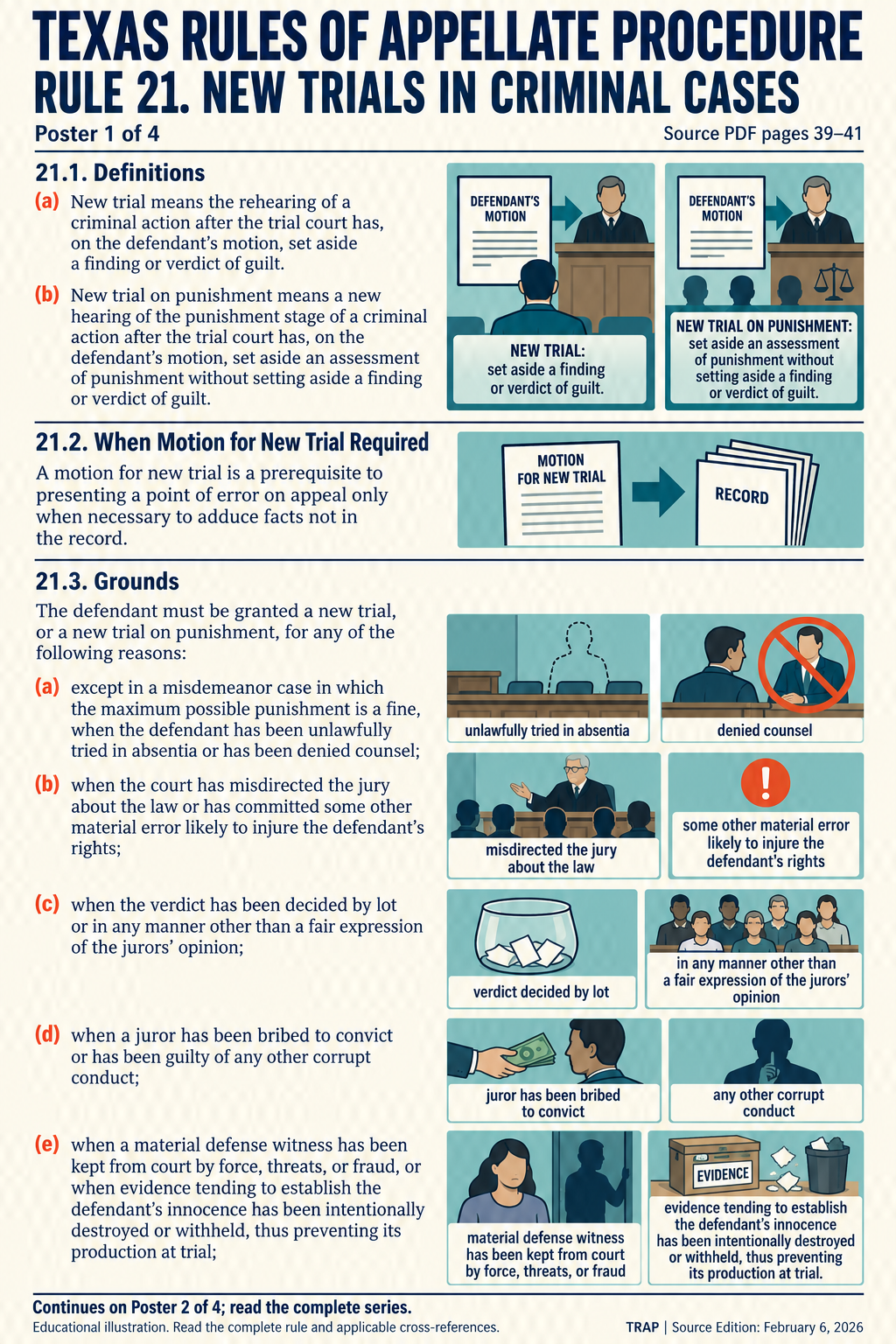
Read assigned text for Rule 21 poster 1
Assigned rule text
21.1. Definitions
(a) New trial means the rehearing of a criminal action after the trial court has, on the defendant's motion, set aside a finding or verdict of guilt.
(b) New trial on punishment means a new hearing of the punishment stage of a criminal action after the trial court has, on the defendant's motion, set aside an assessment of punishment without setting aside a finding or verdict of guilt.
21.2. When Motion for New Trial Required A motion for new trial is a prerequisite to presenting a point of error on appeal only when necessary to adduce facts not in the record.
21.3. Grounds The defendant must be granted a new trial, or a new trial on punishment, for any of the following reasons:
(a) except in a misdemeanor case in which the maximum possible punishment is a fine, when the defendant has been unlawfully tried in absentia or has been denied counsel;
(b) when the court has misdirected the jury about the law or has committed some other material error likely to injure the defendant's rights;
(c) when the verdict has been decided by lot or in any manner other than a fair expression of the jurors' opinion;
(d) when a juror has been bribed to convict or has been guilty of any other corrupt conduct;
(e) when a material defense witness has been kept from court by force, threats, or fraud, or when evidence tending to establish the defendant's innocence has been intentionally destroyed or withheld, thus preventing its production at trial;
Continues on Poster 2 of 4; read the complete series.
Check criminal new-trial grounds and presentmentPoster 2 of 4
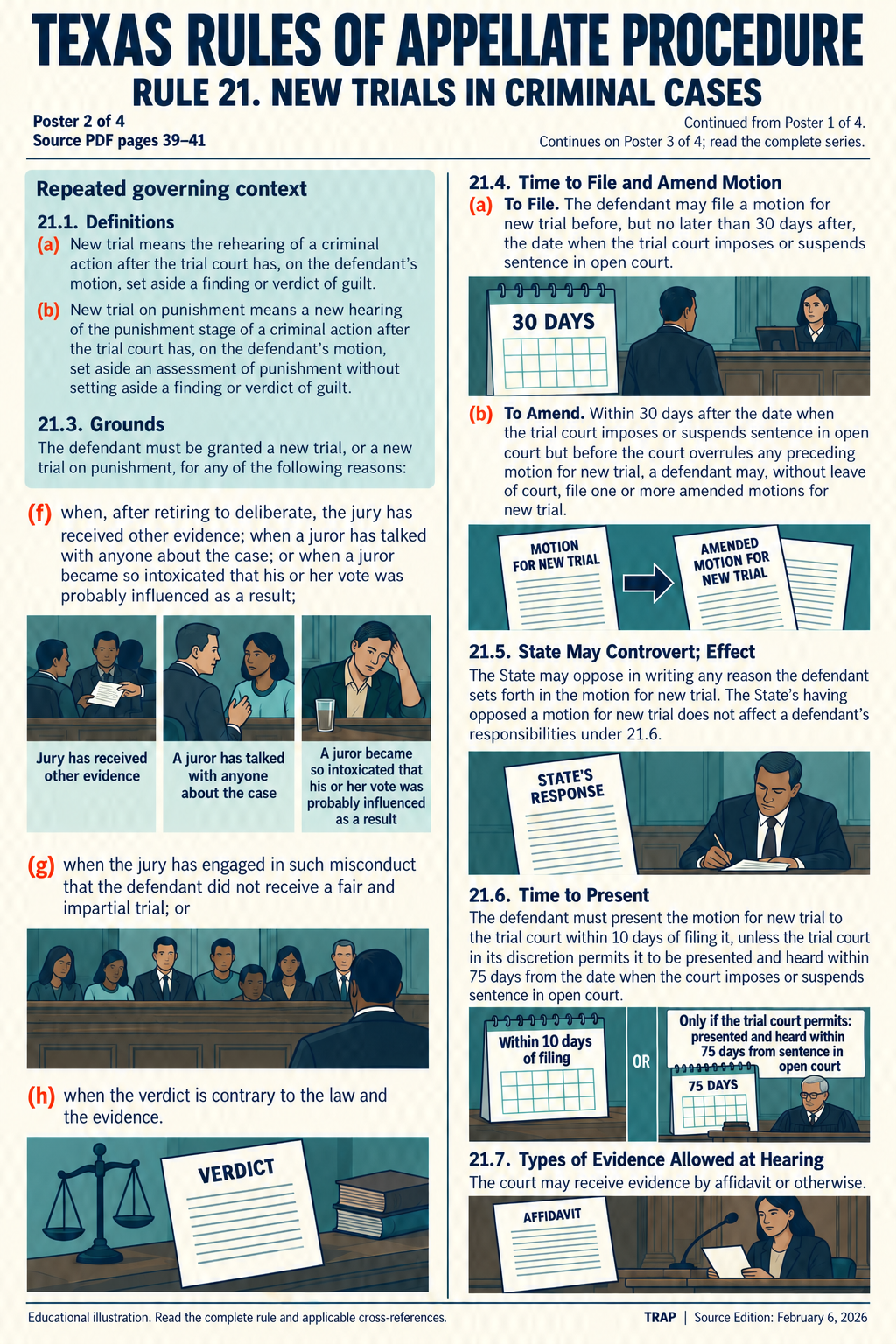
Read assigned text for Rule 21 poster 2
Assigned rule text
(f) when, after retiring to deliberate, the jury has received other evidence; when a juror has talked with anyone about the case; or when a juror became so intoxicated that his or her vote was probably influenced as a result;
(g) when the jury has engaged in such misconduct that the defendant did not receive a fair and impartial trial; or
(h) when the verdict is contrary to the law and the evidence.
21.4. Time to File and Amend Motion
(a) To File. The defendant may file a motion for new trial before, but no later than 30 days after, the date when the trial court imposes or suspends sentence in open court.
(b) To Amend. Within 30 days after the date when the trial court imposes or suspends sentence in open court but before the court overrules any preceding motion for new trial, a defendant may, without leave of court, file one or more amended motions for new trial.
21.5. State May Controvert; Effect The State may oppose in writing any reason the defendant sets forth in the motion for new trial. The State's having opposed a motion for new trial does not affect a defendant's responsibilities under 21.6.
21.6. Time to Present The defendant must present the motion for new trial to the trial court within 10 days of filing it, unless the trial court in its discretion permits it to be presented and heard within 75 days from the date when the court imposes or suspends sentence in open court.
21.7. Types of Evidence Allowed at Hearing The court may receive evidence by affidavit or otherwise.
Repeated governing context
21.1. Definitions
(a) New trial means the rehearing of a criminal action after the trial court has, on the defendant's motion, set aside a finding or verdict of guilt.
(b) New trial on punishment means a new hearing of the punishment stage of a criminal action after the trial court has, on the defendant's motion, set aside an assessment of punishment without setting aside a finding or verdict of guilt.
21.3. Grounds The defendant must be granted a new trial, or a new trial on punishment, for any of the following reasons:
Continued from Poster 1 of 4. Continues on Poster 3 of 4; read the complete series.
Check the criminal new-trial ruling and deadlinePoster 3 of 4
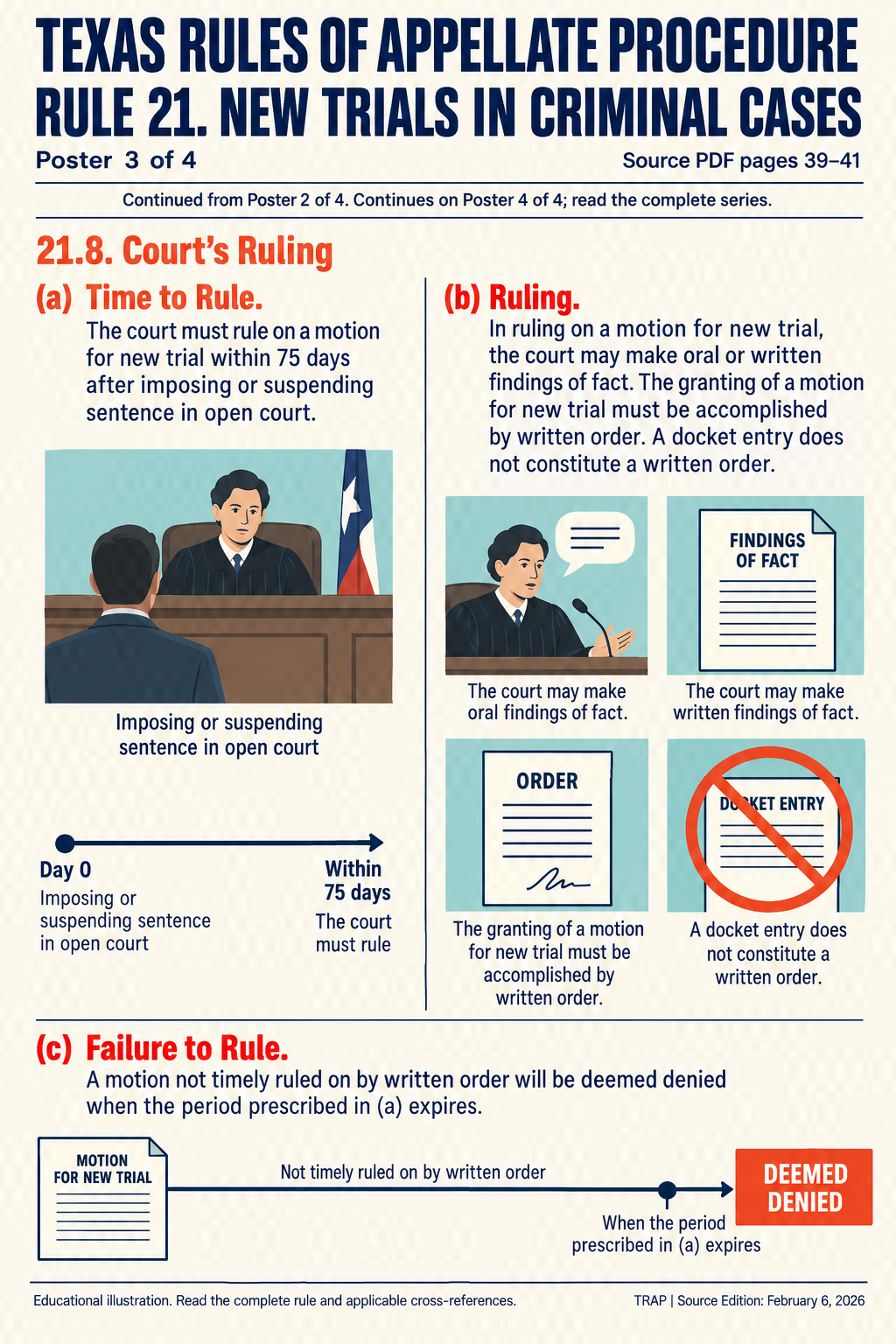
Read assigned text for Rule 21 poster 3
Assigned rule text
21.8. Court's Ruling
(a) Time to Rule. The court must rule on a motion for new trial within 75 days after imposing or suspending sentence in open court.
(b) Ruling. In ruling on a motion for new trial, the court may make oral or written findings of fact. The granting of a motion for new trial must be accomplished by written order. A docket entry does not constitute a written order.
(c) Failure to Rule. A motion not timely ruled on by written order will be deemed denied when the period prescribed in (a) expires.
Continued from Poster 2 of 4. Continues on Poster 4 of 4; read the complete series.
Understand the effect of a criminal new trialPoster 4 of 4
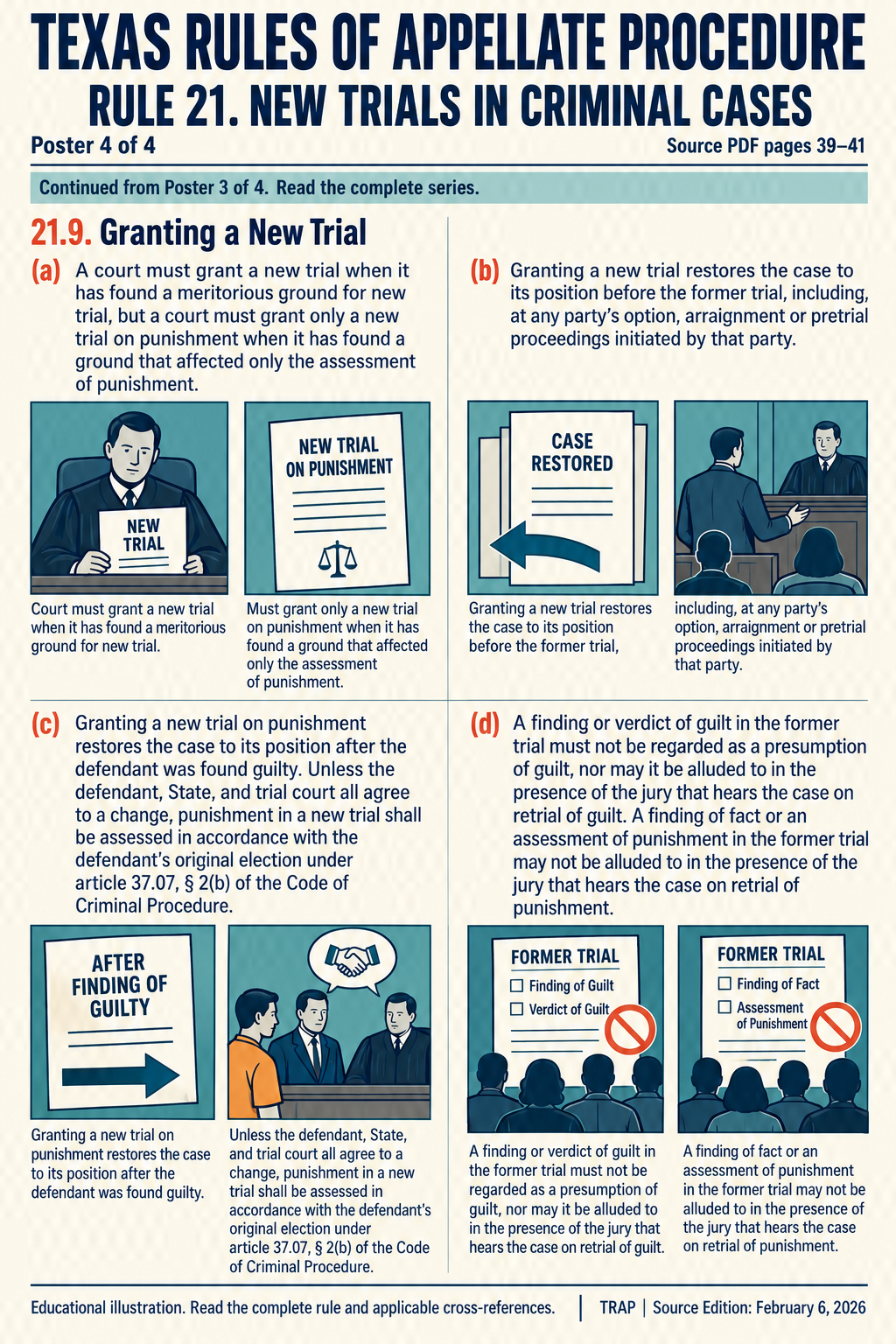
Read assigned text for Rule 21 poster 4
Assigned rule text
21.9. Granting a New Trial
(a) A court must grant a new trial when it has found a meritorious ground for new trial, but a court must grant only a new trial on punishment when it has found a ground that affected only the assessment of punishment.
(b) Granting a new trial restores the case to its position before the former trial, including, at any party's option, arraignment or pretrial proceedings initiated by that party.
(c) Granting a new trial on punishment restores the case to its position after the defendant was found guilty. Unless the defendant, State, and trial court all agree to a change, punishment in a new trial shall be assessed in accordance with the defendant's original election under article 37.07, § 2(b) of the Code of Criminal Procedure.
(d) A finding or verdict of guilt in the former trial must not be regarded as a presumption of guilt, nor may it be alluded to in the presence of the jury that hears the case on retrial of guilt. A finding of fact or an assessment of punishment in the former trial may not be alluded to in the presence of the jury that hears the case on retrial of punishment.
Continued from Poster 3 of 4. Read the complete series.
Rule 22. Arrest Of Judgment In Criminal Cases
Identify a motion in arrest of judgmentPoster 1 of 2
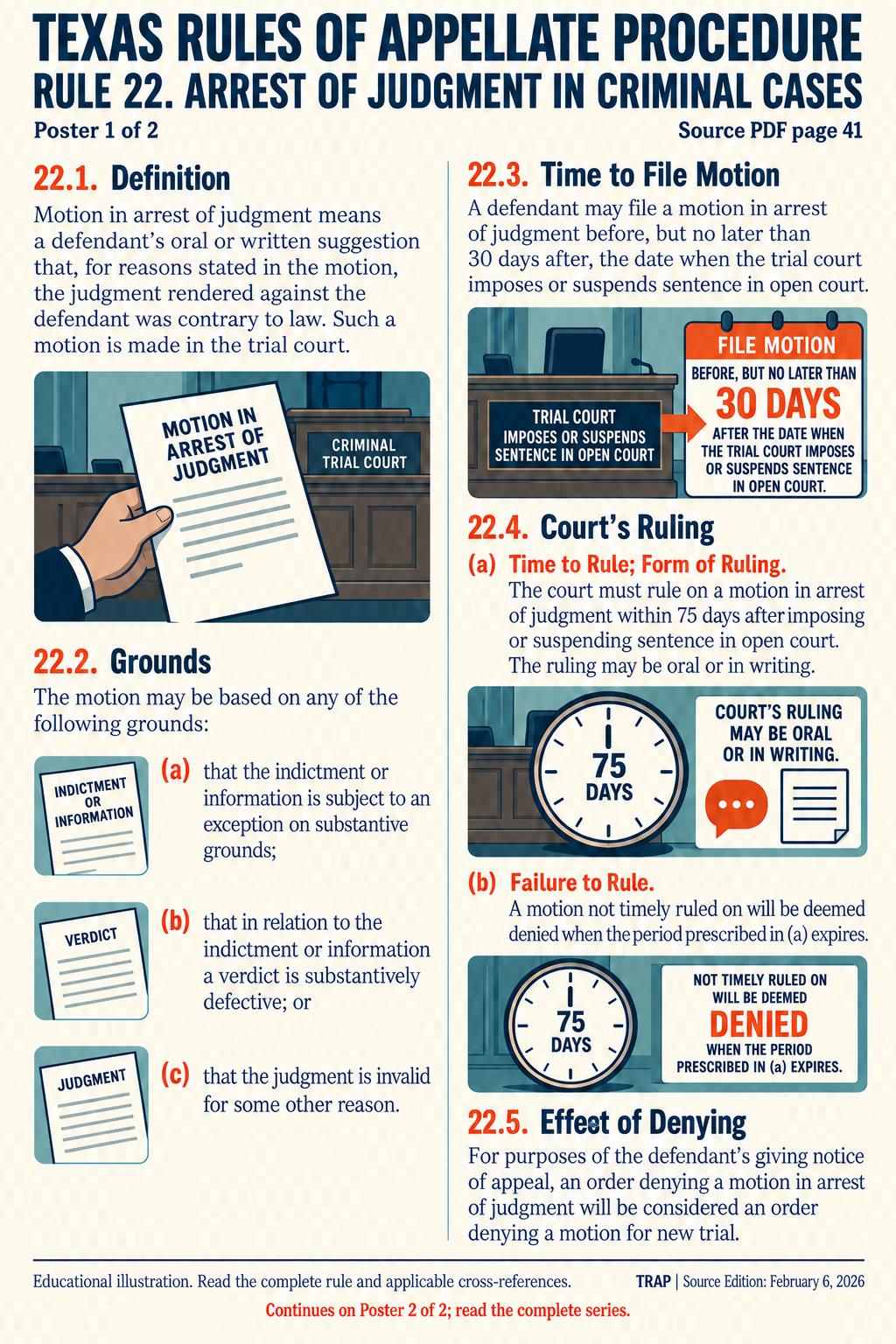
Read assigned text for Rule 22 poster 1
Assigned rule text
22.1. Definition Motion in arrest of judgment means a defendant's oral or written suggestion that, for reasons stated in the motion, the judgment rendered against the defendant was contrary to law. Such a motion is made in the trial court.
22.2. Grounds The motion may be based on any of the following grounds:
(a) that the indictment or information is subject to an exception on substantive grounds;
(b) that in relation to the indictment or information a verdict is substantively defective; or
(c) that the judgment is invalid for some other reason.
22.3. Time to File Motion A defendant may file a motion in arrest of judgment before, but no later than 30 days after, the date when the trial court imposes or suspends sentence in open court.
22.4. Court's Ruling
(a) Time to Rule; Form of Ruling. The court must rule on a motion in arrest of judgment within 75 days after imposing or suspending sentence in open court. The ruling may be oral or in writing.
(b) Failure to Rule. A motion not timely ruled on will be deemed denied when the period prescribed in (a) expires.
22.5. Effect of Denying For purposes of the defendant's giving notice of appeal, an order denying a motion in arrest of judgment will be considered an order denying a motion for new trial.
Continues on Poster 2 of 2; read the complete series.
Rule 22. Arrest Of Judgment In Criminal Cases — poster 2Poster 2 of 2
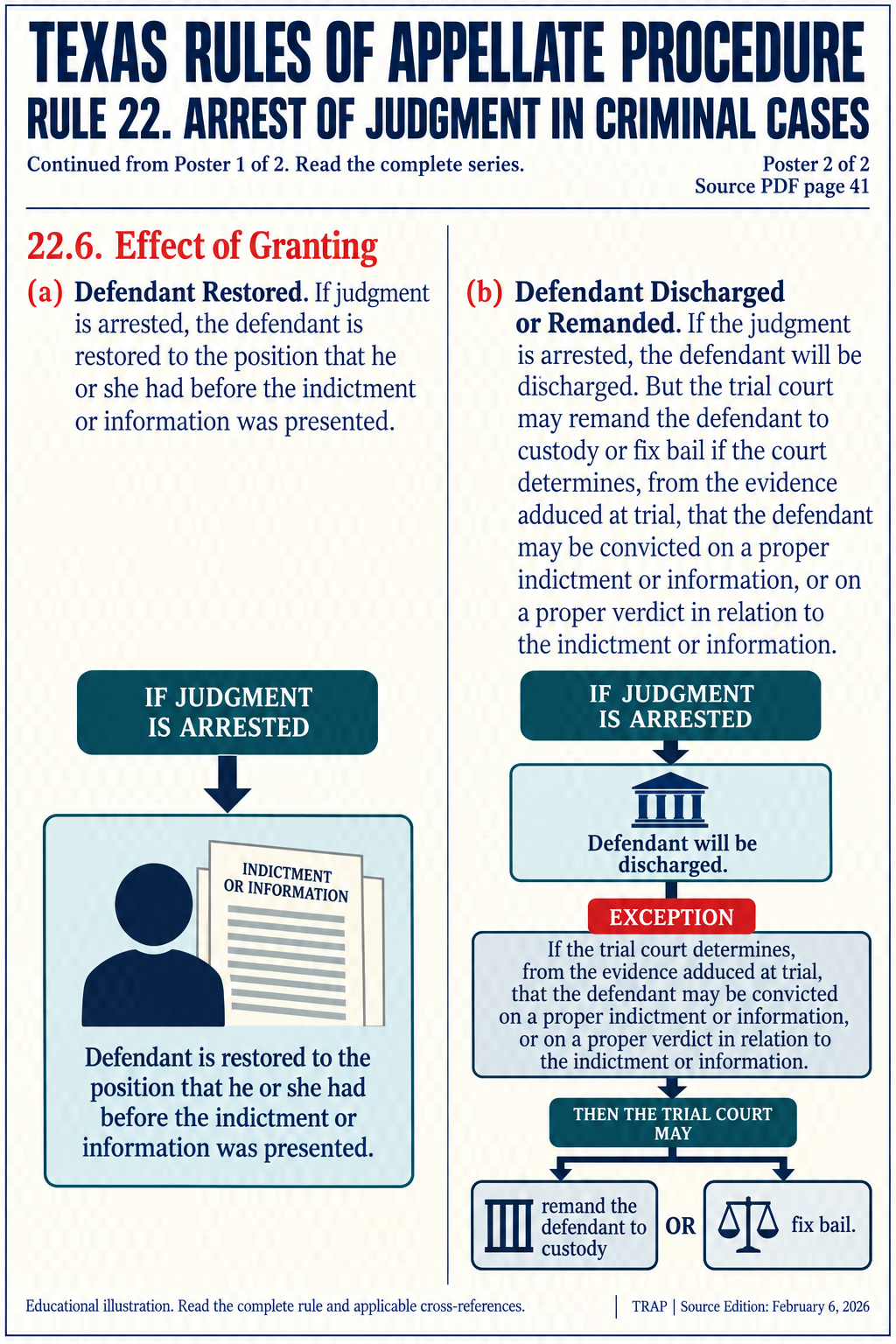
Read assigned text for Rule 22 poster 2
Assigned rule text
22.6. Effect of Granting
(a) Defendant Restored. If judgment is arrested, the defendant is restored to the position that he or she had before the indictment or information was presented.
(b) Defendant Discharged or Remanded. If the judgment is arrested, the defendant will be discharged. But the trial court may remand the defendant to custody or fix bail if the court determines, from the evidence adduced at trial, that the defendant may be convicted on a proper indictment or information, or on a proper verdict in relation to the indictment or information.
Continued from Poster 1 of 2. Read the complete series.
Rule 24. Suspension Of Enforcement Of Judgment Pending Appeal In Civil Cases
Rule 24. Suspension Of Enforcement Of Judgment Pending Appeal In Civil Cases — poster 1Poster 1 of 10
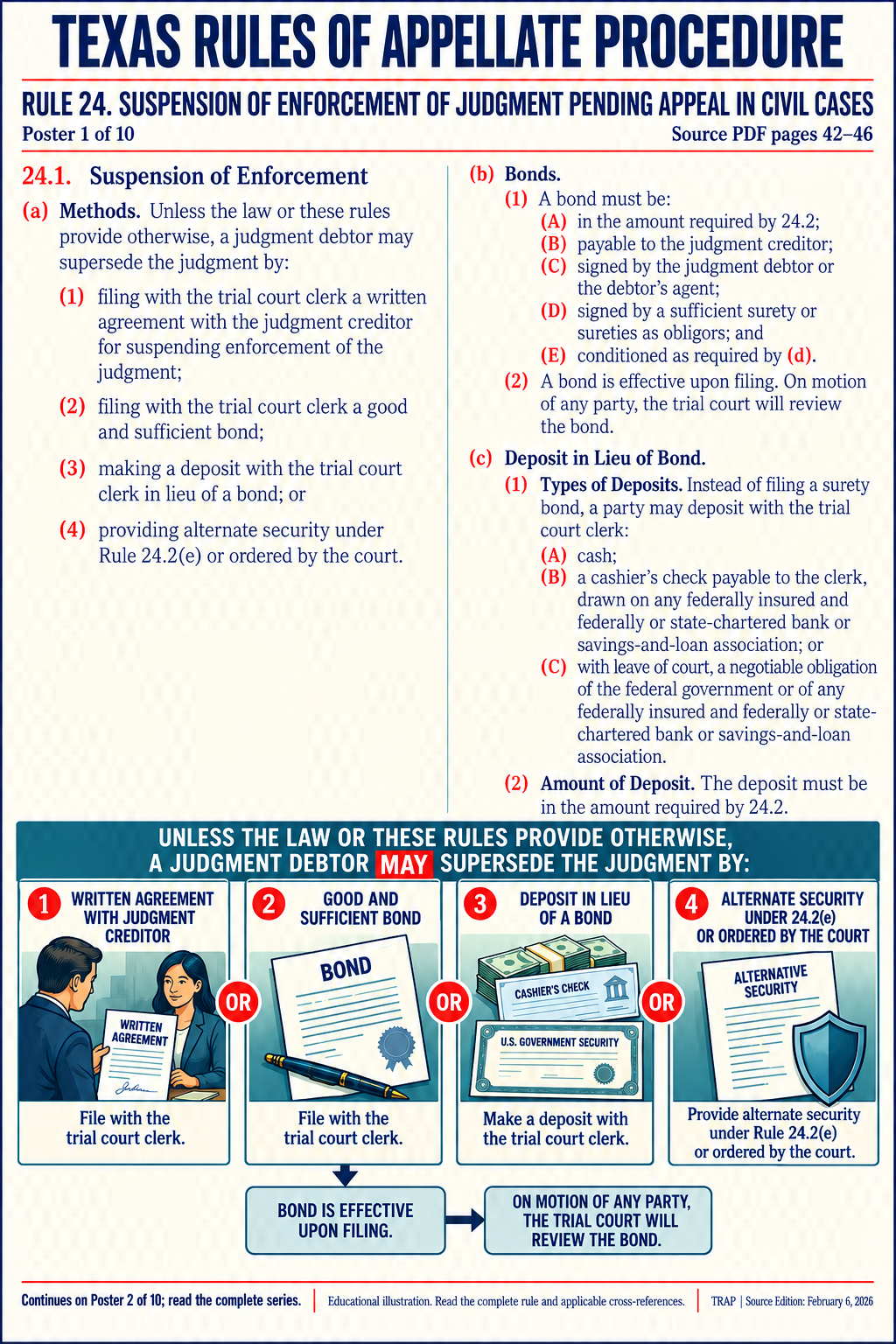
Read assigned text for Rule 24 poster 1
Assigned rule text
24.1. Suspension of Enforcement
(a) Methods. Unless the law or these rules provide otherwise, a judgment debtor may supersede the judgment by:
(1) filing with the trial court clerk a written agreement with the judgment creditor for suspending enforcement of the judgment;
(2) filing with the trial court clerk a good and sufficient bond;
(3) making a deposit with the trial court clerk in lieu of a bond; or
(4) providing alternate security under Rule 24.2(e) or ordered by the court.
(b) Bonds.
(1) A bond must be:
(A) in the amount required by 24.2;
(B) payable to the judgment creditor;
(C) signed by the judgment debtor or the debtor’s agent;
(D) signed by a sufficient surety or sureties as obligors; and
(E) conditioned as required by (d).
(2) A bond is effective upon filing. On motion of any party, the trial court will review the bond.
(c) Deposit in Lieu of Bond.
(1) Types of Deposits. Instead of filing a surety bond, a party may deposit with the trial court clerk:
(A) cash;
(B) a cashier’s check payable to the clerk, drawn on any federally insured and federally or state-chartered bank or savings-and-loan association; or
(C) with leave of court, a negotiable obligation of the federal government or of any federally insured and federally or state-chartered bank or savings-and-loan association.
(2) Amount of Deposit. The deposit must be in the amount required by 24.2.
Continues on Poster 2 of 10; read the complete series.
Rule 24. Suspension Of Enforcement Of Judgment Pending Appeal In Civil Cases — poster 2Poster 2 of 10
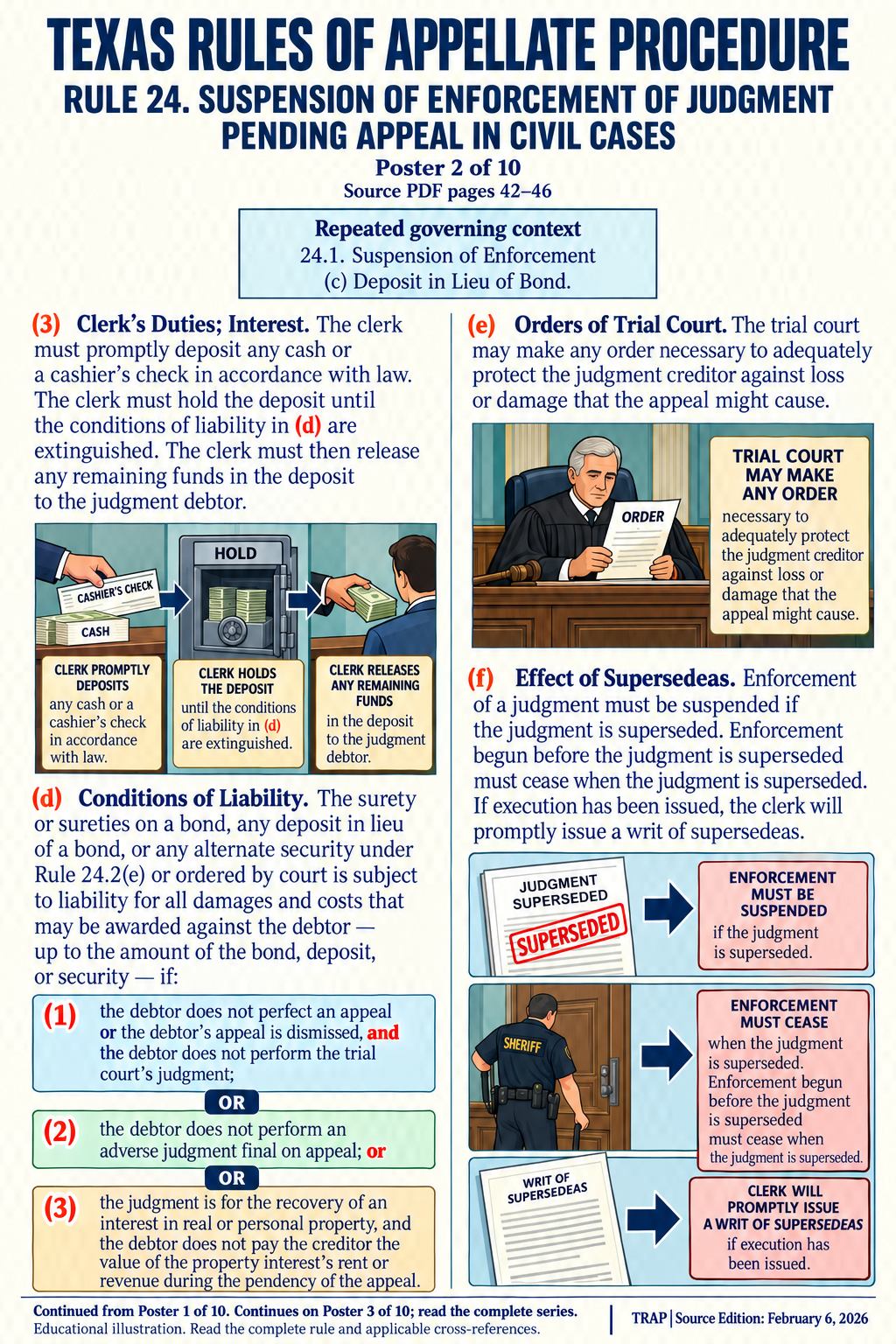
Read assigned text for Rule 24 poster 2
Assigned rule text
(3) Clerk’s Duties; Interest. The clerk must promptly deposit any cash or a cashier’s check in accordance with law. The clerk must hold the deposit until the conditions of liability in (d) are extinguished. The clerk must then release any remaining funds in the deposit to the judgment debtor.
(d) Conditions of Liability. The surety or sureties on a bond, any deposit in lieu of a bond, or any alternate security under Rule 24.2(e) or ordered by court is subject to liability for all damages and costs that may be awarded against the debtor — up to the amount of the bond, deposit, or security — if:
(1) the debtor does not perfect an appeal or the debtor’s appeal is dismissed, and the debtor does not perform the trial court’s judgment;
(2) the debtor does not perform an adverse judgment final on appeal; or
(3) the judgment is for the recovery of an interest in real or personal property, and the debtor does not pay the creditor the value of the property interest’s rent or revenue during the pendency of the appeal.
(e) Orders of Trial Court. The trial court may make any order necessary to adequately protect the judgment creditor against loss or damage that the appeal might cause.
(f) Effect of Supersedeas. Enforcement of a judgment must be suspended if the judgment is superseded. Enforcement begun before the judgment is superseded must cease when the judgment is superseded. If execution has been issued, the clerk will promptly issue a writ of supersedeas.
Repeated governing context
24.1. Suspension of Enforcement
(c) Deposit in Lieu of Bond.
Continued from Poster 1 of 10. Continues on Poster 3 of 10; read the complete series.
Rule 24. Suspension Of Enforcement Of Judgment Pending Appeal In Civil Cases — poster 3Poster 3 of 10
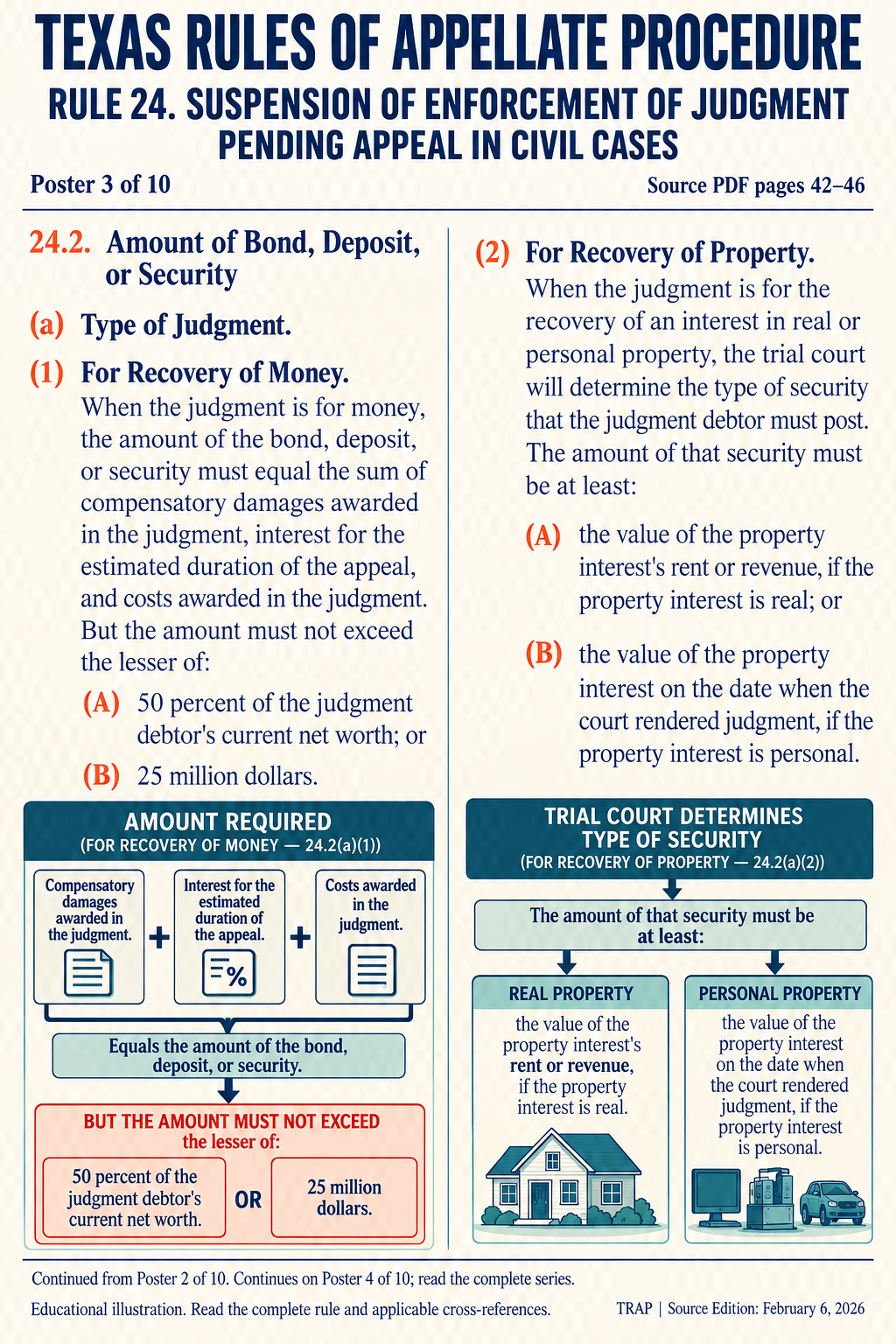
Read assigned text for Rule 24 poster 3
Assigned rule text
24.2. Amount of Bond, Deposit, or Security
(a) Type of Judgment.
(1) For Recovery of Money. When the judgment is for money, the amount of the bond, deposit, or security must equal the sum of compensatory damages awarded in the judgment, interest for the estimated duration of the appeal, and costs awarded in the judgment. But the amount must not exceed the lesser of:
(A) 50 percent of the judgment debtor's current net worth; or
(B) 25 million dollars.
(2) For Recovery of Property. When the judgment is for the recovery of an interest in real or personal property, the trial court will determine the type of security that the judgment debtor must post. The amount of that security must be at least:
(A) the value of the property interest's rent or revenue, if the property interest is real; or
(B) the value of the property interest on the date when the court rendered judgment, if the property interest is personal.
Continued from Poster 2 of 10. Continues on Poster 4 of 10; read the complete series.
Rule 24. Suspension Of Enforcement Of Judgment Pending Appeal In Civil Cases — poster 4Poster 4 of 10
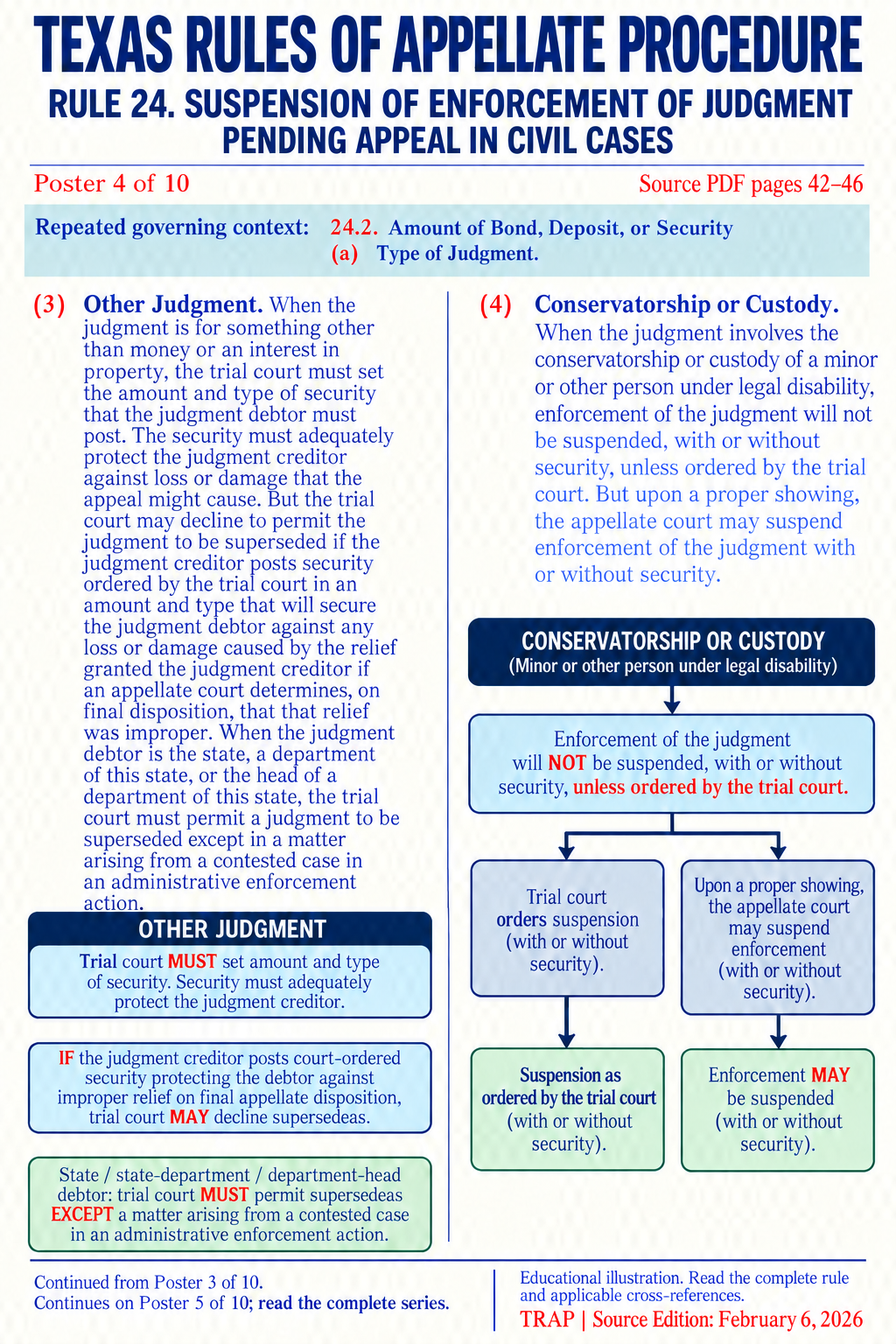
Read assigned text for Rule 24 poster 4
Assigned rule text
(3) Other Judgment. When the judgment is for something other than money or an interest in property, the trial court must set the amount and type of security that the judgment debtor must post. The security must adequately protect the judgment creditor against loss or damage that the appeal might cause. But the trial court may decline to permit the judgment to be superseded if the judgment creditor posts security ordered by the trial court in an amount and type that will secure the judgment debtor against any loss or damage caused by the relief granted the judgment creditor if an appellate court determines, on final disposition, that that relief was improper. When the judgment debtor is the state, a department of this state, or the head of a department of this state, the trial court must permit a judgment to be superseded except in a matter arising from a contested case in an administrative enforcement action.
(4) Conservatorship or Custody. When the judgment involves the conservatorship or custody of a minor or other person under legal disability, enforcement of the judgment will not be suspended, with or without security, unless ordered by the trial court. But upon a proper showing, the appellate court may suspend enforcement of the judgment with or without security.
Repeated governing context
24.2. Amount of Bond, Deposit, or Security
(a) Type of Judgment.
Continued from Poster 3 of 10. Continues on Poster 5 of 10; read the complete series.
Rule 24. Suspension Of Enforcement Of Judgment Pending Appeal In Civil Cases — poster 5Poster 5 of 10
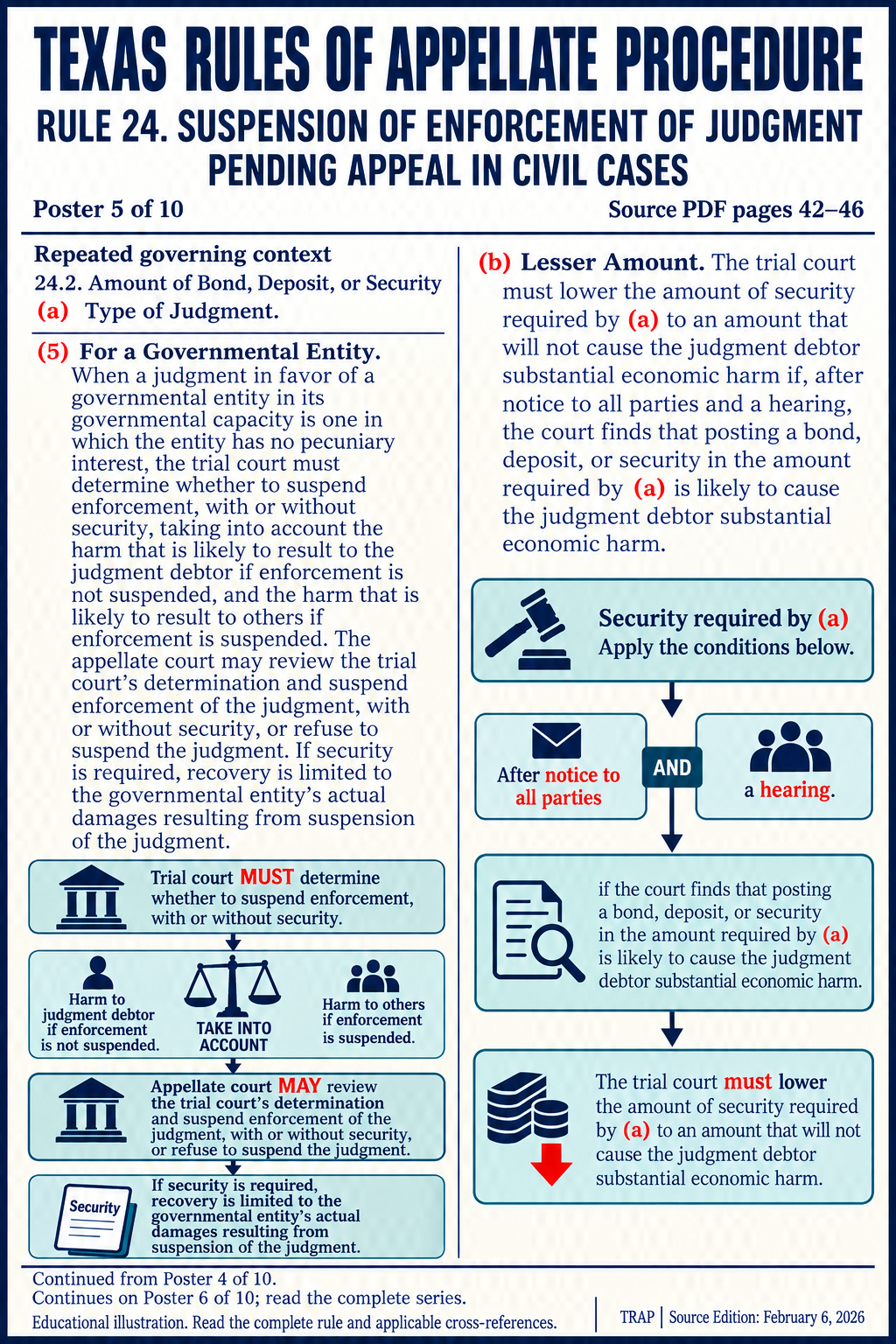
Read assigned text for Rule 24 poster 5
Assigned rule text
(5) For a Governmental Entity. When a judgment in favor of a governmental entity in its governmental capacity is one in which the entity has no pecuniary interest, the trial court must determine whether to suspend enforcement, with or without security, taking into account the harm that is likely to result to the judgment debtor if enforcement is not suspended, and the harm that is likely to result to others if enforcement is suspended. The appellate court may review the trial court’s determination and suspend enforcement of the judgment, with or without security, or refuse to suspend the judgment. If security is required, recovery is limited to the governmental entity’s actual damages resulting from suspension of the judgment.
(b) Lesser Amount. The trial court must lower the amount of security required by (a) to an amount that will not cause the judgment debtor substantial economic harm if, after notice to all parties and a hearing, the court finds that posting a bond, deposit, or security in the amount required by (a) is likely to cause the judgment debtor substantial economic harm.
Repeated governing context
24.2. Amount of Bond, Deposit, or Security
(a) Type of Judgment.
Continued from Poster 4 of 10. Continues on Poster 6 of 10; read the complete series.
Rule 24. Suspension Of Enforcement Of Judgment Pending Appeal In Civil Cases — poster 6Poster 6 of 10
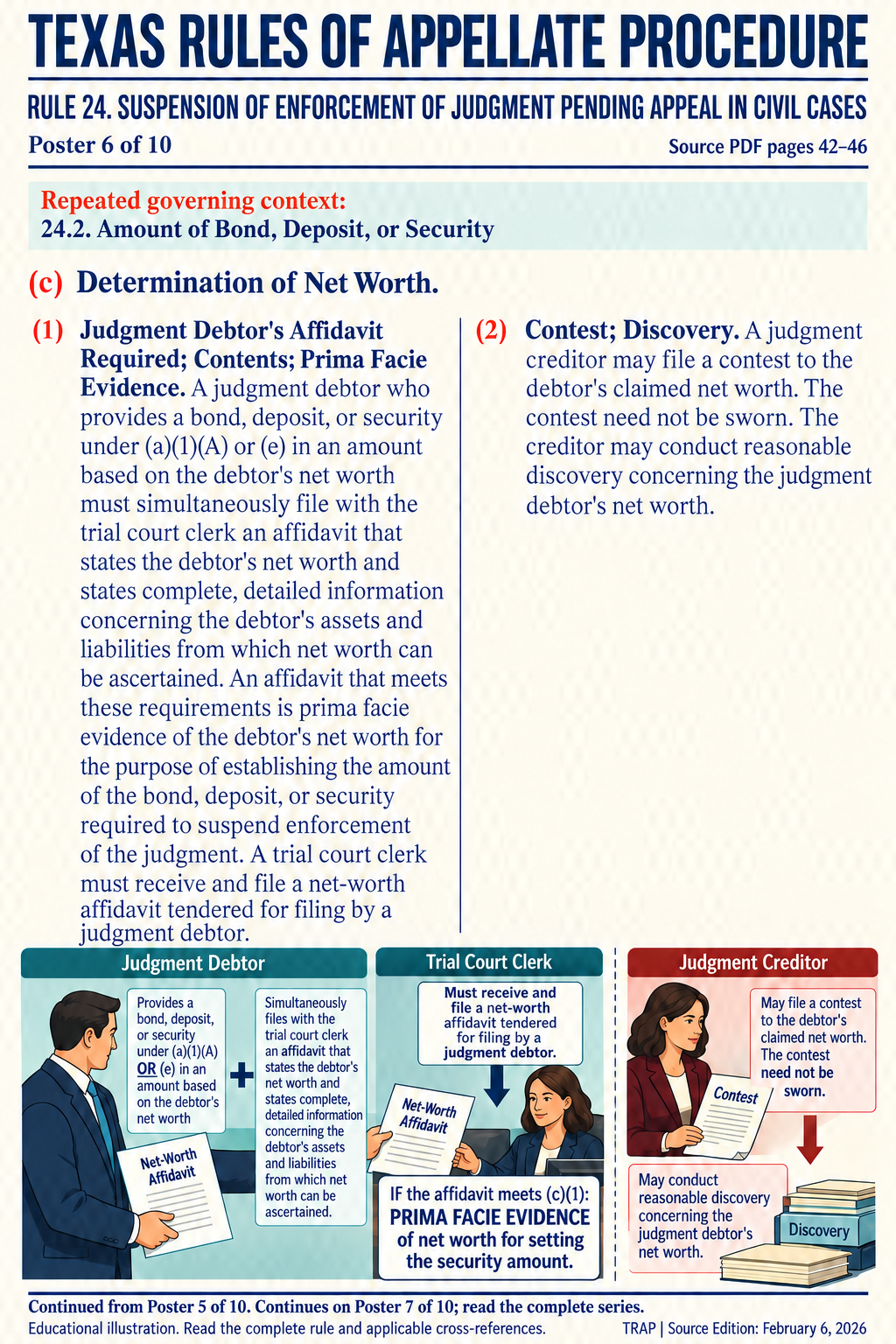
Read assigned text for Rule 24 poster 6
Assigned rule text
(c) Determination of Net Worth.
(1) Judgment Debtor's Affidavit Required; Contents; Prima Facie Evidence. A judgment debtor who provides a bond, deposit, or security under (a)(1)(A) or (e) in an amount based on the debtor's net worth must simultaneously file with the trial court clerk an affidavit that states the debtor's net worth and states complete, detailed information concerning the debtor's assets and liabilities from which net worth can be ascertained. An affidavit that meets these requirements is prima facie evidence of the debtor's net worth for the purpose of establishing the amount of the bond, deposit, or security required to suspend enforcement of the judgment. A trial court clerk must receive and file a net-worth affidavit tendered for filing by a judgment debtor.
(2) Contest; Discovery. A judgment creditor may file a contest to the debtor's claimed net worth. The contest need not be sworn. The creditor may conduct reasonable discovery concerning the judgment debtor's net worth.
Repeated governing context
24.2. Amount of Bond, Deposit, or Security
Continued from Poster 5 of 10. Continues on Poster 7 of 10; read the complete series.
Rule 24. Suspension Of Enforcement Of Judgment Pending Appeal In Civil Cases — poster 7Poster 7 of 10
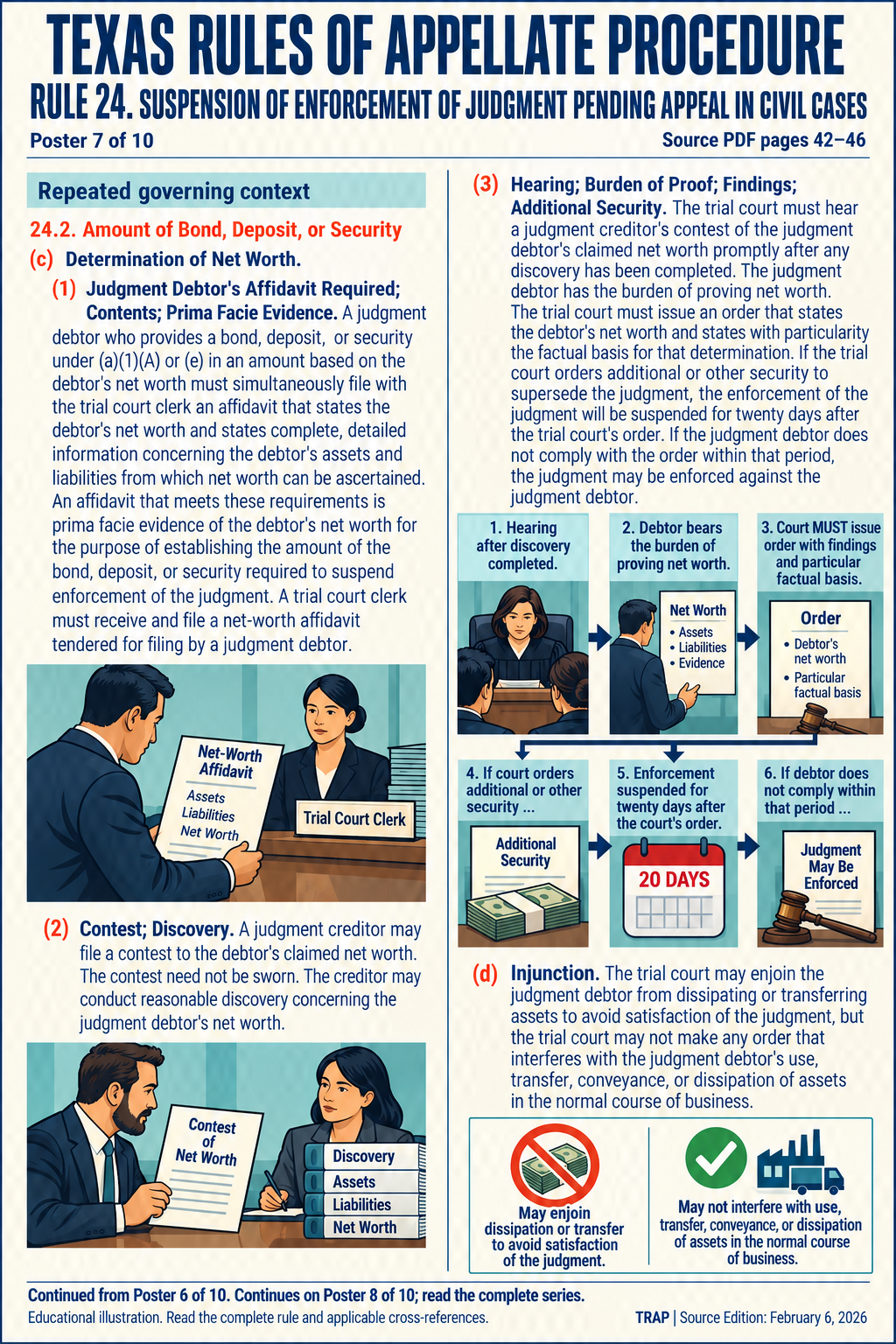
Read assigned text for Rule 24 poster 7
Assigned rule text
(3) Hearing; Burden of Proof; Findings; Additional Security. The trial court must hear a judgment creditor's contest of the judgment debtor's claimed net worth promptly after any discovery has been completed. The judgment debtor has the burden of proving net worth. The trial court must issue an order that states the debtor's net worth and states with particularity the factual basis for that determination. If the trial court orders additional or other security to supersede the judgment, the enforcement of the judgment will be suspended for twenty days after the trial court's order. If the judgment debtor does not comply with the order within that period, the judgment may be enforced against the judgment debtor.
(d) Injunction. The trial court may enjoin the judgment debtor from dissipating or transferring assets to avoid satisfaction of the judgment, but the trial court may not make any order that interferes with the judgment debtor's use, transfer, conveyance, or dissipation of assets in the normal course of business.
Repeated governing context
24.2. Amount of Bond, Deposit, or Security
(c) Determination of Net Worth.
(1) Judgment Debtor's Affidavit Required; Contents; Prima Facie Evidence. A judgment debtor who provides a bond, deposit, or security under (a)(1)(A) or (e) in an amount based on the debtor's net worth must simultaneously file with the trial court clerk an affidavit that states the debtor's net worth and states complete, detailed information concerning the debtor's assets and liabilities from which net worth can be ascertained. An affidavit that meets these requirements is prima facie evidence of the debtor's net worth for the purpose of establishing the amount of the bond, deposit, or security required to suspend enforcement of the judgment. A trial court clerk must receive and file a net-worth affidavit tendered for filing by a judgment debtor.
(2) Contest; Discovery. A judgment creditor may file a contest to the debtor's claimed net worth. The contest need not be sworn. The creditor may conduct reasonable discovery concerning the judgment debtor's net worth.
Continued from Poster 6 of 10. Continues on Poster 8 of 10; read the complete series.
Rule 24. Suspension Of Enforcement Of Judgment Pending Appeal In Civil Cases — poster 8Poster 8 of 10
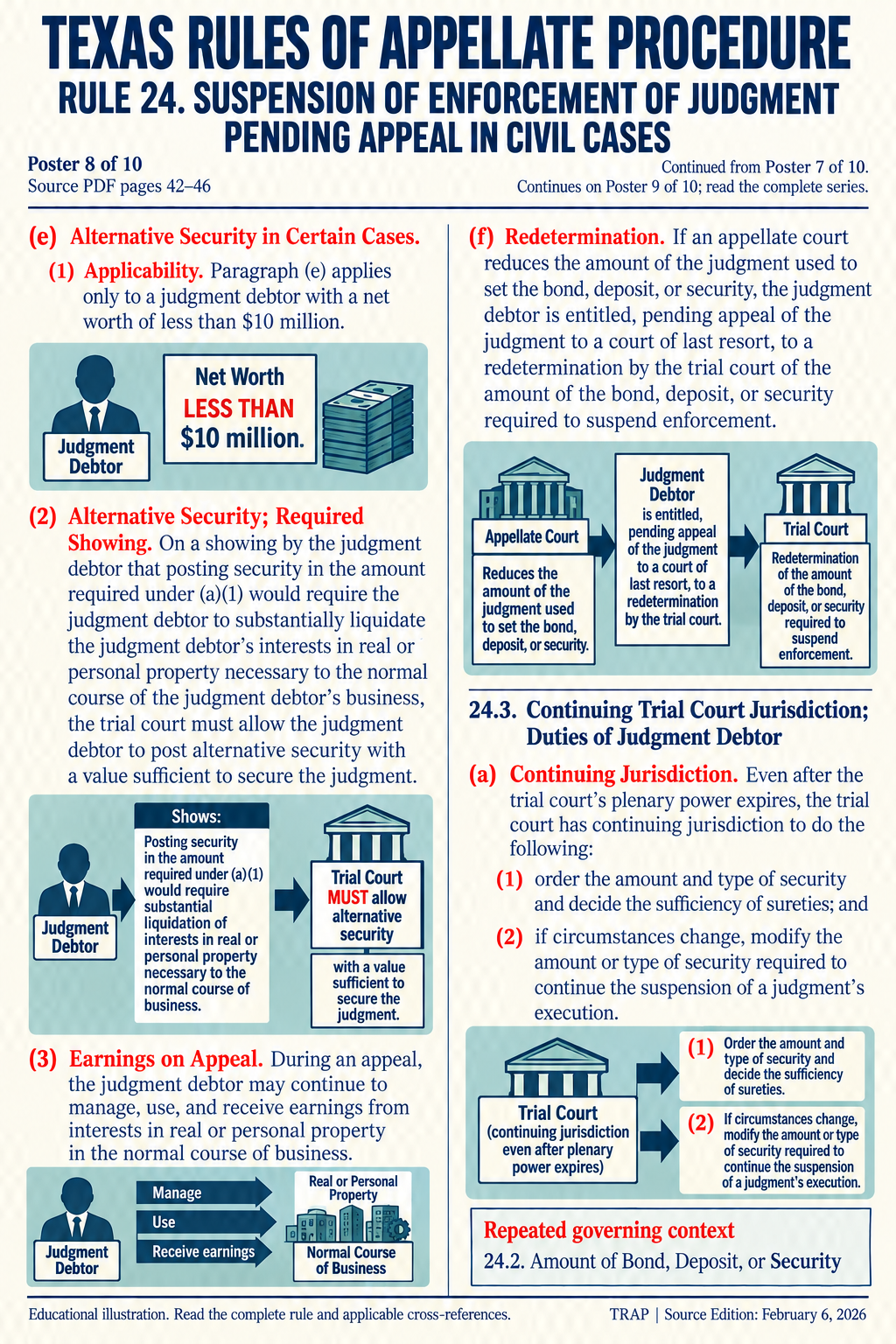
Read assigned text for Rule 24 poster 8
Assigned rule text
(e) Alternative Security in Certain Cases.
(1) Applicability. Paragraph (e) applies only to a judgment debtor with a net worth of less than $10 million.
(2) Alternative Security; Required Showing. On a showing by the judgment debtor that posting security in the amount required under (a)(1) would require the judgment debtor to substantially liquidate the judgment debtor’s interests in real or personal property necessary to the normal course of the judgment debtor’s business, the trial court must allow the judgment debtor to post alternative security with a value sufficient to secure the judgment.
(3) Earnings on Appeal. During an appeal, the judgment debtor may continue to manage, use, and receive earnings from interests in real or personal property in the normal course of business.
(f) Redetermination. If an appellate court reduces the amount of the judgment used to set the bond, deposit, or security, the judgment debtor is entitled, pending appeal of the judgment to a court of last resort, to a redetermination by the trial court of the amount of the bond, deposit, or security required to suspend enforcement.
24.3. Continuing Trial Court Jurisdiction; Duties of Judgment Debtor
(a) Continuing Jurisdiction. Even after the trial court's plenary power expires, the trial court has continuing jurisdiction to do the following:
(1) order the amount and type of security and decide the sufficiency of sureties; and
(2) if circumstances change, modify the amount or type of security required to continue the suspension of a judgment's execution.
Repeated governing context
24.2. Amount of Bond, Deposit, or Security
Continued from Poster 7 of 10. Continues on Poster 9 of 10; read the complete series.
Notify the court and seek review of security ordersPoster 9 of 10
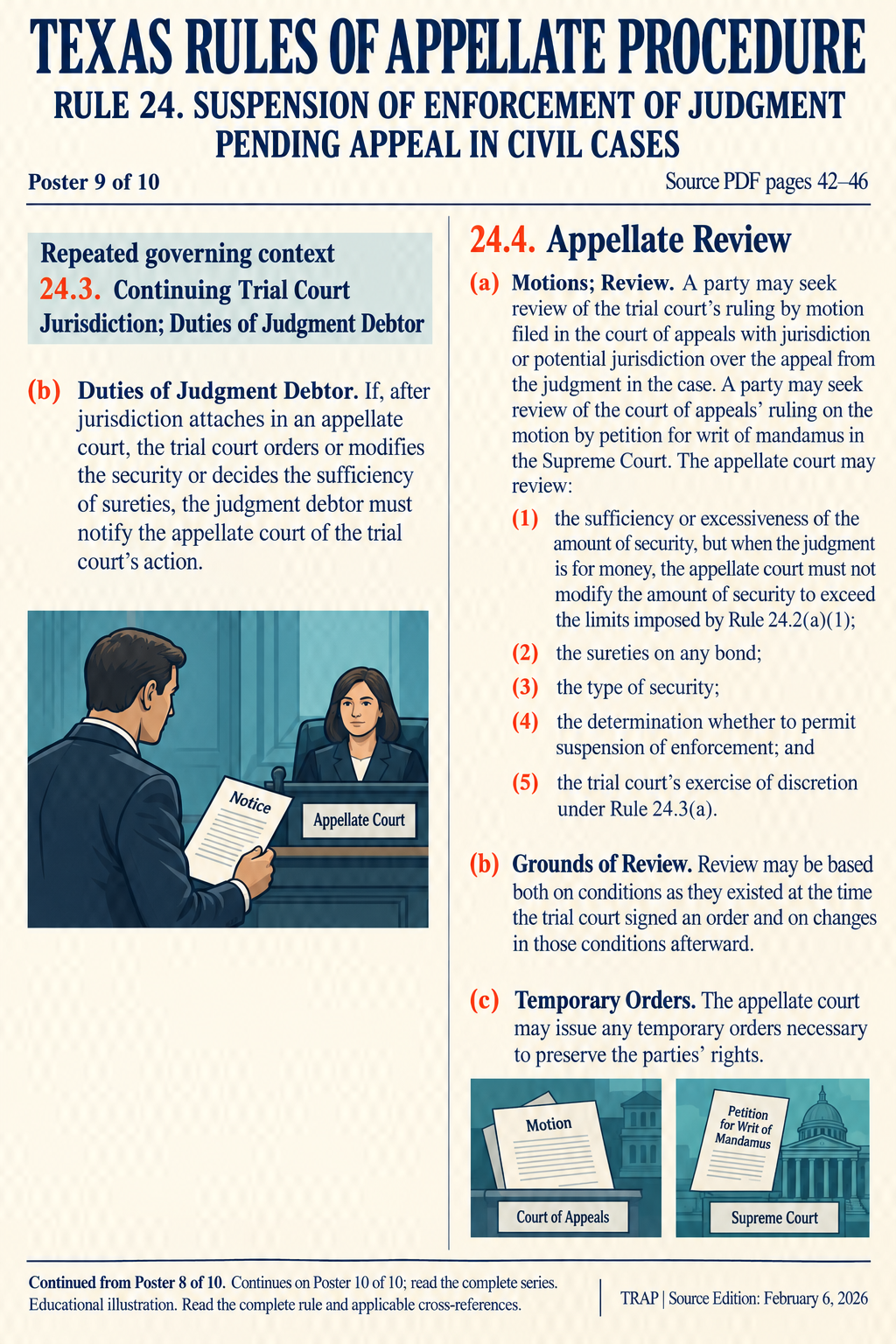
Read assigned text for Rule 24 poster 9
Assigned rule text
(b) Duties of Judgment Debtor. If, after jurisdiction attaches in an appellate court, the trial court orders or modifies the security or decides the sufficiency of sureties, the judgment debtor must notify the appellate court of the trial court's action.
24.4. Appellate Review
(a) Motions; Review. A party may seek review of the trial court's ruling by motion filed in the court of appeals with jurisdiction or potential jurisdiction over the appeal from the judgment in the case. A party may seek review of the court of appeals' ruling on the motion by petition for writ of mandamus in the Supreme Court. The appellate court may review:
(1) the sufficiency or excessiveness of the amount of security, but when the judgment is for money, the appellate court must not modify the amount of security to exceed the limits imposed by Rule 24.2(a)(1);
(2) the sureties on any bond;
(3) the type of security;
(4) the determination whether to permit suspension of enforcement; and
(5) the trial court's exercise of discretion under Rule 24.3(a).
(b) Grounds of Review. Review may be based both on conditions as they existed at the time the trial court signed an order and on changes in those conditions afterward.
(c) Temporary Orders. The appellate court may issue any temporary orders necessary to preserve the parties’ rights.
Repeated governing context
24.3. Continuing Trial Court Jurisdiction; Duties of Judgment Debtor
Continued from Poster 8 of 10. Continues on Poster 10 of 10; read the complete series.
Rule 24. Suspension Of Enforcement Of Judgment Pending Appeal In Civil Cases — poster 10Poster 10 of 10
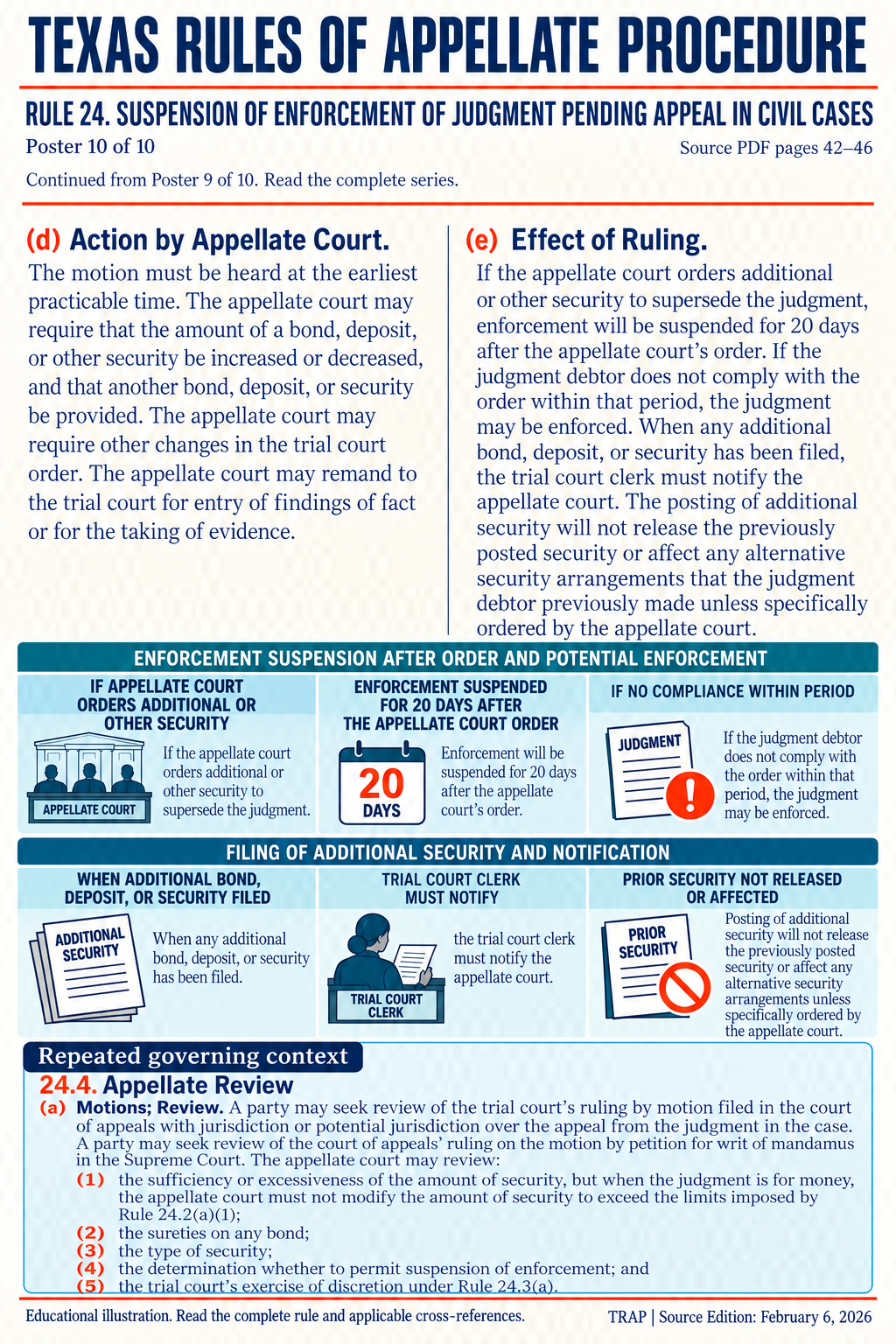
Read assigned text for Rule 24 poster 10
Assigned rule text
(d) Action by Appellate Court. The motion must be heard at the earliest practicable time. The appellate court may require that the amount of a bond, deposit, or other security be increased or decreased, and that another bond, deposit, or security be provided. The appellate court may require other changes in the trial court order. The appellate court may remand to the trial court for entry of findings of fact or for the taking of evidence.
(e) Effect of Ruling. If the appellate court orders additional or other security to supersede the judgment, enforcement will be suspended for 20 days after the appellate court’s order. If the judgment debtor does not comply with the order within that period, the judgment may be enforced. When any additional bond, deposit, or security has been filed, the trial court clerk must notify the appellate court. The posting of additional security will not release the previously posted security or affect any alternative security arrangements that the judgment debtor previously made unless specifically ordered by the appellate court.
Repeated governing context
24.4. Appellate Review
(a) Motions; Review. A party may seek review of the trial court's ruling by motion filed in the court of appeals with jurisdiction or potential jurisdiction over the appeal from the judgment in the case. A party may seek review of the court of appeals' ruling on the motion by petition for writ of mandamus in the Supreme Court. The appellate court may review:
(1) the sufficiency or excessiveness of the amount of security, but when the judgment is for money, the appellate court must not modify the amount of security to exceed the limits imposed by Rule 24.2(a)(1);
(2) the sureties on any bond;
(3) the type of security;
(4) the determination whether to permit suspension of enforcement; and
(5) the trial court's exercise of discretion under Rule 24.3(a).
Continued from Poster 9 of 10. Read the complete series.
Rule 25. Perfecting Appeal
File a civil notice with the trial court clerkPoster 1 of 7
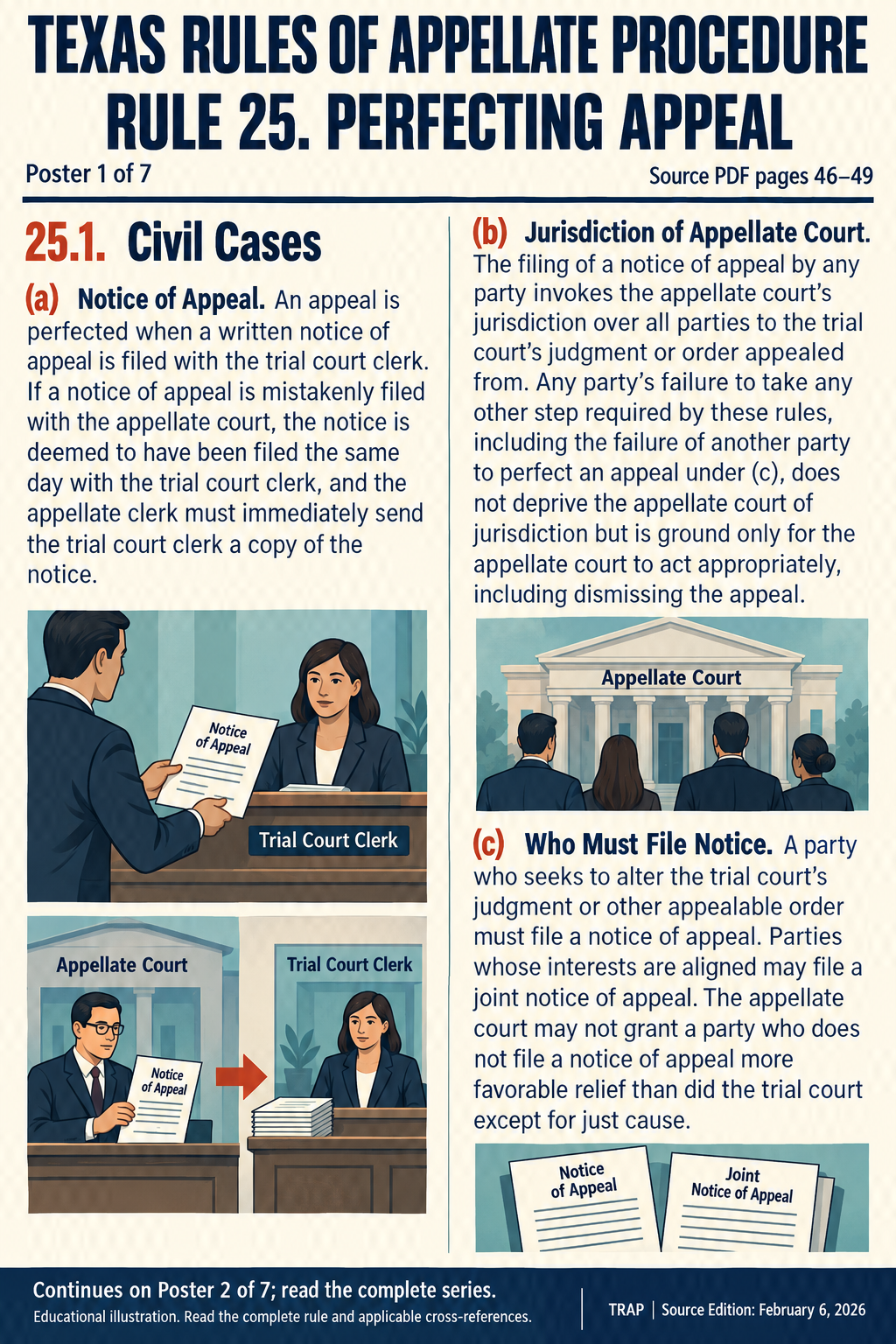
Read assigned text for Rule 25 poster 1
Assigned rule text
25.1. Civil Cases
(a) Notice of Appeal. An appeal is perfected when a written notice of appeal is filed with the trial court clerk. If a notice of appeal is mistakenly filed with the appellate court, the notice is deemed to have been filed the same day with the trial court clerk, and the appellate clerk must immediately send the trial court clerk a copy of the notice.
(b) Jurisdiction of Appellate Court. The filing of a notice of appeal by any party invokes the appellate court’s jurisdiction over all parties to the trial court’s judgment or order appealed from. Any party’s failure to take any other step required by these rules, including the failure of another party to perfect an appeal under (c), does not deprive the appellate court of jurisdiction but is ground only for the appellate court to act appropriately, including dismissing the appeal.
(c) Who Must File Notice. A party who seeks to alter the trial court’s judgment or other appealable order must file a notice of appeal. Parties whose interests are aligned may file a joint notice of appeal. The appellate court may not grant a party who does not file a notice of appeal more favorable relief than did the trial court except for just cause.
Continues on Poster 2 of 7; read the complete series.
Rule 25. Perfecting Appeal — poster 2Poster 2 of 7
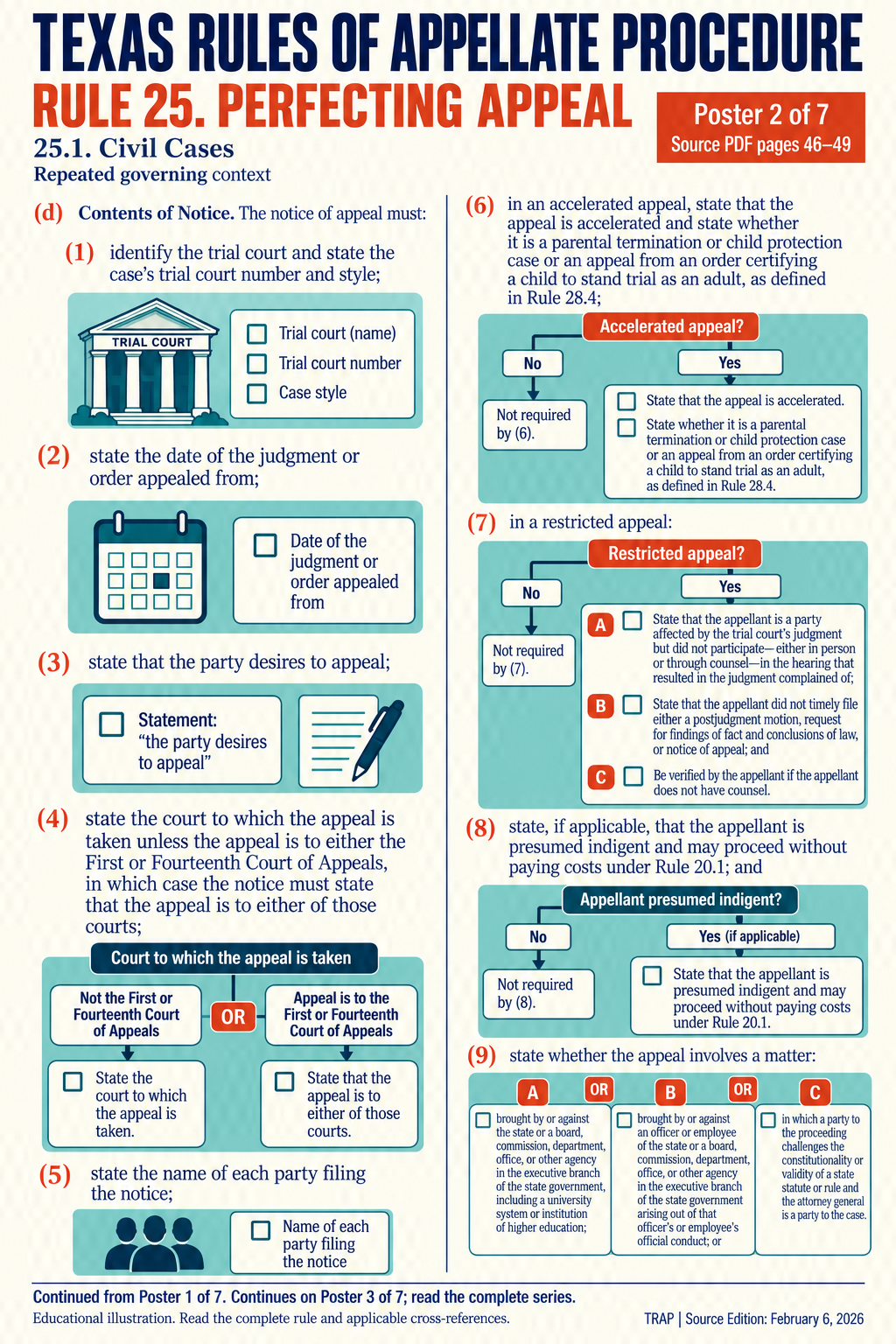
Read assigned text for Rule 25 poster 2
Assigned rule text
(d) Contents of Notice. The notice of appeal must:
(1) identify the trial court and state the case’s trial court number and style;
(2) state the date of the judgment or order appealed from;
(3) state that the party desires to appeal;
(4) state the court to which the appeal is taken unless the appeal is to either the First or Fourteenth Court of Appeals, in which case the notice must state that the appeal is to either of those courts;
(5) state the name of each party filing the notice;
(6) in an accelerated appeal, state that the appeal is accelerated and state whether it is a parental termination or child protection case or an appeal from an order certifying a child to stand trial as an adult, as defined in Rule 28.4;
(7) in a restricted appeal:
(A) state that the appellant is a party affected by the trial court’s judgment but did not participate— either in person or through counsel—in the hearing that resulted in the judgment complained of;
(B) state that the appellant did not timely file either a postjudgment motion, request for findings of fact and conclusions of law, or notice of appeal; and
(C) be verified by the appellant if the appellant does not have counsel.
(8) state, if applicable, that the appellant is presumed indigent and may proceed without paying costs under Rule 20.1; and
(9) state whether the appeal involves a matter:
(A) brought by or against the state or a board, commission, department, office, or other agency in the executive branch of the state government, including a university system or institution of higher education;
(B) brought by or against an officer or employee of the state or a board, commission, department, office, or other agency in the executive branch of the state government arising out of that officer’s or employee’s official conduct; or
(C) in which a party to the proceeding challenges the constitutionality or validity of a state statute or rule and the attorney general is a party to the case.
Repeated governing context
25.1. Civil Cases
Continued from Poster 1 of 7. Continues on Poster 3 of 7; read the complete series.
Rule 25. Perfecting Appeal — poster 3Poster 3 of 7
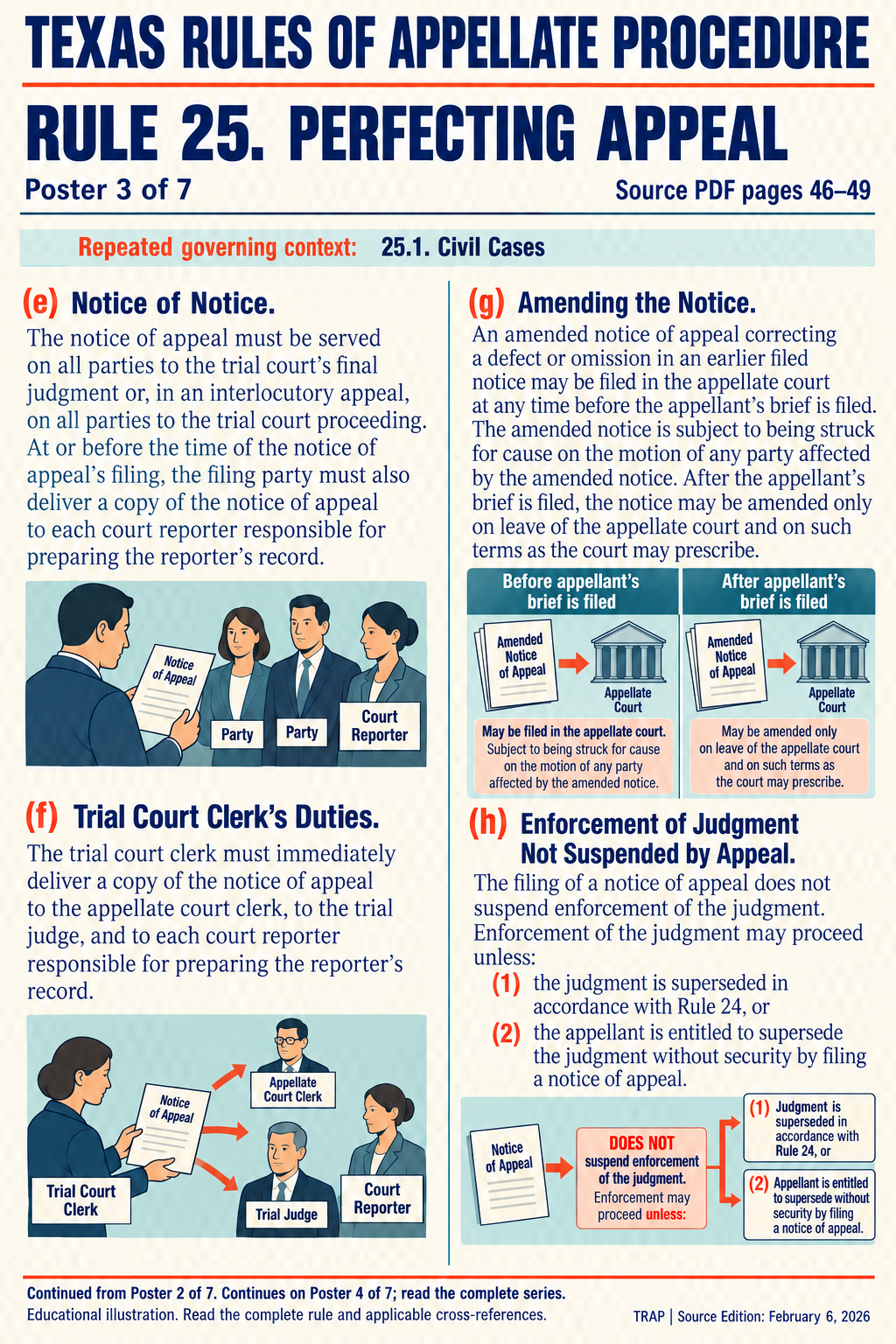
Read assigned text for Rule 25 poster 3
Assigned rule text
(e) Notice of Notice. The notice of appeal must be served on all parties to the trial court's final judgment or, in an interlocutory appeal, on all parties to the trial court proceeding. At or before the time of the notice of appeal’s filing, the filing party must also deliver a copy of the notice of appeal to each court reporter responsible for preparing the reporter’s record.
(f) Trial Court Clerk’s Duties. The trial court clerk must immediately deliver a copy of the notice of appeal to the appellate court clerk, to the trial judge, and to each court reporter responsible for preparing the reporter’s record.
(g) Amending the Notice. An amended notice of appeal correcting a defect or omission in an earlier filed notice may be filed in the appellate court at any time before the appellant's brief is filed. The amended notice is subject to being struck for cause on the motion of any party affected by the amended notice. After the appellant's brief is filed, the notice may be amended only on leave of the appellate court and on such terms as the court may prescribe.
(h) Enforcement of Judgment Not Suspended by Appeal. The filing of a notice of appeal does not suspend enforcement of the judgment. Enforcement of the judgment may proceed unless:
(1) the judgment is superseded in accordance with Rule 24, or
(2) the appellant is entitled to supersede the judgment without security by filing a notice of appeal.
Repeated governing context
25.1. Civil Cases
Continued from Poster 2 of 7. Continues on Poster 4 of 7; read the complete series.
Rule 25. Perfecting Appeal — poster 4Poster 4 of 7
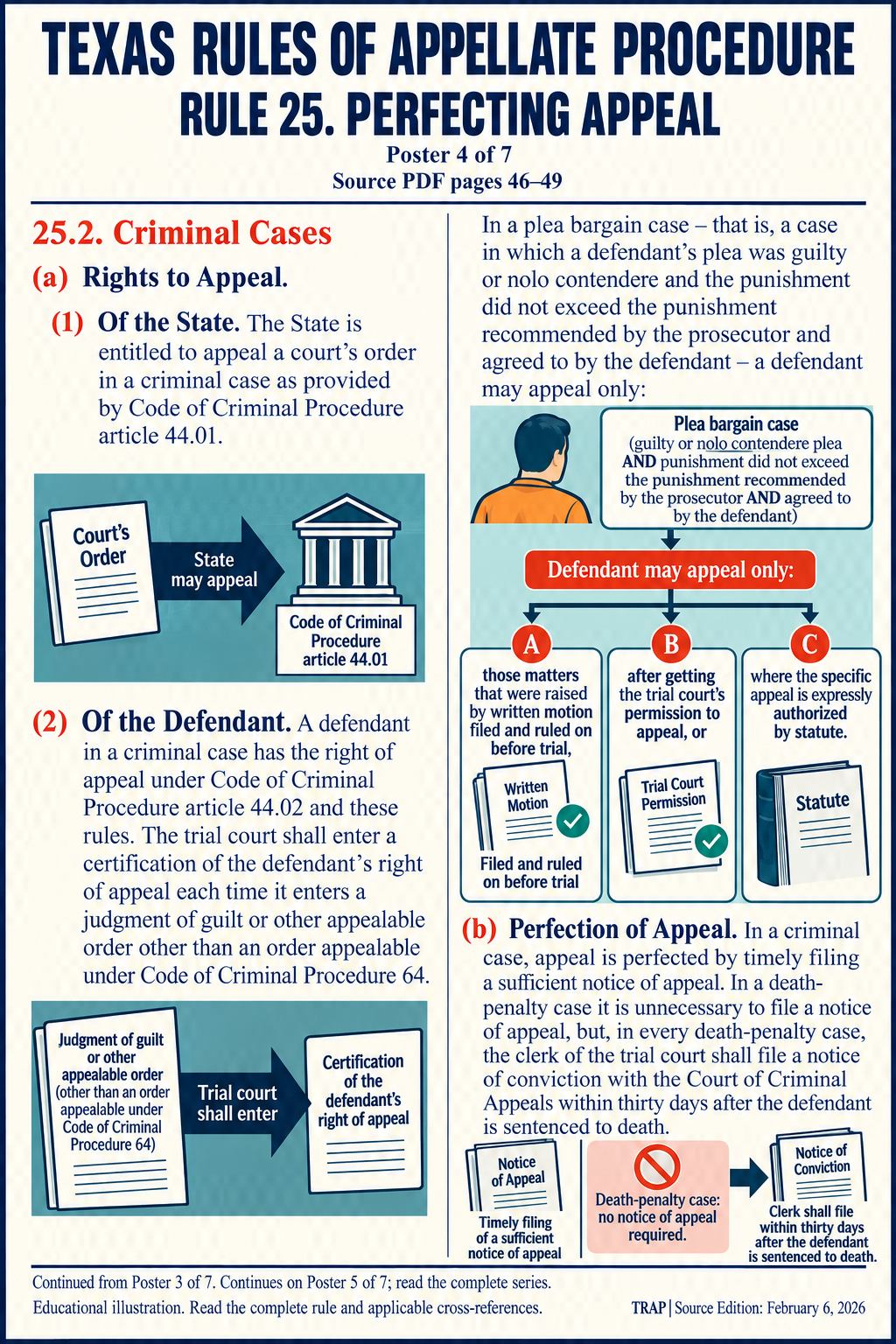
Read assigned text for Rule 25 poster 4
Assigned rule text
25.2. Criminal Cases
(a) Rights to Appeal.
(1) Of the State. The State is entitled to appeal a court’s order in a criminal case as provided by Code of Criminal Procedure article 44.01.
(2) Of the Defendant. A defendant in a criminal case has the right of appeal under Code of Criminal Procedure article 44.02 and these rules. The trial court shall enter a certification of the defendant’s right of appeal each time it enters a judgment of guilt or other appealable order other than an order appealable under Code of Criminal Procedure 64. In a plea bargain case – that is, a case in which a defendant’s plea was guilty or nolo contendere and the punishment did not exceed the punishment recommended by the prosecutor and agreed to by the defendant – a defendant may appeal only:
(A) those matters that were raised by written motion filed and ruled on before trial,
(B) after getting the trial court’s permission to appeal, or
(C) where the specific appeal is expressly authorized by statute.
(b) Perfection of Appeal. In a criminal case, appeal is perfected by timely filing a sufficient notice of appeal. In a death-penalty case it is unnecessary to file a notice of appeal, but, in every death-penalty case, the clerk of the trial court shall file a notice of conviction with the Court of Criminal Appeals within thirty days after the defendant is sentenced to death.
Continued from Poster 3 of 7. Continues on Poster 5 of 7; read the complete series.
Rule 25. Perfecting Appeal — poster 5Poster 5 of 7
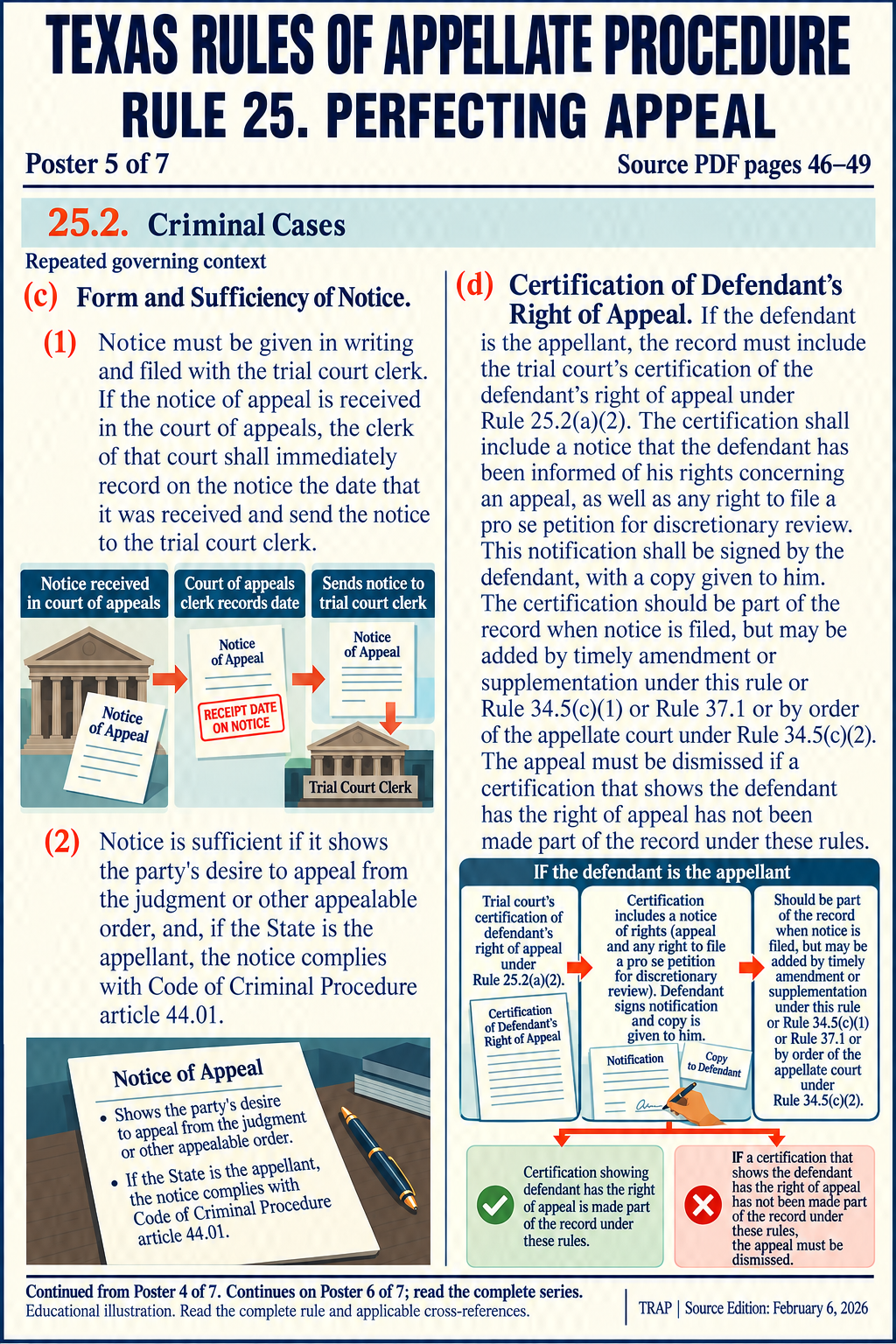
Read assigned text for Rule 25 poster 5
Assigned rule text
(c) Form and Sufficiency of Notice.
(1) Notice must be given in writing and filed with the trial court clerk. If the notice of appeal is received in the court of appeals, the clerk of that court shall immediately record on the notice the date that it was received and send the notice to the trial court clerk.
(2) Notice is sufficient if it shows the party's desire to appeal from the judgment or other appealable order, and, if the State is the appellant, the notice complies with Code of Criminal Procedure article 44.01.
(d) Certification of Defendant’s Right of Appeal. If the defendant is the appellant, the record must include the trial court’s certification of the defendant’s right of appeal under Rule 25.2(a)(2). The certification shall include a notice that the defendant has been informed of his rights concerning an appeal, as well as any right to file a pro se petition for discretionary review. This notification shall be signed by the defendant, with a copy given to him. The certification should be part of the record when notice is filed, but may be added by timely amendment or supplementation under this rule or Rule 34.5(c)(1) or Rule 37.1 or by order of the appellate court under Rule 34.5(c)(2). The appeal must be dismissed if a certification that shows the defendant has the right of appeal has not been made part of the record under these rules.
Repeated governing context
25.2. Criminal Cases
Continued from Poster 4 of 7. Continues on Poster 6 of 7; read the complete series.
Understand the trial clerk’s duties in a criminal appealPoster 6 of 7
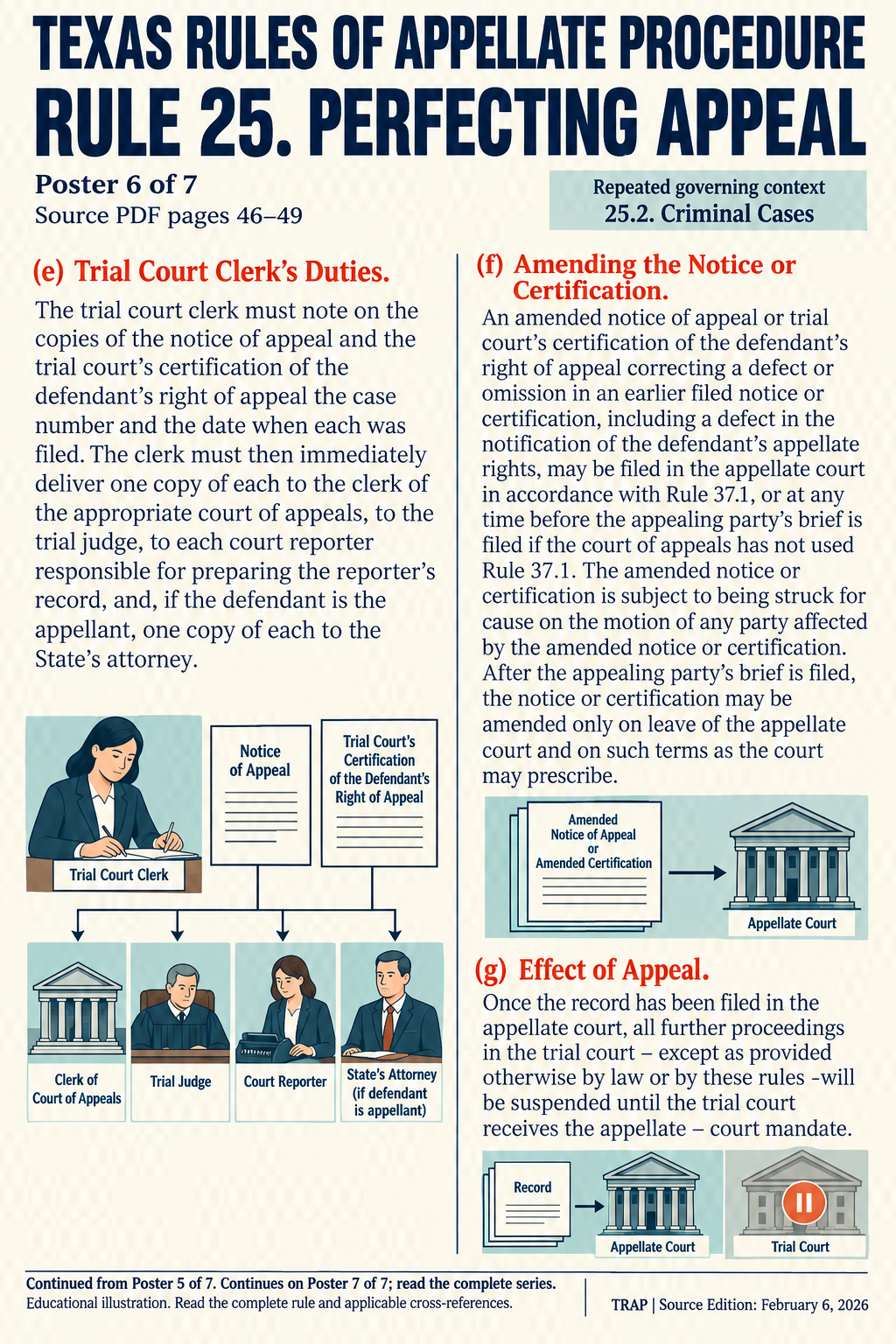
Read assigned text for Rule 25 poster 6
Assigned rule text
(e) Trial Court Clerk's Duties. The trial court clerk must note on the copies of the notice of appeal and the trial court’s certification of the defendant’s right of appeal the case number and the date when each was filed. The clerk must then immediately deliver one copy of each to the clerk of the appropriate court of appeals, to the trial judge, to each court reporter responsible for preparing the reporter’s record, and, if the defendant is the appellant, one copy of each to the State's attorney.
(f) Amending the Notice or Certification. An amended notice of appeal or trial court’s certification of the defendant’s right of appeal correcting a defect or omission in an earlier filed notice or certification, including a defect in the notification of the defendant’s appellate rights, may be filed in the appellate court in accordance with Rule 37.1, or at any time before the appealing party's brief is filed if the court of appeals has not used Rule 37.1. The amended notice or certification is subject to being struck for cause on the motion of any party affected by the amended notice or certification. After the appealing party’s brief is filed, the notice or certification may be amended only on leave of the appellate court and on such terms as the court may prescribe.
(g) Effect of Appeal. Once the record has been filed in the appellate court, all further proceedings in the trial court – except as provided otherwise by law or by these rules -will be suspended until the trial court receives the appellate – court mandate.
Repeated governing context
25.2. Criminal Cases
Continued from Poster 5 of 7. Continues on Poster 7 of 7; read the complete series.
Rule 25. Perfecting Appeal — poster 7Poster 7 of 7
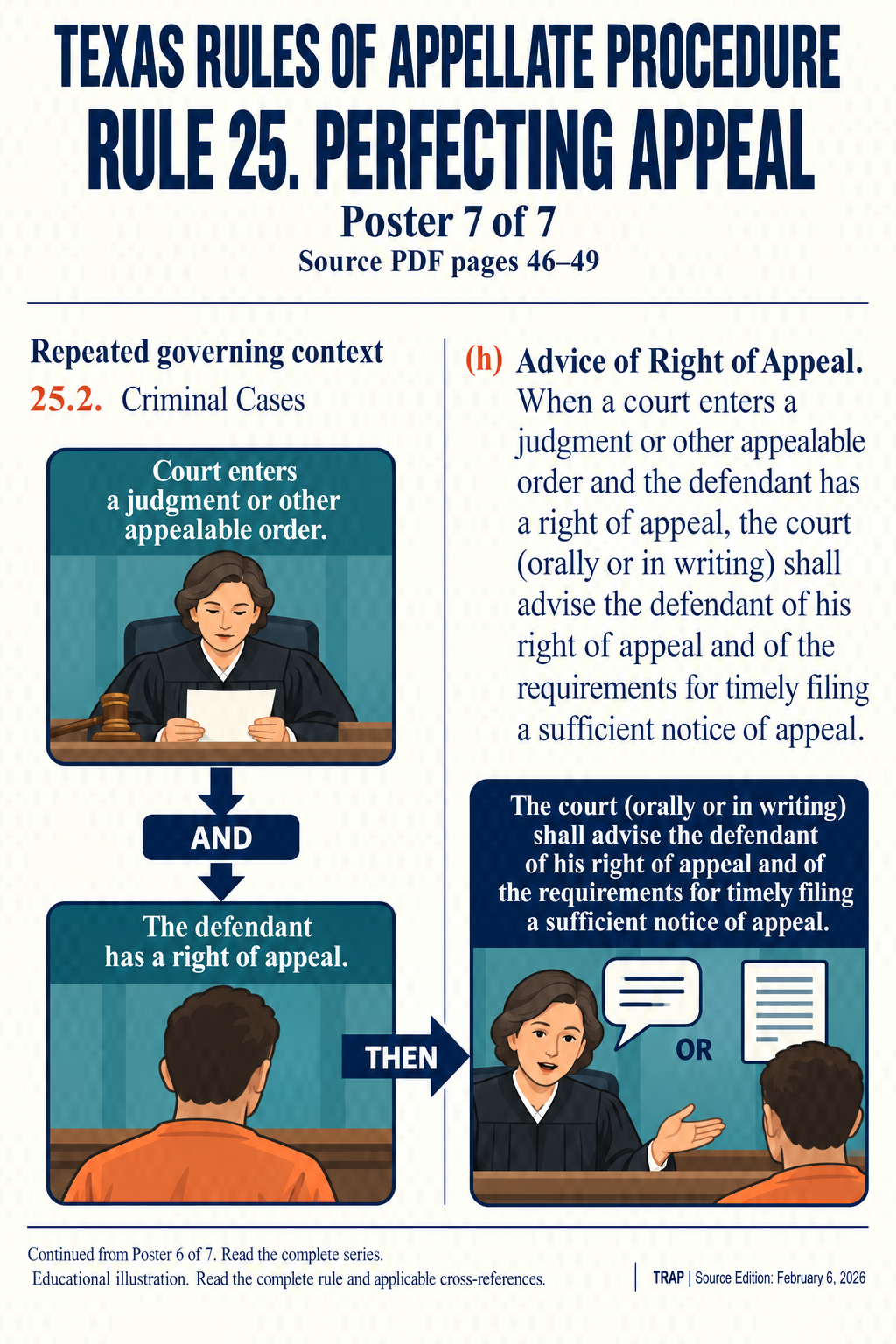
Read assigned text for Rule 25 poster 7
Assigned rule text
(h) Advice of Right of Appeal. When a court enters a judgment or other appealable order and the defendant has a right of appeal, the court (orally or in writing) shall advise the defendant of his right of appeal and of the requirements for timely filing a sufficient notice of appeal.
Repeated governing context
25.2. Criminal Cases
Continued from Poster 6 of 7. Read the complete series.
Rule 26. Time To Perfect Appeal
Identify the triggering event and applicable notice periodPoster 1 of 2
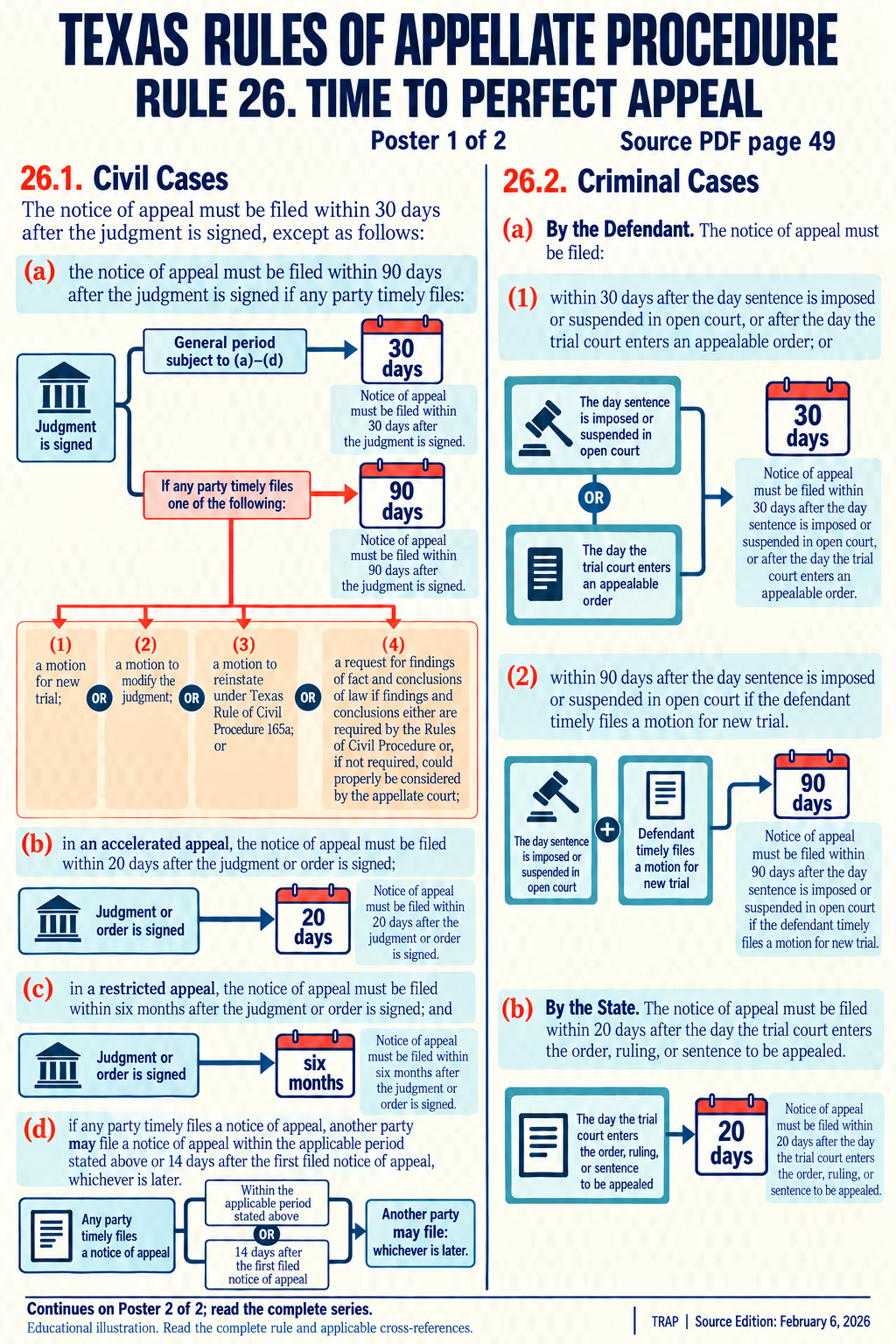
Read assigned text for Rule 26 poster 1
Assigned rule text
26.1. Civil Cases The notice of appeal must be filed within 30 days after the judgment is signed, except as follows:
(a) the notice of appeal must be filed within 90 days after the judgment is signed if any party timely files:
(1) a motion for new trial;
(2) a motion to modify the judgment;
(3) a motion to reinstate under Texas Rule of Civil Procedure 165a; or
(4) a request for findings of fact and conclusions of law if findings and conclusions either are required by the Rules of Civil Procedure or, if not required, could properly be considered by the appellate court;
(b) in an accelerated appeal, the notice of appeal must be filed within 20 days after the judgment or order is signed;
(c) in a restricted appeal, the notice of appeal must be filed within six months after the judgment or order is signed; and
(d) if any party timely files a notice of appeal, another party may file a notice of appeal within the applicable period stated above or 14 days after the first filed notice of appeal, whichever is later.
26.2. Criminal Cases
(a) By the Defendant. The notice of appeal must be filed:
(1) within 30 days after the day sentence is imposed or suspended in open court, or after the day the trial court enters an appealable order; or
(2) within 90 days after the day sentence is imposed or suspended in open court if the defendant timely files a motion for new trial.
(b) By the State. The notice of appeal must be filed within 20 days after the day the trial court enters the order, ruling, or sentence to be appealed.
Continues on Poster 2 of 2; read the complete series.
Check both filings required for an extensionPoster 2 of 2
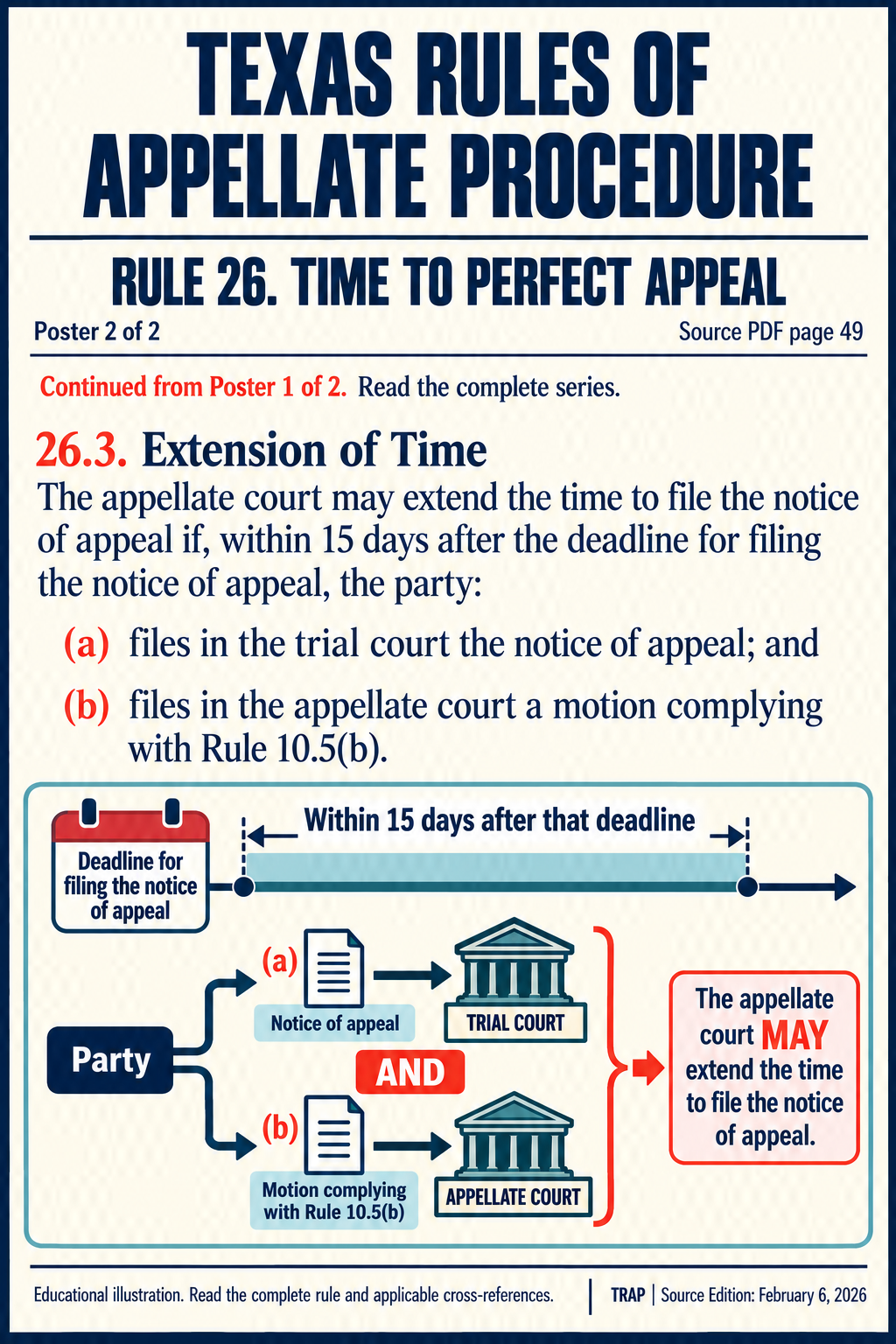
Read assigned text for Rule 26 poster 2
Assigned rule text
26.3. Extension of Time The appellate court may extend the time to file the notice of appeal if, within 15 days after the deadline for filing the notice of appeal, the party:
(a) files in the trial court the notice of appeal; and
(b) files in the appellate court a motion complying with Rule 10.5(b).
Continued from Poster 1 of 2. Read the complete series.
Rule 15. Issuance Of Writ Or Process By Appellate Court
Rule 15. Issuance Of Writ Or Process By Appellate Court — poster 1Poster 1 of 1
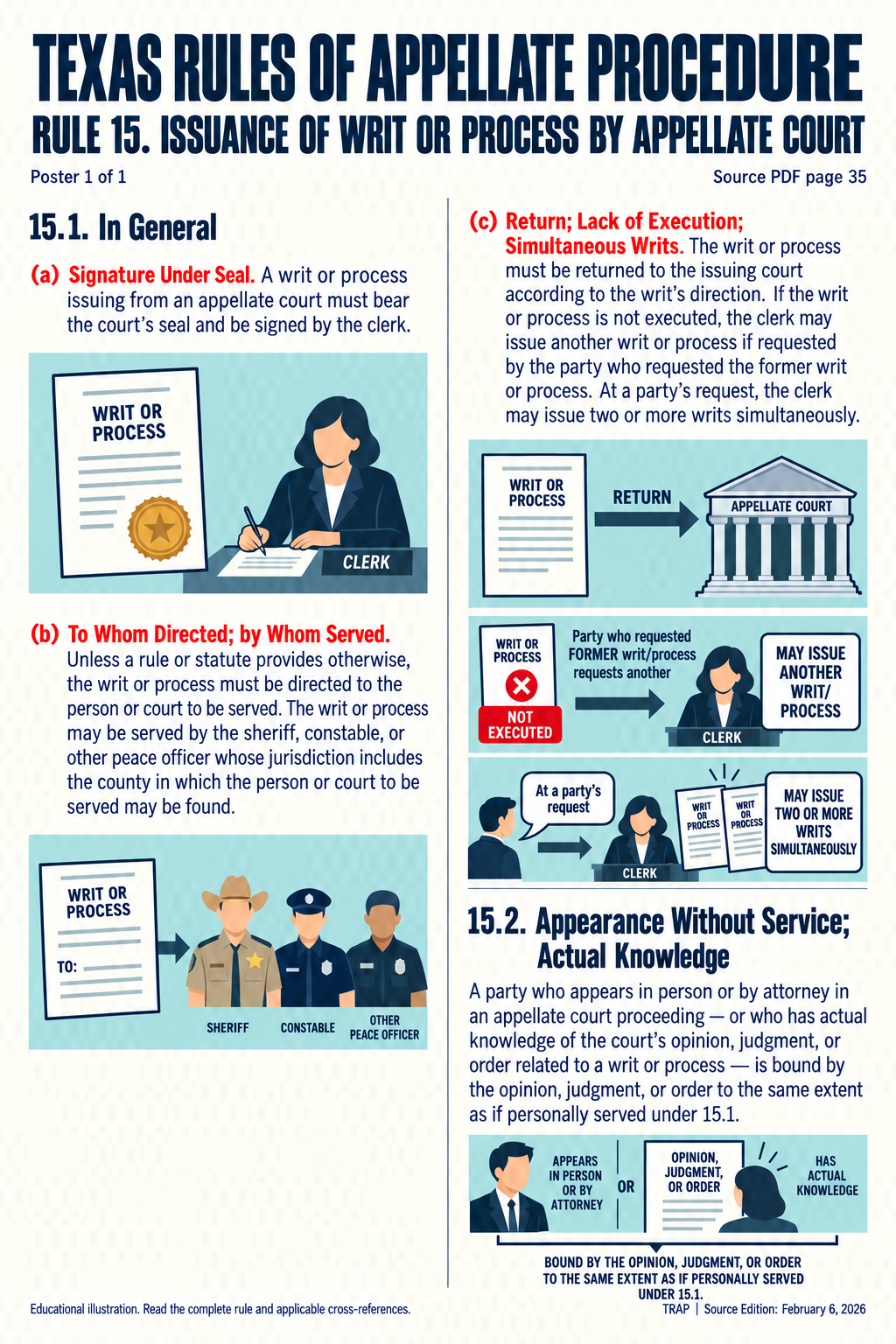
Read assigned text for Rule 15 poster 1
Assigned rule text
15.1. In General
(a) Signature Under Seal. A writ or process issuing from an appellate court must bear the court's seal and be signed by the clerk.
(b) To Whom Directed; by Whom Served. Unless a rule or statute provides otherwise, the writ or process must be directed to the person or court to be served. The writ or process may be served by the sheriff, constable, or other peace officer whose jurisdiction includes the county in which the person or court to be served may be found.
(c) Return; Lack of Execution; Simultaneous Writs. The writ or process must be returned to the issuing court according to the writ's direction. If the writ or process is not executed, the clerk may issue another writ or process if requested by the party who requested the former writ or process. At a party's request, the clerk may issue two or more writs simultaneously.
15.2. Appearance Without Service; Actual Knowledge A party who appears in person or by attorney in an appellate court proceeding — or who has actual knowledge of the court's opinion, judgment, or order related to a writ or process — is bound by the opinion, judgment, or order to the same extent as if personally served under 15.1.
Rule 18. Mandate
Rule 18. Mandate — poster 1Poster 1 of 3
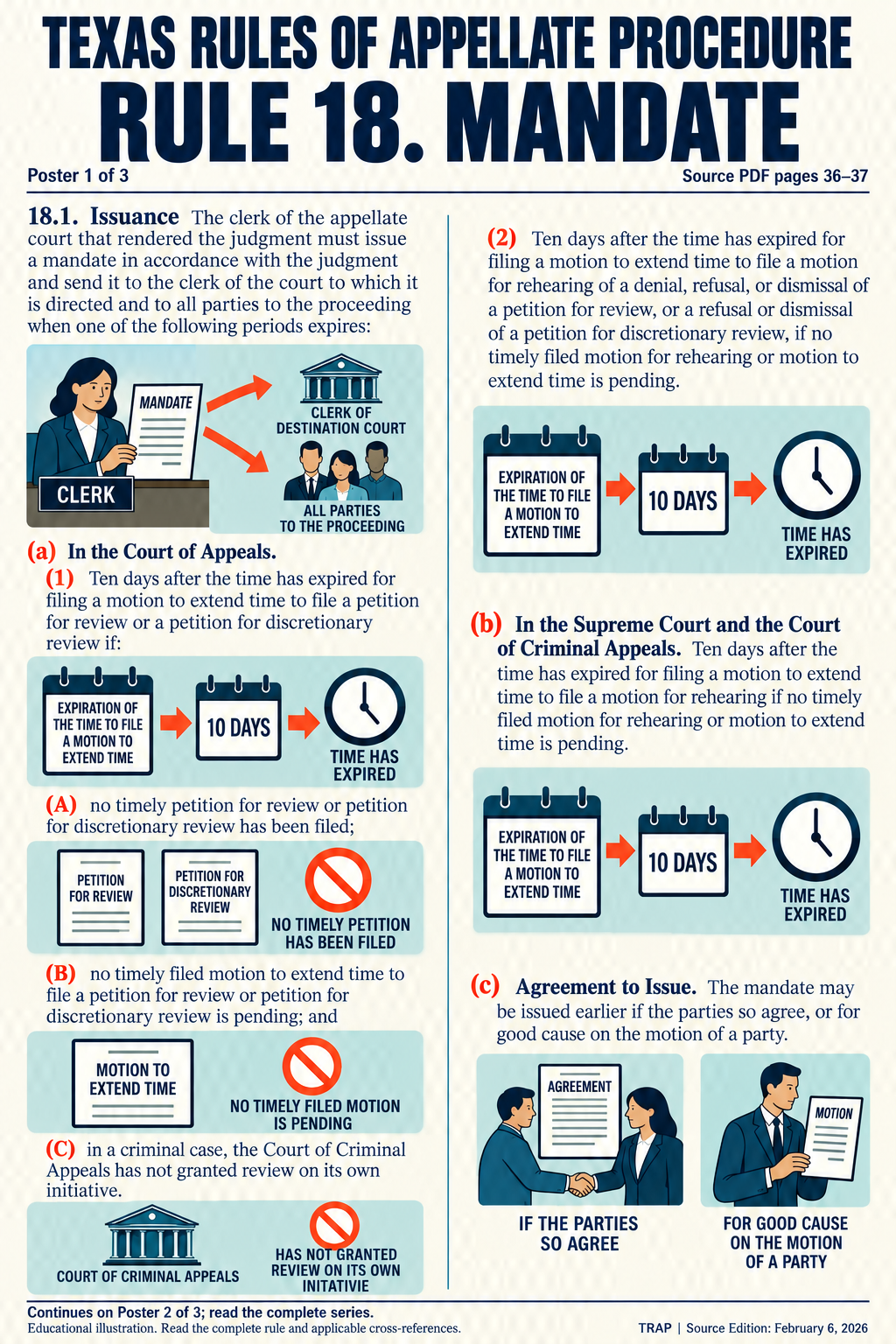
Read assigned text for Rule 18 poster 1
Assigned rule text
18.1. Issuance The clerk of the appellate court that rendered the judgment must issue a mandate in accordance with the judgment and send it to the clerk of the court to which it is directed and to all parties to the proceeding when one of the following periods expires:
(a) In the Court of Appeals.
(1) Ten days after the time has expired for filing a motion to extend time to file a petition for review or a petition for discretionary review if:
(A) no timely petition for review or petition for discretionary review has been filed;
(B) no timely filed motion to extend time to file a petition for review or petition for discretionary review is pending; and
(C) in a criminal case, the Court of Criminal Appeals has not granted review on its own initiative.
(2) Ten days after the time has expired for filing a motion to extend time to file a motion for rehearing of a denial, refusal, or dismissal of a petition for review, or a refusal or dismissal of a petition for discretionary review, if no timely filed motion for rehearing or motion to extend time is pending.
(b) In the Supreme Court and the Court of Criminal Appeals. Ten days after the time has expired for filing a motion to extend time to file a motion for rehearing if no timely filed motion for rehearing or motion to extend time is pending.
(c) Agreement to Issue. The mandate may be issued earlier if the parties so agree, or for good cause on the motion of a party.
Continues on Poster 2 of 3; read the complete series.
Rule 18. Mandate — poster 2Poster 2 of 3
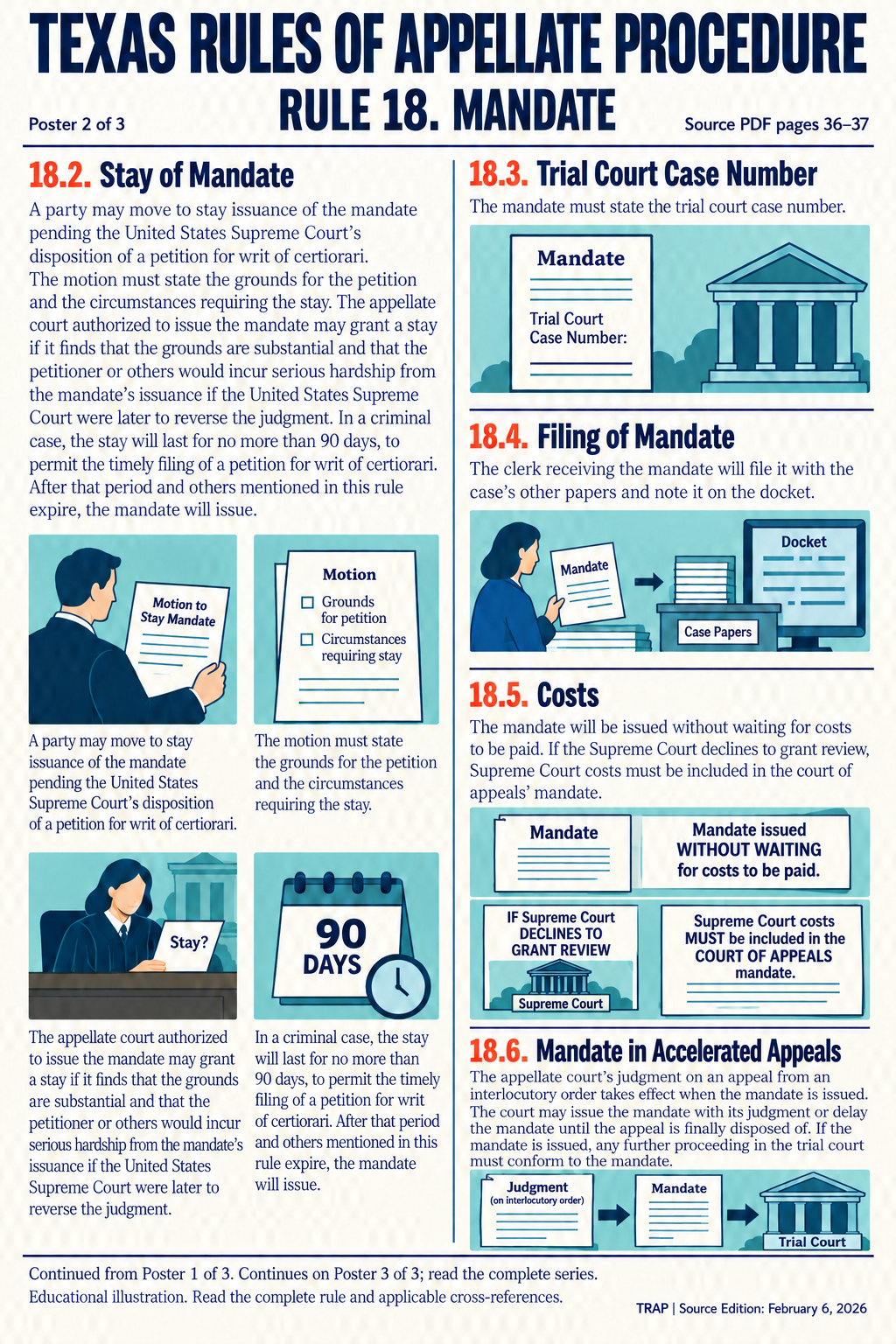
Read assigned text for Rule 18 poster 2
Assigned rule text
18.2. Stay of Mandate A party may move to stay issuance of the mandate pending the United States Supreme Court's disposition of a petition for writ of certiorari. The motion must state the grounds for the petition and the circumstances requiring the stay. The appellate court authorized to issue the mandate may grant a stay if it finds that the grounds are substantial and that the petitioner or others would incur serious hardship from the mandate's issuance if the United States Supreme Court were later to reverse the judgment. In a criminal case, the stay will last for no more than 90 days, to permit the timely filing of a petition for writ of certiorari. After that period and others mentioned in this rule expire, the mandate will issue.
18.3. Trial Court Case Number The mandate must state the trial court case number.
18.4. Filing of Mandate The clerk receiving the mandate will file it with the case's other papers and note it on the docket.
18.5. Costs The mandate will be issued without waiting for costs to be paid. If the Supreme Court declines to grant review, Supreme Court costs must be included in the court of appeals’ mandate.
18.6. Mandate in Accelerated Appeals The appellate court's judgment on an appeal from an interlocutory order takes effect when the mandate is issued. The court may issue the mandate with its judgment or delay the mandate until the appeal is finally disposed of. If the mandate is issued, any further proceeding in the trial court must conform to the mandate.
Continued from Poster 1 of 3. Continues on Poster 3 of 3; read the complete series.
Rule 18. Mandate — poster 3Poster 3 of 3
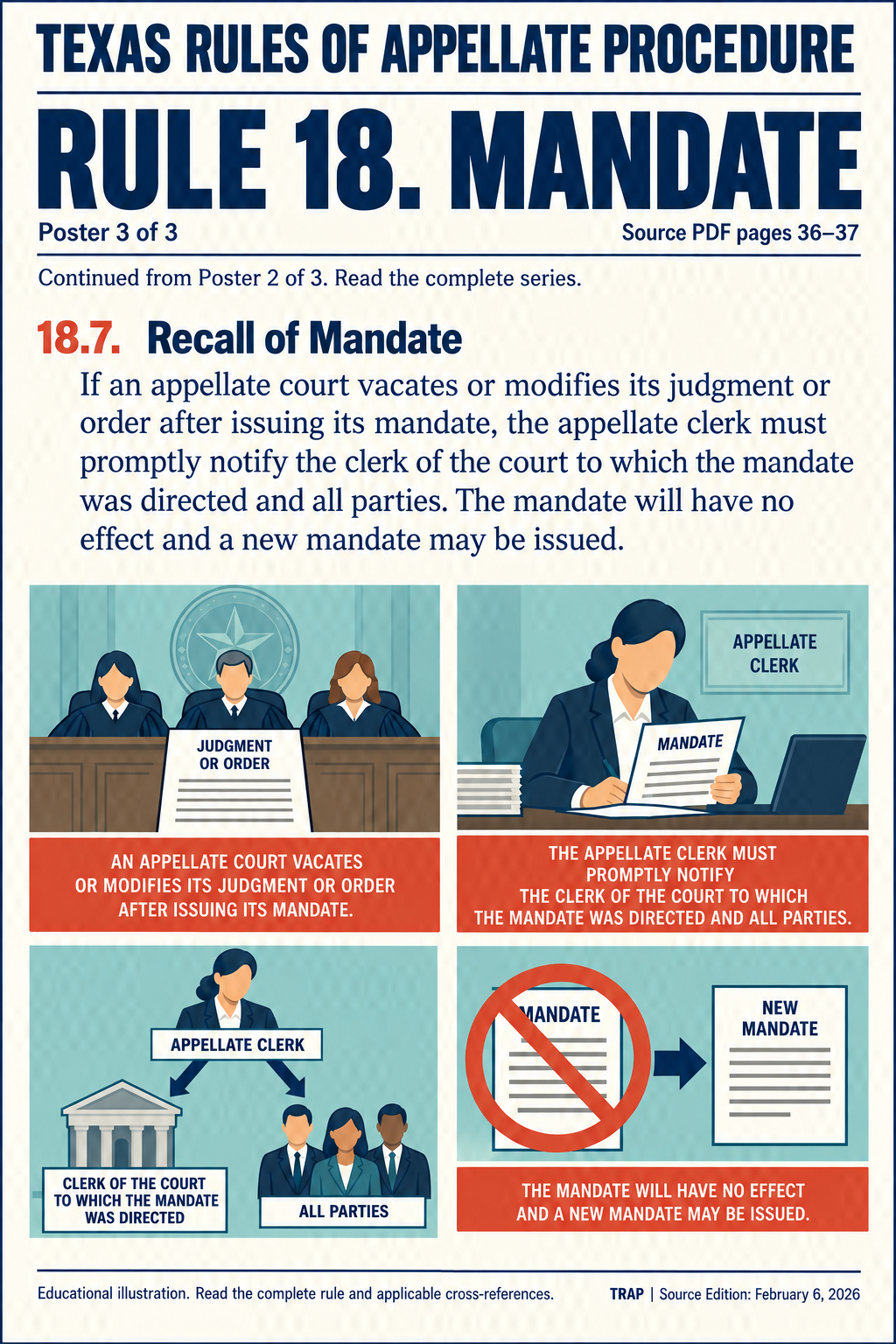
Read assigned text for Rule 18 poster 3
Assigned rule text
18.7. Recall of Mandate If an appellate court vacates or modifies its judgment or order after issuing its mandate, the appellate clerk must promptly notify the clerk of the court to which the mandate was directed and all parties. The mandate will have no effect and a new mandate may be issued.
Continued from Poster 2 of 3. Read the complete series.
Rule 23. Nunc Pro Tunc Proceedings In Criminal Cases
Rule 23. Nunc Pro Tunc Proceedings In Criminal Cases — poster 1Poster 1 of 1
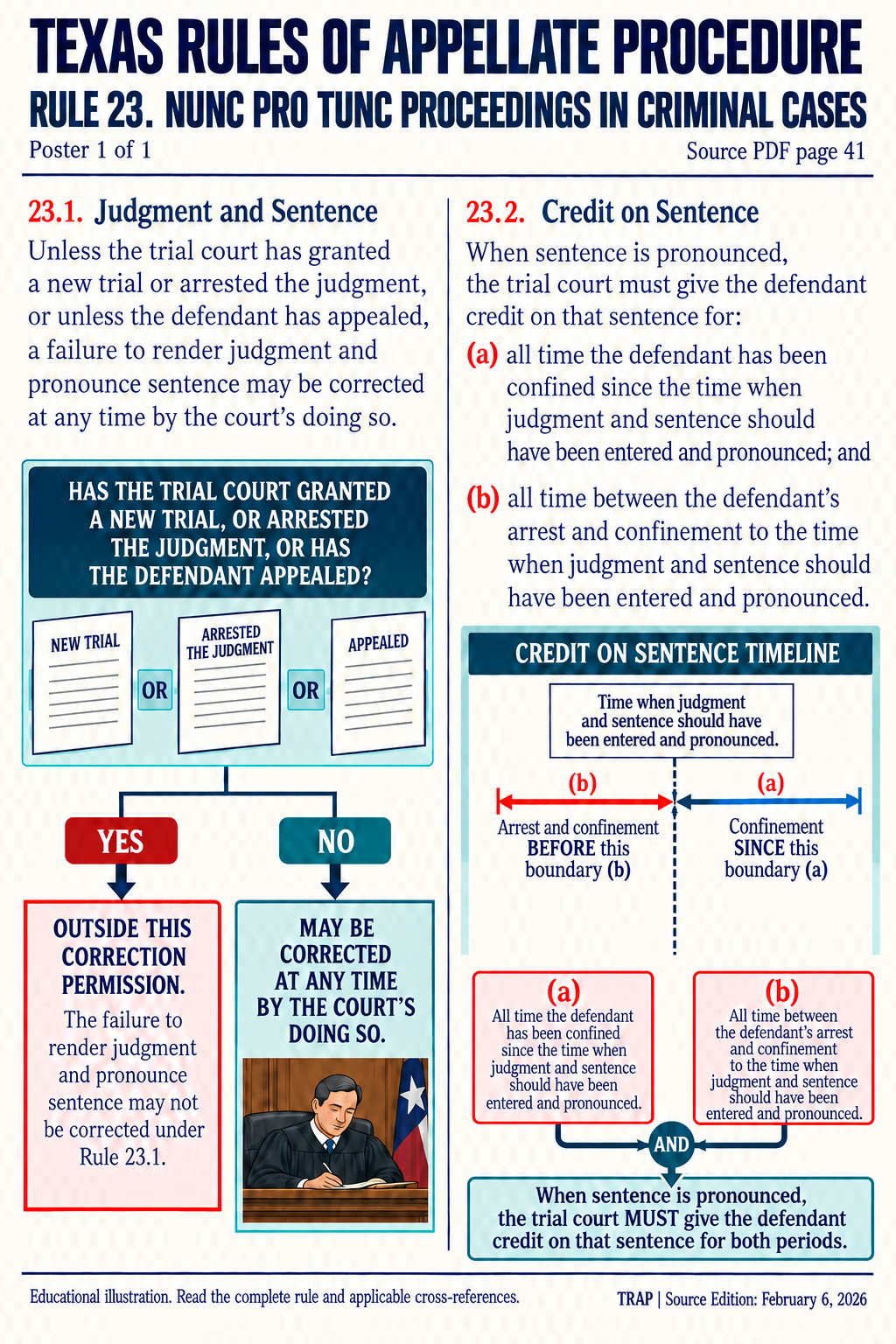
Read assigned text for Rule 23 poster 1
Assigned rule text
23.1. Judgment and Sentence Unless the trial court has granted a new trial or arrested the judgment, or unless the defendant has appealed, a failure to render judgment and pronounce sentence may be corrected at any time by the court's doing so.
23.2. Credit on Sentence When sentence is pronounced, the trial court must give the defendant credit on that sentence for:
(a) all time the defendant has been confined since the time when judgment and sentence should have been entered and pronounced; and
(b) all time between the defendant's arrest and confinement to the time when judgment and sentence should have been entered and pronounced.
Rule 27. Premature Filings
Rule 27. Premature Filings — poster 1Poster 1 of 2
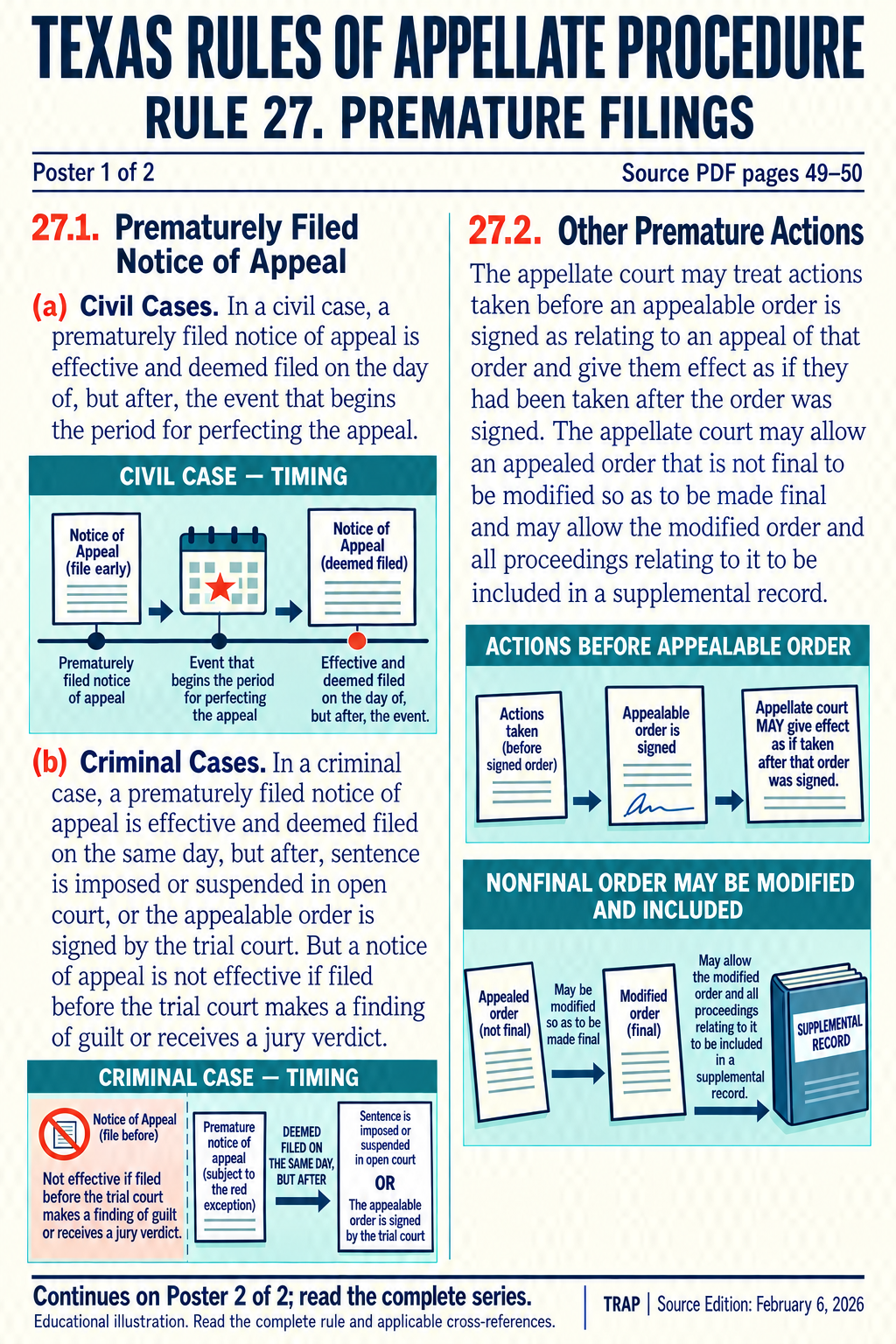
Read assigned text for Rule 27 poster 1
Assigned rule text
27.1. Prematurely Filed Notice of Appeal
(a) Civil Cases. In a civil case, a prematurely filed notice of appeal is effective and deemed filed on the day of, but after, the event that begins the period for perfecting the appeal.
(b) Criminal Cases. In a criminal case, a prematurely filed notice of appeal is effective and deemed filed on the same day, but after, sentence is imposed or suspended in open court, or the appealable order is signed by the trial court. But a notice of appeal is not effective if filed before the trial court makes a finding of guilt or receives a jury verdict.
27.2. Other Premature Actions The appellate court may treat actions taken before an appealable order is signed as relating to an appeal of that order and give them effect as if they had been taken after the order was signed. The appellate court may allow an appealed order that is not final to be modified so as to be made final and may allow the modified order and all proceedings relating to it to be included in a supplemental record.
Continues on Poster 2 of 2; read the complete series.
Rule 27. Premature Filings — poster 2Poster 2 of 2
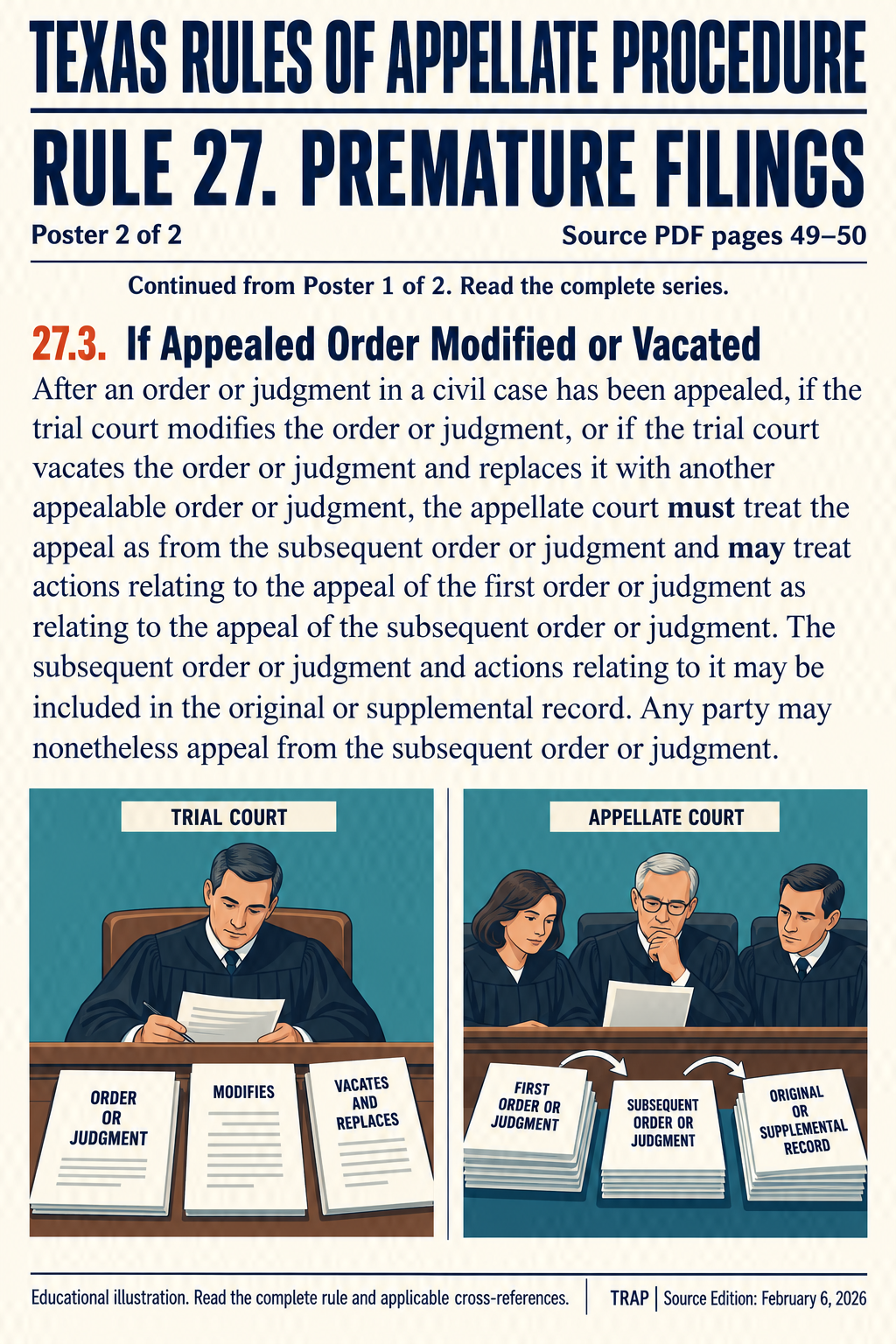
Read assigned text for Rule 27 poster 2
Assigned rule text
27.3. If Appealed Order Modified or Vacated After an order or judgment in a civil case has been appealed, if the trial court modifies the order or judgment, or if the trial court vacates the order or judgment and replaces it with another appealable order or judgment, the appellate court must treat the appeal as from the subsequent order or judgment and may treat actions relating to the appeal of the first order or judgment as relating to the appeal of the subsequent order or judgment. The subsequent order or judgment and actions relating to it may be included in the original or supplemental record. Any party may nonetheless appeal from the subsequent order or judgment.
Continued from Poster 1 of 2. Read the complete series.
Rule 27a. Transfers To And From The Fifteenth Court Of Appeals
Rule 27a. Transfers To And From The Fifteenth Court Of Appeals — poster 1Poster 1 of 3
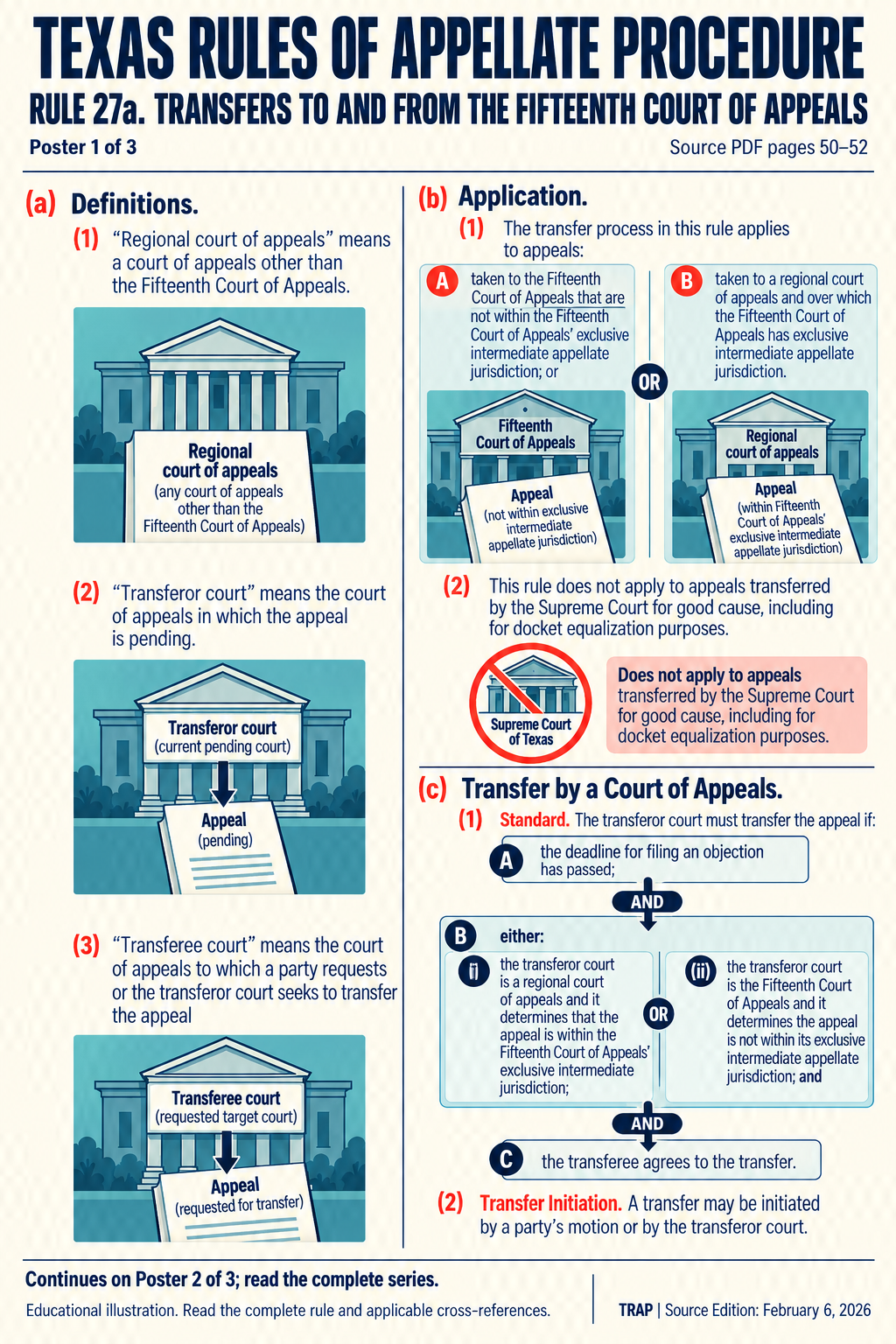
Read assigned text for Rule 27a poster 1
Assigned rule text
(a) Definitions.
(1) “Regional court of appeals” means a court of appeals other than the Fifteenth Court of Appeals.
(2) “Transferor court” means the court of appeals in which the appeal is pending.
(3) “Transferee court” means the court of appeals to which a party requests or the transferor court seeks to transfer the appeal
(b) Application.
(1) The transfer process in this rule applies to appeals:
(A) taken to the Fifteenth Court of Appeals that are not within the Fifteenth Court of Appeals’ exclusive intermediate appellate jurisdiction; or
(B) taken to a regional court of appeals and over which the Fifteenth Court of Appeals has exclusive intermediate appellate jurisdiction.
(2) This rule does not apply to appeals transferred by the Supreme Court for good cause, including for docket equalization purposes.
(c) Transfer by a Court of Appeals.
(1) Standard. The transferor court must transfer the appeal if:
(A) the deadline for filing an objection has passed;
(B) either:
(i) the transferor court is a regional court of appeals and it determines that the appeal is within the Fifteenth Court of Appeals’ exclusive intermediate jurisdiction; or (ii) the transferor court is the Fifteenth Court of Appeals and it determines the appeal is not within its exclusive intermediate appellate jurisdiction; and
(C) the transferee agrees to the transfer.
(2) Transfer Initiation. A transfer may be initiated by a party’s motion or by the transferor court.
Continues on Poster 2 of 3; read the complete series.
Rule 27a. Transfers To And From The Fifteenth Court Of Appeals — poster 2Poster 2 of 3
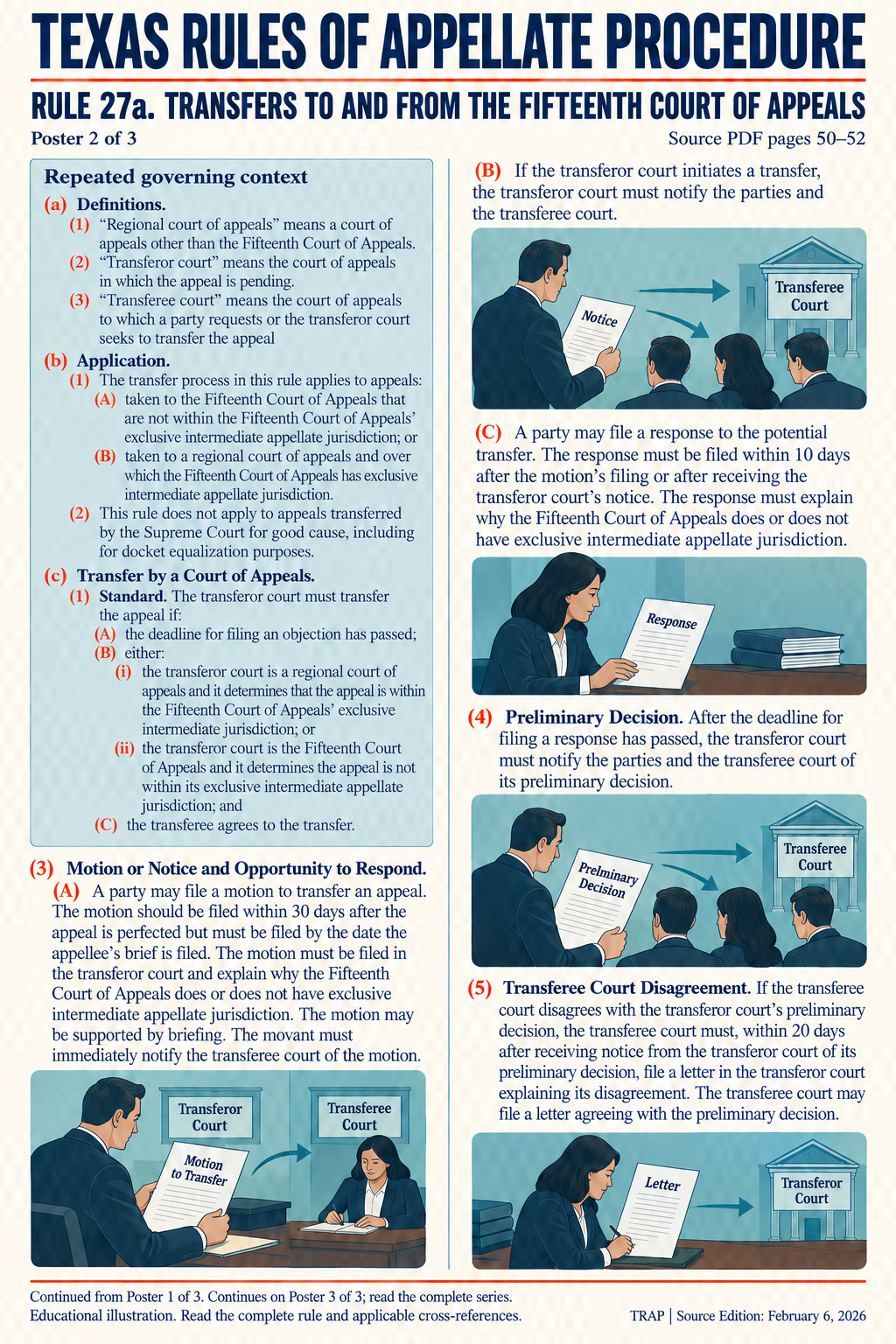
Read assigned text for Rule 27a poster 2
Assigned rule text
(3) Motion or Notice and Opportunity to Respond.
(A) A party may file a motion to transfer an appeal. The motion should be filed within 30 days after the appeal is perfected but must be filed by the date the appellee’s brief is filed. The motion must be filed in the transferor court and explain why the Fifteenth Court of Appeals does or does not have exclusive intermediate appellate jurisdiction. The motion may be supported by briefing. The movant must immediately notify the transferee court of the motion.
(B) If the transferor court initiates a transfer, the transferor court must notify the parties and the transferee court.
(C) A party may file a response to the potential transfer. The response must be filed within 10 days after the motion’s filing or after receiving the transferor court’s notice. The response must explain why the Fifteenth Court of Appeals does or does not have exclusive intermediate appellate jurisdiction.
(4) Preliminary Decision. After the deadline for filing a response has passed, the transferor court must notify the parties and the transferee court of its preliminary decision.
(5) Transferee Court Disagreement. If the transferee court disagrees with the transferor court’s preliminary decision, the transferee court must, within 20 days after receiving notice from the transferor court of its preliminary decision, file a letter in the transferor court explaining its disagreement. The transferee court may file a letter agreeing with the preliminary decision.
Repeated governing context
(a) Definitions.
(1) “Regional court of appeals” means a court of appeals other than the Fifteenth Court of Appeals.
(2) “Transferor court” means the court of appeals in which the appeal is pending.
(3) “Transferee court” means the court of appeals to which a party requests or the transferor court seeks to transfer the appeal
(b) Application.
(1) The transfer process in this rule applies to appeals:
(A) taken to the Fifteenth Court of Appeals that are not within the Fifteenth Court of Appeals’ exclusive intermediate appellate jurisdiction; or
(B) taken to a regional court of appeals and over which the Fifteenth Court of Appeals has exclusive intermediate appellate jurisdiction.
(2) This rule does not apply to appeals transferred by the Supreme Court for good cause, including for docket equalization purposes.
(c) Transfer by a Court of Appeals.
(1) Standard. The transferor court must transfer the appeal if:
(A) the deadline for filing an objection has passed;
(B) either:
(i) the transferor court is a regional court of appeals and it determines that the appeal is within the Fifteenth Court of Appeals’ exclusive intermediate jurisdiction; or (ii) the transferor court is the Fifteenth Court of Appeals and it determines the appeal is not within its exclusive intermediate appellate jurisdiction; and
(C) the transferee agrees to the transfer.
Continued from Poster 1 of 3. Continues on Poster 3 of 3; read the complete series.
Rule 27a. Transfers To And From The Fifteenth Court Of Appeals — poster 3Poster 3 of 3
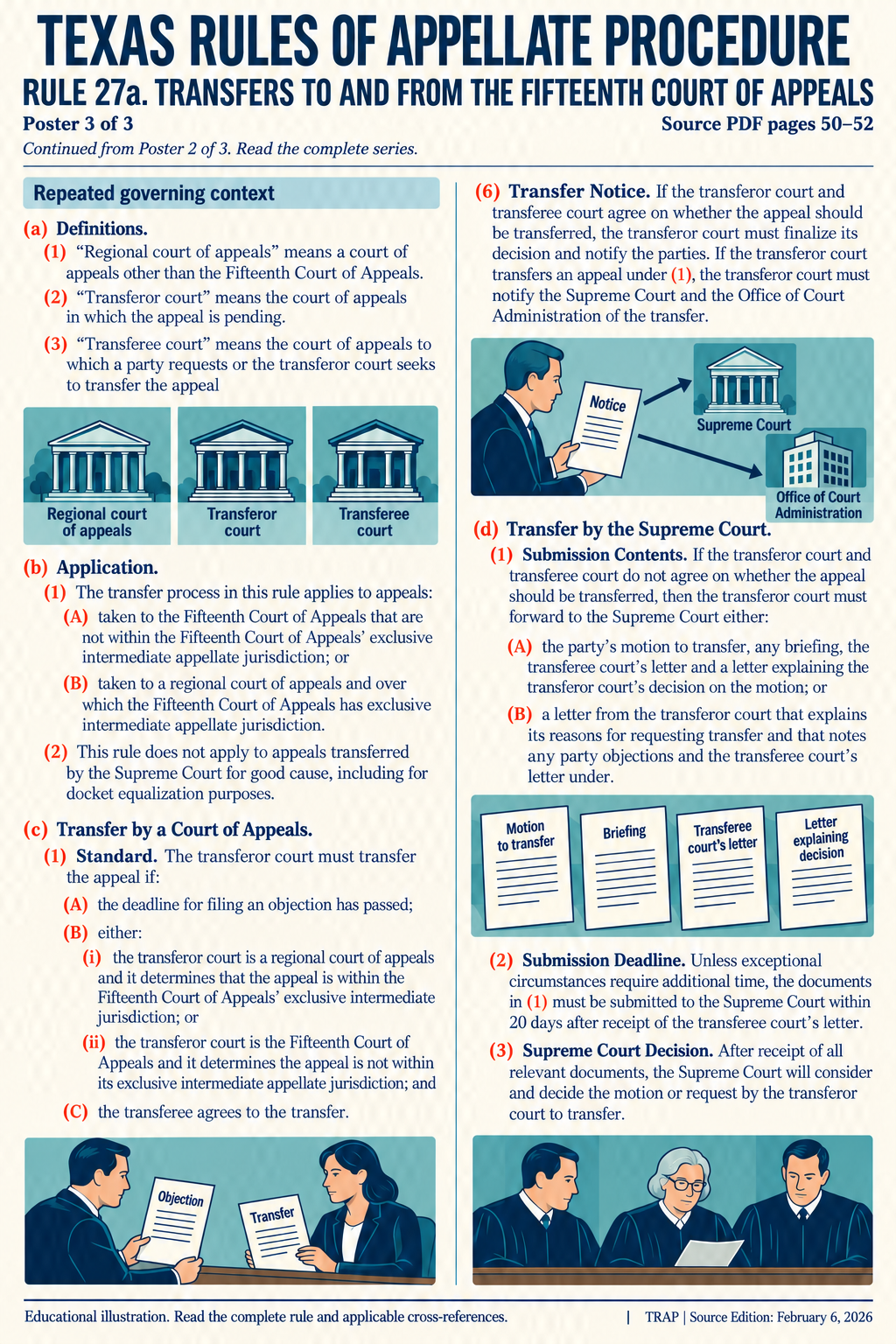
Read assigned text for Rule 27a poster 3
Assigned rule text
(6) Transfer Notice. If the transferor court and transferee court agree on whether the appeal should be transferred, the transferor court must finalize its decision and notify the parties. If the transferor court transfers an appeal under (1), the transferor court must notify the Supreme Court and the Office of Court Administration of the transfer.
(d) Transfer by the Supreme Court.
(1) Submission Contents. If the transferor court and transferee court do not agree on whether the appeal should be transferred, then the transferor court must forward to the Supreme Court either:
(A) the party’s motion to transfer, any briefing, the transferee court’s letter and a letter explaining the transferor court’s decision on the motion; or
(B) a letter from the transferor court that explains its reasons for requesting transfer and that notes any party objections and the transferee court’s letter under.
(2) Submission Deadline. Unless exceptional circumstances require additional time, the documents in (1) must be submitted to the Supreme Court within 20 days after receipt of the transferee court’s letter.
(3) Supreme Court Decision. After receipt of all relevant documents, the Supreme Court will consider and decide the motion or request by the transferor court to transfer.
Repeated governing context
(a) Definitions.
(1) “Regional court of appeals” means a court of appeals other than the Fifteenth Court of Appeals.
(2) “Transferor court” means the court of appeals in which the appeal is pending.
(3) “Transferee court” means the court of appeals to which a party requests or the transferor court seeks to transfer the appeal
(b) Application.
(1) The transfer process in this rule applies to appeals:
(A) taken to the Fifteenth Court of Appeals that are not within the Fifteenth Court of Appeals’ exclusive intermediate appellate jurisdiction; or
(B) taken to a regional court of appeals and over which the Fifteenth Court of Appeals has exclusive intermediate appellate jurisdiction.
(2) This rule does not apply to appeals transferred by the Supreme Court for good cause, including for docket equalization purposes.
(c) Transfer by a Court of Appeals.
(1) Standard. The transferor court must transfer the appeal if:
(A) the deadline for filing an objection has passed;
(B) either:
(i) the transferor court is a regional court of appeals and it determines that the appeal is within the Fifteenth Court of Appeals’ exclusive intermediate jurisdiction; or (ii) the transferor court is the Fifteenth Court of Appeals and it determines the appeal is not within its exclusive intermediate appellate jurisdiction; and
(C) the transferee agrees to the transfer.
Continued from Poster 2 of 3. Read the complete series.
Rule 28. Accelerated And Permissive Appeals In Civil Cases
Rule 28. Accelerated And Permissive Appeals In Civil Cases — poster 1Poster 1 of 6
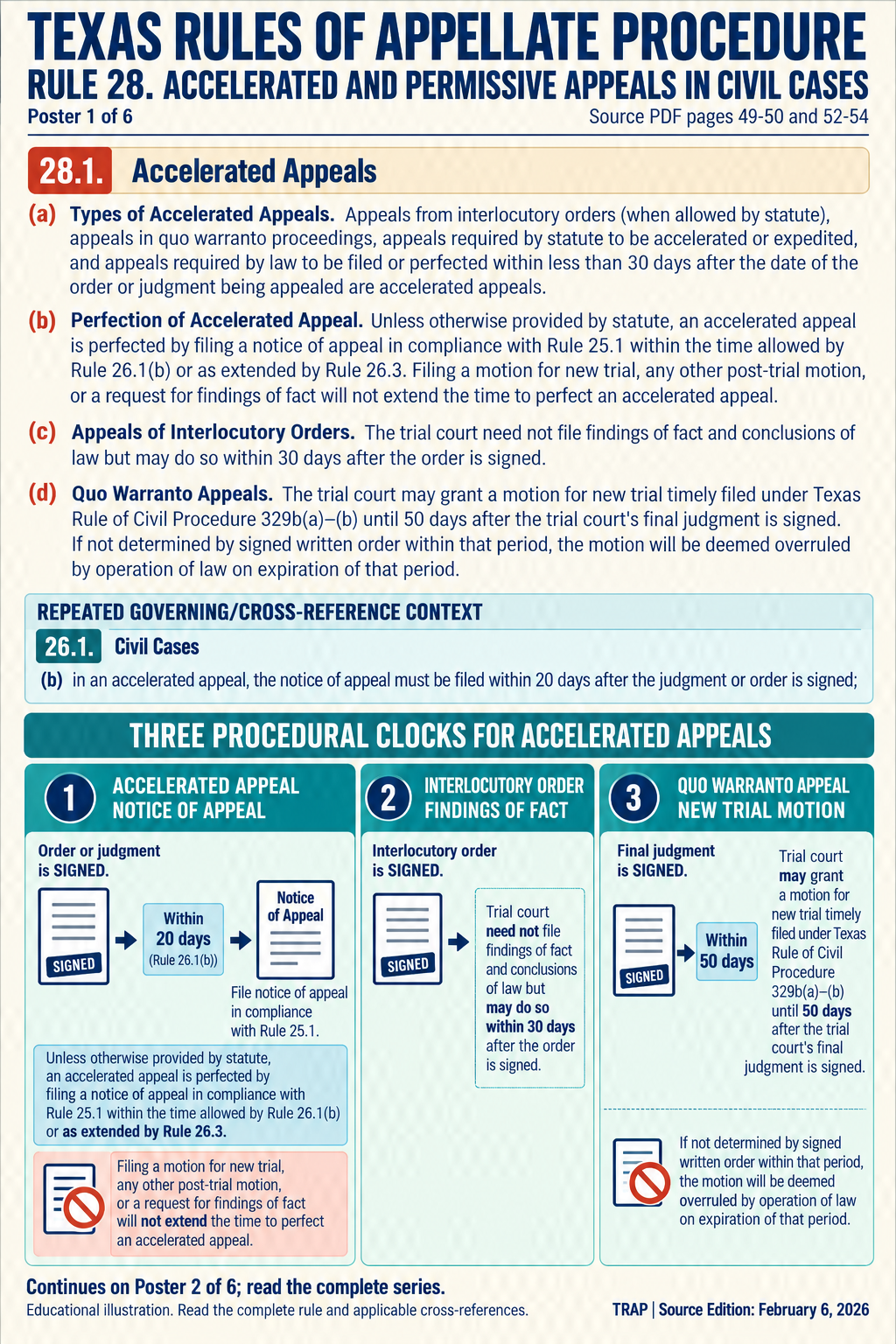
Read assigned text for Rule 28 poster 1
Assigned rule text
28.1. Accelerated Appeals
(a) Types of Accelerated Appeals. Appeals from interlocutory orders (when allowed by statute), appeals in quo warranto proceedings, appeals required by statute to be accelerated or expedited, and appeals required by law to be filed or perfected within less than 30 days after the date of the order or judgment being appealed are accelerated appeals.
(b) Perfection of Accelerated Appeal. Unless otherwise provided by statute, an accelerated appeal is perfected by filing a notice of appeal in compliance with Rule 25.1 within the time allowed by Rule 26.1(b) or as extended by Rule 26.3. Filing a motion for new trial, any other post-trial motion, or a request for findings of fact will not extend the time to perfect an accelerated appeal.
(c) Appeals of Interlocutory Orders. The trial court need not file findings of fact and conclusions of law but may do so within 30 days after the order is signed.
(d) Quo Warranto Appeals. The trial court may grant a motion for new trial timely filed under Texas Rule of Civil Procedure 329b(a)–(b) until 50 days after the trial court's final judgment is signed. If not determined by signed written order within that period, the motion will be deemed overruled by operation of law on expiration of that period.
Repeated governing context
26.1. Civil Cases
(b) in an accelerated appeal, the notice of appeal must be filed within 20 days after the judgment or order is signed;
Continues on Poster 2 of 6; read the complete series.
Rule 28. Accelerated And Permissive Appeals In Civil Cases — poster 2Poster 2 of 6
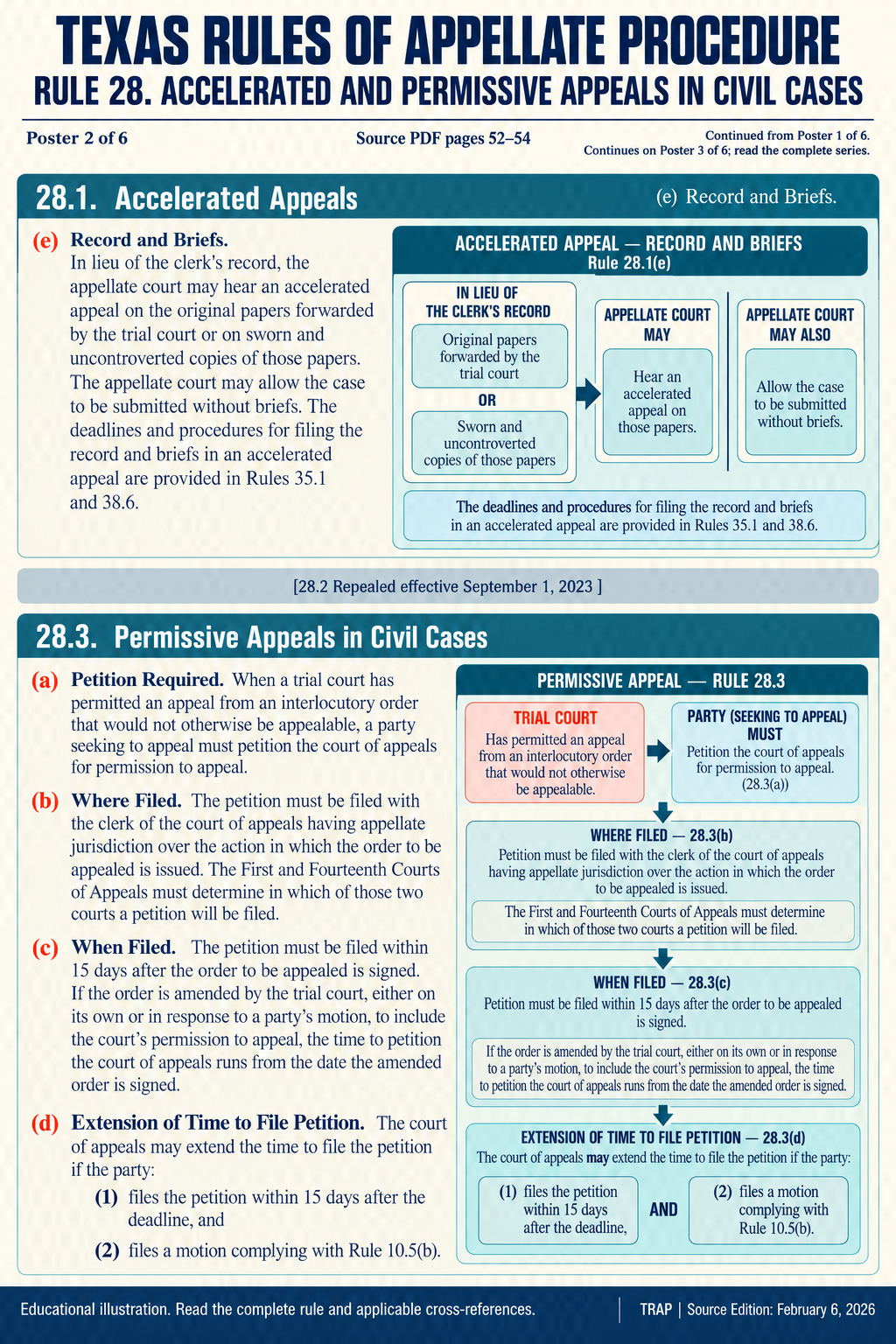
Read assigned text for Rule 28 poster 2
Assigned rule text
(e) Record and Briefs. In lieu of the clerk's record, the appellate court may hear an accelerated appeal on the original papers forwarded by the trial court or on sworn and uncontroverted copies of those papers. The appellate court may allow the case to be submitted without briefs. The deadlines and procedures for filing the record and briefs in an accelerated appeal are provided in Rules 35.1 and 38.6.
[28.2 Repealed effective September 1, 2023 ]
28.3. Permissive Appeals in Civil Cases.
(a) Petition Required. When a trial court has permitted an appeal from an interlocutory order that would not otherwise be appealable, a party seeking to appeal must petition the court of appeals for permission to appeal.
(b) Where Filed. The petition must be filed with the clerk of the court of appeals having appellate jurisdiction over the action in which the order to be appealed is issued. The First and Fourteenth Courts of Appeals must determine in which of those two courts a petition will be filed.
(c) When Filed. The petition must be filed within 15 days after the order to be appealed is signed. If the order is amended by the trial court, either on its own or in response to a party’s motion, to include the court’s permission to appeal, the time to petition the court of appeals runs from the date the amended order is signed.
(d) Extension of Time to File Petition. The court of appeals may extend the time to file the petition if the party:
(1) files the petition within 15 days after the deadline, and
(2) files a motion complying with Rule 10.5(b).
Repeated governing context
28.1. Accelerated Appeals
Continued from Poster 1 of 6. Continues on Poster 3 of 6; read the complete series.
Rule 28. Accelerated And Permissive Appeals In Civil Cases — poster 3Poster 3 of 6
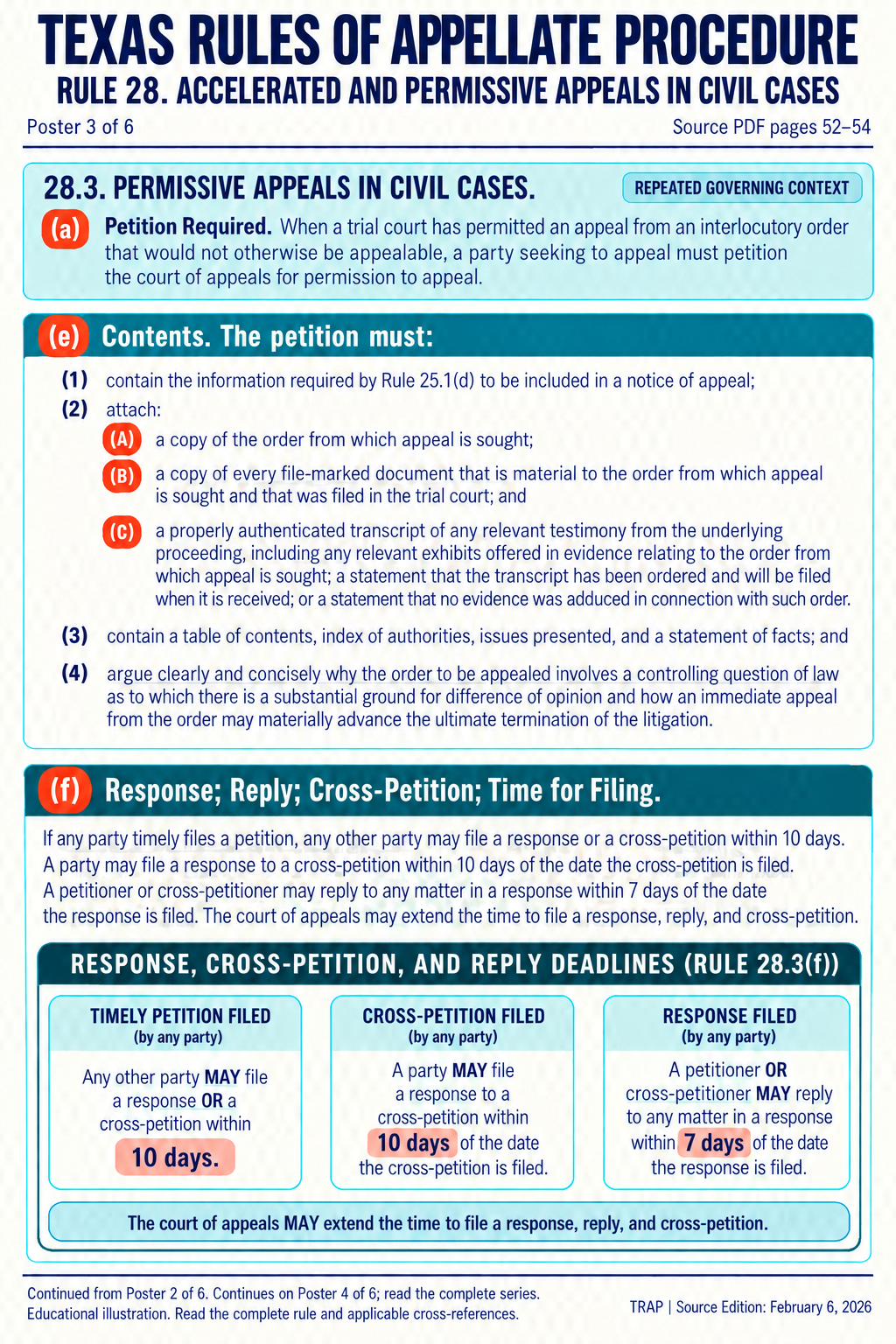
Read assigned text for Rule 28 poster 3
Assigned rule text
(e) Contents. The petition must:
(1) contain the information required by Rule 25.1(d) to be included in a notice of appeal;
(2) attach:
(A) a copy of the order from which appeal is sought;
(B) a copy of every file-marked document that is material to the order from which appeal is sought and that was filed in the trial court; and
(C) a properly authenticated transcript of any relevant testimony from the underlying proceeding, including any relevant exhibits offered in evidence relating to the order from which appeal is sought; a statement that the transcript has been ordered and will be filed when it is received; or a statement that no evidence was adduced in connection with such order.
(3) contain a table of contents, index of authorities, issues presented, and a statement of facts; and
(4) argue clearly and concisely why the order to be appealed involves a controlling question of law as to which there is a substantial ground for difference of opinion and how an immediate appeal from the order may materially advance the ultimate termination of the litigation.
(f) Response; Reply; Cross-Petition; Time for Filing. If any party timely files a petition, any other party may file a response or a cross-petition within 10 days. A party may file a response to a cross-petition within 10 days of the date the cross-petition is filed. A petitioner or cross-petitioner may reply to any matter in a response within 7 days of the date the response is filed. The court of appeals may extend the time to file a response, reply, and cross-petition.
Repeated governing context
28.3. Permissive Appeals in Civil Cases.
(a) Petition Required. When a trial court has permitted an appeal from an interlocutory order that would not otherwise be appealable, a party seeking to appeal must petition the court of appeals for permission to appeal.
Continued from Poster 2 of 6. Continues on Poster 4 of 6; read the complete series.
Rule 28. Accelerated And Permissive Appeals In Civil Cases — poster 4Poster 4 of 6
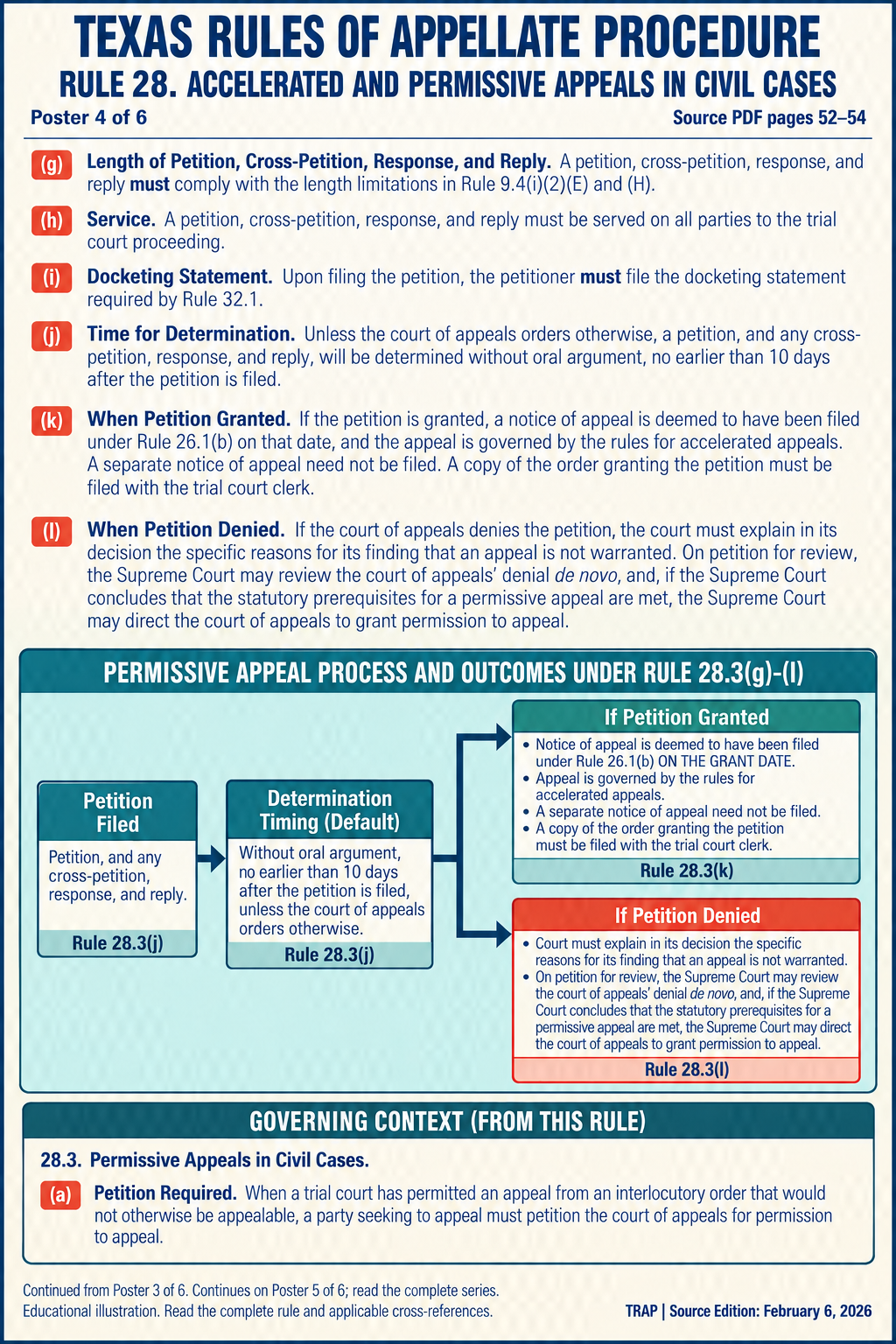
Read assigned text for Rule 28 poster 4
Assigned rule text
(g) Length of Petition, Cross-Petition, Response, and Reply. A petition, cross-petition, response, and reply must comply with the length limitations in Rule 9.4(i)(2)(E) and (H).
(h) Service. A petition, cross-petition, response, and reply must be served on all parties to the trial court proceeding.
(i) Docketing Statement. Upon filing the petition, the petitioner must file the docketing statement required by Rule 32.1.
(j) Time for Determination. Unless the court of appeals orders otherwise, a petition, and any cross-petition, response, and reply, will be determined without oral argument, no earlier than 10 days after the petition is filed.
(k) When Petition Granted. If the petition is granted, a notice of appeal is deemed to have been filed under Rule 26.1(b) on that date, and the appeal is governed by the rules for accelerated appeals. A separate notice of appeal need not be filed. A copy of the order granting the petition must be filed with the trial court clerk.
(l) When Petition Denied. If the court of appeals denies the petition, the court must explain in its decision the specific reasons for its finding that an appeal is not warranted. On petition for review, the Supreme Court may review the court of appeals’ denial de novo, and, if the Supreme Court concludes that the statutory prerequisites for a permissive appeal are met, the Supreme Court may direct the court of appeals to grant permission to appeal.
Repeated governing context
28.3. Permissive Appeals in Civil Cases.
(a) Petition Required. When a trial court has permitted an appeal from an interlocutory order that would not otherwise be appealable, a party seeking to appeal must petition the court of appeals for permission to appeal.
Continued from Poster 3 of 6. Continues on Poster 5 of 6; read the complete series.
Rule 28. Accelerated And Permissive Appeals In Civil Cases — poster 5Poster 5 of 6
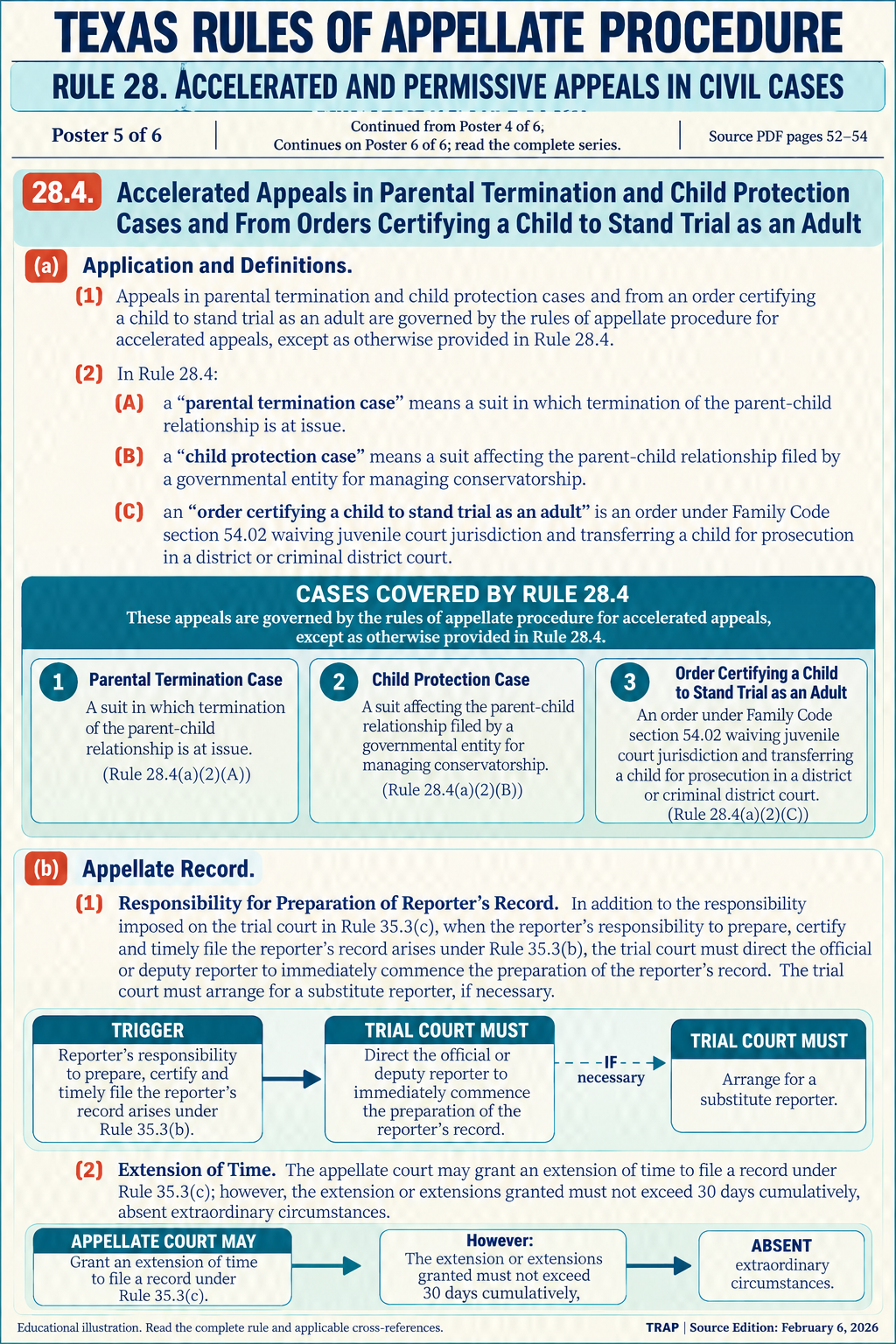
Read assigned text for Rule 28 poster 5
Assigned rule text
28.4. Accelerated Appeals in Parental Termination and Child Protection Cases and From Orders Certifying a Child to Stand Trial as an Adult
(a) Application and Definitions.
(1) Appeals in parental termination and child protection cases and from an order certifying a child to stand trial as an adult are governed by the rules of appellate procedure for accelerated appeals, except as otherwise provided in Rule 28.4.
(2) In Rule 28.4:
(A) a “parental termination case” means a suit in which termination of the parent-child relationship is at issue.
(B) a “child protection case” means a suit affecting the parent-child relationship filed by a governmental entity for managing conservatorship.
(C) an “order certifying a child to stand trial as an adult” is an order under Family Code section 54.02 waiving juvenile court jurisdiction and transferring a child for prosecution in a district or criminal district court.
(b) Appellate Record.
(1) Responsibility for Preparation of Reporter’s Record. In addition to the responsibility imposed on the trial court in Rule 35.3(c), when the reporter’s responsibility to prepare, certify and timely file the reporter’s record arises under Rule 35.3(b), the trial court must direct the official or deputy reporter to immediately commence the preparation of the reporter’s record. The trial court must arrange for a substitute reporter, if necessary.
(2) Extension of Time. The appellate court may grant an extension of time to file a record under Rule 35.3(c); however, the extension or extensions granted must not exceed 30 days cumulatively, absent extraordinary circumstances.
Continued from Poster 4 of 6. Continues on Poster 6 of 6; read the complete series.
Rule 28. Accelerated And Permissive Appeals In Civil Cases — poster 6Poster 6 of 6
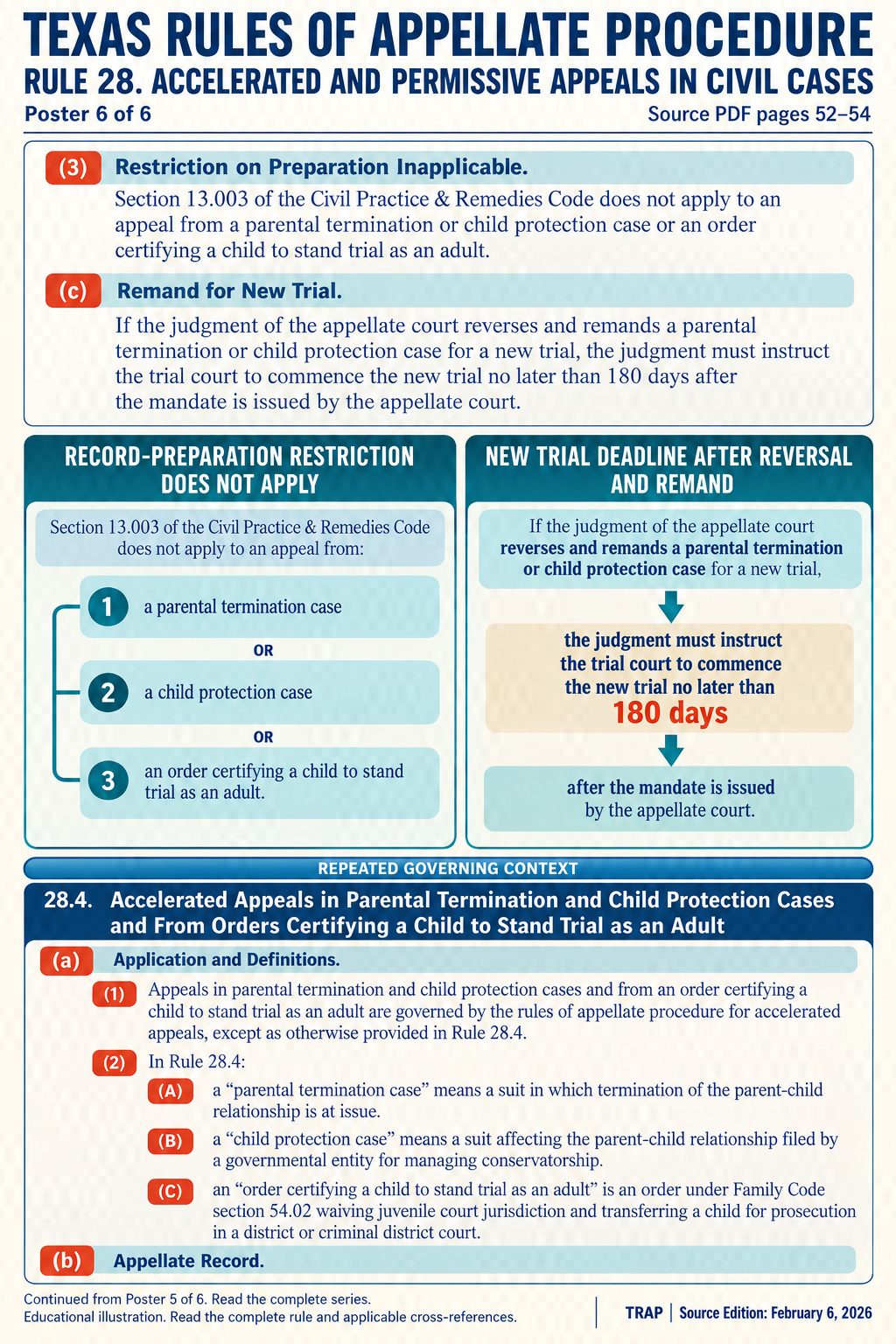
Read assigned text for Rule 28 poster 6
Assigned rule text
(3) Restriction on Preparation Inapplicable. Section 13.003 of the Civil Practice & Remedies Code does not apply to an appeal from a parental termination or child protection case or an order certifying a child to stand trial as an adult.
(c) Remand for New Trial. If the judgment of the appellate court reverses and remands a parental termination or child protection case for a new trial, the judgment must instruct the trial court to commence the new trial no later than 180 days after the mandate is issued by the appellate court.
Repeated governing context
28.4. Accelerated Appeals in Parental Termination and Child Protection Cases and From Orders Certifying a Child to Stand Trial as an Adult
(a) Application and Definitions.
(1) Appeals in parental termination and child protection cases and from an order certifying a child to stand trial as an adult are governed by the rules of appellate procedure for accelerated appeals, except as otherwise provided in Rule 28.4.
(2) In Rule 28.4:
(A) a “parental termination case” means a suit in which termination of the parent-child relationship is at issue.
(B) a “child protection case” means a suit affecting the parent-child relationship filed by a governmental entity for managing conservatorship.
(C) an “order certifying a child to stand trial as an adult” is an order under Family Code section 54.02 waiving juvenile court jurisdiction and transferring a child for prosecution in a district or criminal district court.
(b) Appellate Record.
Continued from Poster 5 of 6. Read the complete series.
Rule 29. Orders Pending Interlocutory Appeal In Civil Cases
Rule 29. Orders Pending Interlocutory Appeal In Civil Cases — poster 1Poster 1 of 2
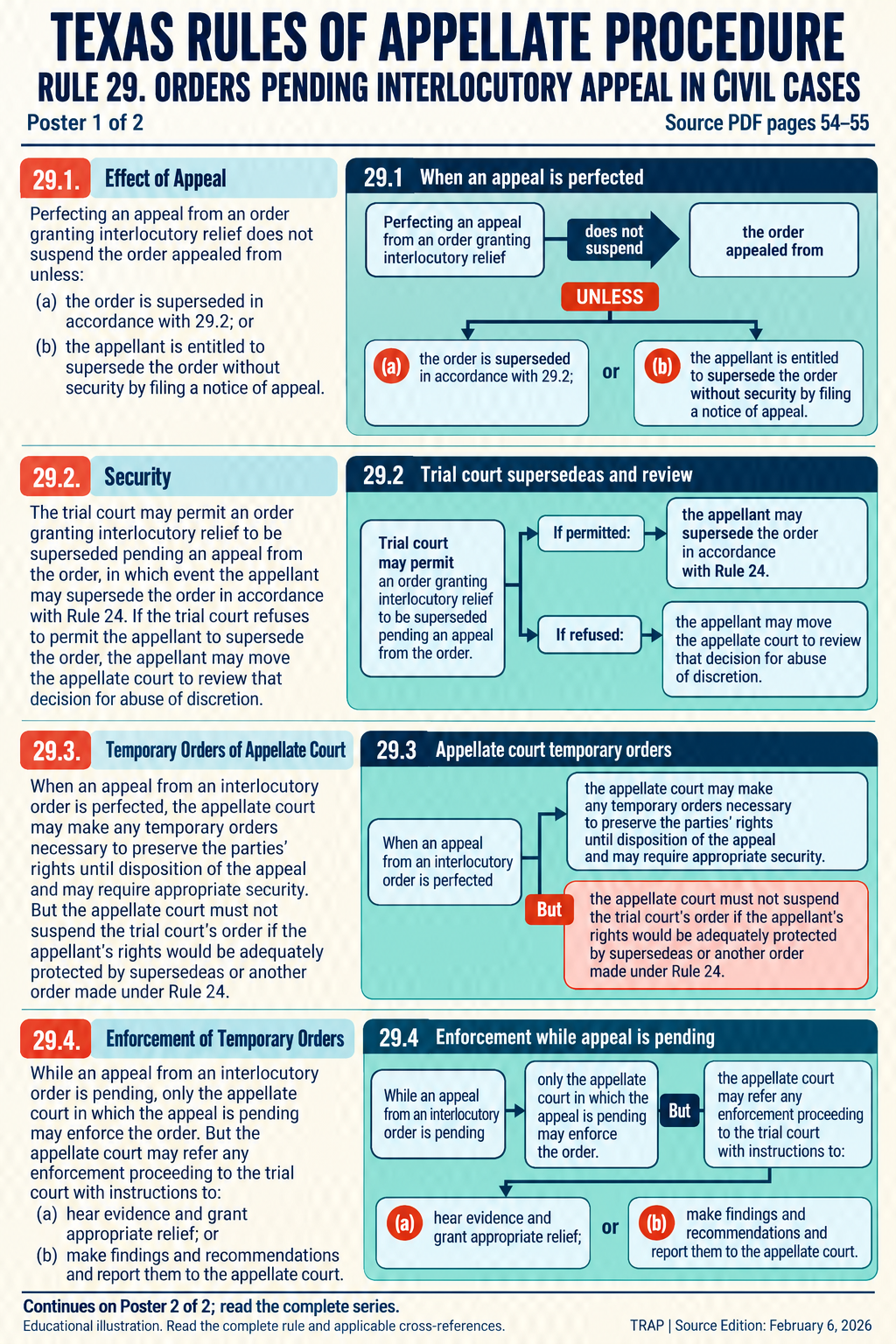
Read assigned text for Rule 29 poster 1
Assigned rule text
29.1. Effect of Appeal Perfecting an appeal from an order granting interlocutory relief does not suspend the order appealed from unless:
(a) the order is superseded in accordance with 29.2; or
(b) the appellant is entitled to supersede the order without security by filing a notice of appeal.
29.2. Security The trial court may permit an order granting interlocutory relief to be superseded pending an appeal from the order, in which event the appellant may supersede the order in accordance with Rule 24. If the trial court refuses to permit the appellant to supersede the order, the appellant may move the appellate court to review that decision for abuse of discretion.
29.3. Temporary Orders of Appellate Court When an appeal from an interlocutory order is perfected, the appellate court may make any temporary orders necessary to preserve the parties' rights until disposition of the appeal and may require appropriate security. But the appellate court must not suspend the trial court's order if the appellant's rights would be adequately protected by supersedeas or another order made under Rule 24.
29.4. Enforcement of Temporary Orders While an appeal from an interlocutory order is pending, only the appellate court in which the appeal is pending may enforce the order. But the appellate court may refer any enforcement proceeding to the trial court with instructions to:
(a) hear evidence and grant appropriate relief; or
(b) make findings and recommendations and report them to the appellate court.
Continues on Poster 2 of 2; read the complete series.
Rule 29. Orders Pending Interlocutory Appeal In Civil Cases — poster 2Poster 2 of 2
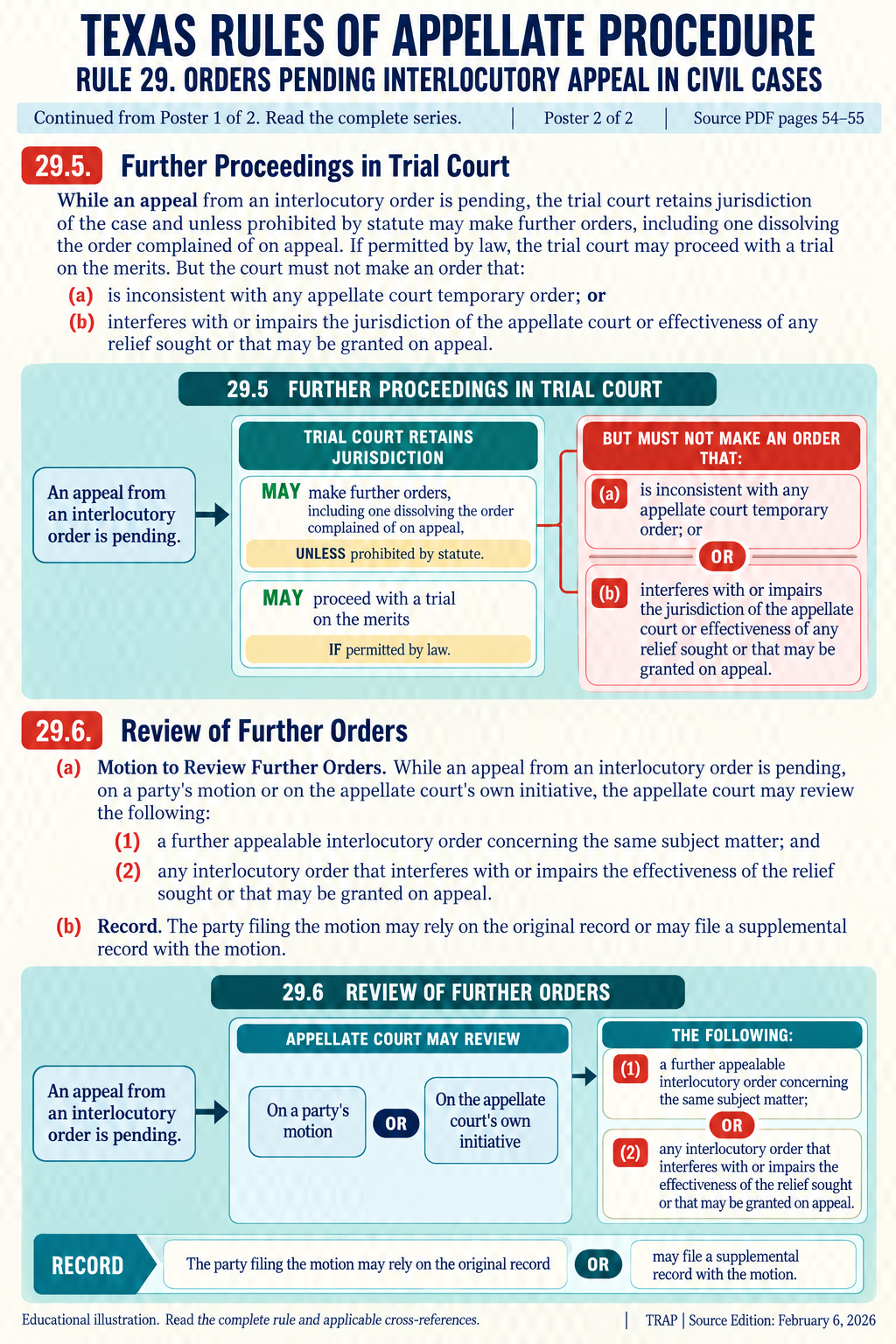
Read assigned text for Rule 29 poster 2
Assigned rule text
29.5. Further Proceedings in Trial Court While an appeal from an interlocutory order is pending, the trial court retains jurisdiction of the case and unless prohibited by statute may make further orders, including one dissolving the order complained of on appeal. If permitted by law, the trial court may proceed with a trial on the merits. But the court must not make an order that:
(a) is inconsistent with any appellate court temporary order; or
(b) interferes with or impairs the jurisdiction of the appellate court or effectiveness of any relief sought or that may be granted on appeal.
29.6. Review of Further Orders
(a) Motion to Review Further Orders. While an appeal from an interlocutory order is pending, on a party's motion or on the appellate court's own initiative, the appellate court may review the following:
(1) a further appealable interlocutory order concerning the same subject matter; and
(2) any interlocutory order that interferes with or impairs the effectiveness of the relief sought or that may be granted on appeal.
(b) Record. The party filing the motion may rely on the original record or may file a supplemental record with the motion.
Continued from Poster 1 of 2. Read the complete series.
Rule 30. Restricted Appeals To Court Of Appeals In Civil Cases
Rule 30. Restricted Appeals To Court Of Appeals In Civil Cases — poster 1Poster 1 of 1
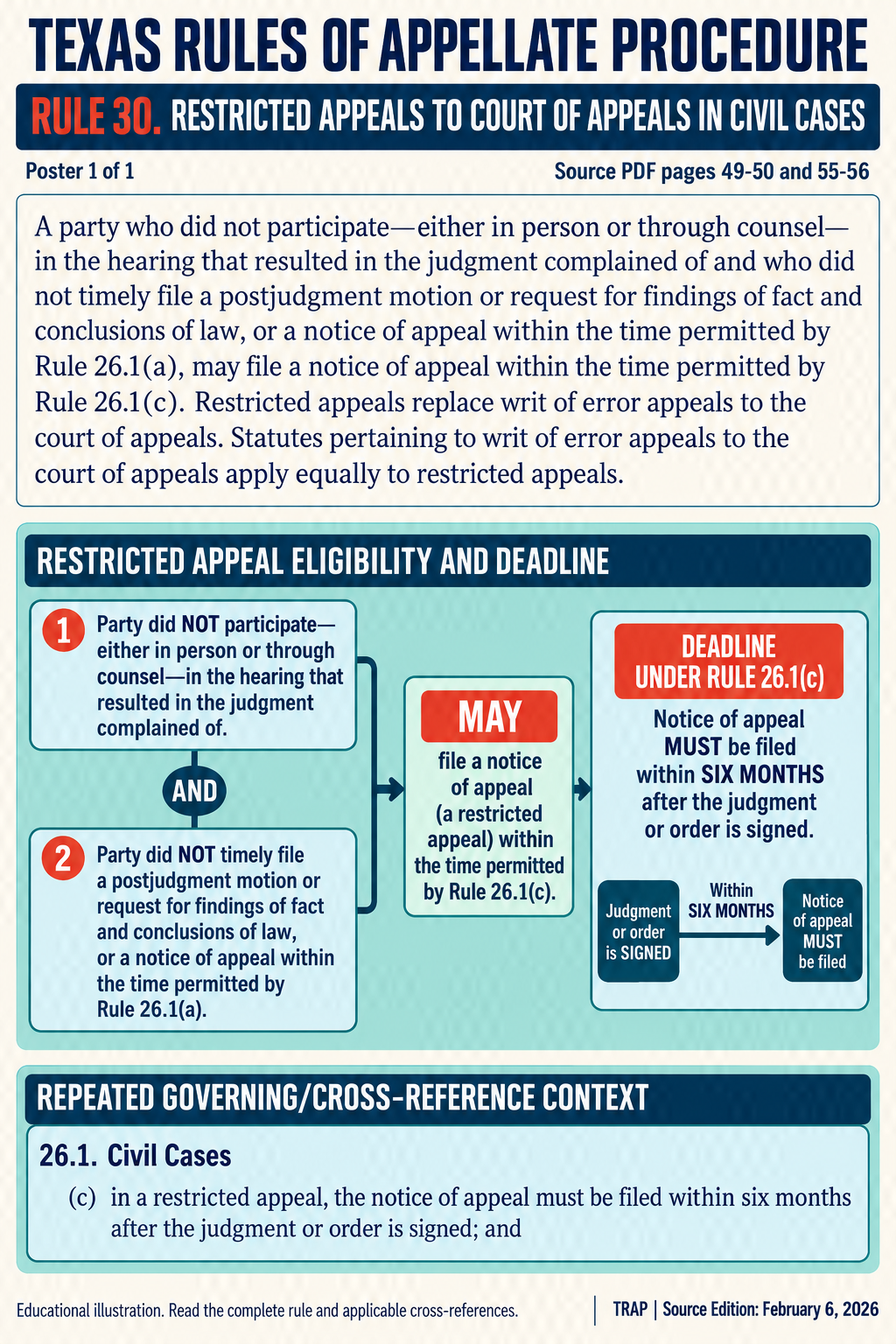
Read assigned text for Rule 30 poster 1
Assigned rule text
A party who did not participate—either in person or through counsel—in the hearing that resulted in the judgment complained of and who did not timely file a postjudgment motion or request for findings of fact and conclusions of law, or a notice of appeal within the time permitted by Rule 26.1(a), may file a notice of appeal within the time permitted by Rule 26.1(c). Restricted appeals replace writ of error appeals to the court of appeals. Statutes pertaining to writ of error appeals to the court of appeals apply equally to restricted appeals.
Repeated governing context
26.1. Civil Cases
(c) in a restricted appeal, the notice of appeal must be filed within six months after the judgment or order is signed; and
Rule 31. Appeals In Habeas Corpus, Bail, And Extradition Proceedings In Criminal Cases
Rule 31. Appeals In Habeas Corpus, Bail, And Extradition Proceedings In Criminal Cases — poster 1Poster 1 of 10
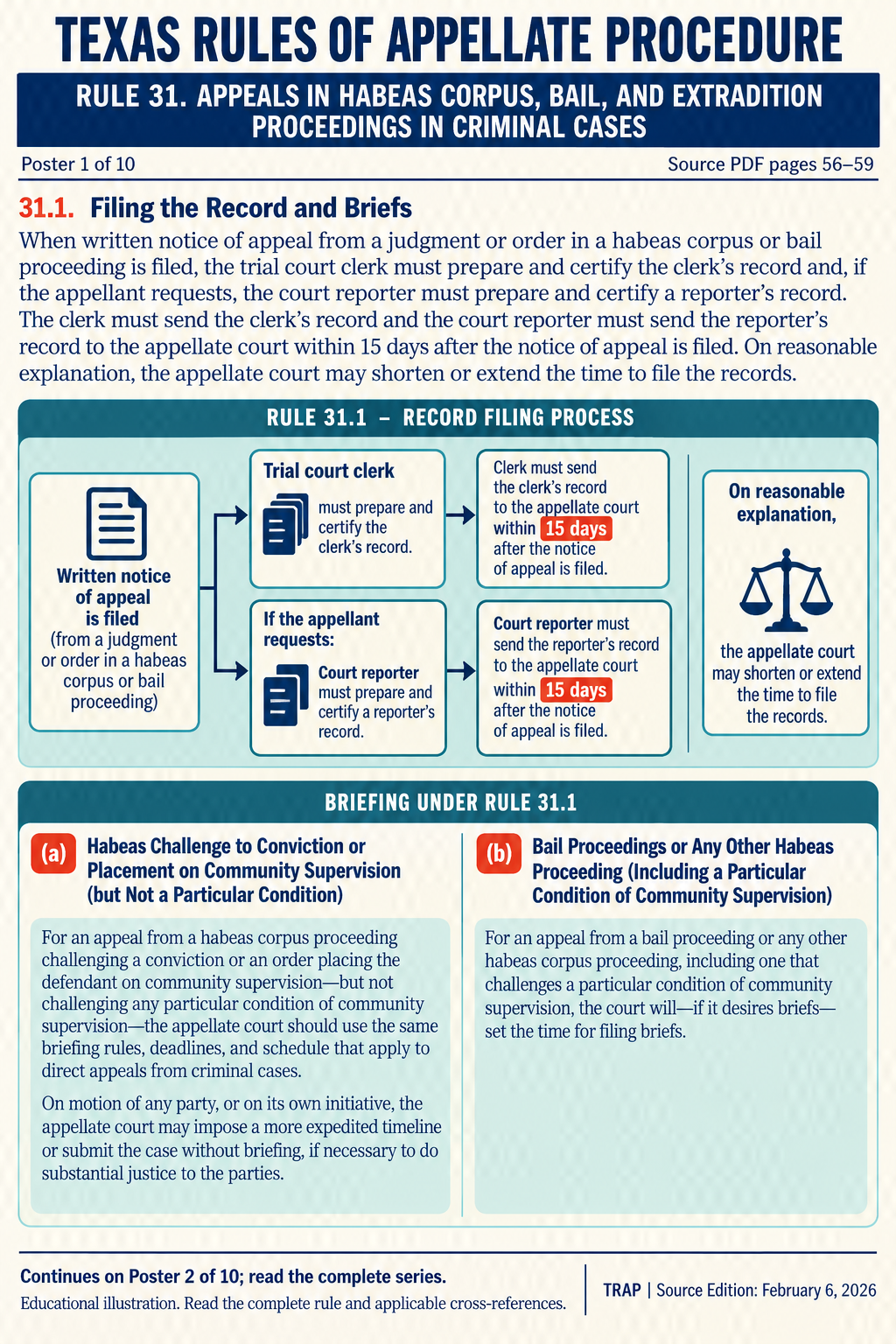
Read assigned text for Rule 31 poster 1
Assigned rule text
31.1. Filing the Record and Briefs When written notice of appeal from a judgment or order in a habeas corpus or bail proceeding is filed, the trial court clerk must prepare and certify the clerk’s record and, if the appellant requests, the court reporter must prepare and certify a reporter’s record. The clerk must send the clerk’s record and the court reporter must send the reporter’s record to the appellate court within 15 days after the notice of appeal is filed. On reasonable explanation, the appellate court may shorten or extend the time to file the records.
(a) For an appeal from a habeas corpus proceeding challenging a conviction or an order placing the defendant on community supervision—but not challenging any particular condition of community supervision—the appellate court should use the same briefing rules, deadlines, and schedule that apply to direct appeals from criminal cases. On motion of any party, or on its own initiative, the appellate court may impose a more expedited timeline or submit the case without briefing, if necessary to do substantial justice to the parties.
(b) For an appeal from a bail proceeding or any other habeas corpus proceeding, including one that challenges a particular condition of community supervision, the court will—if it desires briefs—set the time for filing briefs.
Continues on Poster 2 of 10; read the complete series.
Rule 31. Appeals In Habeas Corpus, Bail, And Extradition Proceedings In Criminal Cases — poster 2Poster 2 of 10
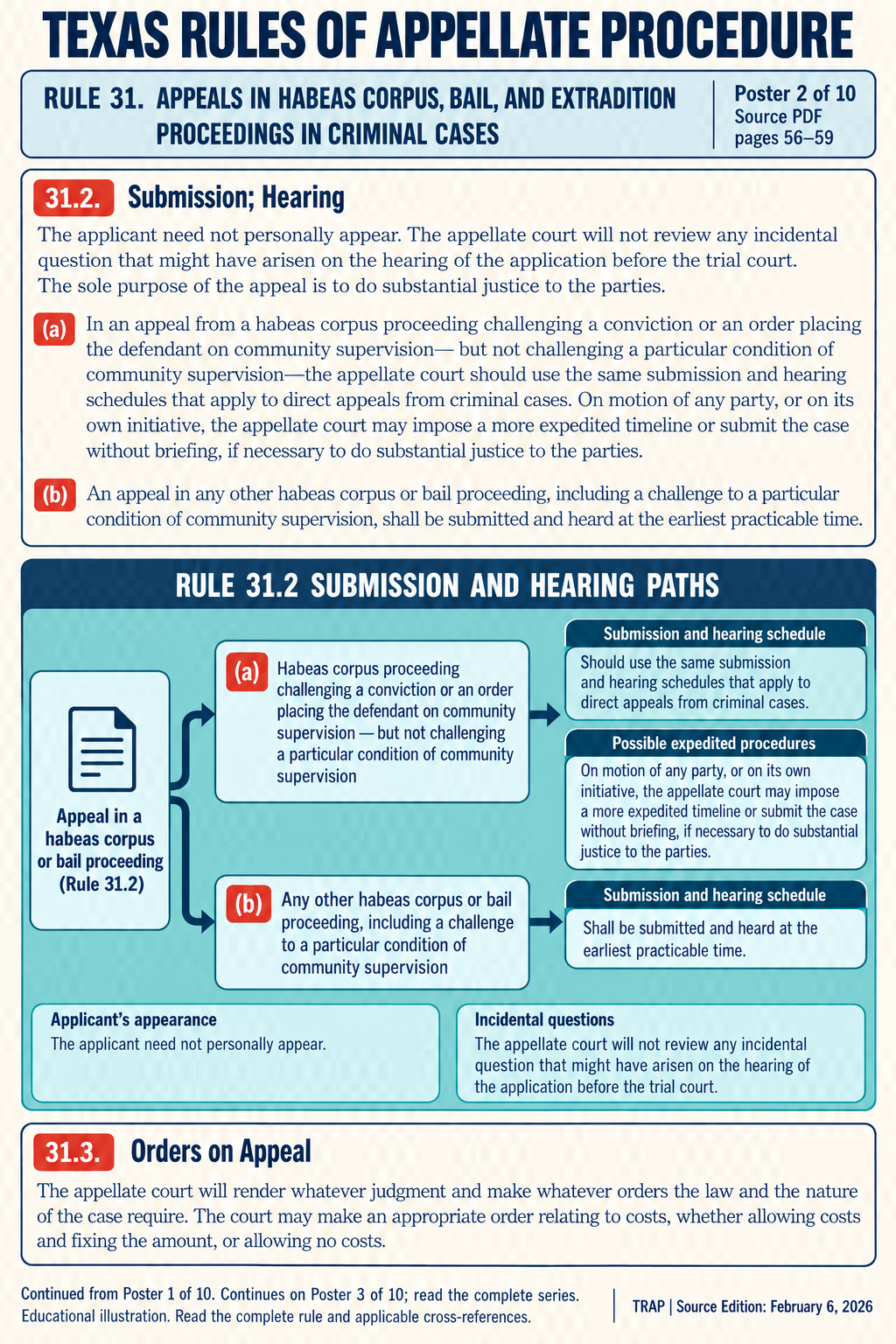
Read assigned text for Rule 31 poster 2
Assigned rule text
31.2. Submission; Hearing The applicant need not personally appear. The appellate court will not review any incidental question that might have arisen on the hearing of the application before the trial court. The sole purpose of the appeal is to do substantial justice to the parties.
(a) In an appeal from a habeas corpus proceeding challenging a conviction or an order placing the defendant on community supervision— but not challenging a particular condition of community supervision—the appellate court should use the same submission and hearing schedules that apply to direct appeals from criminal cases. On motion of any party, or on its own initiative, the appellate court may impose a more expedited timeline or submit the case without briefing, if necessary to do substantial justice to the parties.
(b) An appeal in any other habeas corpus or bail proceeding, including a challenge to a particular condition of community supervision, shall be submitted and heard at the earliest practicable time.
31.3. Orders on Appeal The appellate court will render whatever judgment and make whatever orders the law and the nature of the case require. The court may make an appropriate order relating to costs, whether allowing costs and fixing the amount, or allowing no costs.
Continued from Poster 1 of 10. Continues on Poster 3 of 10; read the complete series.
Rule 31. Appeals In Habeas Corpus, Bail, And Extradition Proceedings In Criminal Cases — poster 3Poster 3 of 10
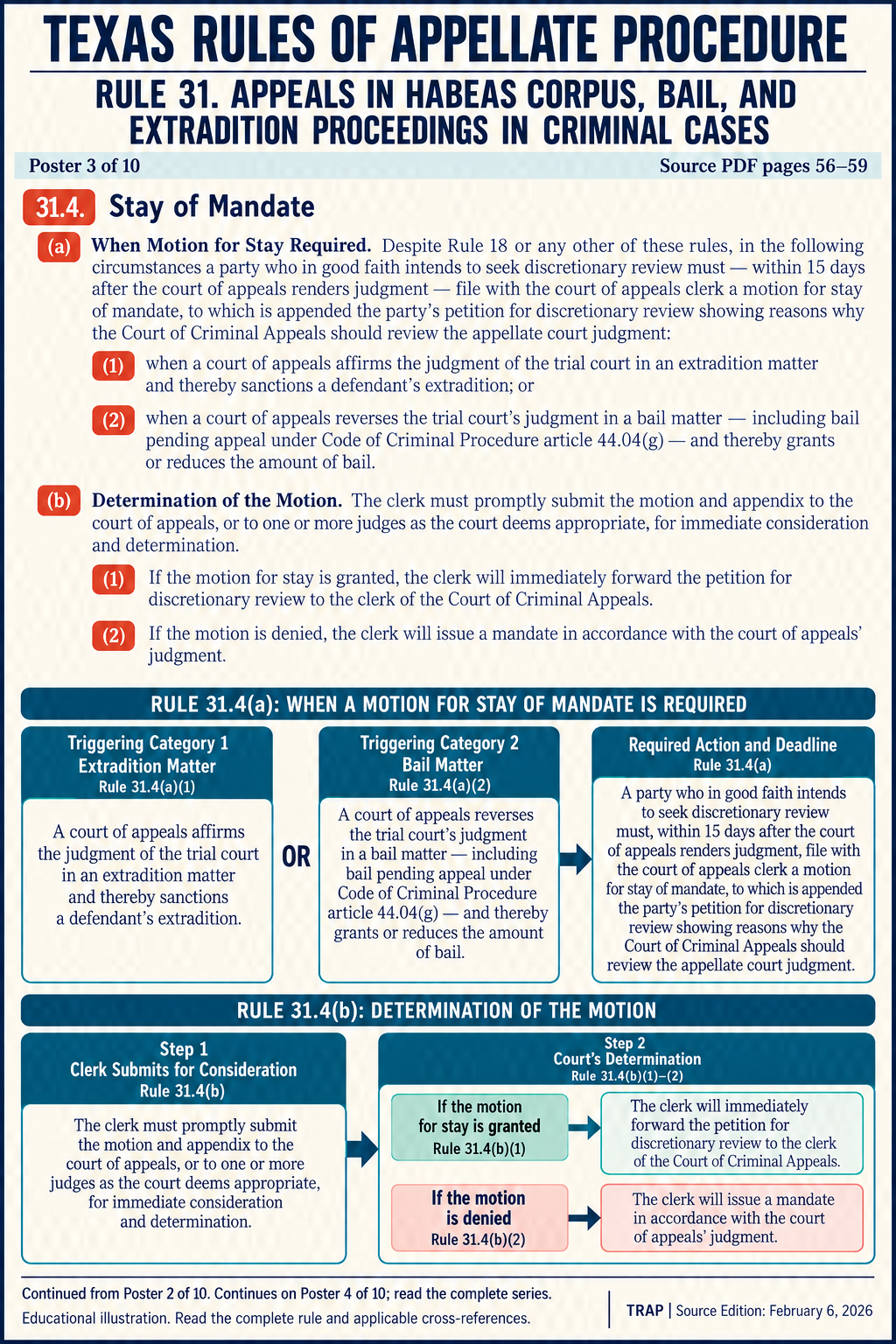
Read assigned text for Rule 31 poster 3
Assigned rule text
31.4. Stay of Mandate
(a) When Motion for Stay Required. Despite Rule 18 or any other of these rules, in the following circumstances a party who in good faith intends to seek discretionary review must — within 15 days after the court of appeals renders judgment — file with the court of appeals clerk a motion for stay of mandate, to which is appended the party's petition for discretionary review showing reasons why the Court of Criminal Appeals should review the appellate court judgment:
(1) when a court of appeals affirms the judgment of the trial court in an extradition matter and thereby sanctions a defendant's extradition; or
(2) when a court of appeals reverses the trial court’s judgment in a bail matter — including bail pending appeal under Code of Criminal Procedure article 44.04(g) — and thereby grants or reduces the amount of bail.
(b) Determination of the Motion. The clerk must promptly submit the motion and appendix to the court of appeals, or to one or more judges as the court deems appropriate, for immediate consideration and determination.
(1) If the motion for stay is granted, the clerk will immediately forward the petition for discretionary review to the clerk of the Court of Criminal Appeals.
(2) If the motion is denied, the clerk will issue a mandate in accordance with the court of appeals' judgment.
Continued from Poster 2 of 10. Continues on Poster 4 of 10; read the complete series.
Rule 31. Appeals In Habeas Corpus, Bail, And Extradition Proceedings In Criminal Cases — poster 4Poster 4 of 10
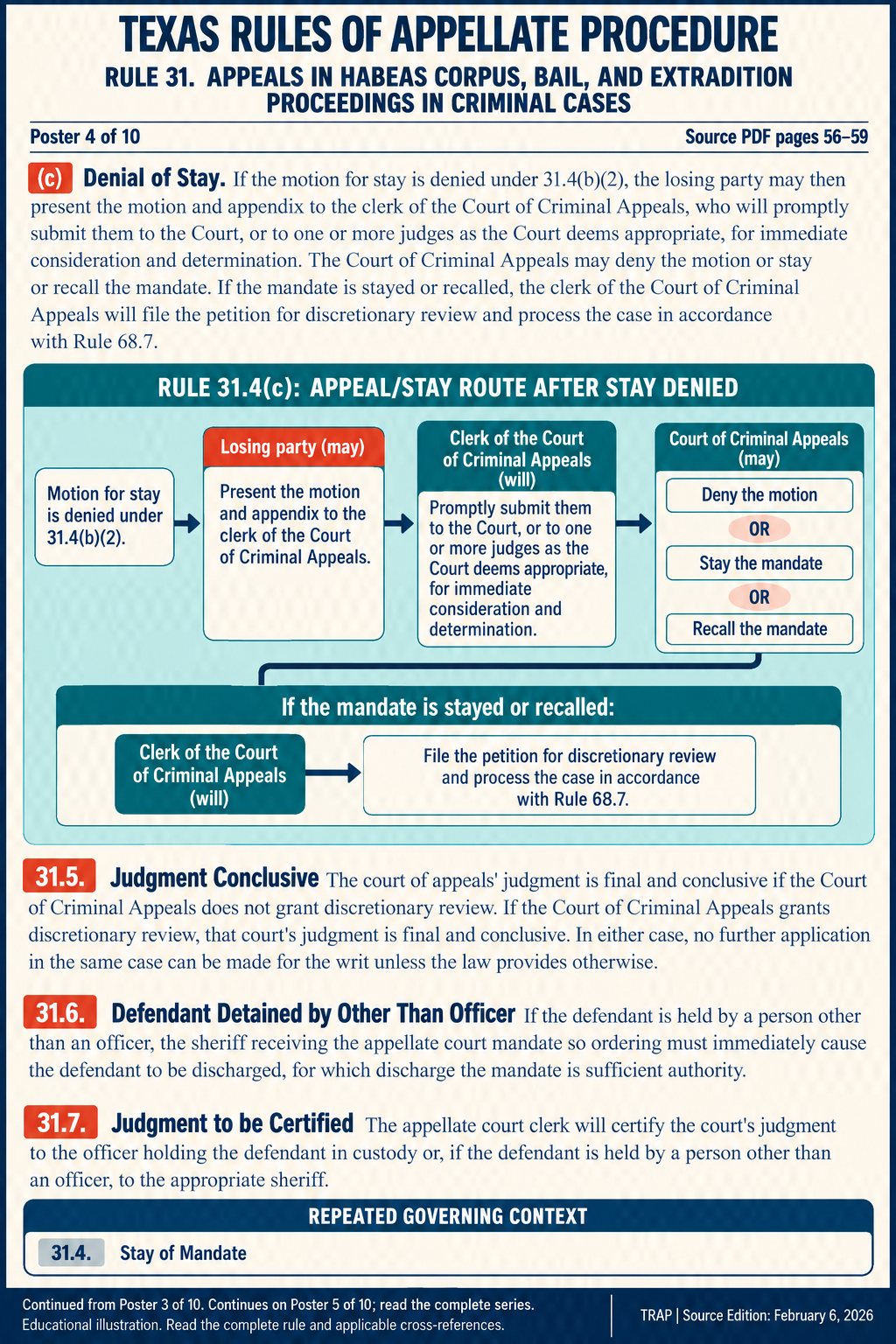
Read assigned text for Rule 31 poster 4
Assigned rule text
(c) Denial of Stay. If the motion for stay is denied under 31.4(b)(2), the losing party may then present the motion and appendix to the clerk of the Court of Criminal Appeals, who will promptly submit them to the Court, or to one or more judges as the Court deems appropriate, for immediate consideration and determination. The Court of Criminal Appeals may deny the motion or stay or recall the mandate. If the mandate is stayed or recalled, the clerk of the Court of Criminal Appeals will file the petition for discretionary review and process the case in accordance with Rule 68.7.
31.5. Judgment Conclusive The court of appeals' judgment is final and conclusive if the Court of Criminal Appeals does not grant discretionary review. If the Court of Criminal Appeals grants discretionary review, that court's judgment is final and conclusive. In either case, no further application in the same case can be made for the writ unless the law provides otherwise.
31.6. Defendant Detained by Other Than Officer If the defendant is held by a person other than an officer, the sheriff receiving the appellate court mandate so ordering must immediately cause the defendant to be discharged, for which discharge the mandate is sufficient authority.
31.7. Judgment to be Certified The appellate court clerk will certify the court's judgment to the officer holding the defendant in custody or, if the defendant is held by a person other than an officer, to the appropriate sheriff.
Repeated governing context
31.4. Stay of Mandate
Continued from Poster 3 of 10. Continues on Poster 5 of 10; read the complete series.
Rule 31. Appeals In Habeas Corpus, Bail, And Extradition Proceedings In Criminal Cases — poster 5Poster 5 of 10
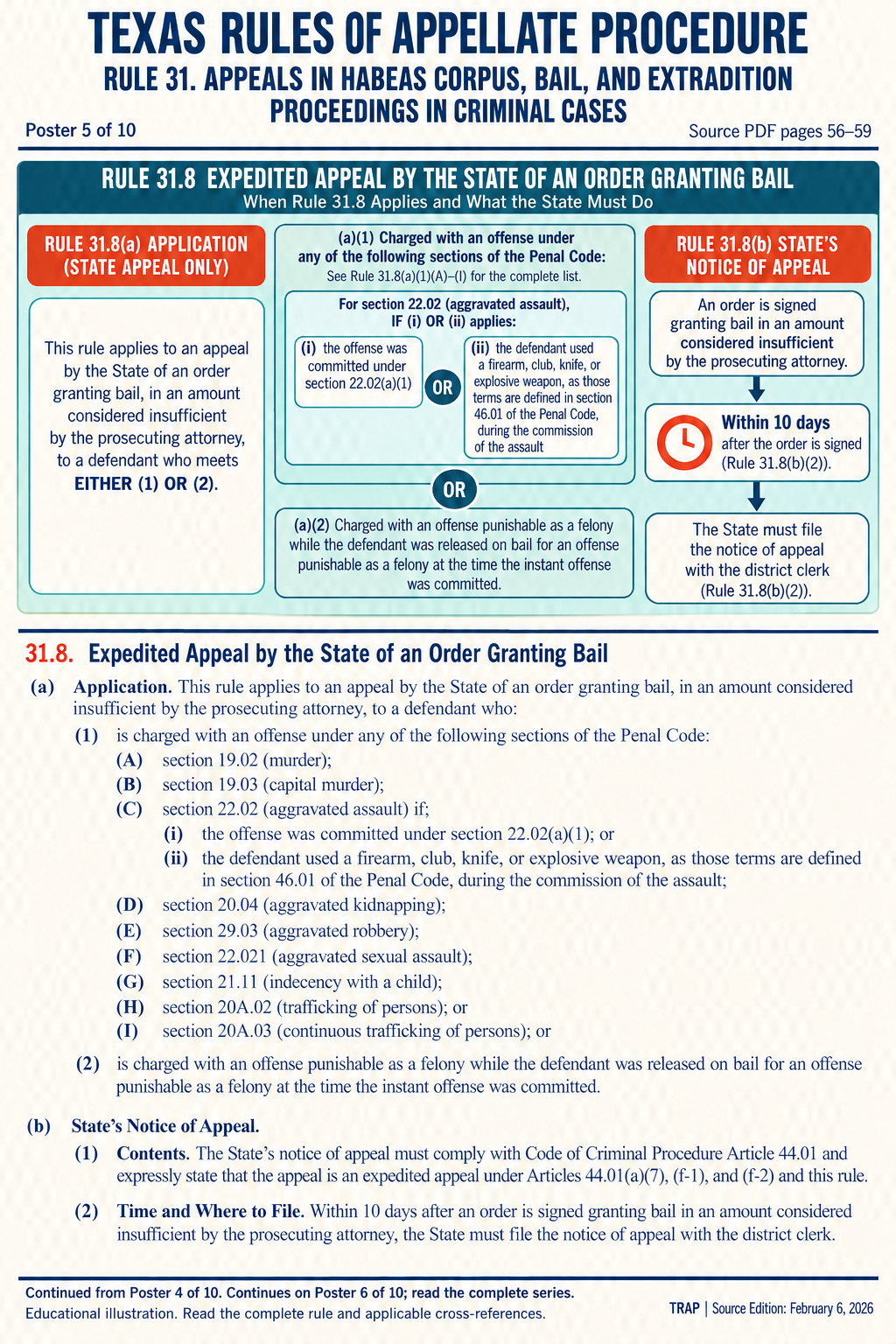
Read assigned text for Rule 31 poster 5
Assigned rule text
31.8. Expedited Appeal by the State of an Order Granting Bail
(a) Application. This rule applies to an appeal by the State of an order granting bail, in an amount considered insufficient by the prosecuting attorney, to a defendant who:
(1) is charged with an offense under any of the following sections of the Penal Code:
(A) section 19.02 (murder);
(B) section 19.03 (capital murder);
(C) section 22.02 (aggravated assault) if;
(i) the offense was committed under section 22.02(a)(1); or (ii) the defendant used a firearm, club, knife, or explosive weapon, as those terms are defined in section 46.01 of the Penal Code, during the commission of the assault;
(D) section 20.04 (aggravated kidnapping);
(E) section 29.03 (aggravated robbery);
(F) section 22.021 (aggravated sexual assault);
(G) section 21.11 (indecency with a child);
(H) section 20A.02 (trafficking of persons); or
(I) section 20A.03 (continuous trafficking of persons); or
(2) is charged with an offense punishable as a felony while the defendant was released on bail for an offense punishable as a felony at the time the instant offense was committed.
(b) State’s Notice of Appeal.
(1) Contents. The State’s notice of appeal must comply with Code of Criminal Procedure Article 44.01 and expressly state that the appeal is an expedited appeal under Articles 44.01(a)(7), (f-1), and (f-2) and this rule.
(2) Time and Where to File. Within 10 days after an order is signed granting bail in an amount considered insufficient by the prosecuting attorney, the State must file the notice of appeal with the district clerk.
Continued from Poster 4 of 10. Continues on Poster 6 of 10; read the complete series.
Rule 31. Appeals In Habeas Corpus, Bail, And Extradition Proceedings In Criminal Cases — poster 6Poster 6 of 10
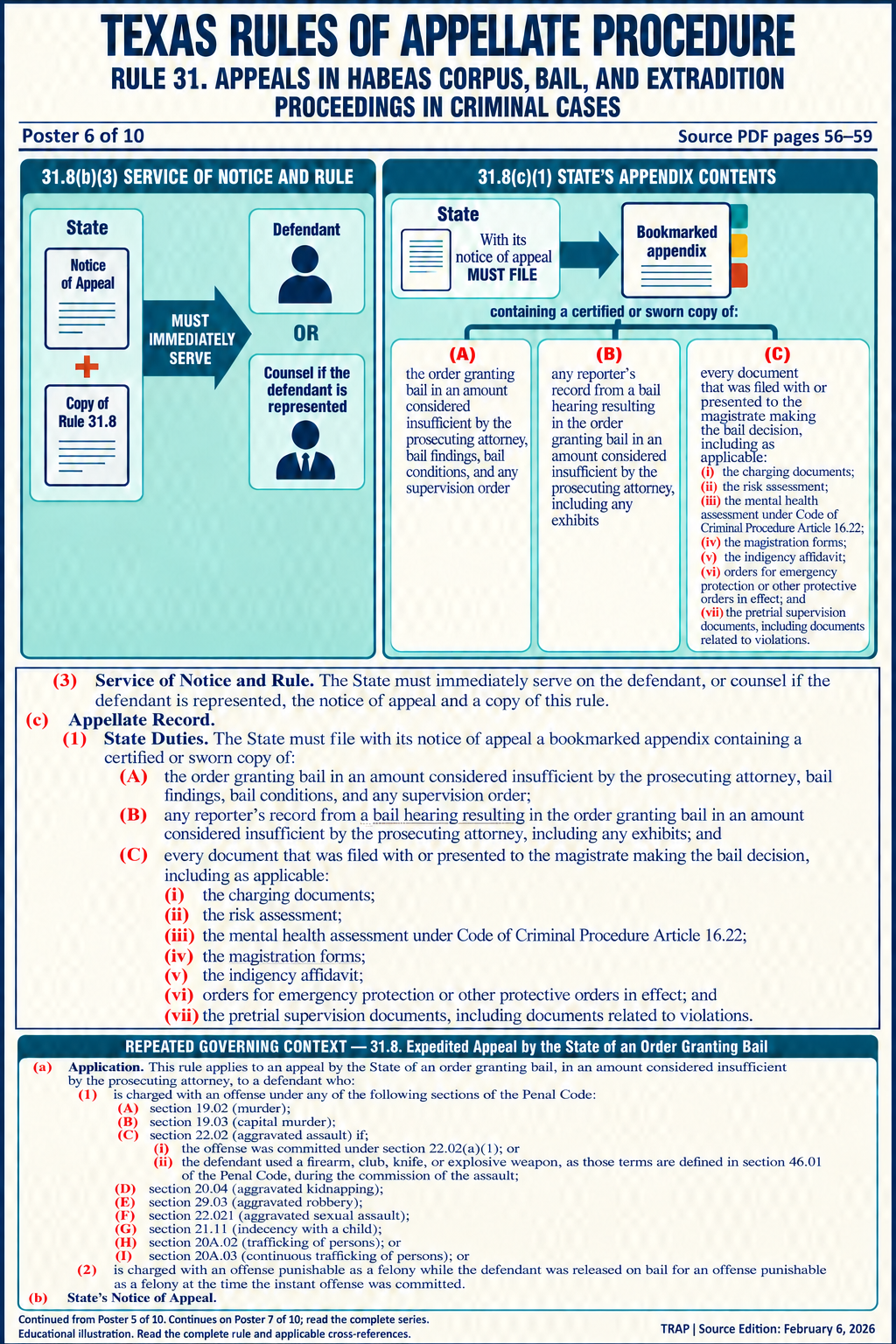
Read assigned text for Rule 31 poster 6
Assigned rule text
(3) Service of Notice and Rule. The State must immediately serve on the defendant, or counsel if the defendant is represented, the notice of appeal and a copy of this rule.
(c) Appellate Record.
(1) State Duties. The State must file with its notice of appeal a bookmarked appendix containing a certified or sworn copy of:
(A) the order granting bail in an amount considered insufficient by the prosecuting attorney, bail findings, bail conditions, and any supervision order;
(B) any reporter’s record from a bail hearing resulting in the order granting bail in an amount considered insufficient by the prosecuting attorney, including any exhibits; and
(C) every document that was filed with or presented to the magistrate making the bail decision, including as applicable:
(i) the charging documents; (ii) the risk assessment; (iii) the mental health assessment under Code of Criminal Procedure Article 16.22; (iv) the magistration forms;
(v) the indigency affidavit; (vi) orders for emergency protection or other protective orders in effect; and (vii)the pretrial supervision documents, including documents related to violations.
Repeated governing context
31.8. Expedited Appeal by the State of an Order Granting Bail
(a) Application. This rule applies to an appeal by the State of an order granting bail, in an amount considered insufficient by the prosecuting attorney, to a defendant who:
(1) is charged with an offense under any of the following sections of the Penal Code:
(A) section 19.02 (murder);
(B) section 19.03 (capital murder);
(C) section 22.02 (aggravated assault) if;
(i) the offense was committed under section 22.02(a)(1); or (ii) the defendant used a firearm, club, knife, or explosive weapon, as those terms are defined in section 46.01 of the Penal Code, during the commission of the assault;
(D) section 20.04 (aggravated kidnapping);
(E) section 29.03 (aggravated robbery);
(F) section 22.021 (aggravated sexual assault);
(G) section 21.11 (indecency with a child);
(H) section 20A.02 (trafficking of persons); or
(I) section 20A.03 (continuous trafficking of persons); or
(2) is charged with an offense punishable as a felony while the defendant was released on bail for an offense punishable as a felony at the time the instant offense was committed.
(b) State’s Notice of Appeal.
Continued from Poster 5 of 10. Continues on Poster 7 of 10; read the complete series.
Rule 31. Appeals In Habeas Corpus, Bail, And Extradition Proceedings In Criminal Cases — poster 7Poster 7 of 10
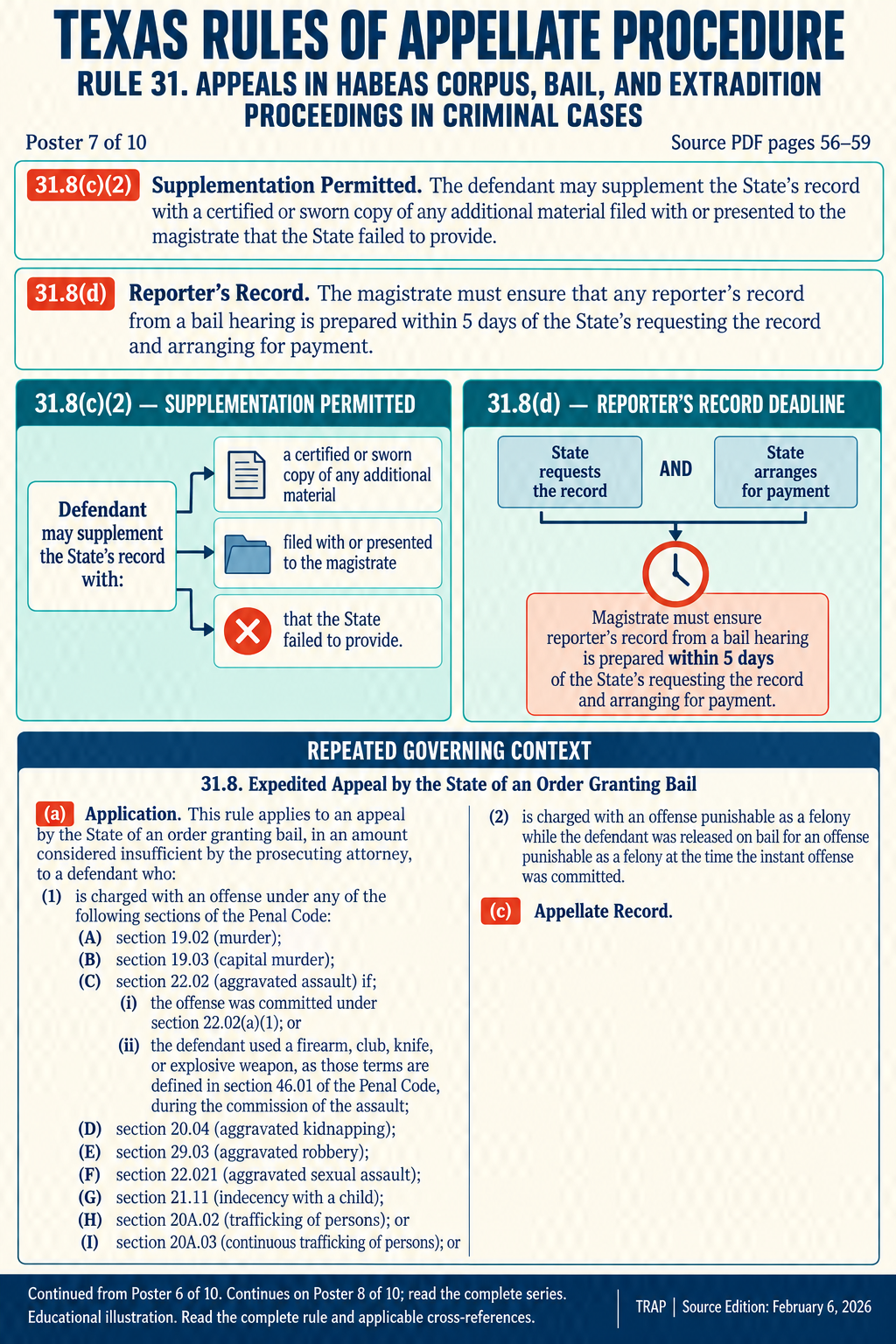
Read assigned text for Rule 31 poster 7
Assigned rule text
(2) Supplementation Permitted. The defendant may supplement the State’s record with a certified or sworn copy of any additional material filed with or presented to the magistrate that the State failed to provide.
(d) Reporter’s Record. The magistrate must ensure that any reporter’s record from a bail hearing is prepared within 5 days of the State’s requesting the record and arranging for payment.
Repeated governing context
31.8. Expedited Appeal by the State of an Order Granting Bail
(a) Application. This rule applies to an appeal by the State of an order granting bail, in an amount considered insufficient by the prosecuting attorney, to a defendant who:
(1) is charged with an offense under any of the following sections of the Penal Code:
(A) section 19.02 (murder);
(B) section 19.03 (capital murder);
(C) section 22.02 (aggravated assault) if;
(i) the offense was committed under section 22.02(a)(1); or (ii) the defendant used a firearm, club, knife, or explosive weapon, as those terms are defined in section 46.01 of the Penal Code, during the commission of the assault;
(D) section 20.04 (aggravated kidnapping);
(E) section 29.03 (aggravated robbery);
(F) section 22.021 (aggravated sexual assault);
(G) section 21.11 (indecency with a child);
(H) section 20A.02 (trafficking of persons); or
(I) section 20A.03 (continuous trafficking of persons); or
(2) is charged with an offense punishable as a felony while the defendant was released on bail for an offense punishable as a felony at the time the instant offense was committed.
(c) Appellate Record.
Continued from Poster 6 of 10. Continues on Poster 8 of 10; read the complete series.
Rule 31. Appeals In Habeas Corpus, Bail, And Extradition Proceedings In Criminal Cases — poster 8Poster 8 of 10
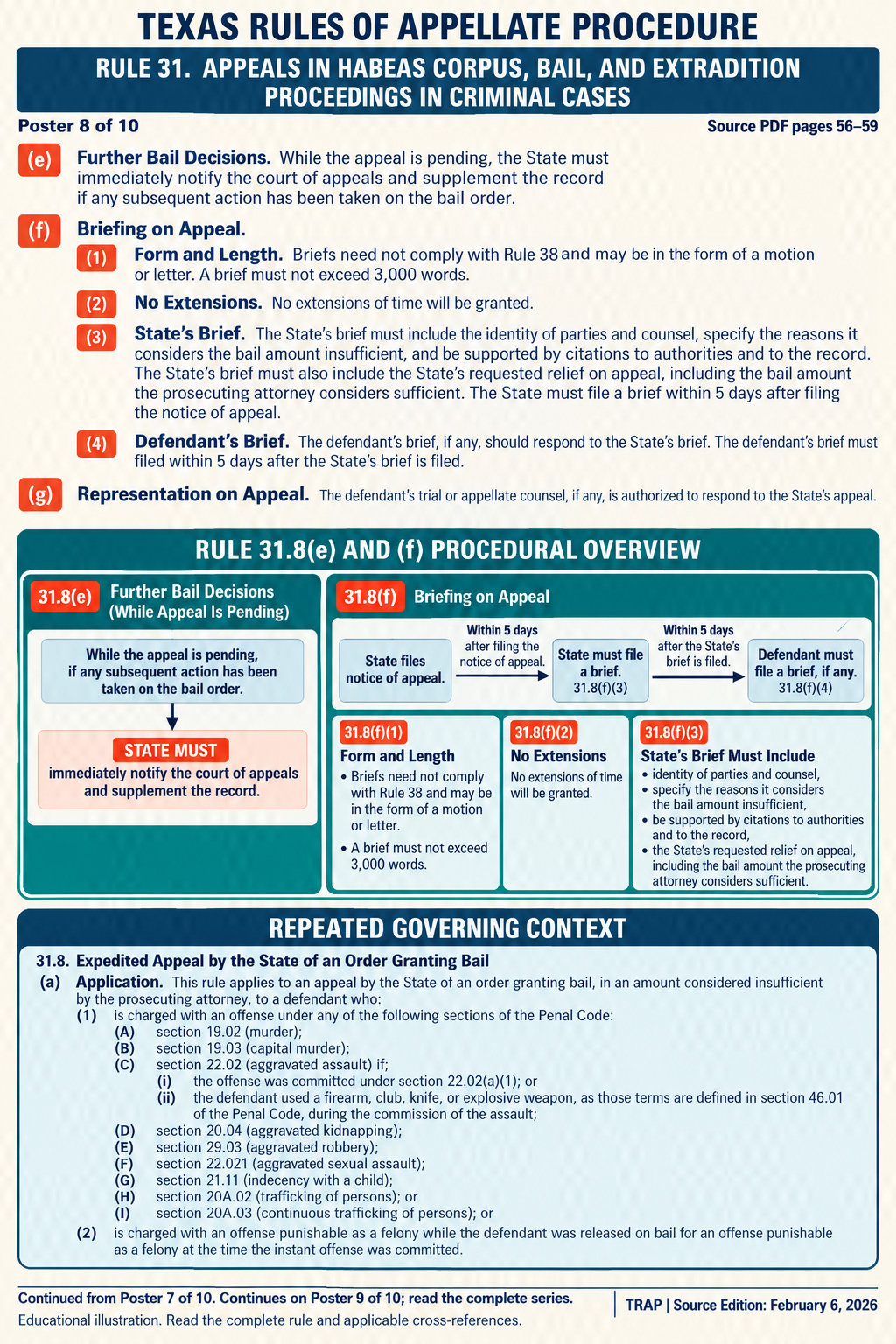
Read assigned text for Rule 31 poster 8
Assigned rule text
(e) Further Bail Decisions. While the appeal is pending, the State must immediately notify the court of appeals and supplement the record if any subsequent action has been taken on the bail order.
(f) Briefing on Appeal.
(1) Form and Length. Briefs need not comply with Rule 38 and may be in the form of a motion or letter. A brief must not exceed 3,000 words.
(2) No Extensions. No extensions of time will be granted.
(3) State’s Brief. The State’s brief must include the identity of parties and counsel, specify the reasons it considers the bail amount insufficient, and be supported by citations to authorities and to the record. The State’s brief must also include the State’s requested relief on appeal, including the bail amount the prosecuting attorney considers sufficient. The State must file a brief within 5 days after filing the notice of appeal.
(4) Defendant’s Brief. The defendant’s brief, if any, should respond to the State’s brief. The defendant’s brief must be filed within 5 days after the State’s brief is filed.
(g) Representation on Appeal. The defendant’s trial or appellate counsel, if any, is authorized to respond to the State’s appeal.
Repeated governing context
31.8. Expedited Appeal by the State of an Order Granting Bail
(a) Application. This rule applies to an appeal by the State of an order granting bail, in an amount considered insufficient by the prosecuting attorney, to a defendant who:
(1) is charged with an offense under any of the following sections of the Penal Code:
(A) section 19.02 (murder);
(B) section 19.03 (capital murder);
(C) section 22.02 (aggravated assault) if;
(i) the offense was committed under section 22.02(a)(1); or (ii) the defendant used a firearm, club, knife, or explosive weapon, as those terms are defined in section 46.01 of the Penal Code, during the commission of the assault;
(D) section 20.04 (aggravated kidnapping);
(E) section 29.03 (aggravated robbery);
(F) section 22.021 (aggravated sexual assault);
(G) section 21.11 (indecency with a child);
(H) section 20A.02 (trafficking of persons); or
(I) section 20A.03 (continuous trafficking of persons); or
(2) is charged with an offense punishable as a felony while the defendant was released on bail for an offense punishable as a felony at the time the instant offense was committed.
Continued from Poster 7 of 10. Continues on Poster 9 of 10; read the complete series.
Rule 31. Appeals In Habeas Corpus, Bail, And Extradition Proceedings In Criminal Cases — poster 9Poster 9 of 10
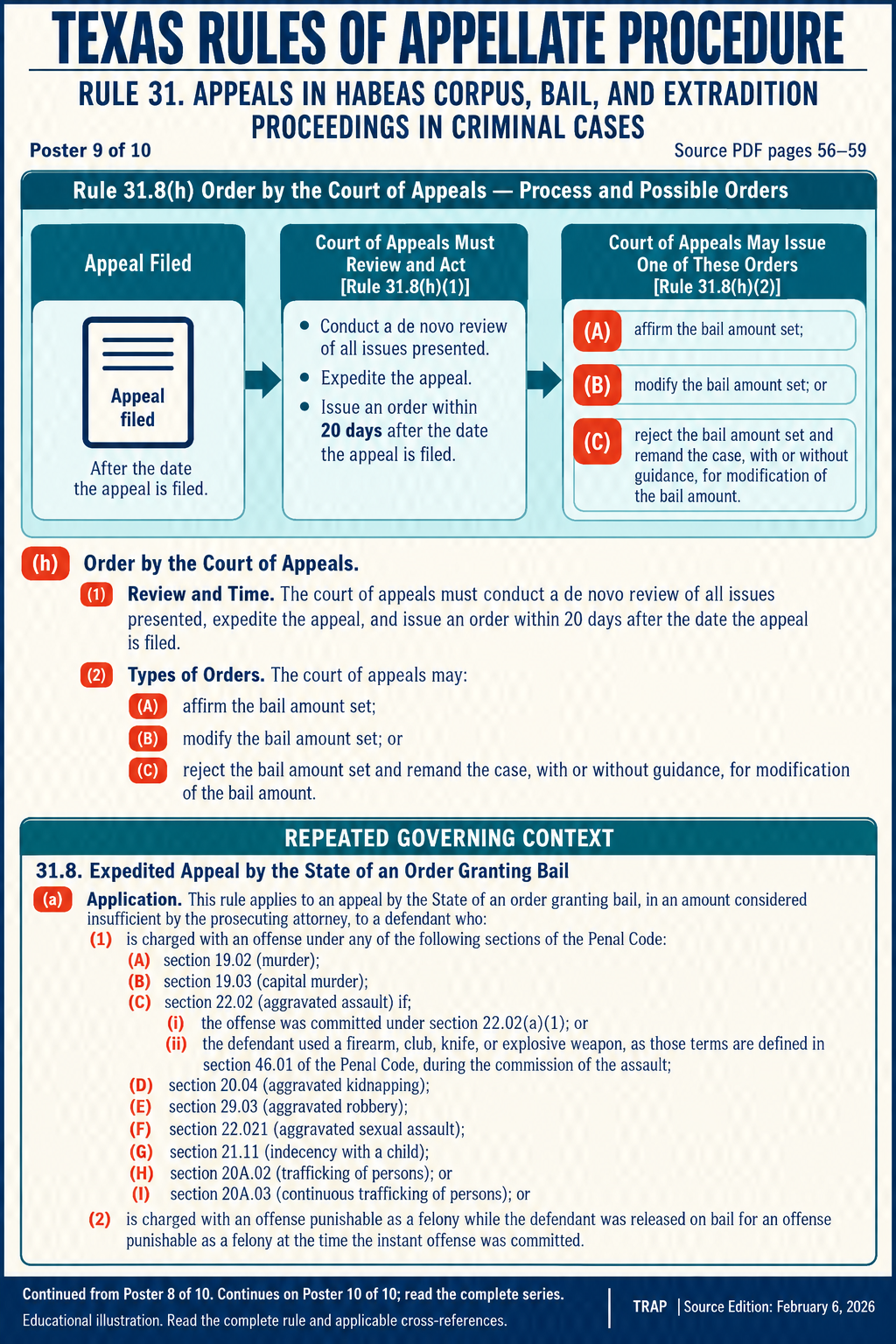
Read assigned text for Rule 31 poster 9
Assigned rule text
(h) Order by the Court of Appeals.
(1) Review and Time. The court of appeals must conduct a de novo review of all issues presented, expedite the appeal, and issue an order within 20 days after the date the appeal is filed.
(2) Types of Orders. The court of appeals may:
(A) affirm the bail amount set;
(B) modify the bail amount set; or
(C) reject the bail amount set and remand the case, with or without guidance, for modification of the bail amount.
Repeated governing context
31.8. Expedited Appeal by the State of an Order Granting Bail
(a) Application. This rule applies to an appeal by the State of an order granting bail, in an amount considered insufficient by the prosecuting attorney, to a defendant who:
(1) is charged with an offense under any of the following sections of the Penal Code:
(A) section 19.02 (murder);
(B) section 19.03 (capital murder);
(C) section 22.02 (aggravated assault) if;
(i) the offense was committed under section 22.02(a)(1); or (ii) the defendant used a firearm, club, knife, or explosive weapon, as those terms are defined in section 46.01 of the Penal Code, during the commission of the assault;
(D) section 20.04 (aggravated kidnapping);
(E) section 29.03 (aggravated robbery);
(F) section 22.021 (aggravated sexual assault);
(G) section 21.11 (indecency with a child);
(H) section 20A.02 (trafficking of persons); or
(I) section 20A.03 (continuous trafficking of persons); or
(2) is charged with an offense punishable as a felony while the defendant was released on bail for an offense punishable as a felony at the time the instant offense was committed.
Continued from Poster 8 of 10. Continues on Poster 10 of 10; read the complete series.
Rule 31. Appeals In Habeas Corpus, Bail, And Extradition Proceedings In Criminal Cases — poster 10Poster 10 of 10
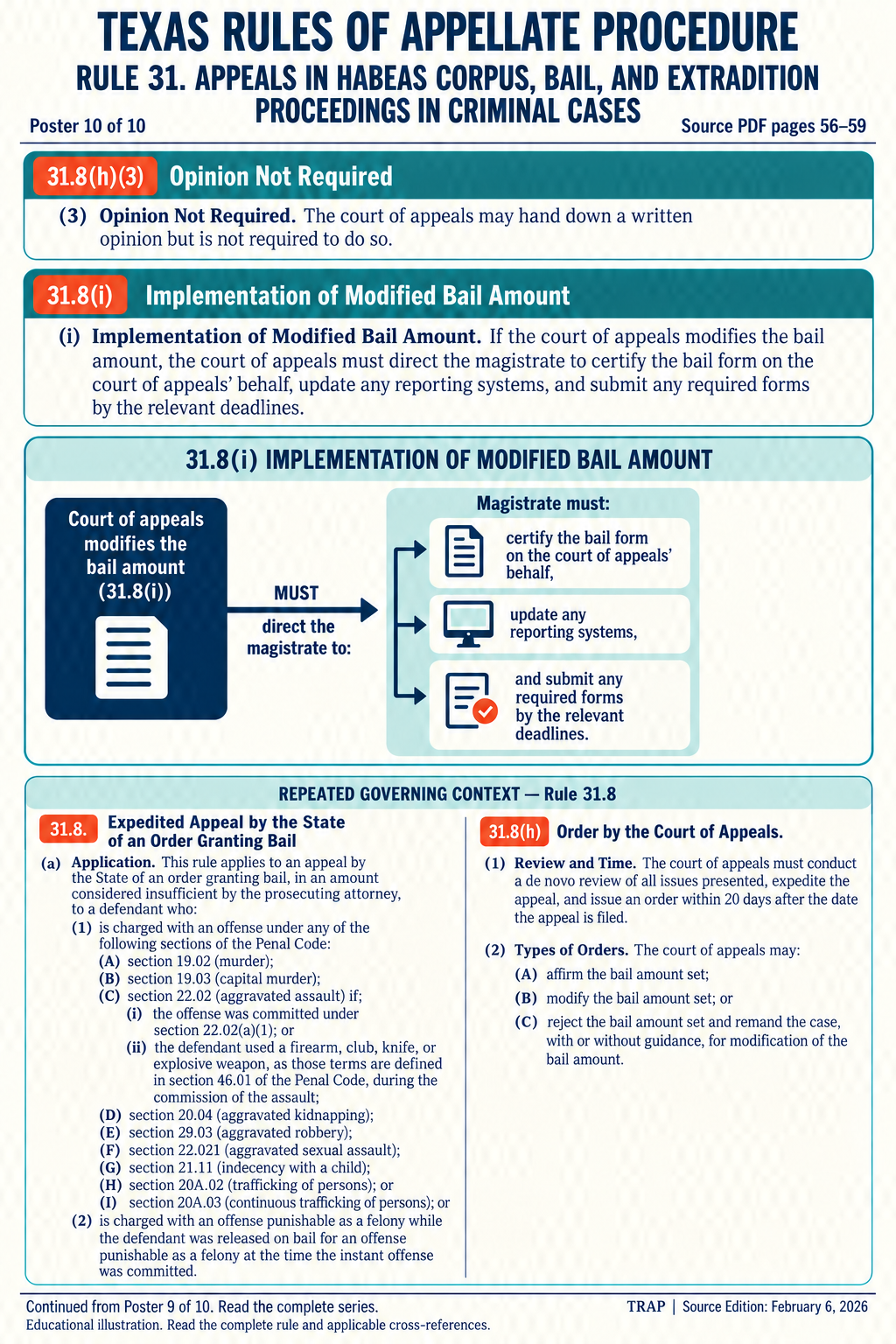
Read assigned text for Rule 31 poster 10
Assigned rule text
(3) Opinion Not Required. The court of appeals may hand down a written opinion but is not required to do so.
(i) Implementation of Modified Bail Amount. If the court of appeals modifies the bail amount, the court of appeals must direct the magistrate to certify the bail form on the court of appeals’ behalf, update any reporting systems, and submit any required forms by the relevant deadlines.
Repeated governing context
31.8. Expedited Appeal by the State of an Order Granting Bail
(a) Application. This rule applies to an appeal by the State of an order granting bail, in an amount considered insufficient by the prosecuting attorney, to a defendant who:
(1) is charged with an offense under any of the following sections of the Penal Code:
(A) section 19.02 (murder);
(B) section 19.03 (capital murder);
(C) section 22.02 (aggravated assault) if;
(i) the offense was committed under section 22.02(a)(1); or (ii) the defendant used a firearm, club, knife, or explosive weapon, as those terms are defined in section 46.01 of the Penal Code, during the commission of the assault;
(D) section 20.04 (aggravated kidnapping);
(E) section 29.03 (aggravated robbery);
(F) section 22.021 (aggravated sexual assault);
(G) section 21.11 (indecency with a child);
(H) section 20A.02 (trafficking of persons); or
(I) section 20A.03 (continuous trafficking of persons); or
(2) is charged with an offense punishable as a felony while the defendant was released on bail for an offense punishable as a felony at the time the instant offense was committed.
(h) Order by the Court of Appeals.
(1) Review and Time. The court of appeals must conduct a de novo review of all issues presented, expedite the appeal, and issue an order within 20 days after the date the appeal is filed.
(2) Types of Orders. The court of appeals may:
(A) affirm the bail amount set;
(B) modify the bail amount set; or
(C) reject the bail amount set and remand the case, with or without guidance, for modification of the bail amount.
Continued from Poster 9 of 10. Read the complete series.
Rule 32. Docketing Statement
Rule 32. Docketing Statement — poster 1Poster 1 of 2
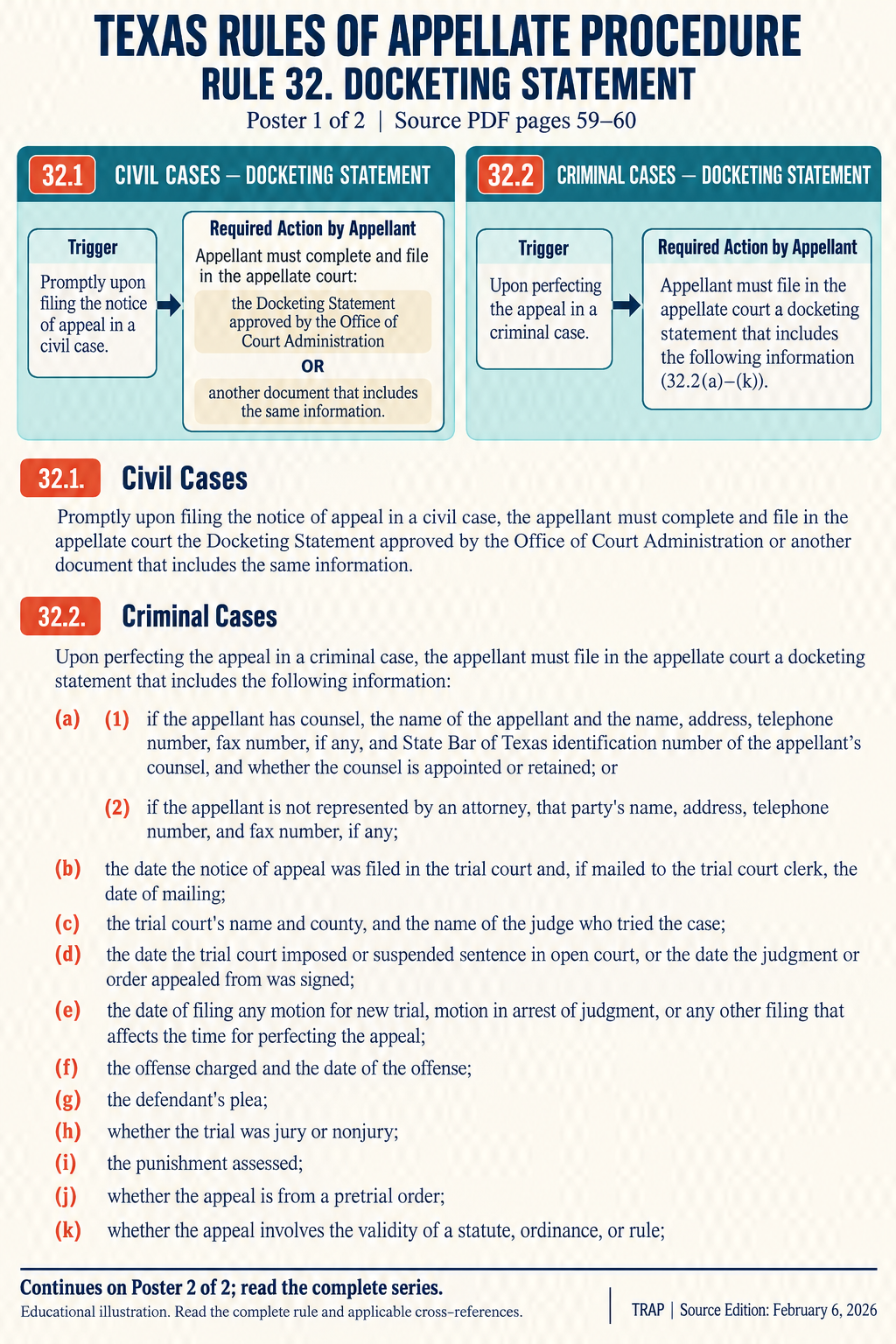
Read assigned text for Rule 32 poster 1
Assigned rule text
32.1. Civil Cases Promptly upon filing the notice of appeal in a civil case, the appellant must complete and file in the appellate court the Docketing Statement approved by the Office of Court Administration or another document that includes the same information.
32.2. Criminal Cases Upon perfecting the appeal in a criminal case, the appellant must file in the appellate court a docketing statement that includes the following information:
(a) (1) if the appellant has counsel, the name of the appellant and the name, address, telephone number, fax number, if any, and State Bar of Texas identification number of the appellant’s counsel, and whether the counsel is appointed or retained; or
(2) if the appellant is not represented by an attorney, that party's name, address, telephone number, and fax number, if any;
(b) the date the notice of appeal was filed in the trial court and, if mailed to the trial court clerk, the date of mailing;
(c) the trial court's name and county, and the name of the judge who tried the case;
(d) the date the trial court imposed or suspended sentence in open court, or the date the judgment or order appealed from was signed;
(e) the date of filing any motion for new trial, motion in arrest of judgment, or any other filing that affects the time for perfecting the appeal;
(f) the offense charged and the date of the offense;
(g) the defendant's plea;
(h) whether the trial was jury or nonjury;
(i) the punishment assessed;
(j) whether the appeal is from a pretrial order;
(k) whether the appeal involves the validity of a statute, ordinance, or rule;
Continues on Poster 2 of 2; read the complete series.
Rule 32. Docketing Statement — poster 2Poster 2 of 2
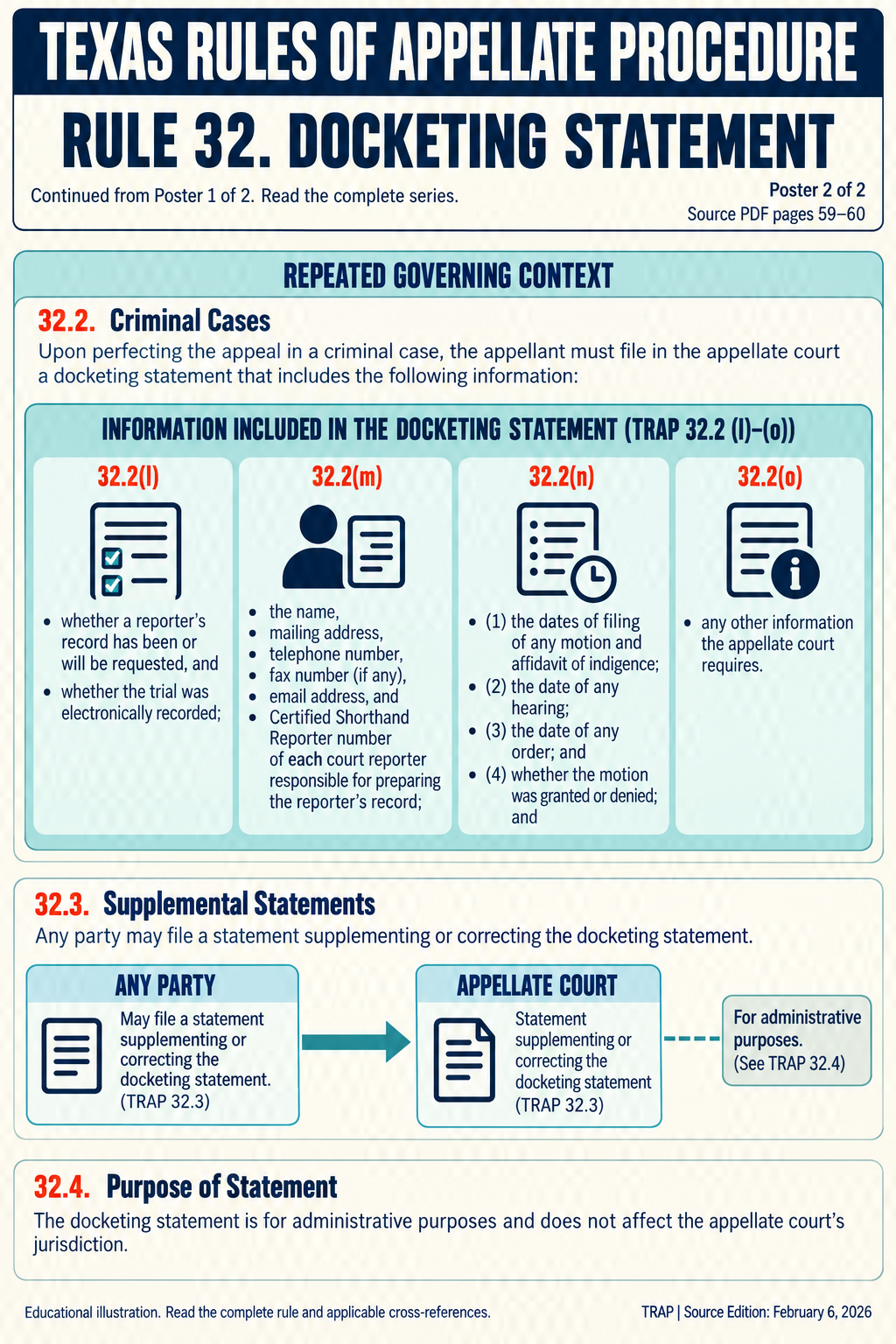
Read assigned text for Rule 32 poster 2
Assigned rule text
(l) whether a reporter’s record has been or will be requested, and whether the trial was electronically recorded;
(m) the name, mailing address, telephone number, fax number (if any), email address, and Certified Shorthand Reporter number of each court reporter responsible for preparing the reporter’s record;
(n) (1) the dates of filing of any motion and affidavit of indigence;
(2) the date of any hearing;
(3) the date of any order; and
(4) whether the motion was granted or denied; and
(o) any other information the appellate court requires.
32.3. Supplemental Statements Any party may file a statement supplementing or correcting the docketing statement.
32.4. Purpose of Statement The docketing statement is for administrative purposes and does not affect the appellate court's jurisdiction.
Repeated governing context
32.2. Criminal Cases Upon perfecting the appeal in a criminal case, the appellant must file in the appellate court a docketing statement that includes the following information:
Continued from Poster 1 of 2. Read the complete series.
Rule 52. Original Proceedings
Rule 52. Original Proceedings — poster 1Poster 1 of 10
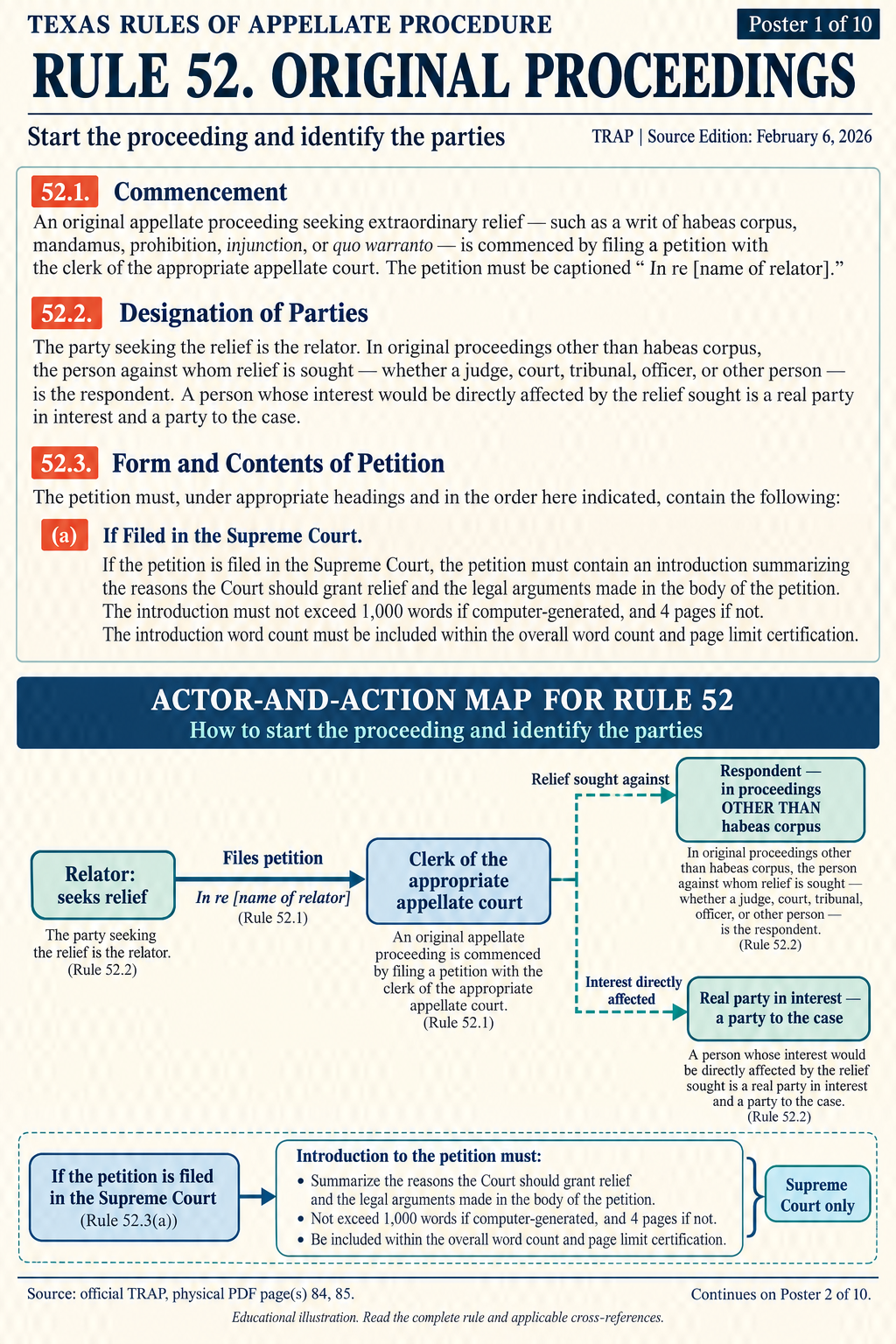
Read assigned text for Rule 52 poster 1
Assigned rule text
52.1. Commencement An original appellate proceeding seeking extraordinary relief — such as a writ of habeas corpus, mandamus, prohibition, injunction, or quo warranto — is commenced by filing a petition with the clerk of the appropriate appellate court. The petition must be captioned “ In re [name of relator].”
52.2. Designation of Parties The party seeking the relief is the relator. In original proceedings other than habeas corpus, the person against whom relief is sought — whether a judge, court, tribunal, officer, or other person — is the respondent. A person whose interest would be directly affected by the relief sought is a real party in interest and a party to the case.
52.3. Form and Contents of Petition The petition must, under appropriate headings and in the order here indicated, contain the following:
(a) If Filed in the Supreme Court. If the petition is filed in the Supreme Court, the petition must contain an introduction summarizing the reasons the Court should grant relief and the legal arguments made in the body of the petition. The introduction must not exceed 1,000 words if computer-generated, and 4 pages if not. The introduction word count must be included within the overall word count and page limit certification.
Continues on poster 2 of 10. Read the complete series with the official rulebook.
Rule 52. Original Proceedings — poster 2Poster 2 of 10
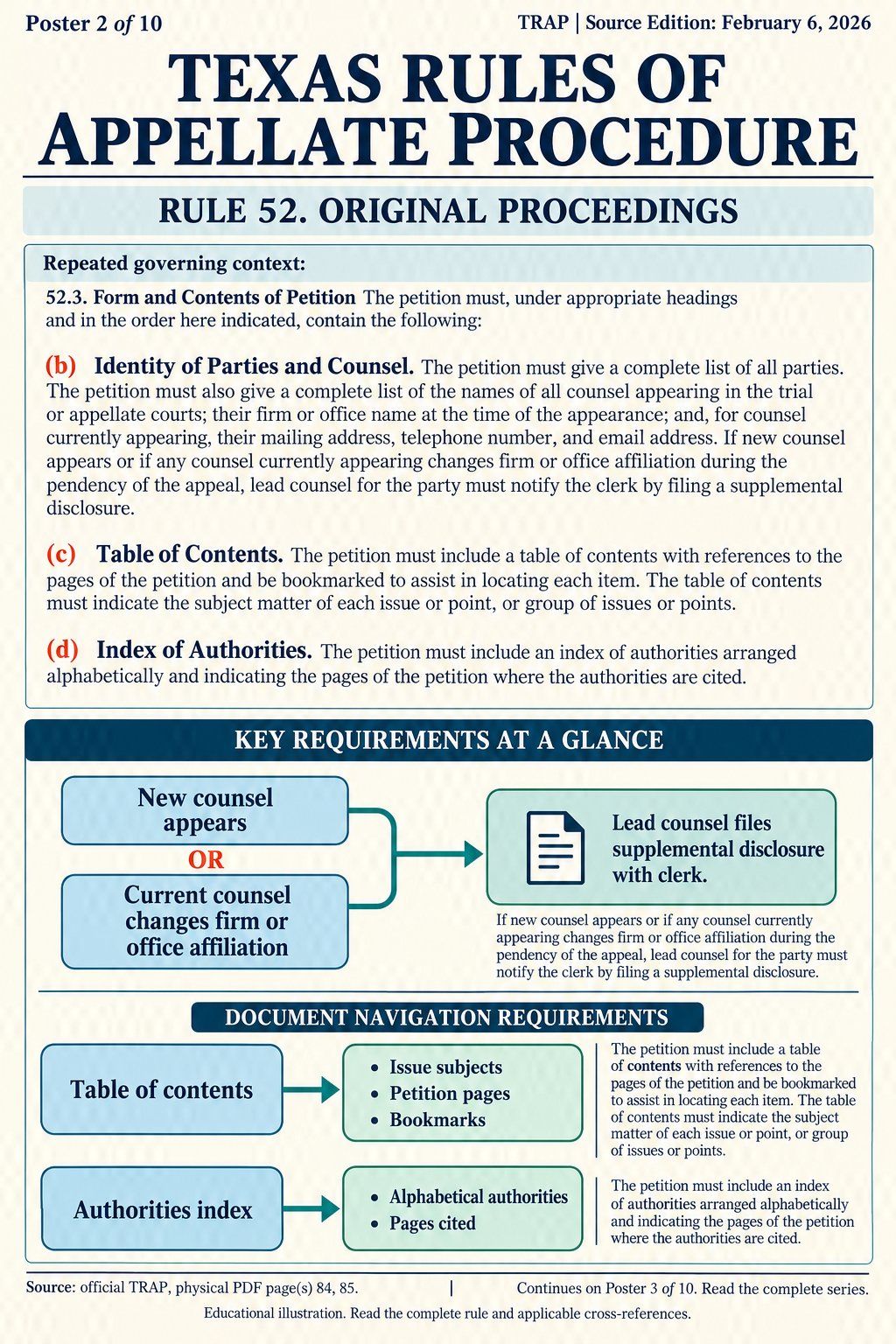
Read assigned text for Rule 52 poster 2
Assigned rule text
(b) Identity of Parties and Counsel. The petition must give a complete list of all parties. The petition must also give a complete list of the names of all counsel appearing in the trial or appellate courts; their firm or office name at the time of the appearance; and, for counsel currently appearing, their mailing address, telephone number, and email address. If new counsel appears or if any counsel currently appearing changes firm or office affiliation during the pendency of the appeal, lead counsel for the party must notify the clerk by filing a supplemental disclosure.
(c) Table of Contents. The petition must include a table of contents with references to the pages of the petition and be bookmarked to assist in locating each item. The table of contents must indicate the subject matter of each issue or point, or group of issues or points.
(d) Index of Authorities. The petition must include an index of authorities arranged alphabetically and indicating the pages of the petition where the authorities are cited.
Repeated governing context
52.3. Form and Contents of Petition The petition must, under appropriate headings and in the order here indicated, contain the following:
Continued from poster 1 of 10. Continues on poster 3 of 10. Read the complete series with the official rulebook.
Rule 52. Original Proceedings — poster 3Poster 3 of 10
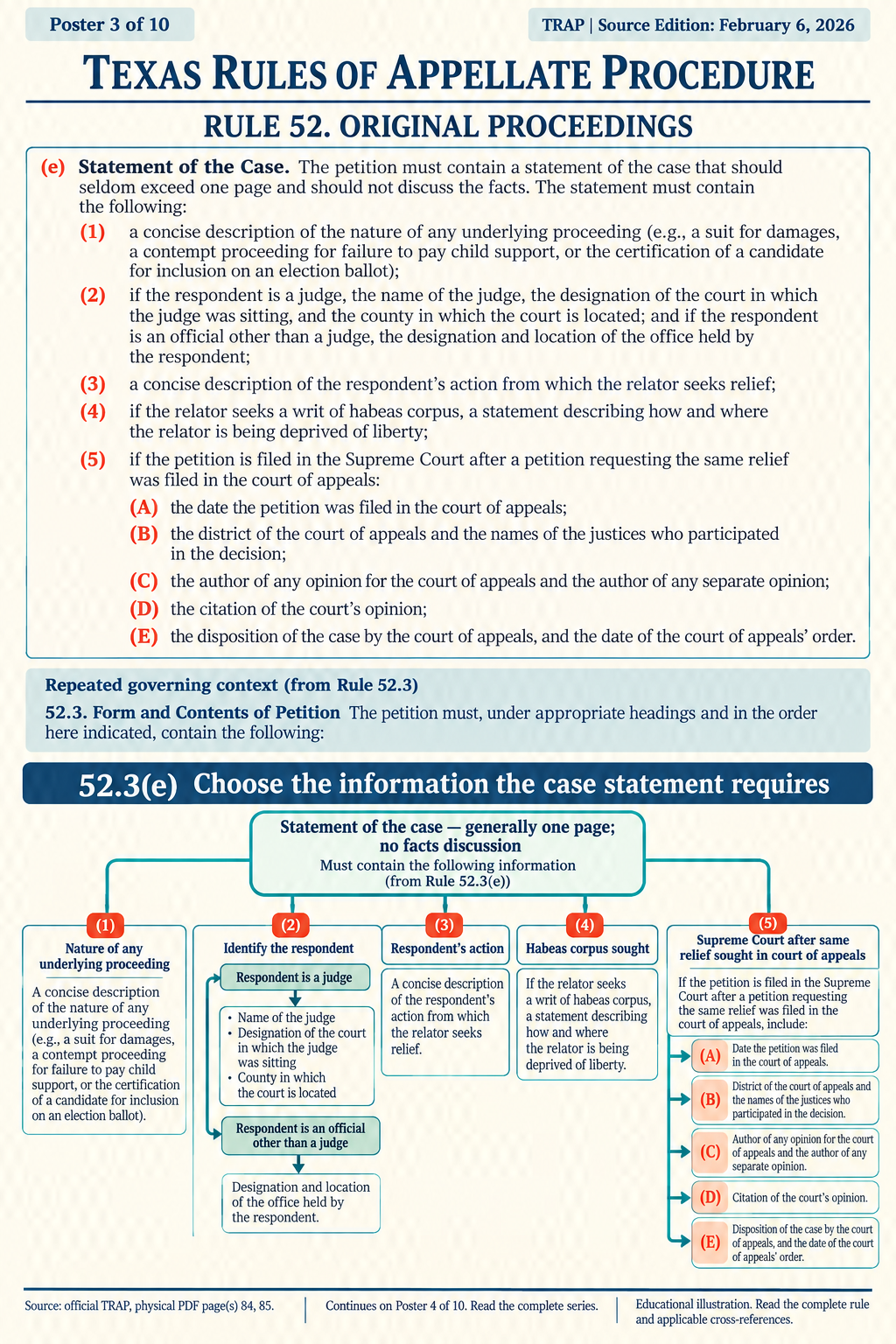
Read assigned text for Rule 52 poster 3
Assigned rule text
(e) Statement of the Case. The petition must contain a statement of the case that should seldom exceed one page and should not discuss the facts. The statement must contain the following:
(1) a concise description of the nature of any underlying proceeding (e.g., a suit for damages, a contempt proceeding for failure to pay child support, or the certification of a candidate for inclusion on an election ballot);
(2) if the respondent is a judge, the name of the judge, the designation of the court in which the judge was sitting, and the county in which the court is located; and if the respondent is an official other than a judge, the designation and location of the office held by the respondent;
(3) a concise description of the respondent’s action from which the relator seeks relief;
(4) if the relator seeks a writ of habeas corpus, a statement describing how and where the relator is being deprived of liberty;
(5) if the petition is filed in the Supreme Court after a petition requesting the same relief was filed in the court of appeals:
(A) the date the petition was filed in the court of appeals;
(B) the district of the court of appeals and the names of the justices who participated in the decision;
(C) the author of any opinion for the court of appeals and the author of any separate opinion;
(D) the citation of the court’s opinion;
(E) the disposition of the case by the court of appeals, and the date of the court of appeals’ order.
Repeated governing context
52.3. Form and Contents of Petition The petition must, under appropriate headings and in the order here indicated, contain the following:
Continued from poster 2 of 10. Continues on poster 4 of 10. Read the complete series with the official rulebook.
Rule 52. Original Proceedings — poster 4Poster 4 of 10
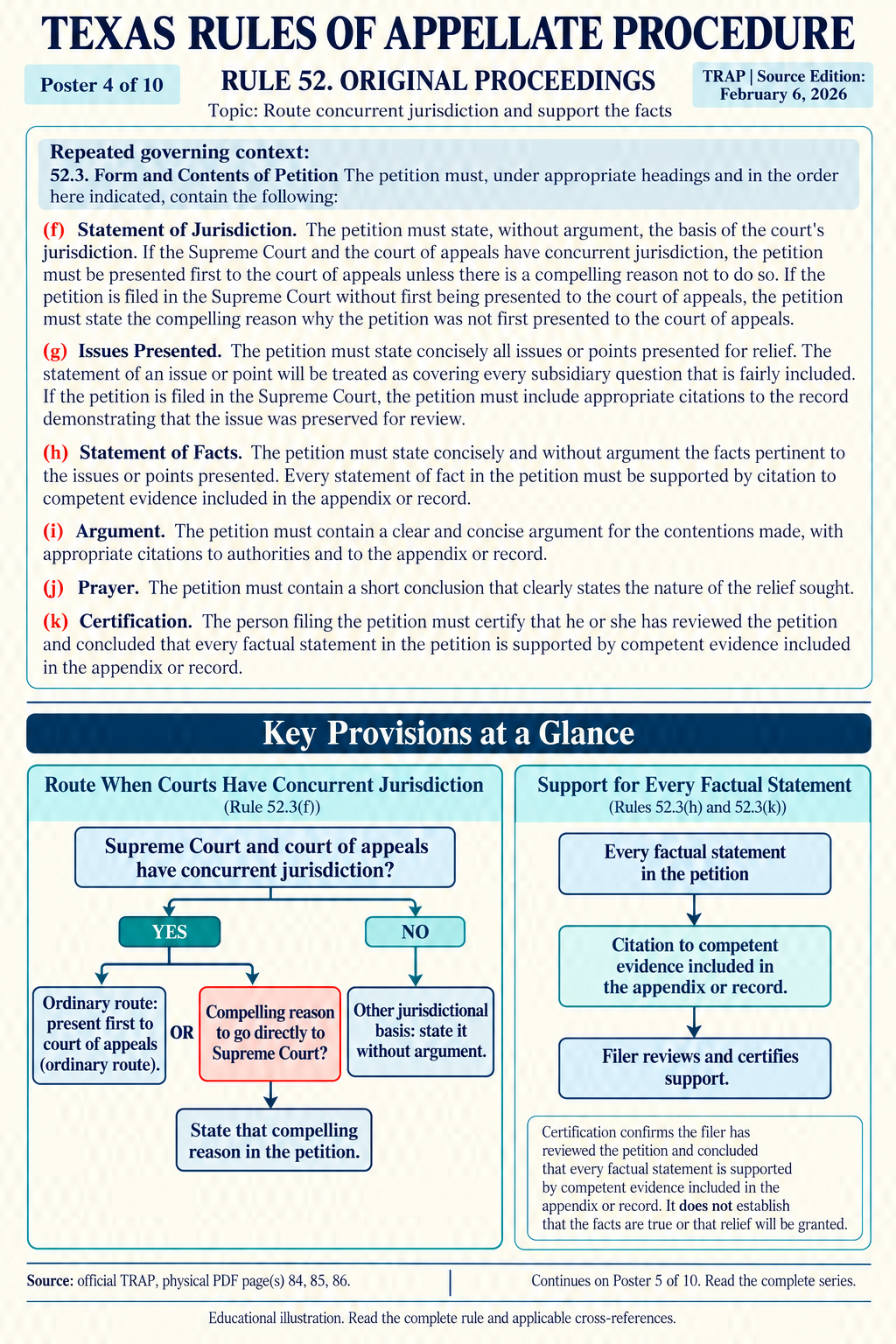
Read assigned text for Rule 52 poster 4
Assigned rule text
(f) Statement of Jurisdiction. The petition must state, without argument, the basis of the court's jurisdiction. If the Supreme Court and the court of appeals have concurrent jurisdiction, the petition must be presented first to the court of appeals unless there is a compelling reason not to do so. If the petition is filed in the Supreme Court without first being presented to the court of appeals, the petition must state the compelling reason why the petition was not first presented to the court of appeals.
(g) Issues Presented. The petition must state concisely all issues or points presented for relief. The statement of an issue or point will be treated as covering every subsidiary question that is fairly included. If the petition is filed in the Supreme Court, the petition must include appropriate citations to the record demonstrating that the issue was preserved for review.
(h) Statement of Facts. The petition must state concisely and without argument the facts pertinent to the issues or points presented. Every statement of fact in the petition must be supported by citation to competent evidence included in the appendix or record.
(i) Argument. The petition must contain a clear and concise argument for the contentions made, with appropriate citations to authorities and to the appendix or record.
(j) Prayer. The petition must contain a short conclusion that clearly states the nature of the relief sought.
(k) Certification. The person filing the petition must certify that he or she has reviewed the petition and concluded that every factual statement in the petition is supported by competent evidence included in the appendix or record.
Repeated governing context
52.3. Form and Contents of Petition The petition must, under appropriate headings and in the order here indicated, contain the following:
Continued from poster 3 of 10. Continues on poster 5 of 10. Read the complete series with the official rulebook.
Rule 52. Original Proceedings — poster 5Poster 5 of 10
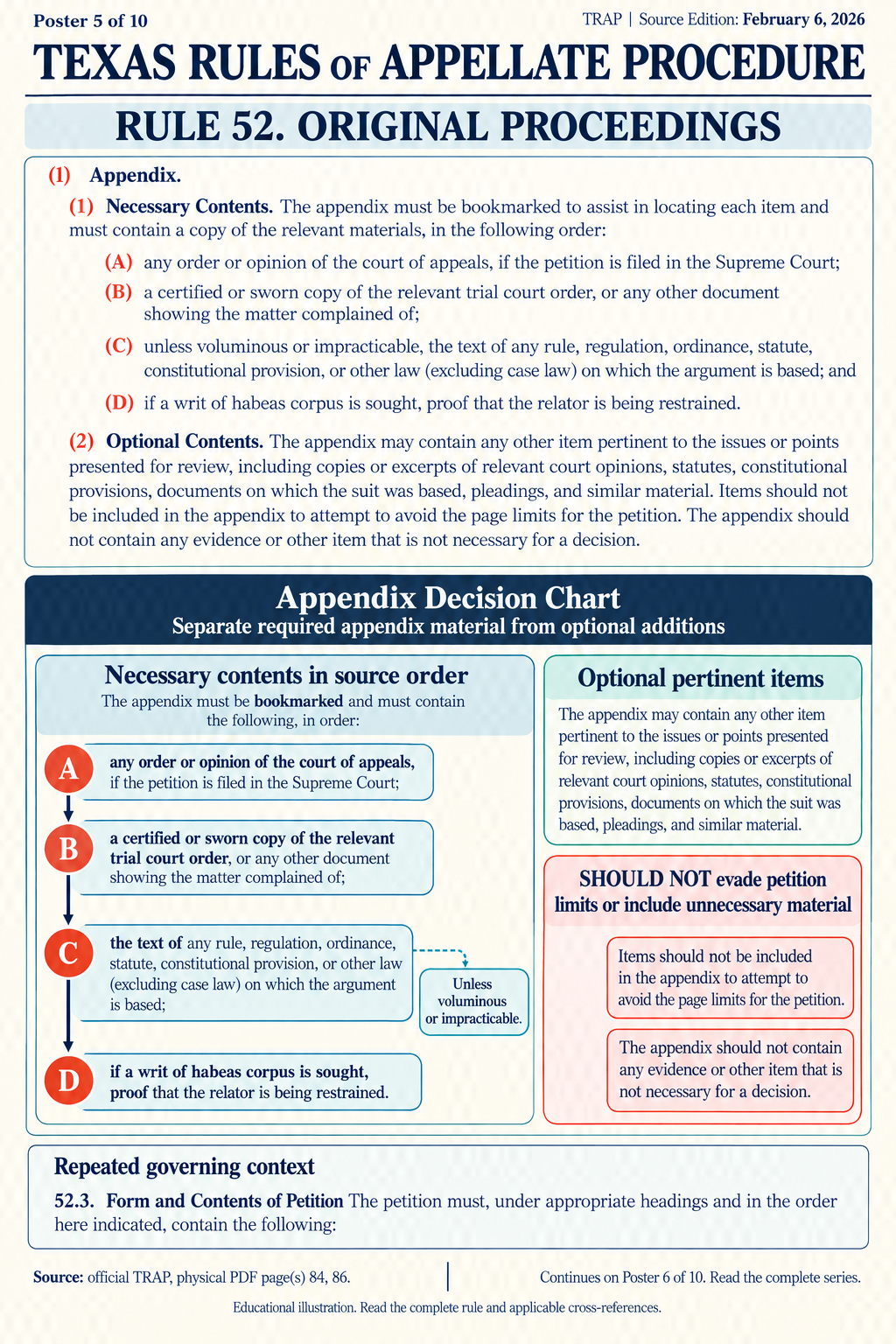
Read assigned text for Rule 52 poster 5
Assigned rule text
(l) Appendix.
(1) Necessary Contents. The appendix must be bookmarked to assist in locating each item and must contain a copy of the relevant materials, in the following order:
(A) any order or opinion of the court of appeals, if the petition is filed in the Supreme Court;
(B) a certified or sworn copy of the relevant trial court order, or any other document showing the matter complained of;
(C) unless voluminous or impracticable, the text of any rule, regulation, ordinance, statute, constitutional provision, or other law (excluding case law) on which the argument is based; and
(D) if a writ of habeas corpus is sought, proof that the relator is being restrained.
(2) Optional Contents. The appendix may contain any other item pertinent to the issues or points presented for review, including copies or excerpts of relevant court opinions, statutes, constitutional provisions, documents on which the suit was based, pleadings, and similar material. Items should not be included in the appendix to attempt to avoid the page limits for the petition. The appendix should not contain any evidence or other item that is not necessary for a decision.
Repeated governing context
52.3. Form and Contents of Petition The petition must, under appropriate headings and in the order here indicated, contain the following:
Continued from poster 4 of 10. Continues on poster 6 of 10. Read the complete series with the official rulebook.
Rule 52. Original Proceedings — poster 6Poster 6 of 10
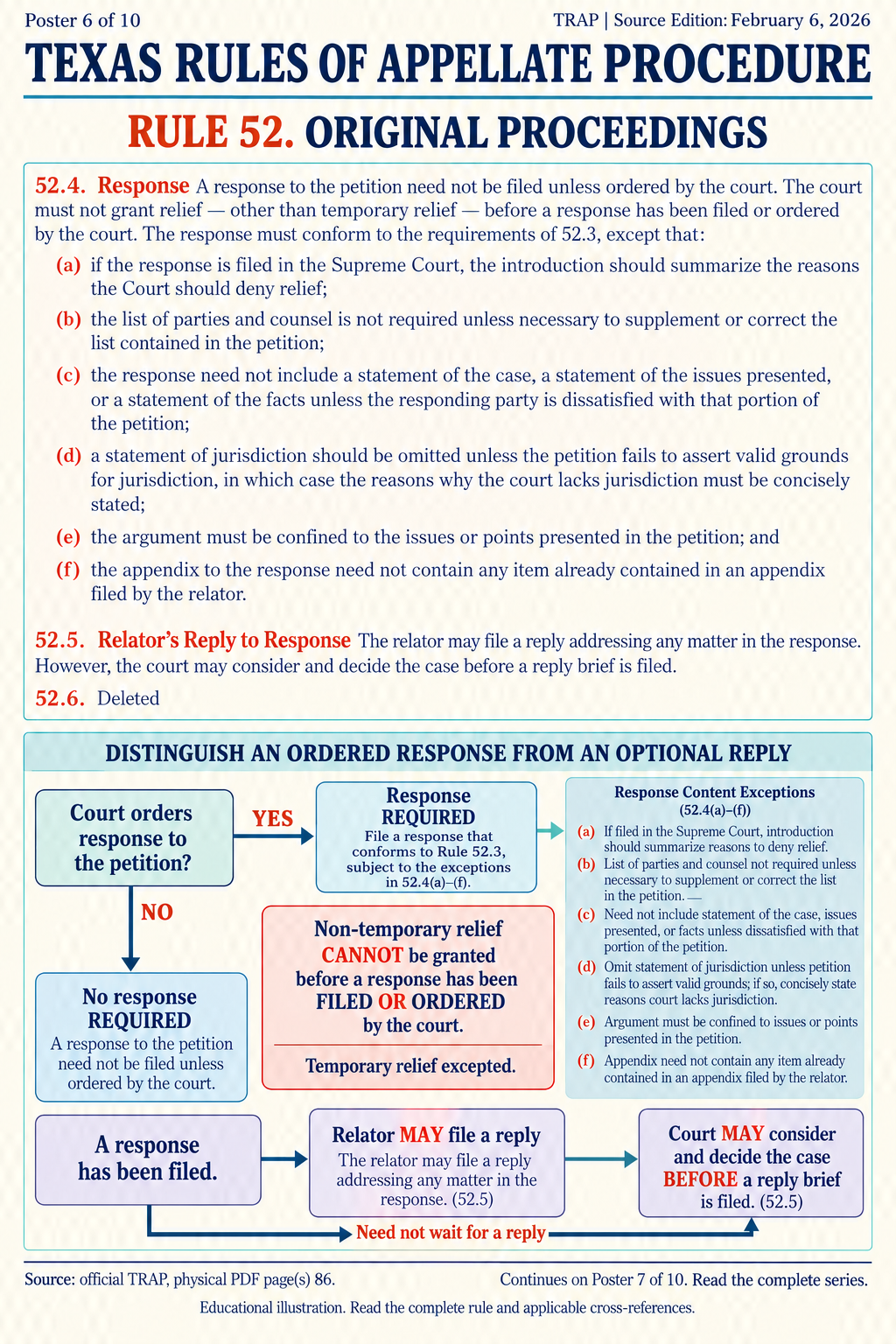
Read assigned text for Rule 52 poster 6
Assigned rule text
52.4. Response A response to the petition need not be filed unless ordered by the court. The court must not grant relief — other than temporary relief — before a response has been filed or ordered by the court. The response must conform to the requirements of 52.3, except that:
(a) if the response is filed in the Supreme Court, the introduction should summarize the reasons the Court should deny relief;
(b) the list of parties and counsel is not required unless necessary to supplement or correct the list contained in the petition;
(c) the response need not include a statement of the case, a statement of the issues presented, or a statement of the facts unless the responding party is dissatisfied with that portion of the petition;
(d) a statement of jurisdiction should be omitted unless the petition fails to assert valid grounds for jurisdiction, in which case the reasons why the court lacks jurisdiction must be concisely stated;
(e) the argument must be confined to the issues or points presented in the petition; and
(f) the appendix to the response need not contain any item already contained in an appendix filed by the relator.
52.5. Relator’s Reply to Response The relator may file a reply addressing any matter in the response. However, the court may consider and decide the case before a reply brief is filed.
52.6. Deleted
Continued from poster 5 of 10. Continues on poster 7 of 10. Read the complete series with the official rulebook.
Rule 52. Original Proceedings — poster 7Poster 7 of 10
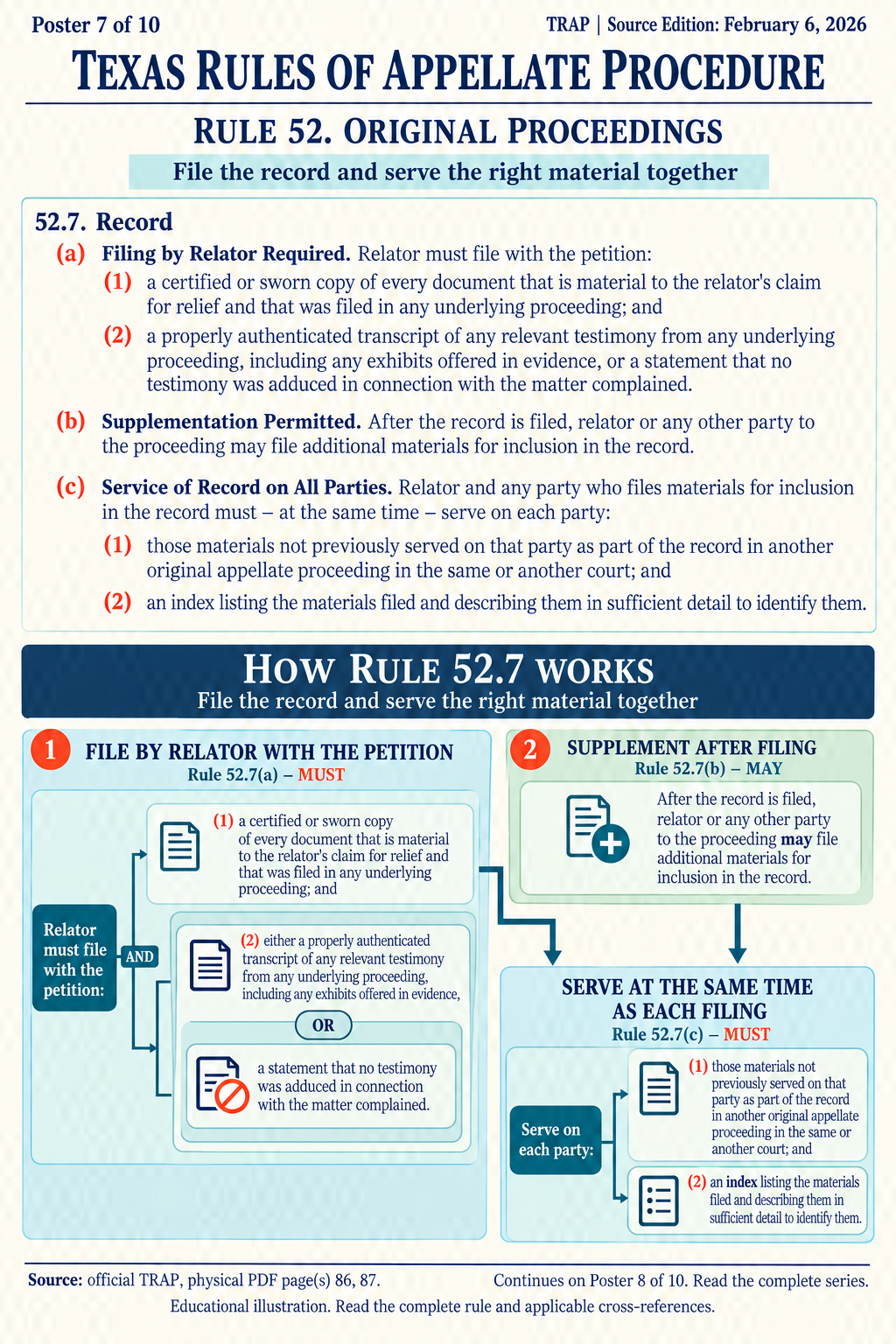
Read assigned text for Rule 52 poster 7
Assigned rule text
52.7. Record
(a) Filing by Relator Required. Relator must file with the petition:
(1) a certified or sworn copy of every document that is material to the relator's claim for relief and that was filed in any underlying proceeding; and
(2) a properly authenticated transcript of any relevant testimony from any underlying proceeding, including any exhibits offered in evidence, or a statement that no testimony was adduced in connection with the matter complained.
(b) Supplementation Permitted. After the record is filed, relator or any other party to the proceeding may file additional materials for inclusion in the record.
(c) Service of Record on All Parties. Relator and any party who files materials for inclusion in the record must – at the same time – serve on each party:
(1) those materials not previously served on that party as part of the record in another original appellate proceeding in the same or another court; and
(2) an index listing the materials filed and describing them in sufficient detail to identify them.
Continued from poster 6 of 10. Continues on poster 8 of 10. Read the complete series with the official rulebook.
Rule 52. Original Proceedings — poster 8Poster 8 of 10
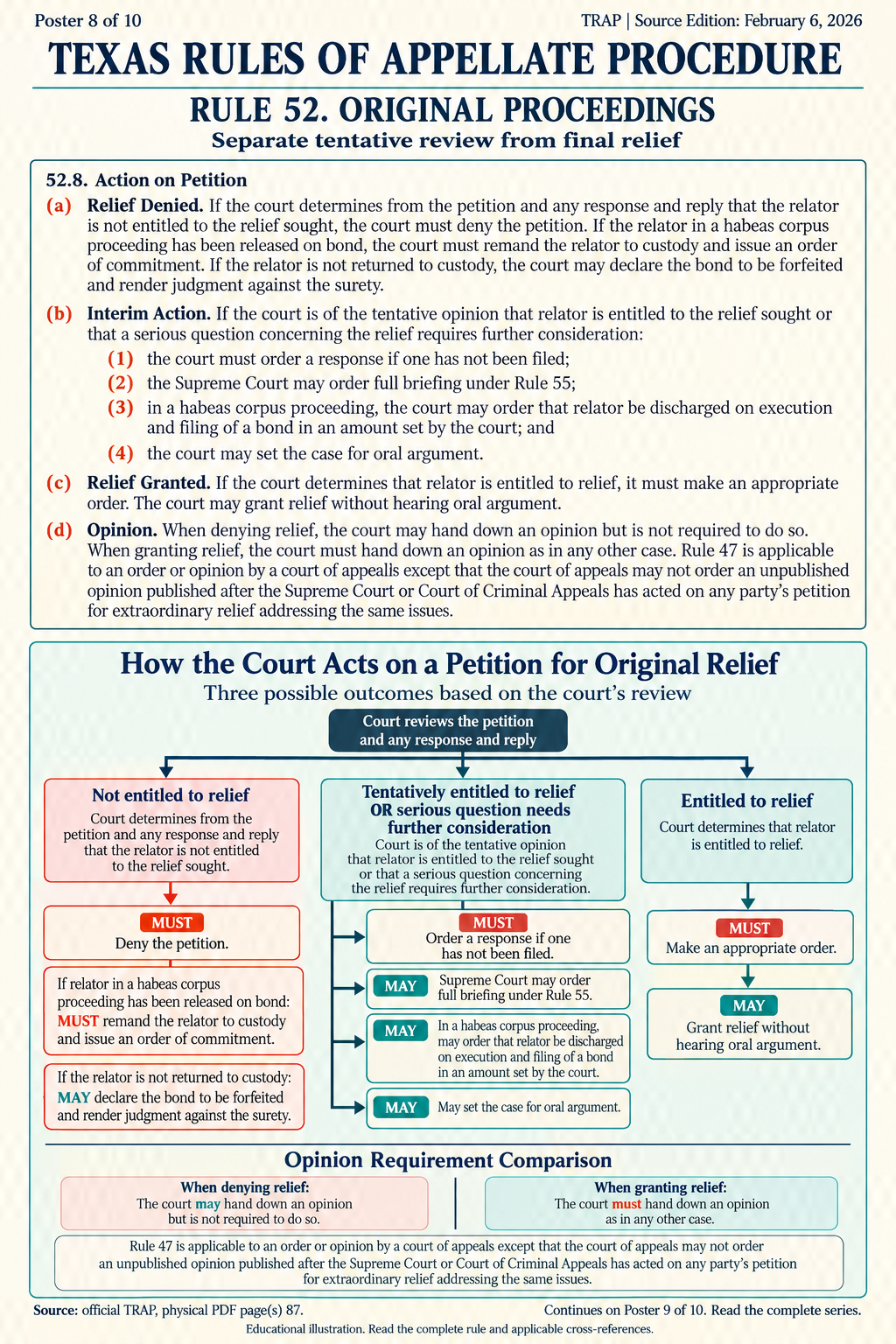
Read assigned text for Rule 52 poster 8
Assigned rule text
52.8. Action on Petition
(a) Relief Denied. If the court determines from the petition and any response and reply that the relator is not entitled to the relief sought, the court must deny the petition. If the relator in a habeas corpus proceeding has been released on bond, the court must remand the relator to custody and issue an order of commitment. If the relator is not returned to custody, the court may declare the bond to be forfeited and render judgment against the surety.
(b) Interim Action. If the court is of the tentative opinion that relator is entitled to the relief sought or that a serious question concerning the relief requires further consideration:
(1) the court must order a response if one has not been filed;
(2) the Supreme Court may order full briefing under Rule 55;
(3) in a habeas corpus proceeding, the court may order that relator be discharged on execution and filing of a bond in an amount set by the court; and
(4) the court may set the case for oral argument.
(c) Relief Granted. If the court determines that relator is entitled to relief, it must make an appropriate order. The court may grant relief without hearing oral argument.
(d) Opinion. When denying relief, the court may hand down an opinion but is not required to do so. When granting relief, the court must hand down an opinion as in any other case. Rule 47 is applicable to an order or opinion by a court of appeals except that the court of appeals may not order an unpublished opinion published after the Supreme Court or Court of Criminal Appeals has acted on any party’s petition for extraordinary relief addressing the same issues.
Continued from poster 7 of 10. Continues on poster 9 of 10. Read the complete series with the official rulebook.
Rule 52. Original Proceedings — poster 9Poster 9 of 10
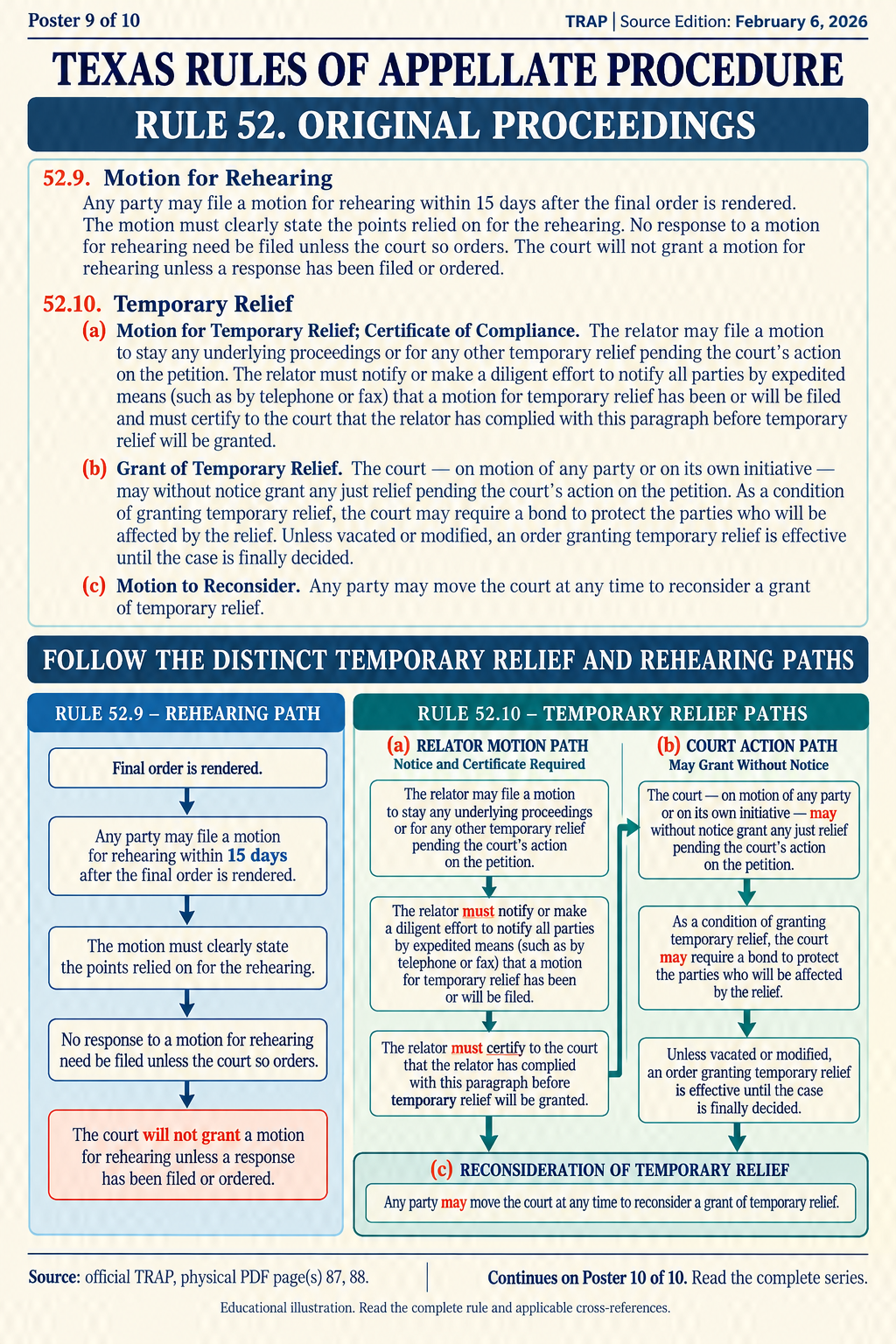
Read assigned text for Rule 52 poster 9
Assigned rule text
52.9. Motion for Rehearing Any party may file a motion for rehearing within 15 days after the final order is rendered. The motion must clearly state the points relied on for the rehearing. No response to a motion for rehearing need be filed unless the court so orders. The court will not grant a motion for rehearing unless a response has been filed or ordered.
52.10. Temporary Relief
(a) Motion for Temporary Relief; Certificate of Compliance. The relator may file a motion to stay any underlying proceedings or for any other temporary relief pending the court’s action on the petition. The relator must notify or make a diligent effort to notify all parties by expedited means (such as by telephone or fax) that a motion for temporary relief has been or will be filed and must certify to the court that the relator has complied with this paragraph before temporary relief will be granted.
(b) Grant of Temporary Relief. The court — on motion of any party or on its own initiative — may without notice grant any just relief pending the court’s action on the petition. As a condition of granting temporary relief, the court may require a bond to protect the parties who will be affected by the relief. Unless vacated or modified, an order granting temporary relief is effective until the case is finally decided.
(c) Motion to Reconsider. Any party may move the court at any time to reconsider a grant of temporary relief.
Continued from poster 8 of 10. Continues on poster 10 of 10. Read the complete series with the official rulebook.
Rule 52. Original Proceedings — poster 10Poster 10 of 10
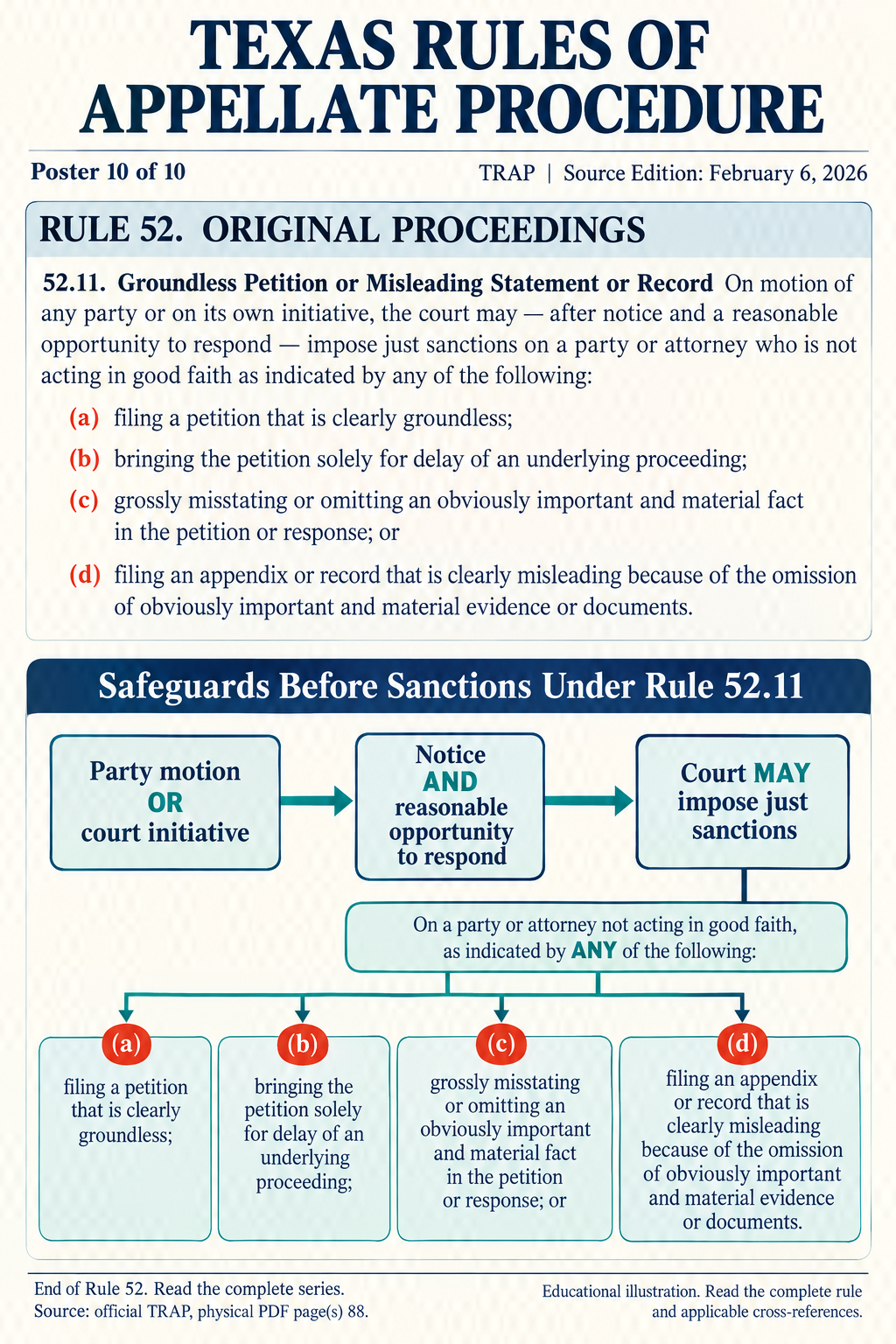
Read assigned text for Rule 52 poster 10
Assigned rule text
52.11. Groundless Petition or Misleading Statement or Record On motion of any party or on its own initiative, the court may — after notice and a reasonable opportunity to respond — impose just sanctions on a party or attorney who is not acting in good faith as indicated by any of the following:
(a) filing a petition that is clearly groundless;
(b) bringing the petition solely for delay of an underlying proceeding;
(c) grossly misstating or omitting an obviously important and material fact in the petition or response; or
(d) filing an appendix or record that is clearly misleading because of the omission of obviously important and material evidence or documents.
Continued from poster 9 of 10. Read the complete series with the official rulebook.
Rule 53. Petition For Review
Rule 53. Petition For Review — poster 1Poster 1 of 9
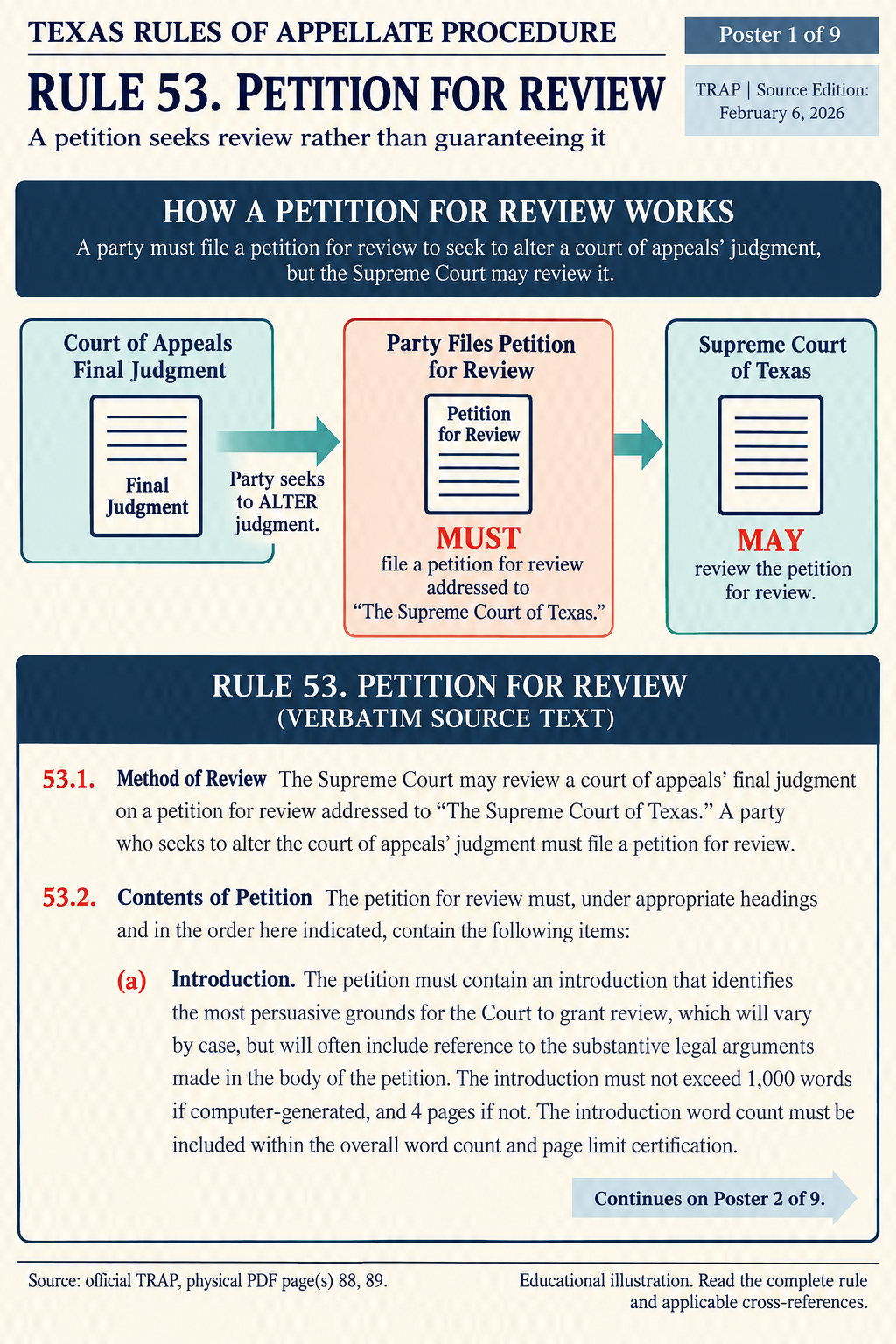
Read assigned text for Rule 53 poster 1
Assigned rule text
53.1. Method of Review The Supreme Court may review a court of appeals’ final judgment on a petition for review addressed to “The Supreme Court of Texas.” A party who seeks to alter the court of appeals’ judgment must file a petition for review.
53.2. Contents of Petition The petition for review must, under appropriate headings and in the order here indicated, contain the following items:
(a) Introduction. The petition must contain an introduction that identifies the most persuasive grounds for the Court to grant review, which will vary by case, but will often include reference to the substantive legal arguments made in the body of the petition. The introduction must not exceed 1,000 words if computer-generated, and 4 pages if not. The introduction word count must be included within the overall word count and page limit certification.
Continues on poster 2 of 9. Read the complete series with the official rulebook.
Rule 53. Petition For Review — poster 2Poster 2 of 9
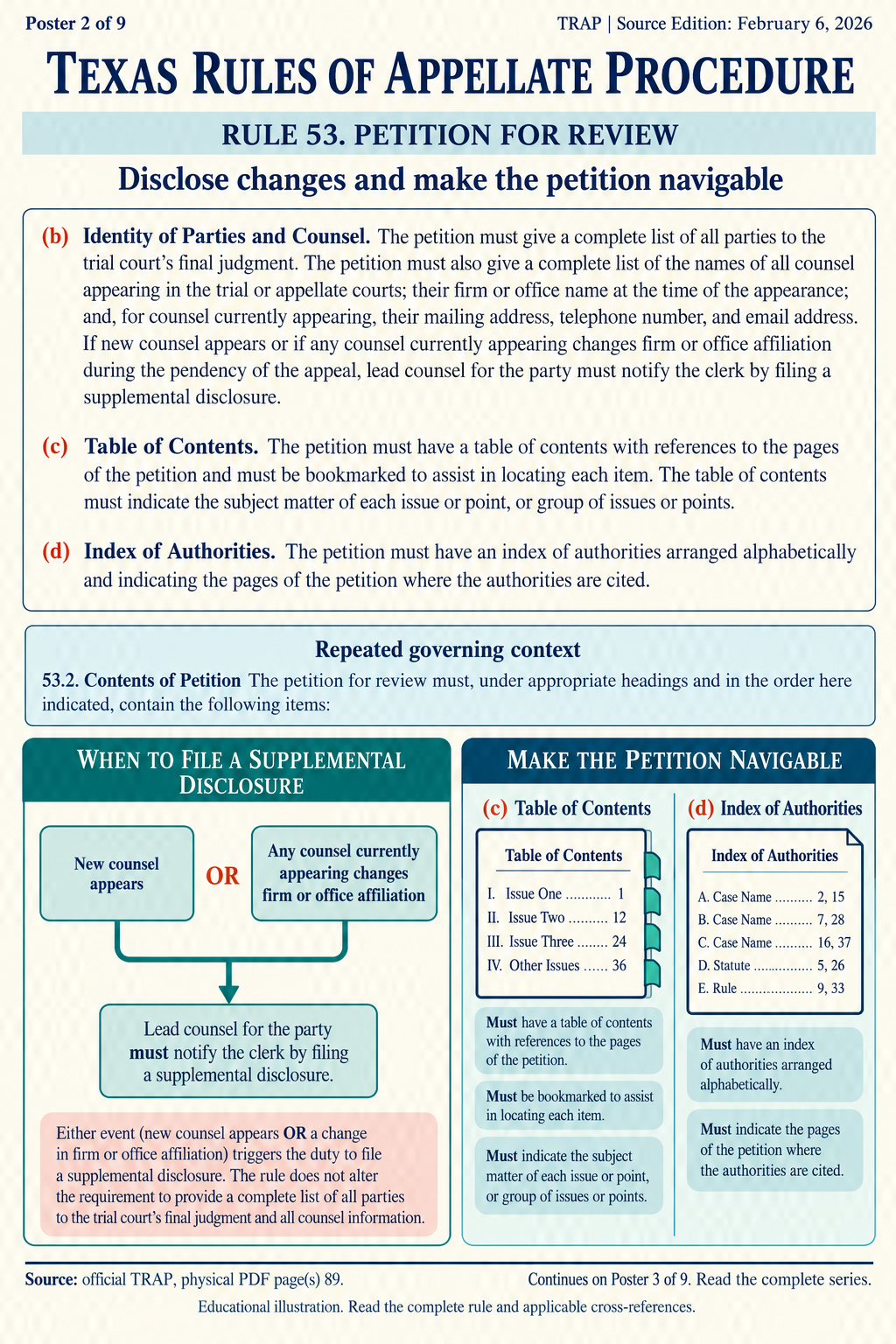
Read assigned text for Rule 53 poster 2
Assigned rule text
(b) Identity of Parties and Counsel. The petition must give a complete list of all parties to the trial court’s final judgment. The petition must also give a complete list of the names of all counsel appearing in the trial or appellate courts; their firm or office name at the time of the appearance; and, for counsel currently appearing, their mailing address, telephone number, and email address. If new counsel appears or if any counsel currently appearing changes firm or office affiliation during the pendency of the appeal, lead counsel for the party must notify the clerk by filing a supplemental disclosure.
(c) Table of Contents. The petition must have a table of contents with references to the pages of the petition and must be bookmarked to assist in locating each item. The table of contents must indicate the subject matter of each issue or point, or group of issues or points.
(d) Index of Authorities. The petition must have an index of authorities arranged alphabetically and indicating the pages of the petition where the authorities are cited.
Repeated governing context
53.2. Contents of Petition The petition for review must, under appropriate headings and in the order here indicated, contain the following items:
Continued from poster 1 of 9. Continues on poster 3 of 9. Read the complete series with the official rulebook.
Rule 53. Petition For Review — poster 3Poster 3 of 9
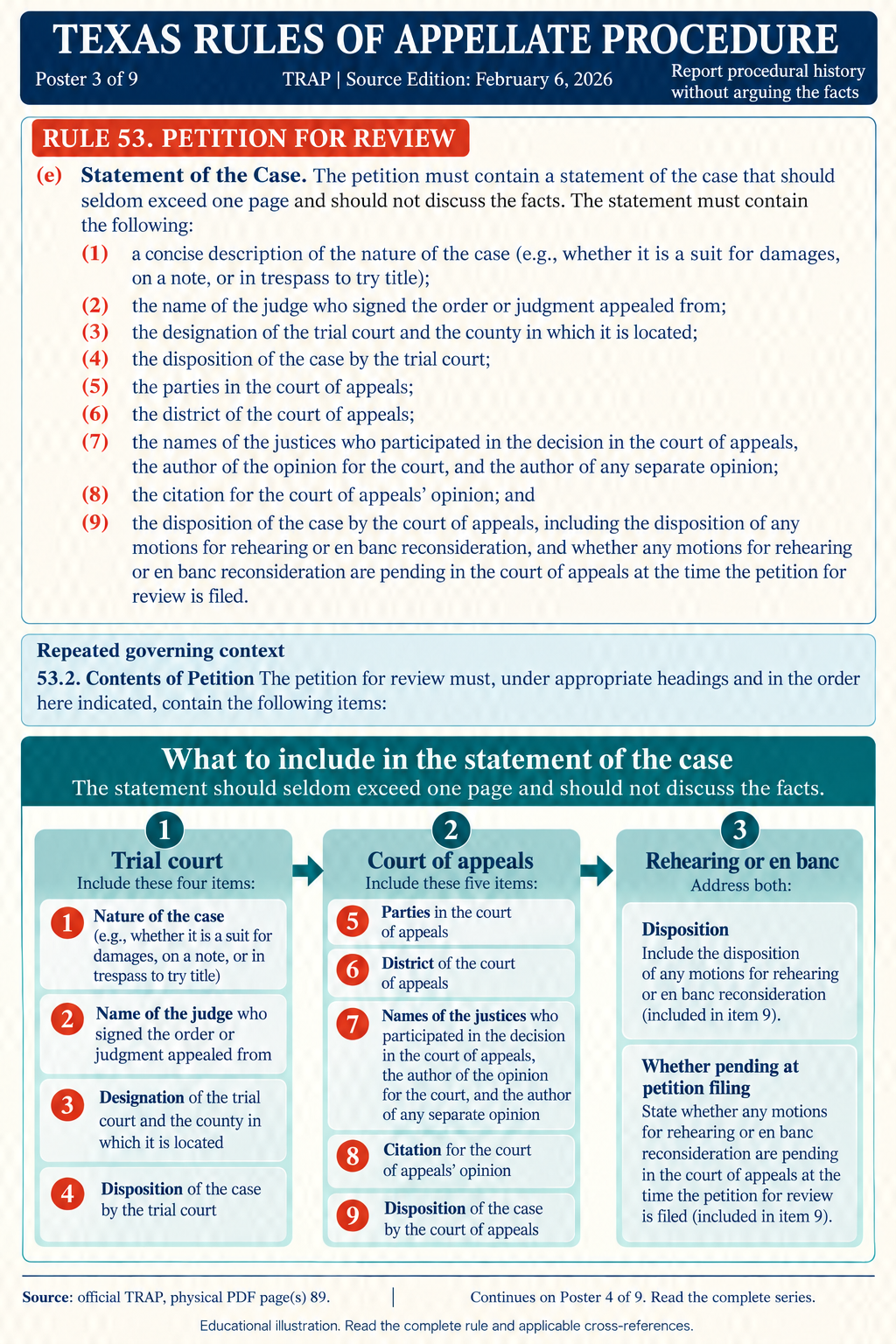
Read assigned text for Rule 53 poster 3
Assigned rule text
(e) Statement of the Case. The petition must contain a statement of the case that should seldom exceed one page and should not discuss the facts. The statement must contain the following:
(1) a concise description of the nature of the case (e.g., whether it is a suit for damages, on a note, or in trespass to try title);
(2) the name of the judge who signed the order or judgment appealed from;
(3) the designation of the trial court and the county in which it is located;
(4) the disposition of the case by the trial court;
(5) the parties in the court of appeals;
(6) the district of the court of appeals;
(7) the names of the justices who participated in the decision in the court of appeals, the author of the opinion for the court, and the author of any separate opinion;
(8) the citation for the court of appeals’ opinion; and
(9) the disposition of the case by the court of appeals, including the disposition of any motions for rehearing or en banc reconsideration, and whether any motions for rehearing or en banc reconsideration are pending in the court of appeals at the time the petition for review is filed.
Repeated governing context
53.2. Contents of Petition The petition for review must, under appropriate headings and in the order here indicated, contain the following items:
Continued from poster 2 of 9. Continues on poster 4 of 9. Read the complete series with the official rulebook.
Rule 53. Petition For Review — poster 4Poster 4 of 9
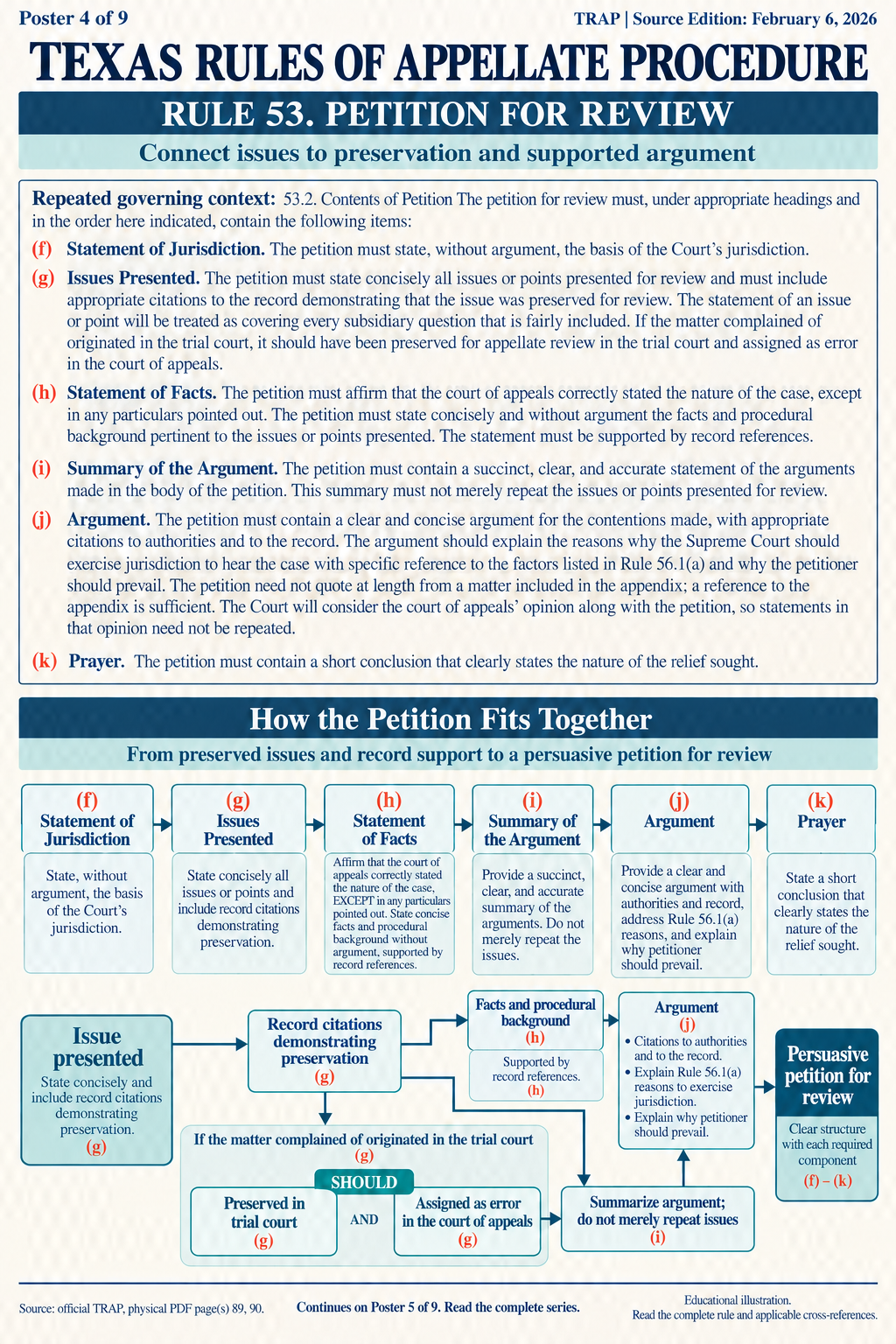
Read assigned text for Rule 53 poster 4
Assigned rule text
(f) Statement of Jurisdiction. The petition must state, without argument, the basis of the Court’s jurisdiction.
(g) Issues Presented. The petition must state concisely all issues or points presented for review and must include appropriate citations to the record demonstrating that the issue was preserved for review. The statement of an issue or point will be treated as covering every subsidiary question that is fairly included. If the matter complained of originated in the trial court, it should have been preserved for appellate review in the trial court and assigned as error in the court of appeals.
(h) Statement of Facts. The petition must affirm that the court of appeals correctly stated the nature of the case, except in any particulars pointed out. The petition must state concisely and without argument the facts and procedural background pertinent to the issues or points presented. The statement must be supported by record references.
(i) Summary of the Argument. The petition must contain a succinct, clear, and accurate statement of the arguments made in the body of the petition. This summary must not merely repeat the issues or points presented for review.
(j) Argument. The petition must contain a clear and concise argument for the contentions made, with appropriate citations to authorities and to the record. The argument should explain the reasons why the Supreme Court should exercise jurisdiction to hear the case with specific reference to the factors listed in Rule 56.1(a) and why the petitioner should prevail. The petition need not quote at length from a matter included in the appendix; a reference to the appendix is sufficient. The Court will consider the court of appeals’ opinion along with the petition, so statements in that opinion need not be repeated.
(k) Prayer. The petition must contain a short conclusion that clearly states the nature of the relief sought.
Repeated governing context
53.2. Contents of Petition The petition for review must, under appropriate headings and in the order here indicated, contain the following items:
Continued from poster 3 of 9. Continues on poster 5 of 9. Read the complete series with the official rulebook.
Rule 53. Petition For Review — poster 5Poster 5 of 9
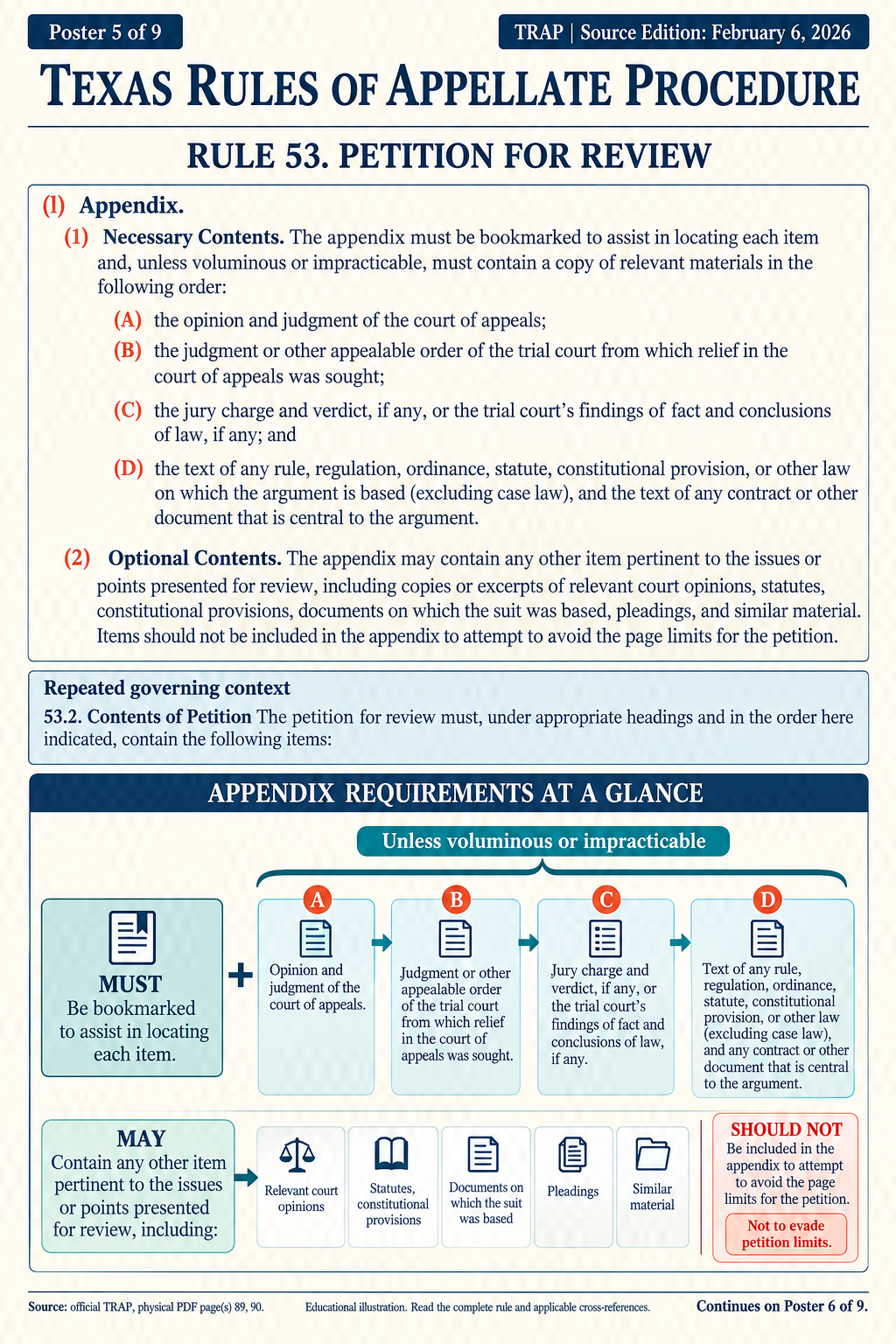
Read assigned text for Rule 53 poster 5
Assigned rule text
(l) Appendix.
(1) Necessary Contents. The appendix must be bookmarked to assist in locating each item and, unless voluminous or impracticable, must contain a copy of relevant materials in the following order:
(A) the opinion and judgment of the court of appeals;
(B) the judgment or other appealable order of the trial court from which relief in the court of appeals was sought;
(C) the jury charge and verdict, if any, or the trial court’s findings of fact and conclusions of law, if any; and
(D) the text of any rule, regulation, ordinance, statute, constitutional provision, or other law on which the argument is based (excluding case law), and the text of any contract or other document that is central to the argument.
(2) Optional Contents. The appendix may contain any other item pertinent to the issues or points presented for review, including copies or excerpts of relevant court opinions, statutes, constitutional provisions, documents on which the suit was based, pleadings, and similar material. Items should not be included in the appendix to attempt to avoid the page limits for the petition.
Repeated governing context
53.2. Contents of Petition The petition for review must, under appropriate headings and in the order here indicated, contain the following items:
Continued from poster 4 of 9. Continues on poster 6 of 9. Read the complete series with the official rulebook.
Rule 53. Petition For Review — poster 6Poster 6 of 9
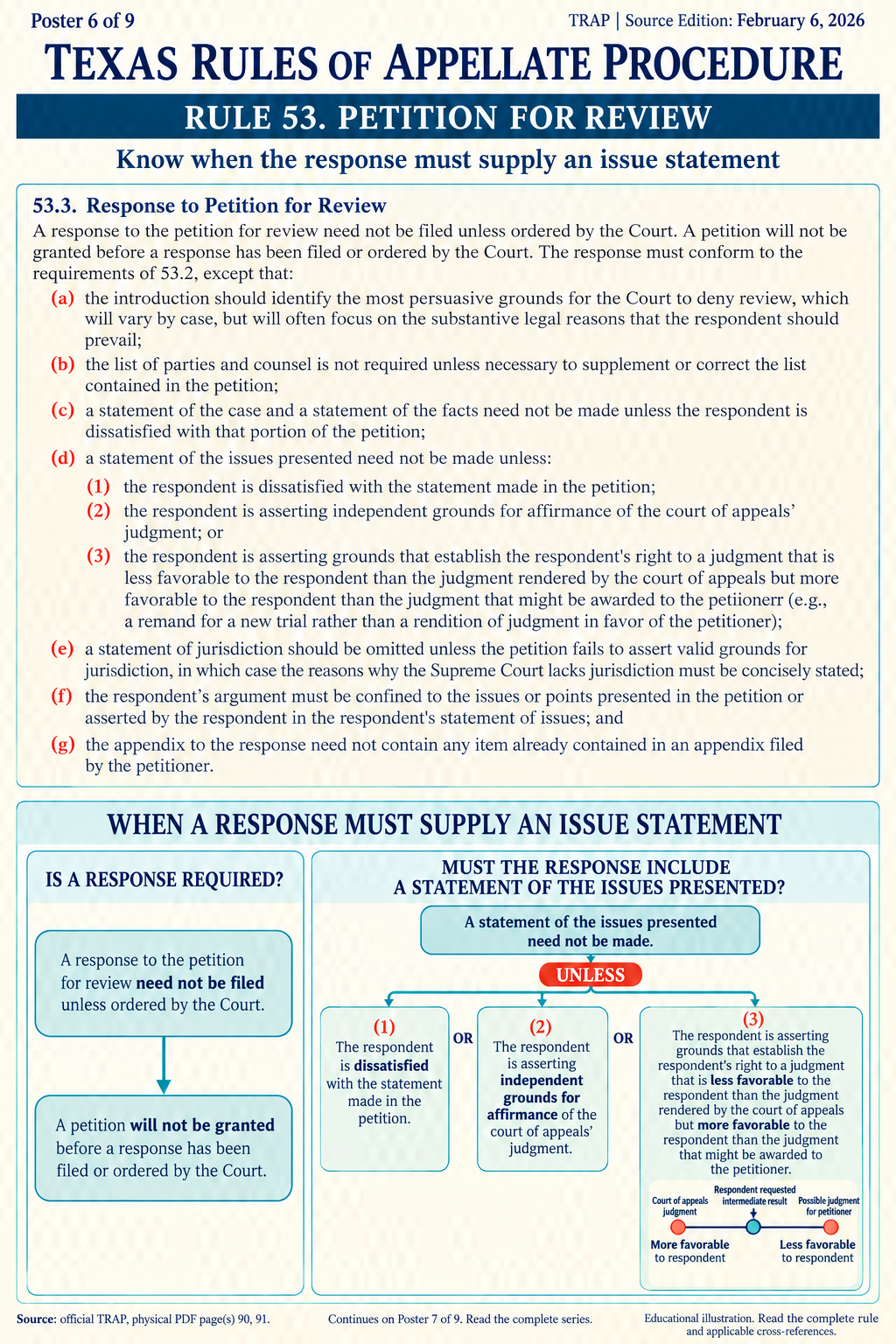
Read assigned text for Rule 53 poster 6
Assigned rule text
53.3. Response to Petition for Review A response to the petition for review need not be filed unless ordered by the Court. A petition will not be granted before a response has been filed or ordered by the Court. The response must conform to the requirements of 53.2, except that:
(a) the introduction should identify the most persuasive grounds for the Court to deny review, which will vary by case, but will often focus on the substantive legal reasons that the respondent should prevail;
(b) the list of parties and counsel is not required unless necessary to supplement or correct the list contained in the petition;
(c) a statement of the case and a statement of the facts need not be made unless the respondent is dissatisfied with that portion of the petition;
(d) a statement of the issues presented need not be made unless:
(1) the respondent is dissatisfied with the statement made in the petition;
(2) the respondent is asserting independent grounds for affirmance of the court of appeals’ judgment; or
(3) the respondent is asserting grounds that establish the respondent's right to a judgment that is less favorable to the respondent than the judgment rendered by the court of appeals but more favorable to the respondent than the judgment that might be awarded to the petitioner (e.g., a remand for a new trial rather than a rendition of judgment in favor of the petitioner);
(e) a statement of jurisdiction should be omitted unless the petition fails to assert valid grounds for jurisdiction, in which case the reasons why the Supreme Court lacks jurisdiction must be concisely stated;
(f) the respondent’s argument must be confined to the issues or points presented in the petition or asserted by the respondent in the respondent's statement of issues; and
(g) the appendix to the response need not contain any item already contained in an appendix filed by the petitioner.
Continued from poster 5 of 9. Continues on poster 7 of 9. Read the complete series with the official rulebook.
Rule 53. Petition For Review — poster 7Poster 7 of 9
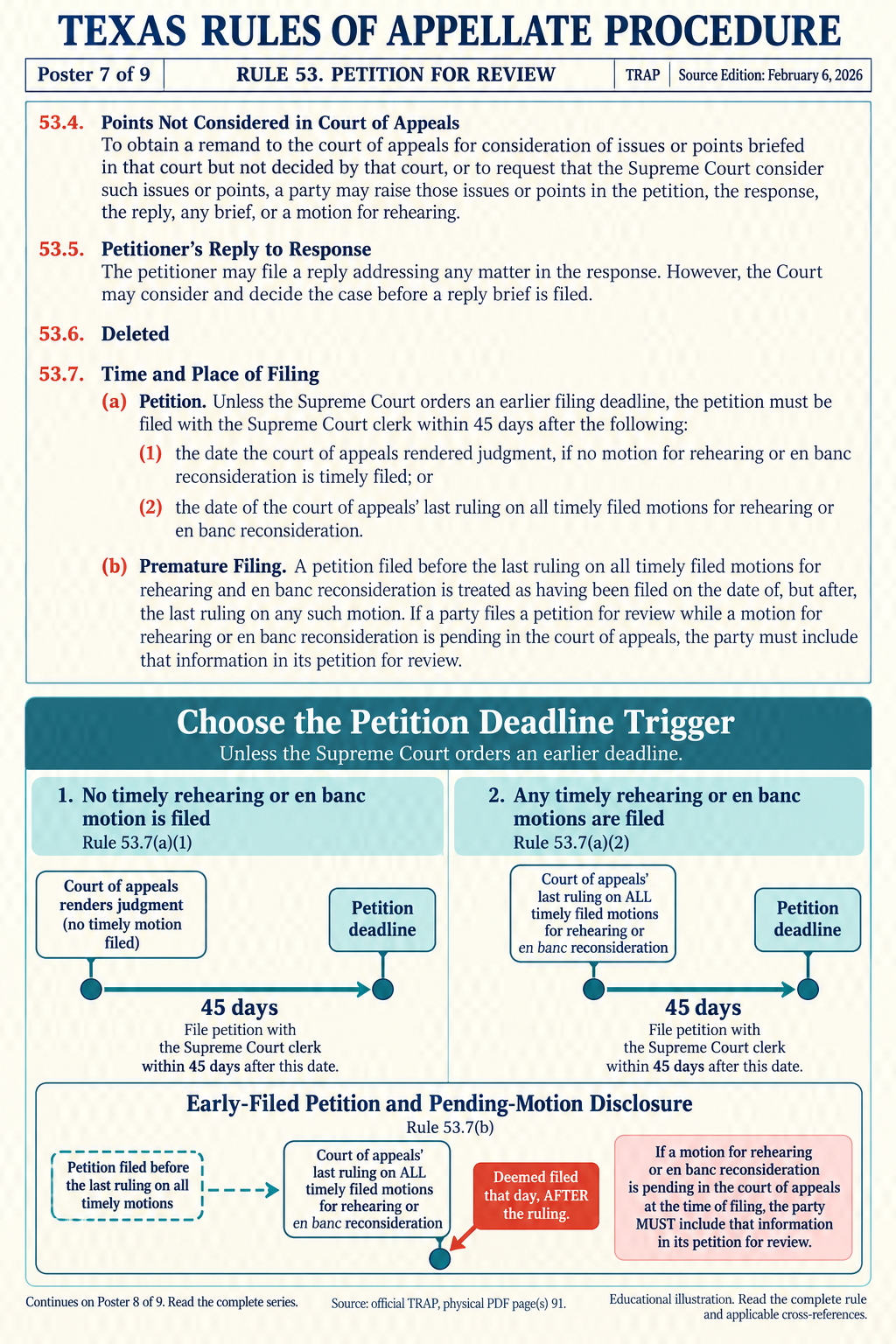
Read assigned text for Rule 53 poster 7
Assigned rule text
53.4. Points Not Considered in Court of Appeals To obtain a remand to the court of appeals for consideration of issues or points briefed in that court but not decided by that court, or to request that the Supreme Court consider such issues or points, a party may raise those issues or points in the petition, the response, the reply, any brief, or a motion for rehearing.
53.5. Petitioner’s Reply to Response The petitioner may file a reply addressing any matter in the response. However, the Court may consider and decide the case before a reply brief is filed.
53.6. Deleted
53.7. Time and Place of Filing
(a) Petition. Unless the Supreme Court orders an earlier filing deadline, the petition must be filed with the Supreme Court clerk within 45 days after the following:
(1) the date the court of appeals rendered judgment, if no motion for rehearing or en banc reconsideration is timely filed; or
(2) the date of the court of appeals’ last ruling on all timely filed motions for rehearing or en banc reconsideration.
(b) Premature Filing. A petition filed before the last ruling on all timely filed motions for rehearing and en banc reconsideration is treated as having been filed on the date of, but after, the last ruling on any such motion. If a party files a petition for review while a motion for rehearing or en banc reconsideration is pending in the court of appeals, the party must include that information in its petition for review.
Continued from poster 6 of 9. Continues on poster 8 of 9. Read the complete series with the official rulebook.
Rule 53. Petition For Review — poster 8Poster 8 of 9
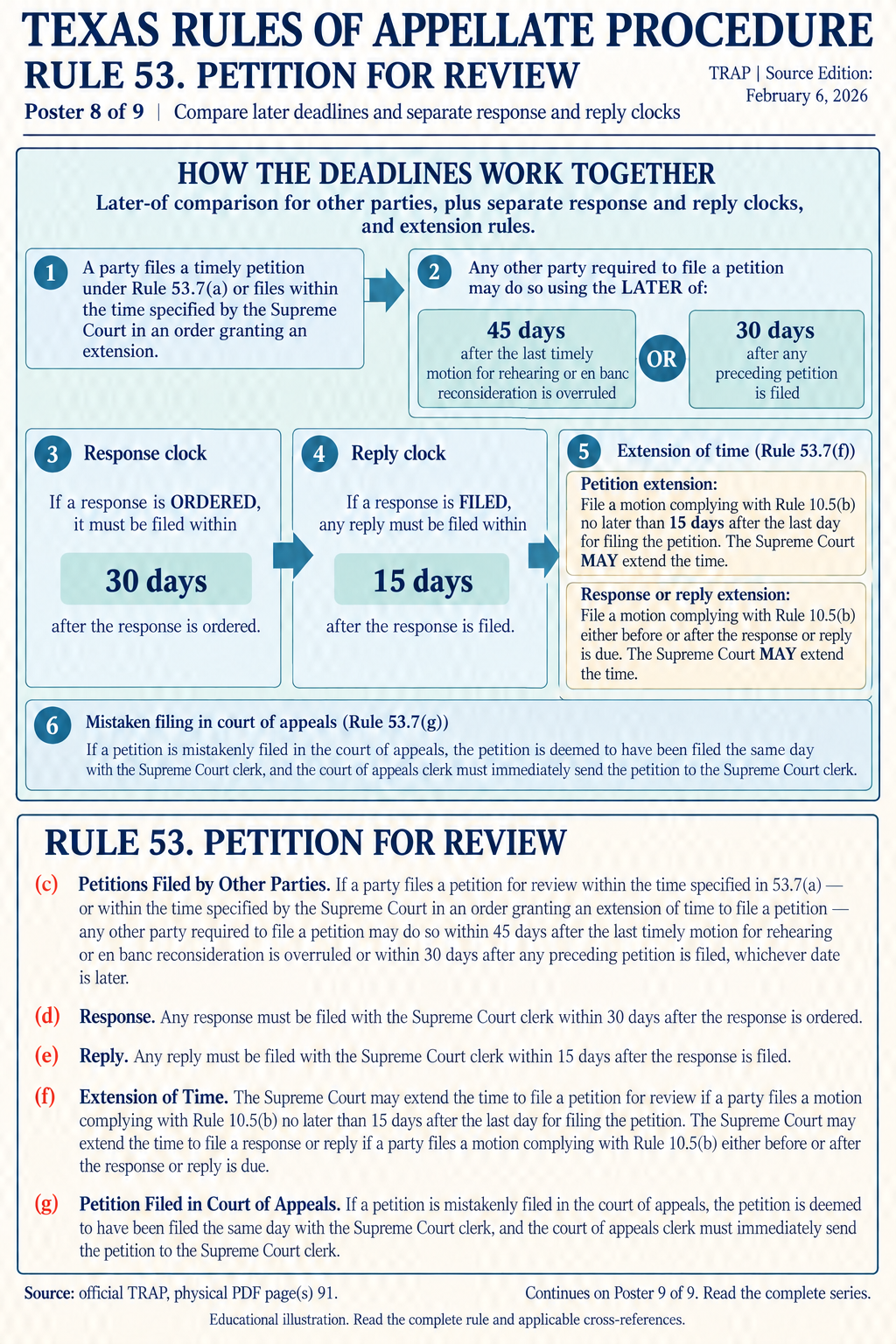
Read assigned text for Rule 53 poster 8
Assigned rule text
(c) Petitions Filed by Other Parties. If a party files a petition for review within the time specified in 53.7(a) — or within the time specified by the Supreme Court in an order granting an extension of time to file a petition — any other party required to file a petition may do so within 45 days after the last timely motion for rehearing or en banc reconsideration is overruled or within 30 days after any preceding petition is filed, whichever date is later.
(d) Response. Any response must be filed with the Supreme Court clerk within 30 days after the response is ordered.
(e) Reply. Any reply must be filed with the Supreme Court clerk within 15 days after the response is filed.
(f) Extension of Time. The Supreme Court may extend the time to file a petition for review if a party files a motion complying with Rule 10.5(b) no later than 15 days after the last day for filing the petition. The Supreme Court may extend the time to file a response or reply if a party files a motion complying with Rule 10.5(b) either before or after the response or reply is due.
(g) Petition Filed in Court of Appeals. If a petition is mistakenly filed in the court of appeals, the petition is deemed to have been filed the same day with the Supreme Court clerk, and the court of appeals clerk must immediately send the petition to the Supreme Court clerk.
Continued from poster 7 of 9. Continues on poster 9 of 9. Read the complete series with the official rulebook.
Rule 53. Petition For Review — poster 9Poster 9 of 9
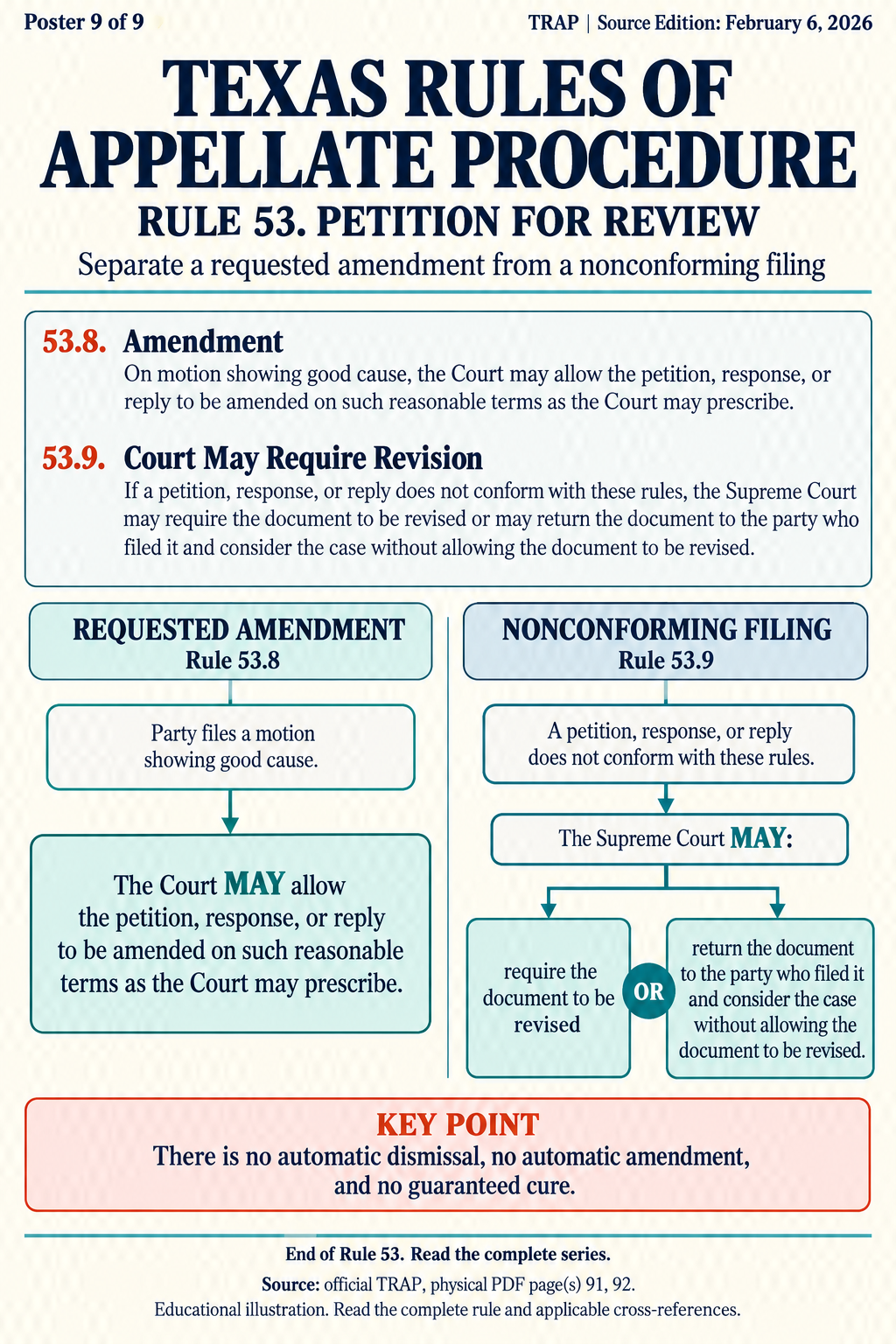
Read assigned text for Rule 53 poster 9
Assigned rule text
53.8. Amendment On motion showing good cause, the Court may allow the petition, response, or reply to be amended on such reasonable terms as the Court may prescribe.
53.9. Court May Require Revision If a petition, response, or reply does not conform with these rules, the Supreme Court may require the document to be revised or may return the document to the party who filed it and consider the case without allowing the document to be revised.
Continued from poster 8 of 9. Read the complete series with the official rulebook.
Rule 54. Filing The Record
Rule 54. Filing The Record — poster 1Poster 1 of 1
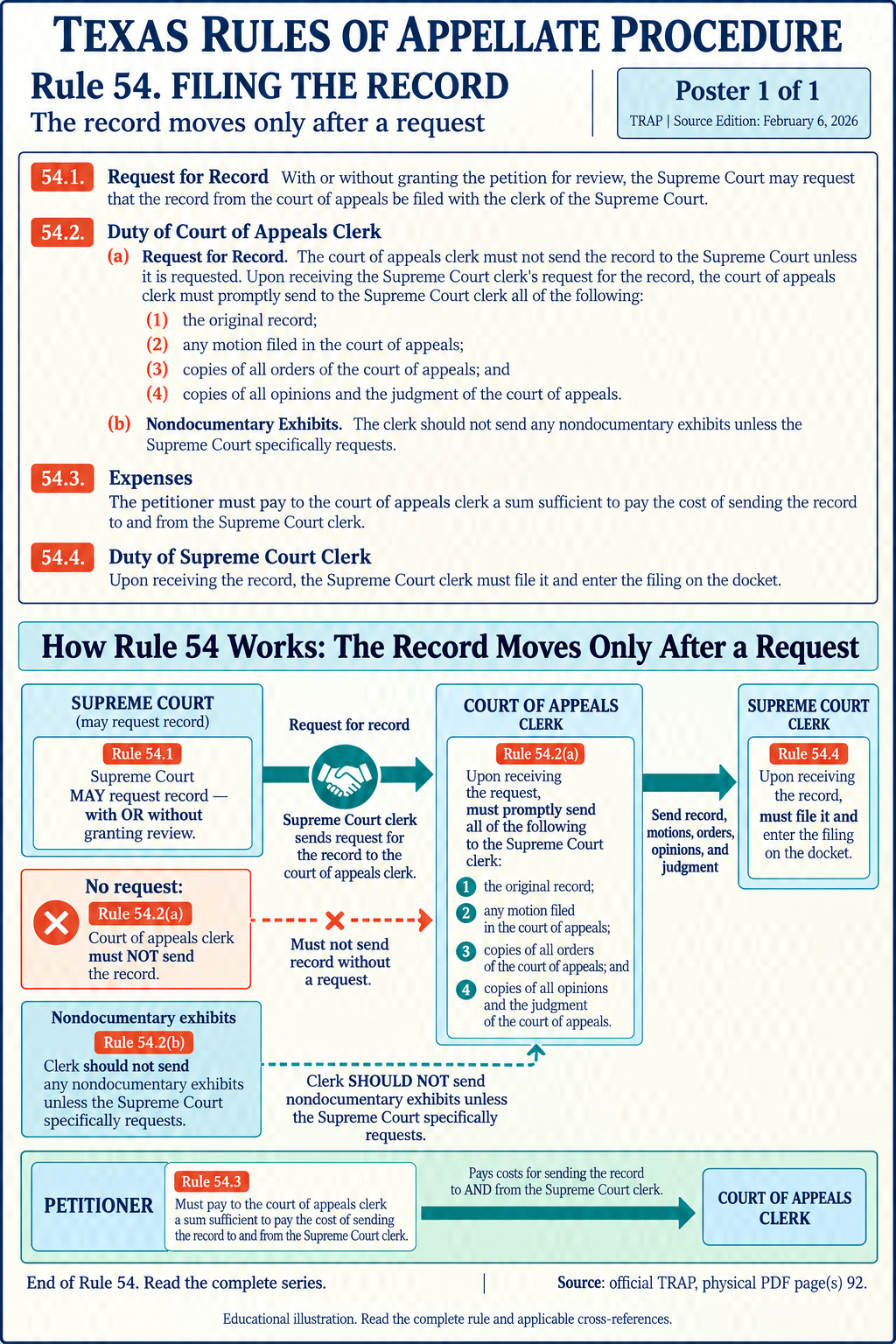
Read assigned text for Rule 54 poster 1
Assigned rule text
54.1. Request for Record With or without granting the petition for review, the Supreme Court may request that the record from the court of appeals be filed with the clerk of the Supreme Court.
54.2. Duty of Court of Appeals Clerk
(a) Request for Record. The court of appeals clerk must not send the record to the Supreme Court unless it is requested. Upon receiving the Supreme Court clerk's request for the record, the court of appeals clerk must promptly send to the Supreme Court clerk all of the following:
(1) the original record;
(2) any motion filed in the court of appeals;
(3) copies of all orders of the court of appeals; and
(4) copies of all opinions and the judgment of the court of appeals.
(b) Nondocumentary Exhibits. The clerk should not send any nondocumentary exhibits unless the Supreme Court specifically requests.
54.3. Expenses The petitioner must pay to the court of appeals clerk a sum sufficient to pay the cost of sending the record to and from the Supreme Court clerk.
54.4. Duty of Supreme Court Clerk Upon receiving the record, the Supreme Court clerk must file it and enter the filing on the docket.
Read the complete series with the official rulebook.
Rule 55. Brief On The Merits
Rule 55. Brief On The Merits — poster 1Poster 1 of 5
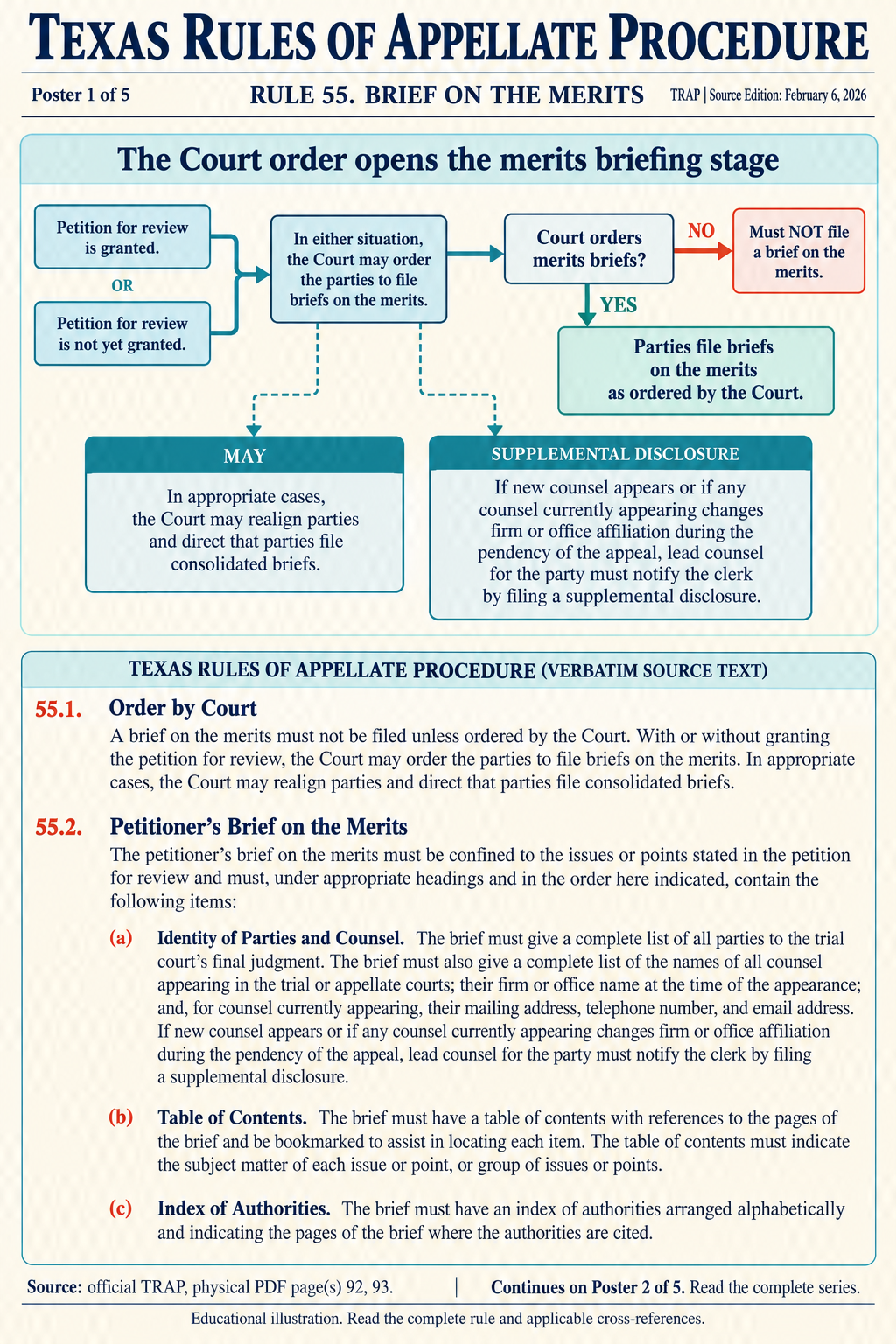
Read assigned text for Rule 55 poster 1
Assigned rule text
55.1. Order by Court A brief on the merits must not be filed unless ordered by the Court. With or without granting the petition for review, the Court may order the parties to file briefs on the merits. In appropriate cases, the Court may realign parties and direct that parties file consolidated briefs.
55.2. Petitioner's Brief on the Merits The petitioner’s brief on the merits must be confined to the issues or points stated in the petition for review and must, under appropriate headings and in the order here indicated, contain the following items:
(a) Identity of Parties and Counsel. The brief must give a complete list of all parties to the trial court’s final judgment. The brief must also give a complete list of the names of all counsel appearing in the trial or appellate courts; their firm or office name at the time of the appearance; and, for counsel currently appearing, their mailing address, telephone number, and email address. If new counsel appears or if any counsel currently appearing changes firm or office affiliation during the pendency of the appeal, lead counsel for the party must notify the clerk by filing a supplemental disclosure.
(b) Table of Contents. The brief must have a table of contents with references to the pages of the brief and be bookmarked to assist in locating each item. The table of contents must indicate the subject matter of each issue or point, or group of issues or points.
(c) Index of Authorities. The brief must have an index of authorities arranged alphabetically and indicating the pages of the brief where the authorities are cited.
Continues on poster 2 of 5. Read the complete series with the official rulebook.
Rule 55. Brief On The Merits — poster 2Poster 2 of 5
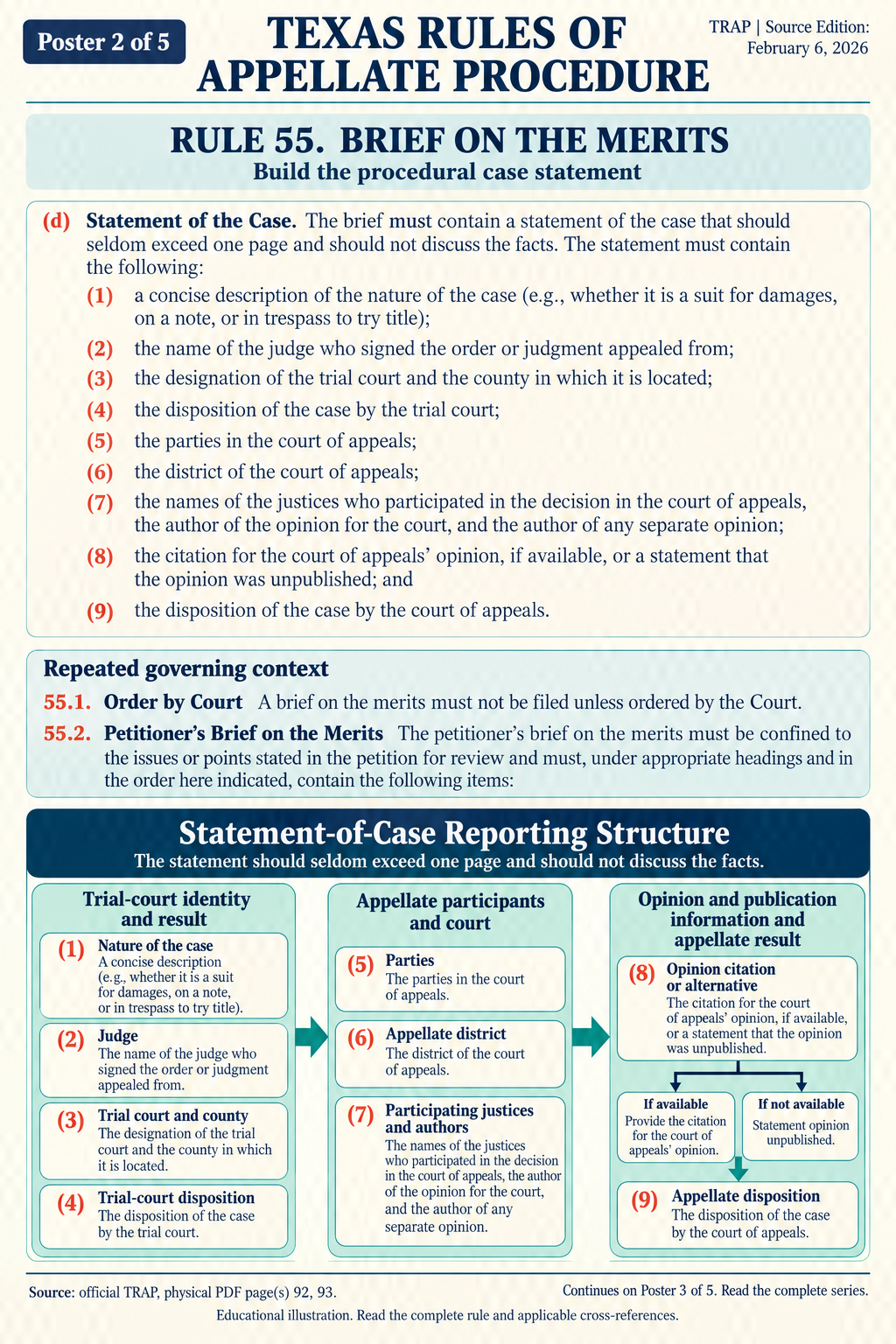
Read assigned text for Rule 55 poster 2
Assigned rule text
(d) Statement of the Case. The brief must contain a statement of the case that should seldom exceed one page and should not discuss the facts. The statement must contain the following:
(1) a concise description of the nature of the case (e.g., whether it is a suit for damages, on a note, or in trespass to try title);
(2) the name of the judge who signed the order or judgment appealed from;
(3) the designation of the trial court and the county in which it is located;
(4) the disposition of the case by the trial court;
(5) the parties in the court of appeals;
(6) the district of the court of appeals;
(7) the names of the justices who participated in the decision in the court of appeals, the author of the opinion for the court, and the author of any separate opinion;
(8) the citation for the court of appeals’ opinion, if available, or a statement that the opinion was unpublished; and
(9) the disposition of the case by the court of appeals.
Repeated governing context
55.1. Order by Court A brief on the merits must not be filed unless ordered by the Court.
55.2. Petitioner's Brief on the Merits The petitioner’s brief on the merits must be confined to the issues or points stated in the petition for review and must, under appropriate headings and in the order here indicated, contain the following items:
Continued from poster 1 of 5. Continues on poster 3 of 5. Read the complete series with the official rulebook.
Rule 55. Brief On The Merits — poster 3Poster 3 of 5
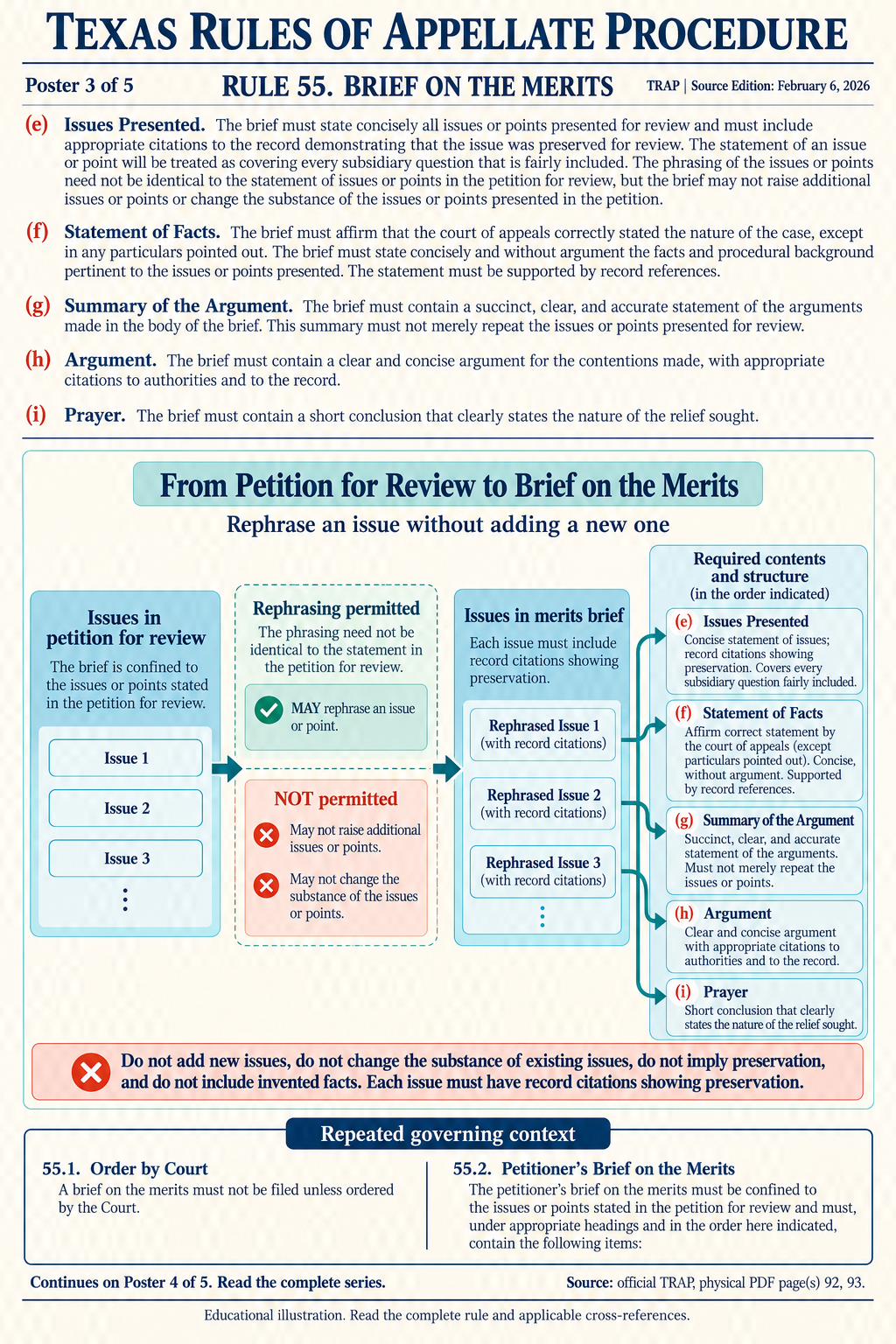
Read assigned text for Rule 55 poster 3
Assigned rule text
(e) Issues Presented. The brief must state concisely all issues or points presented for review and must include appropriate citations to the record demonstrating that the issue was preserved for review. The statement of an issue or point will be treated as covering every subsidiary question that is fairly included. The phrasing of the issues or points need not be identical to the statement of issues or points in the petition for review, but the brief may not raise additional issues or points or change the substance of the issues or points presented in the petition.
(f) Statement of Facts. The brief must affirm that the court of appeals correctly stated the nature of the case, except in any particulars pointed out. The brief must state concisely and without argument the facts and procedural background pertinent to the issues or points presented. The statement must be supported by record references.
(g) Summary of the Argument. The brief must contain a succinct, clear, and accurate statement of the arguments made in the body of the brief. This summary must not merely repeat the issues or points presented for review.
(h) Argument. The brief must contain a clear and concise argument for the contentions made, with appropriate citations to authorities and to the record.
(i) Prayer. The brief must contain a short conclusion that clearly states the nature of the relief sought.
Repeated governing context
55.1. Order by Court A brief on the merits must not be filed unless ordered by the Court.
55.2. Petitioner's Brief on the Merits The petitioner’s brief on the merits must be confined to the issues or points stated in the petition for review and must, under appropriate headings and in the order here indicated, contain the following items:
Continued from poster 2 of 5. Continues on poster 4 of 5. Read the complete series with the official rulebook.
Rule 55. Brief On The Merits — poster 4Poster 4 of 5
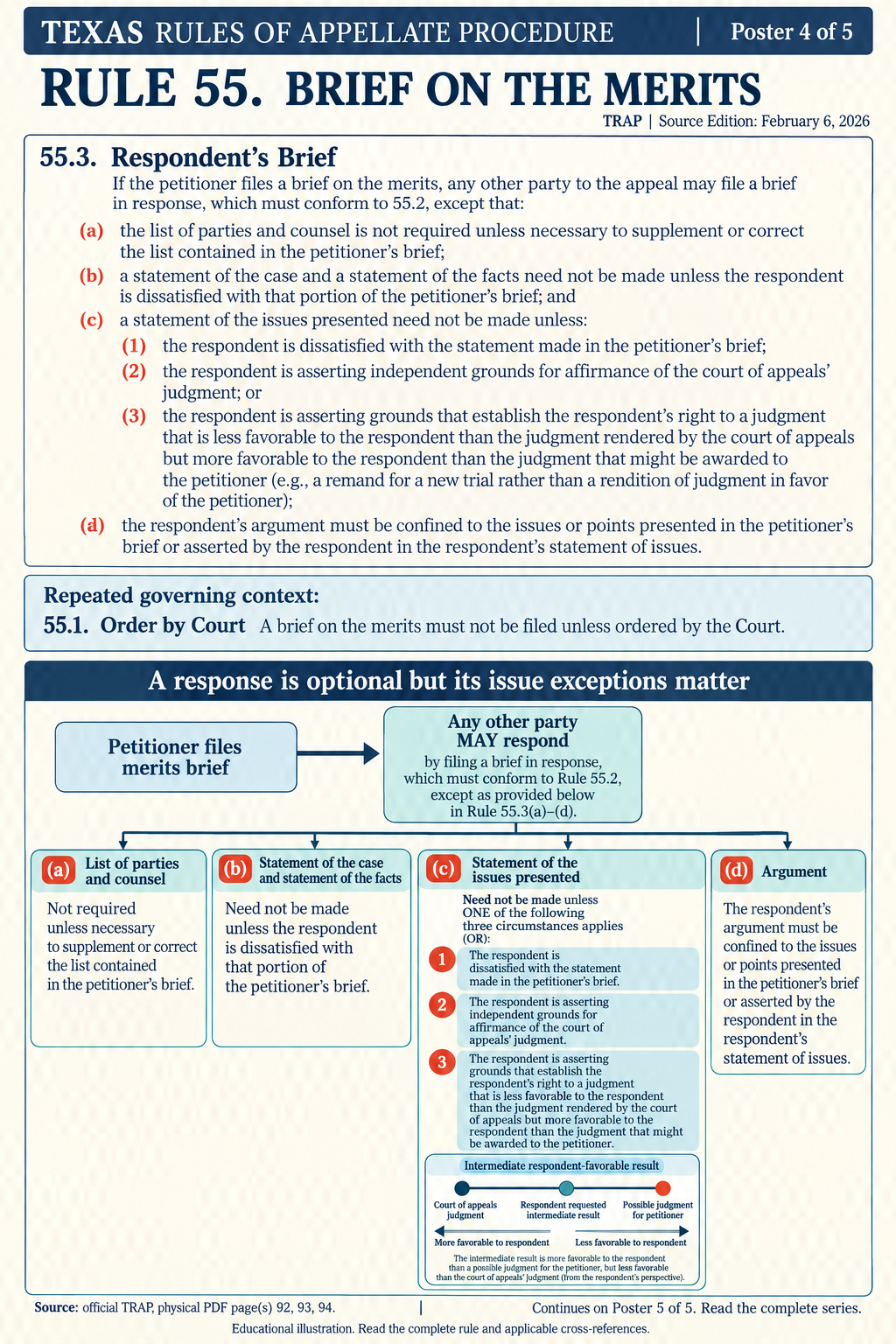
Read assigned text for Rule 55 poster 4
Assigned rule text
55.3. Respondent’s Brief If the petitioner files a brief on the merits, any other party to the appeal may file a brief in response, which must conform to 55.2, except that:
(a) the list of parties and counsel is not required unless necessary to supplement or correct the list contained in the petitioner's brief;
(b) a statement of the case and a statement of the facts need not be made unless the respondent is dissatisfied with that portion of the petitioner's brief; and
(c) a statement of the issues presented need not be made unless:
(1) the respondent is dissatisfied with the statement made in the petitioner's brief;
(2) the respondent is asserting independent grounds for affirmance of the court of appeals' judgment; or
(3) the respondent is asserting grounds that establish the respondent's right to a judgment that is less favorable to the respondent than the judgment rendered by the court of appeals but more favorable to the respondent than the judgment that might be awarded to the petitioner (e.g., a remand for a new trial rather than a rendition of judgment in favor of the petitioner);
(d) the respondent’s argument must be confined to the issues or points presented in the petitioner's brief or asserted by the respondent in the respondent’s statement of issues.
Repeated governing context
55.1. Order by Court A brief on the merits must not be filed unless ordered by the Court.
Continued from poster 3 of 5. Continues on poster 5 of 5. Read the complete series with the official rulebook.
Rule 55. Brief On The Merits — poster 5Poster 5 of 5
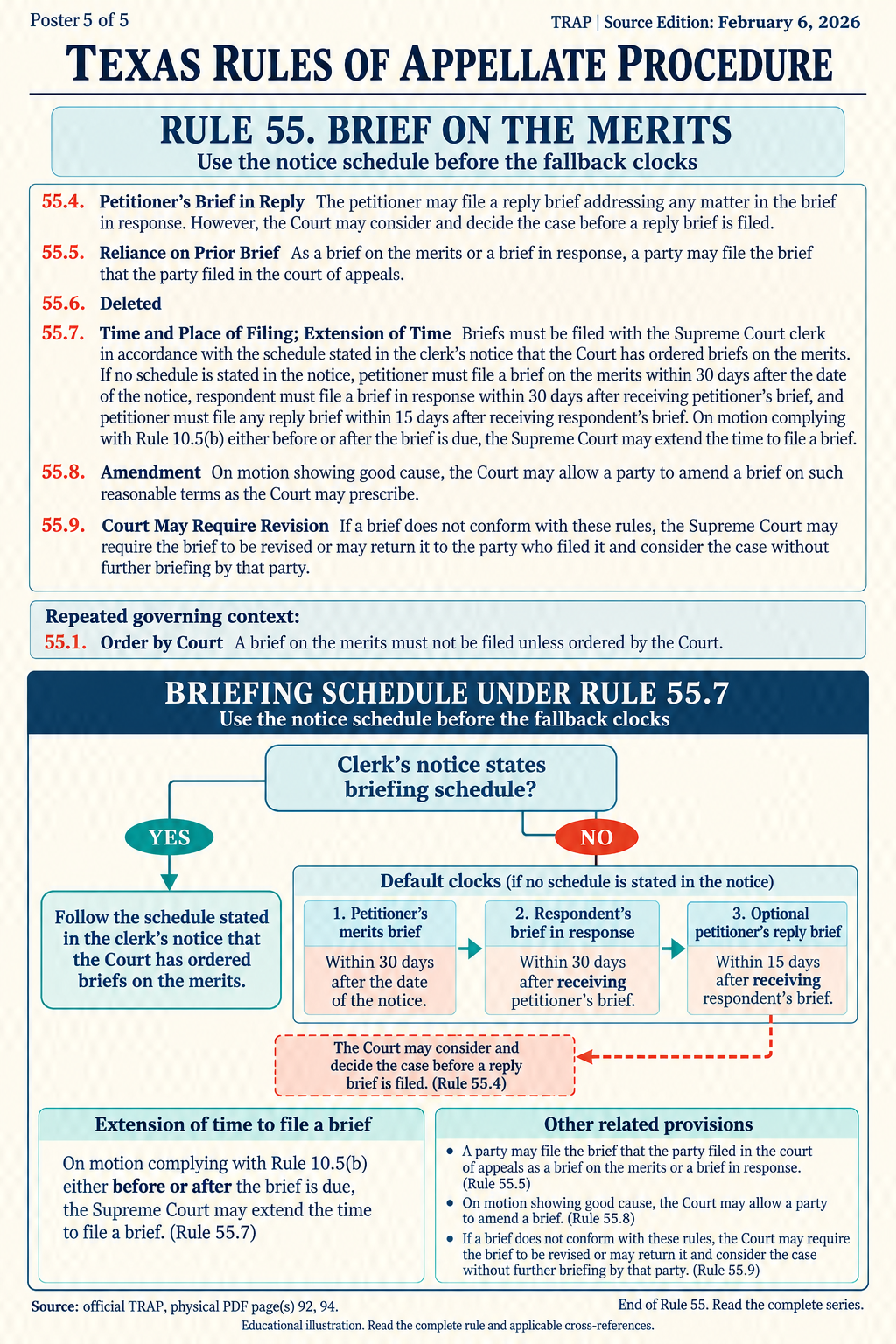
Read assigned text for Rule 55 poster 5
Assigned rule text
55.4. Petitioner’s Brief in Reply The petitioner may file a reply brief addressing any matter in the brief in response. However, the Court may consider and decide the case before a reply brief is filed.
55.5. Reliance on Prior Brief As a brief on the merits or a brief in response, a party may file the brief that the party filed in the court of appeals.
55.6. Deleted
55.7. Time and Place of Filing; Extension of Time Briefs must be filed with the Supreme Court clerk in accordance with the schedule stated in the clerk’s notice that the Court has ordered briefs on the merits. If no schedule is stated in the notice, petitioner must file a brief on the merits within 30 days after the date of the notice, respondent must file a brief in response within 30 days after receiving petitioner’s brief, and petitioner must file any reply brief within 15 days after receiving respondent’s brief. On motion complying with Rule 10.5(b) either before or after the brief is due, the Supreme Court may extend the time to file a brief.
55.8. Amendment On motion showing good cause, the Court may allow a party to amend a brief on such reasonable terms as the Court may prescribe.
55.9. Court May Require Revision If a brief does not conform with these rules, the Supreme Court may require the brief to be revised or may return it to the party who filed it and consider the case without further briefing by that party.
Repeated governing context
55.1. Order by Court A brief on the merits must not be filed unless ordered by the Court.
Continued from poster 4 of 5. Read the complete series with the official rulebook.
Rule 56. Orders On Petition For Review
Rule 56. Orders On Petition For Review — poster 1Poster 1 of 4
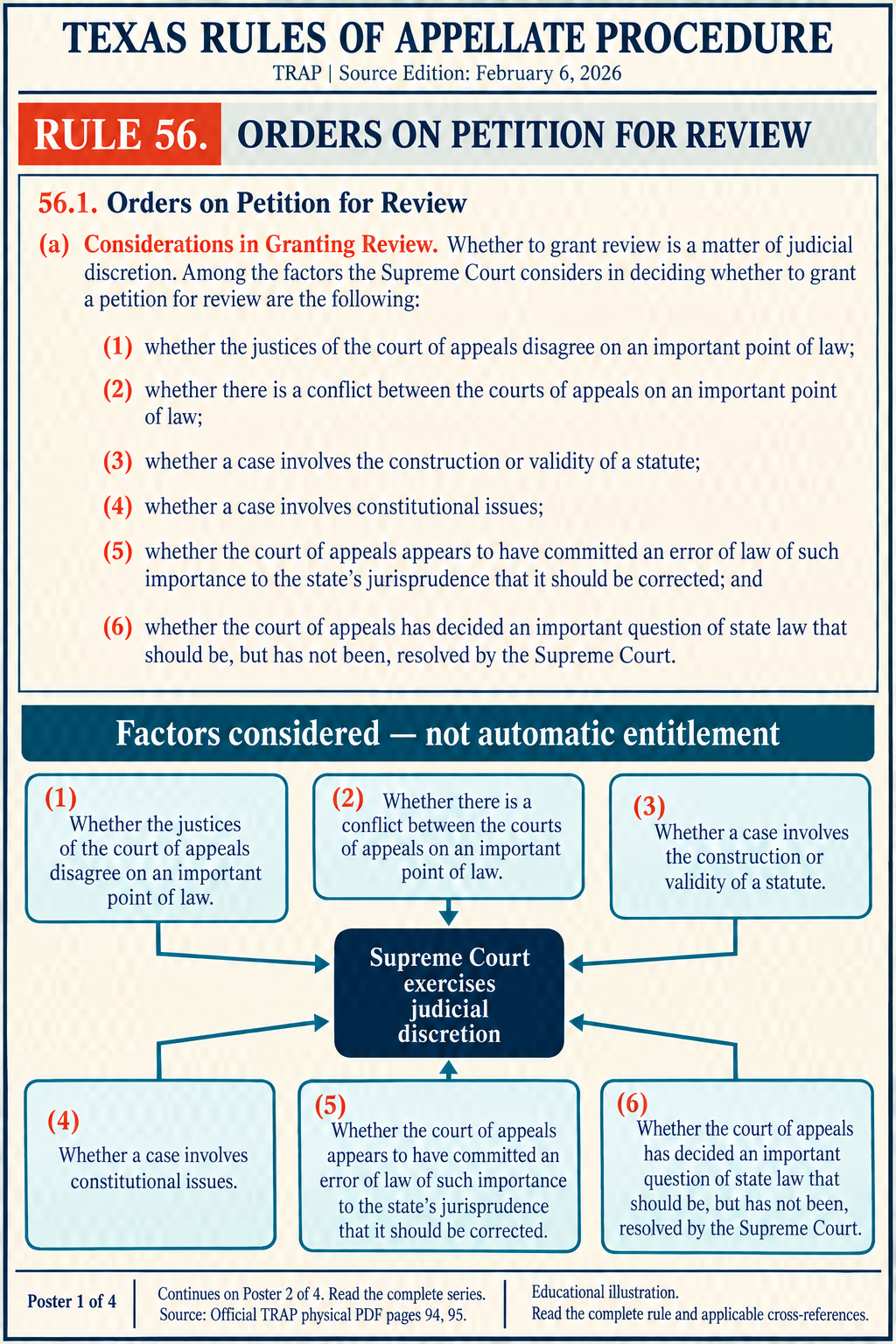
Read assigned text for Rule 56 poster 1
Assigned rule text
56.1. Orders on Petition for Review
(a) Considerations in Granting Review. Whether to grant review is a matter of judicial discretion. Among the factors the Supreme Court considers in deciding whether to grant a petition for review are the following:
(1) whether the justices of the court of appeals disagree on an important point of law;
(2) whether there is a conflict between the courts of appeals on an important point of law;
(3) whether a case involves the construction or validity of a statute;
(4) whether a case involves constitutional issues;
(5) whether the court of appeals appears to have committed an error of law of such importance to the state’s jurisprudence that it should be corrected; and
(6) whether the court of appeals has decided an important question of state law that should be, but has not been, resolved by the Supreme Court.
Continues on poster 2 of 4. Read the complete series with the official rulebook.
Rule 56. Orders On Petition For Review — poster 2Poster 2 of 4
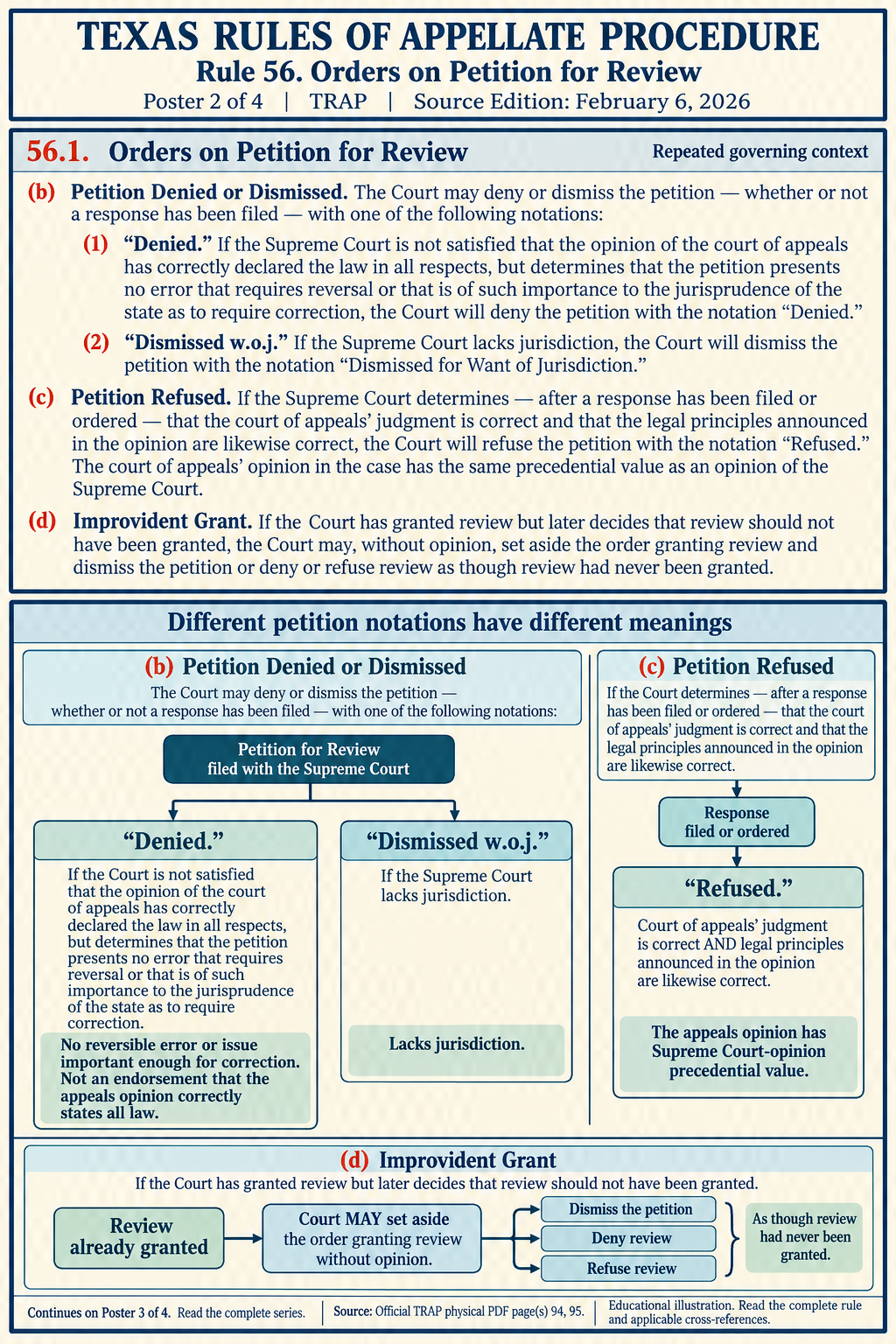
Read assigned text for Rule 56 poster 2
Assigned rule text
(b) Petition Denied or Dismissed. The Court may deny or dismiss the petition — whether or not a response has been filed — with one of the following notations:
(1) “Denied.” If the Supreme Court is not satisfied that the opinion of the court of appeals has correctly declared the law in all respects, but determines that the petition presents no error that requires reversal or that is of such importance to the jurisprudence of the state as to require correction, the Court will deny the petition with the notation “Denied.”
(2) “Dismissed w.o.j.” If the Supreme Court lacks jurisdiction, the Court will dismiss the petition with the notation “Dismissed for Want of Jurisdiction.”
(c) Petition Refused. If the Supreme Court determines — after a response has been filed or ordered — that the court of appeals’ judgment is correct and that the legal principles announced in the opinion are likewise correct, the Court will refuse the petition with the notation “Refused.” The court of appeals’ opinion in the case has the same precedential value as an opinion of the Supreme Court.
(d) Improvident Grant. If the Court has granted review but later decides that review should not have been granted, the Court may, without opinion, set aside the order granting review and dismiss the petition or deny or refuse review as though review had never been granted.
Repeated governing context
56.1. Orders on Petition for Review
Continued from poster 1 of 4. Continues on poster 3 of 4. Read the complete series with the official rulebook.
Rule 56. Orders On Petition For Review — poster 3Poster 3 of 4
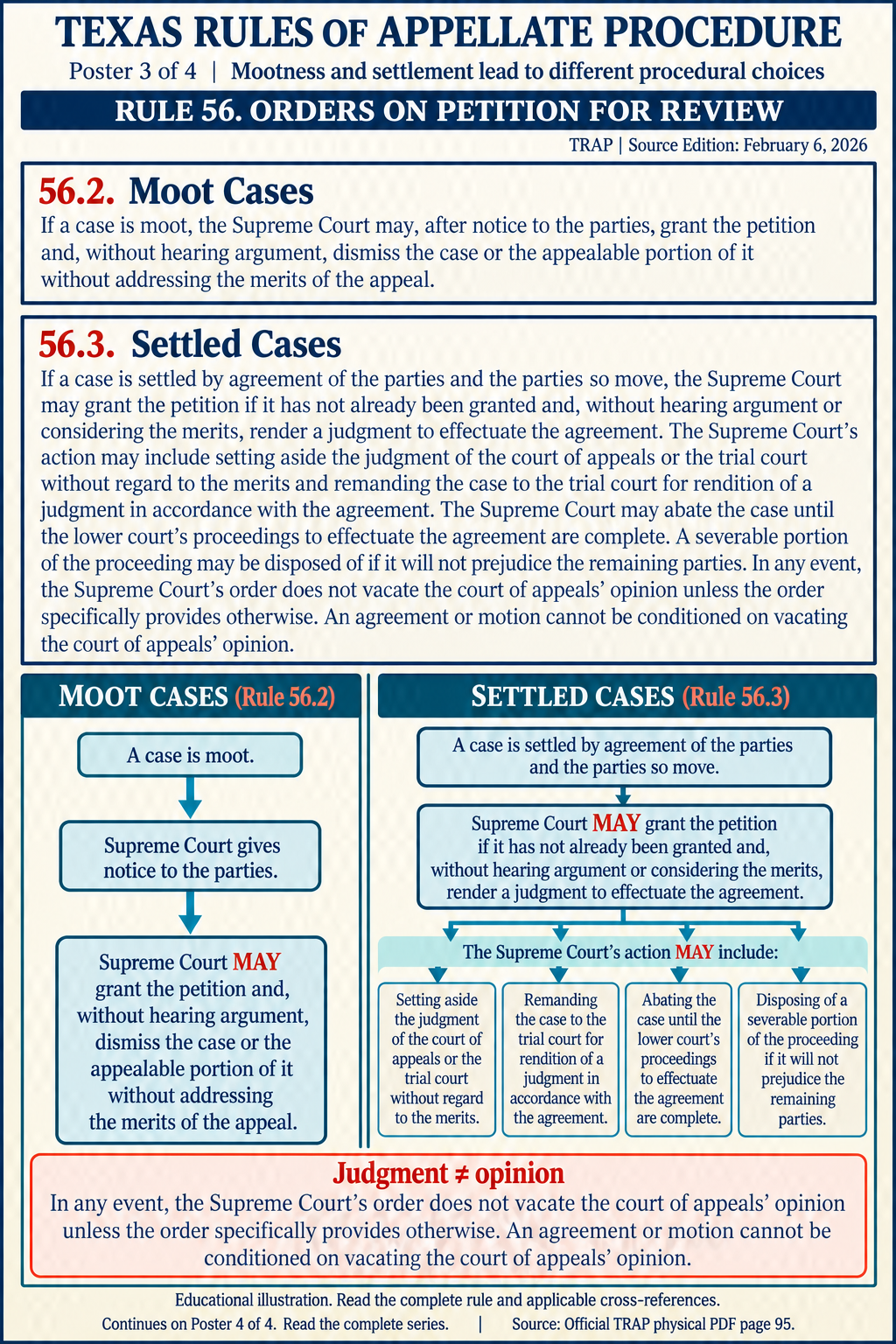
Read assigned text for Rule 56 poster 3
Assigned rule text
56.2. Moot Cases If a case is moot, the Supreme Court may, after notice to the parties, grant the petition and, without hearing argument, dismiss the case or the appealable portion of it without addressing the merits of the appeal.
56.3. Settled Cases If a case is settled by agreement of the parties and the parties so move, the Supreme Court may grant the petition if it has not already been granted and, without hearing argument or considering the merits, render a judgment to effectuate the agreement. The Supreme Court's action may include setting aside the judgment of the court of appeals or the trial court without regard to the merits and remanding the case to the trial court for rendition of a judgment in accordance with the agreement. The Supreme Court may abate the case until the lower court’s proceedings to effectuate the agreement are complete. A severable portion of the proceeding may be disposed of if it will not prejudice the remaining parties. In any event, the Supreme Court's order does not vacate the court of appeals' opinion unless the order specifically provides otherwise. An agreement or motion cannot be conditioned on vacating the court of appeals’ opinion.
Continued from poster 2 of 4. Continues on poster 4 of 4. Read the complete series with the official rulebook.
Rule 56. Orders On Petition For Review — poster 4Poster 4 of 4
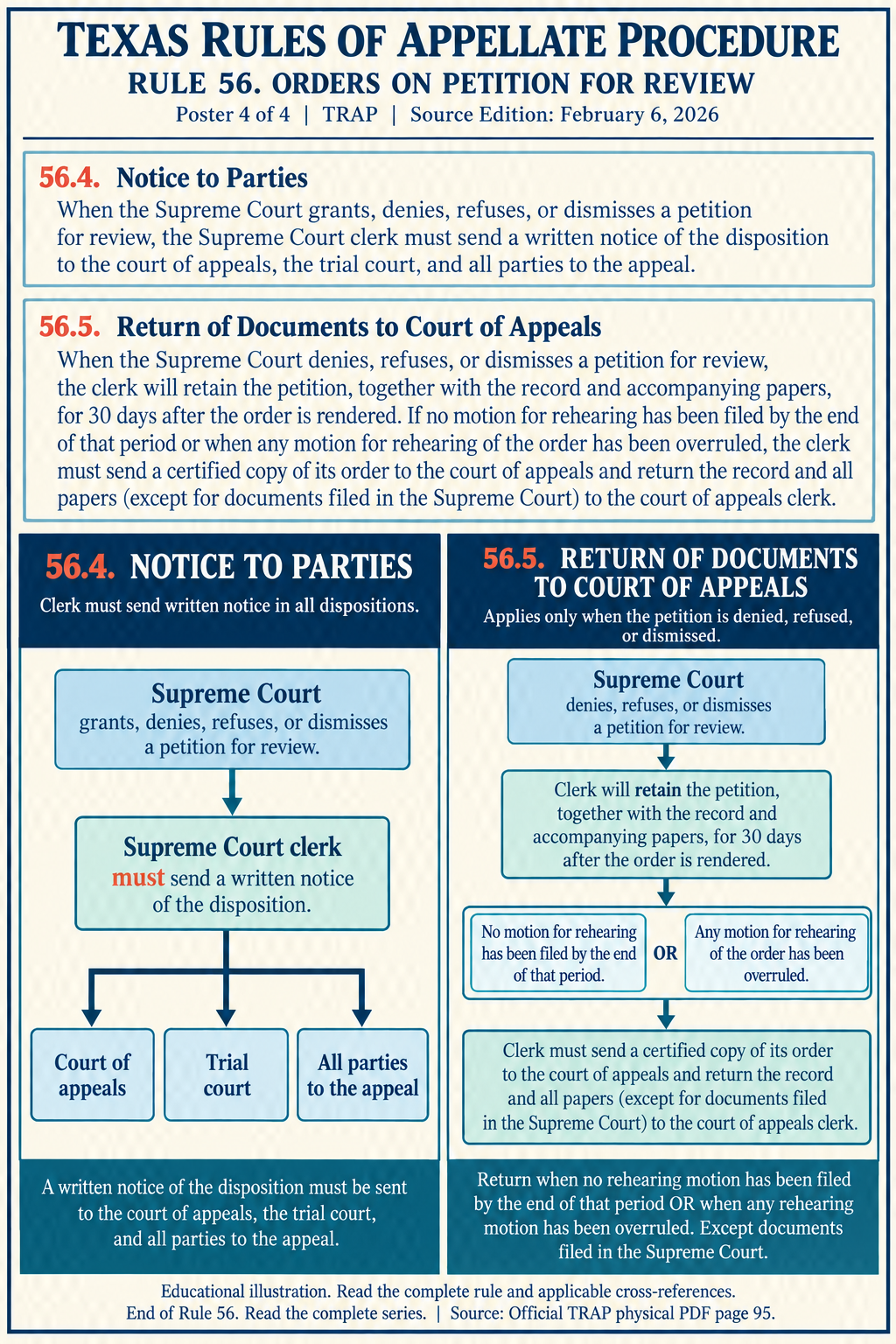
Read assigned text for Rule 56 poster 4
Assigned rule text
56.4. Notice to Parties When the Supreme Court grants, denies, refuses, or dismisses a petition for review, the Supreme Court clerk must send a written notice of the disposition to the court of appeals, the trial court, and all parties to the appeal.
56.5. Return of Documents to Court of Appeals When the Supreme Court denies, refuses, or dismisses a petition for review, the clerk will retain the petition, together with the record and accompanying papers, for 30 days after the order is rendered. If no motion for rehearing has been filed by the end of that period or when any motion for rehearing of the order has been overruled, the clerk must send a certified copy of its order to the court of appeals and return the record and all papers (except for documents filed in the Supreme Court) to the court of appeals clerk.
Continued from poster 3 of 4. Read the complete series with the official rulebook.
Rule 57. Direct Appeals To The Supreme Court
Rule 57. Direct Appeals To The Supreme Court — poster 1Poster 1 of 4
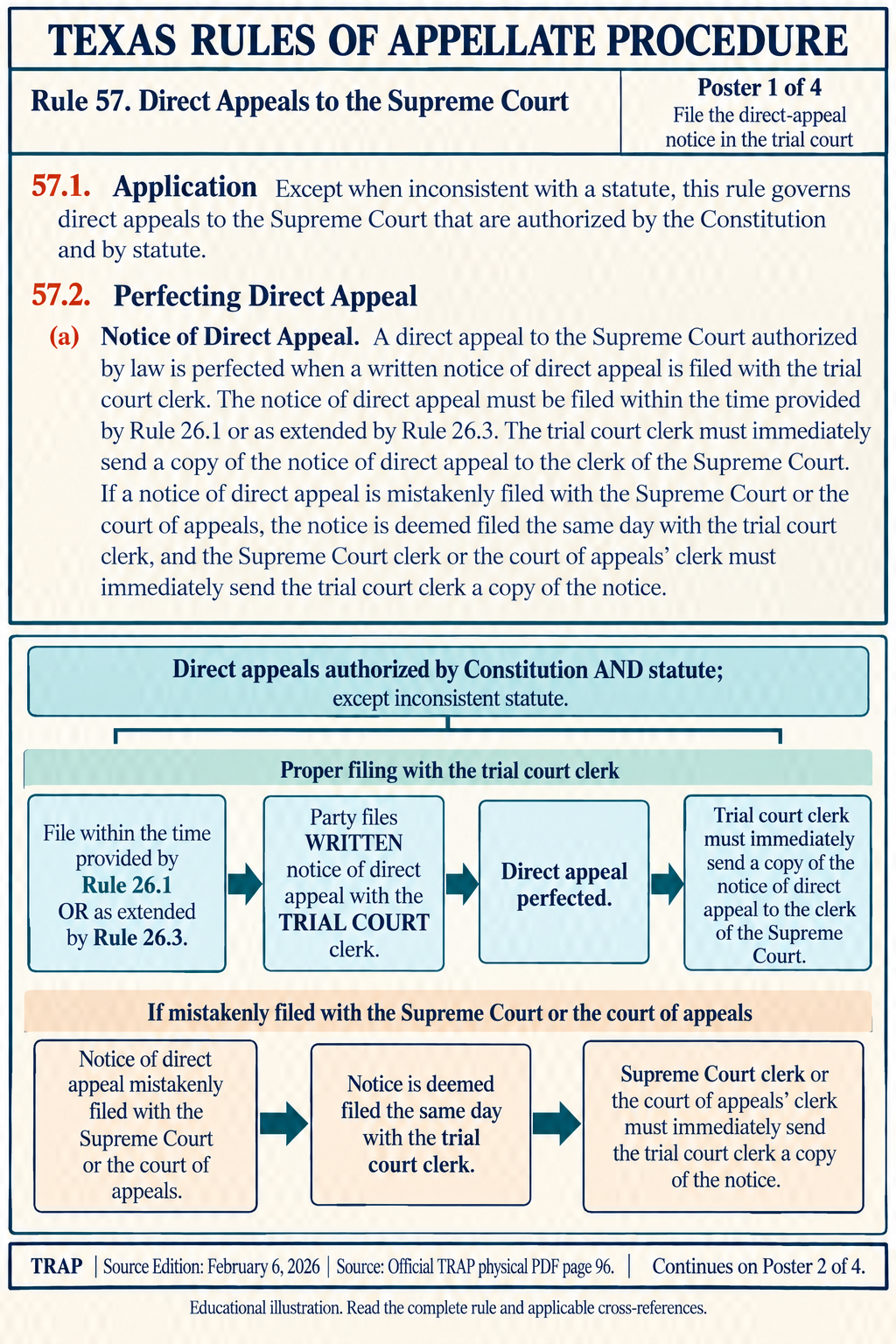
Read assigned text for Rule 57 poster 1
Assigned rule text
57.1. Application Except when inconsistent with a statute, this rule governs direct appeals to the Supreme Court that are authorized by the Constitution and by statute.
57.2. Perfecting Direct Appeal
(a) Notice of Direct Appeal. A direct appeal to the Supreme Court authorized by law is perfected when a written notice of direct appeal is filed with the trial court clerk. The notice of direct appeal must be filed within the time provided by Rule 26.1 or as extended by Rule 26.3. The trial court clerk must immediately send a copy of the notice of direct appeal to the clerk of the Supreme Court. If a notice of direct appeal is mistakenly filed with the Supreme Court or the court of appeals, the notice is deemed filed the same day with the trial court clerk, and the Supreme Court clerk or the court of appeals’ clerk must immediately send the trial court clerk a copy of the notice.
Continues on poster 2 of 4. Read the complete series with the official rulebook.
Rule 57. Direct Appeals To The Supreme Court — poster 2Poster 2 of 4
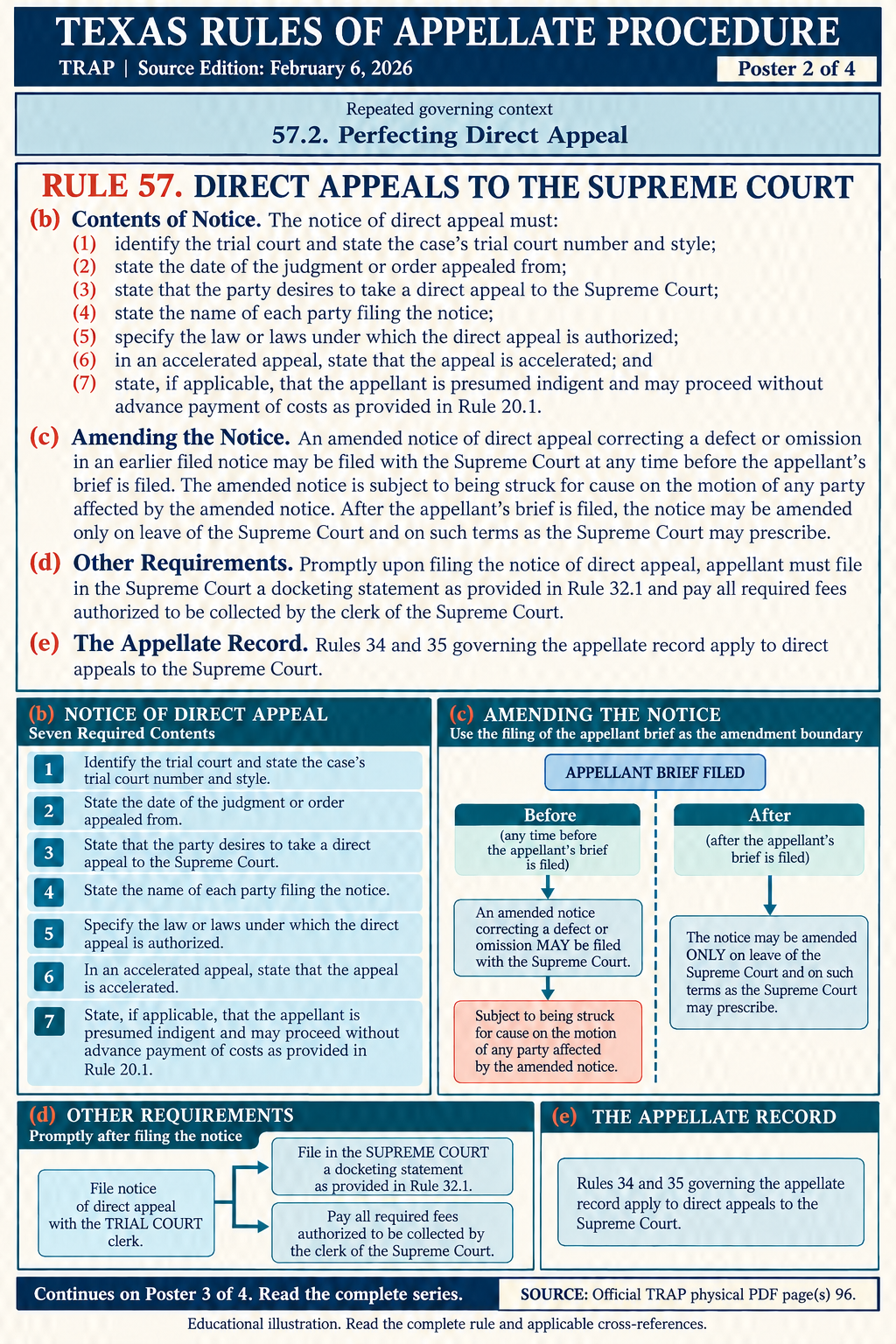
Read assigned text for Rule 57 poster 2
Assigned rule text
(b) Contents of Notice. The notice of direct appeal must:
(1) identify the trial court and state the case’s trial court number and style;
(2) state the date of the judgment or order appealed from;
(3) state that the party desires to take a direct appeal to the Supreme Court;
(4) state the name of each party filing the notice;
(5) specify the law or laws under which the direct appeal is authorized;
(6) in an accelerated appeal, state that the appeal is accelerated; and
(7) state, if applicable, that the appellant is presumed indigent and may proceed without advance payment of costs as provided in Rule 20.1.
(c) Amending the Notice. An amended notice of direct appeal correcting a defect or omission in an earlier filed notice may be filed with the Supreme Court at any time before the appellant’s brief is filed. The amended notice is subject to being struck for cause on the motion of any party affected by the amended notice. After the appellant’s brief is filed, the notice may be amended only on leave of the Supreme Court and on such terms as the Supreme Court may prescribe.
(d) Other Requirements. Promptly upon filing the notice of direct appeal, appellant must file in the Supreme Court a docketing statement as provided in Rule 32.1 and pay all required fees authorized to be collected by the clerk of the Supreme Court.
(e) The Appellate Record. Rules 34 and 35 governing the appellate record apply to direct appeals to the Supreme Court.
Repeated governing context
57.2. Perfecting Direct Appeal
Continued from poster 1 of 4. Continues on poster 3 of 4. Read the complete series with the official rulebook.
Rule 57. Direct Appeals To The Supreme Court — poster 3Poster 3 of 4
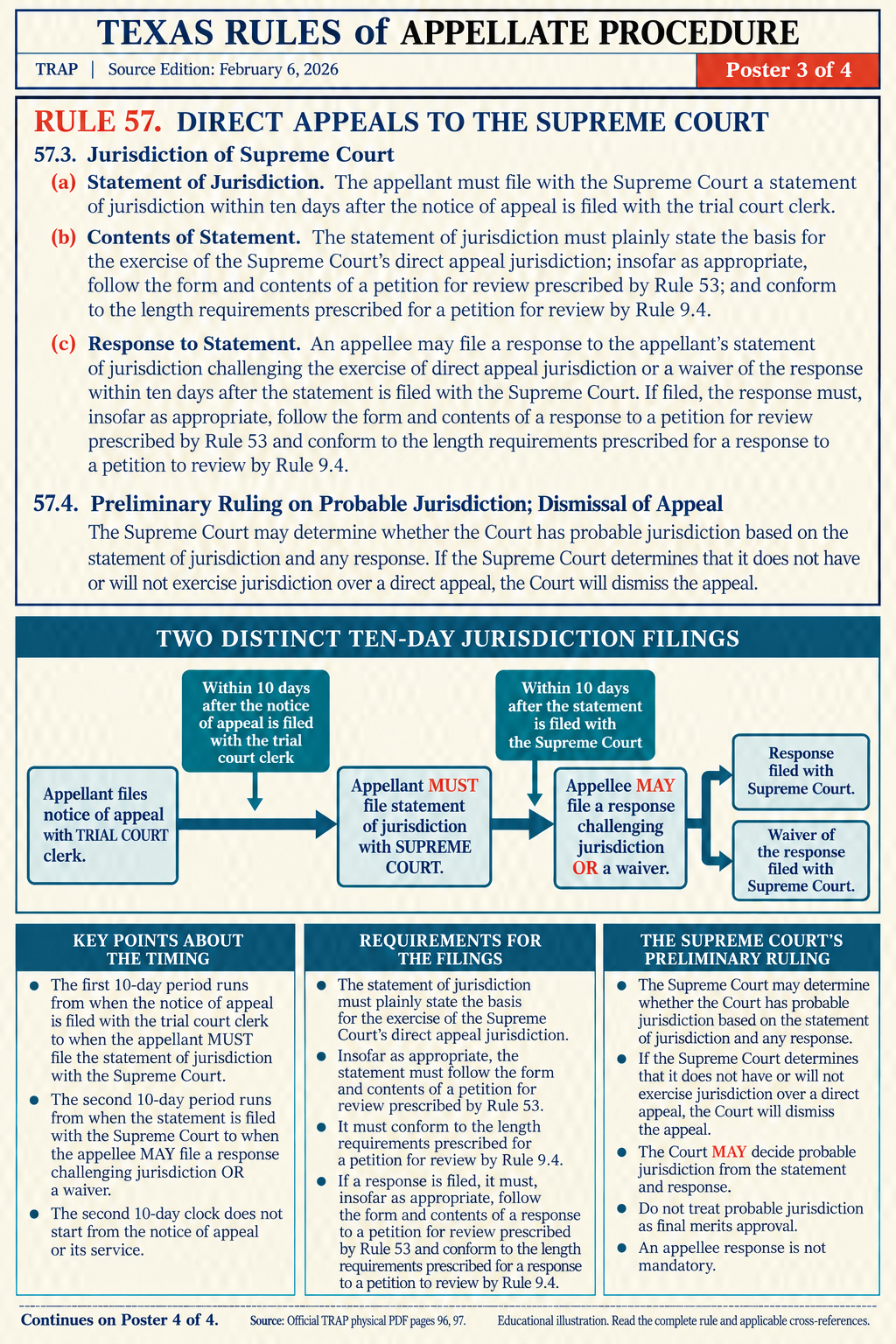
Read assigned text for Rule 57 poster 3
Assigned rule text
57.3. Jurisdiction of Supreme Court
(a) Statement of Jurisdiction. The appellant must file with the Supreme Court a statement of jurisdiction within ten days after the notice of appeal is filed with the trial court clerk.
(b) Contents of Statement. The statement of jurisdiction must plainly state the basis for the exercise of the Supreme Court’s direct appeal jurisdiction; insofar as appropriate, follow the form and contents of a petition for review prescribed by Rule 53; and conform to the length requirements prescribed for a petition for review by Rule 9.4.
(c) Response to Statement. An appellee may file a response to the appellant’s statement of jurisdiction challenging the exercise of direct appeal jurisdiction or a waiver of the response within ten days after the statement is filed with the Supreme Court. If filed, the response must, insofar as appropriate, follow the form and contents of a response to a petition for review prescribed by Rule 53 and conform to the length requirements prescribed for a response to a petition to review by Rule 9.4.
57.4. Preliminary Ruling on Probable Jurisdiction; Dismissal of Appeal The Supreme Court may determine whether the Court has probable jurisdiction based on the statement of jurisdiction and any response. If the Supreme Court determines that it does not have or will not exercise jurisdiction over a direct appeal, the Court will dismiss the appeal.
Continued from poster 2 of 4. Continues on poster 4 of 4. Read the complete series with the official rulebook.
Rule 57. Direct Appeals To The Supreme Court — poster 4Poster 4 of 4
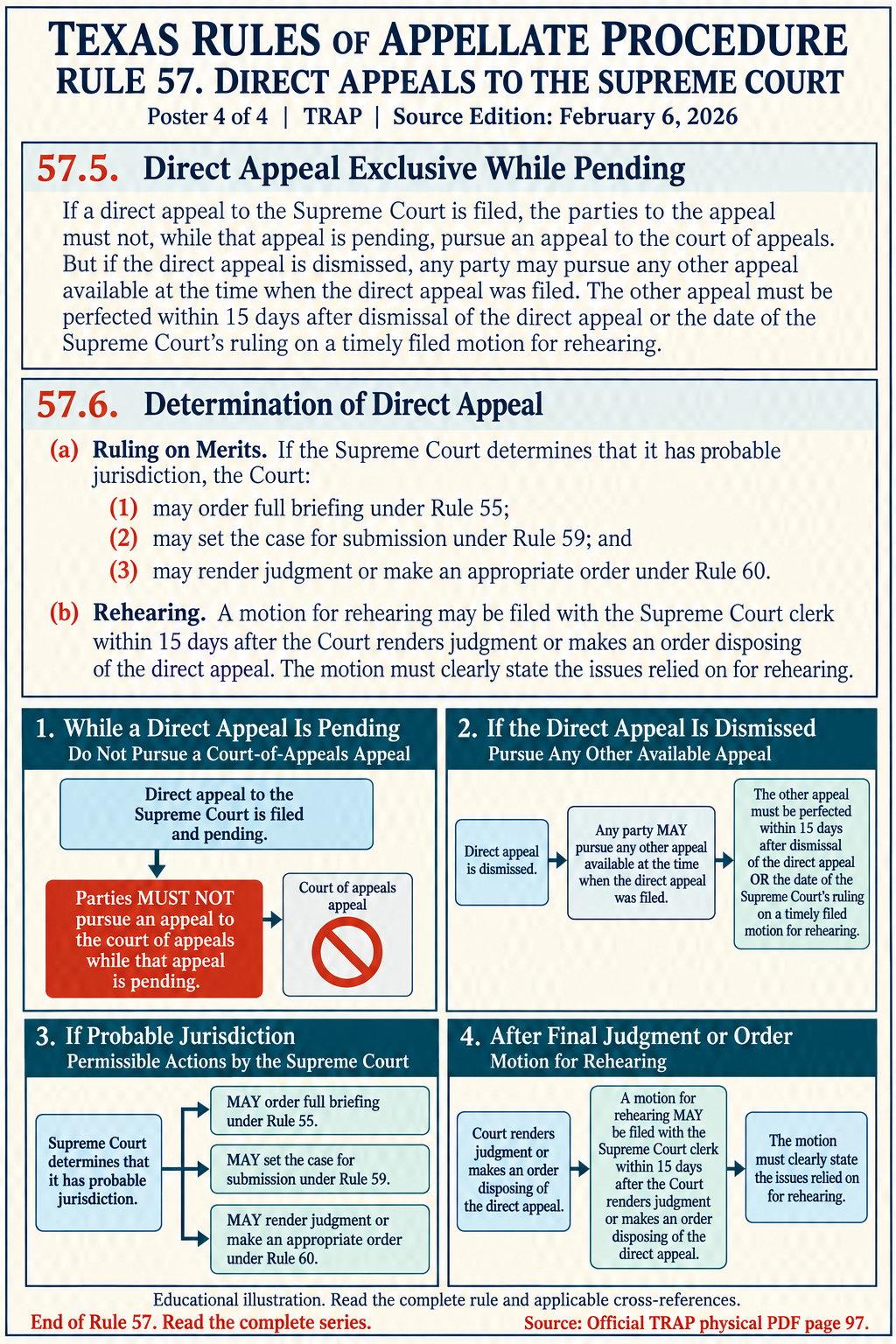
Read assigned text for Rule 57 poster 4
Assigned rule text
57.5. Direct Appeal Exclusive While Pending If a direct appeal to the Supreme Court is filed, the parties to the appeal must not, while that appeal is pending, pursue an appeal to the court of appeals. But if the direct appeal is dismissed, any party may pursue any other appeal available at the time when the direct appeal was filed. The other appeal must be perfected within 15 days after dismissal of the direct appeal or the date of the Supreme Court’s ruling on a timely filed motion for rehearing.
57.6. Determination of Direct Appeal
(a) Ruling on Merits. If the Supreme Court determines that it has probable jurisdiction, the Court:
(1) may order full briefing under Rule 55;
(2) may set the case for submission under Rule 59; and
(3) may render judgment or make an appropriate order under Rule 60.
(b) Rehearing. A motion for rehearing may be filed with the Supreme Court clerk within 15 days after the Court renders judgment or makes an order disposing of the direct appeal. The motion must clearly state the issues relied on for rehearing.
Continued from poster 3 of 4. Read the complete series with the official rulebook.
Rule 58. Certification Of Questions Of Law By United State Courts
Rule 58. Certification Of Questions Of Law By United State Courts — poster 1Poster 1 of 2
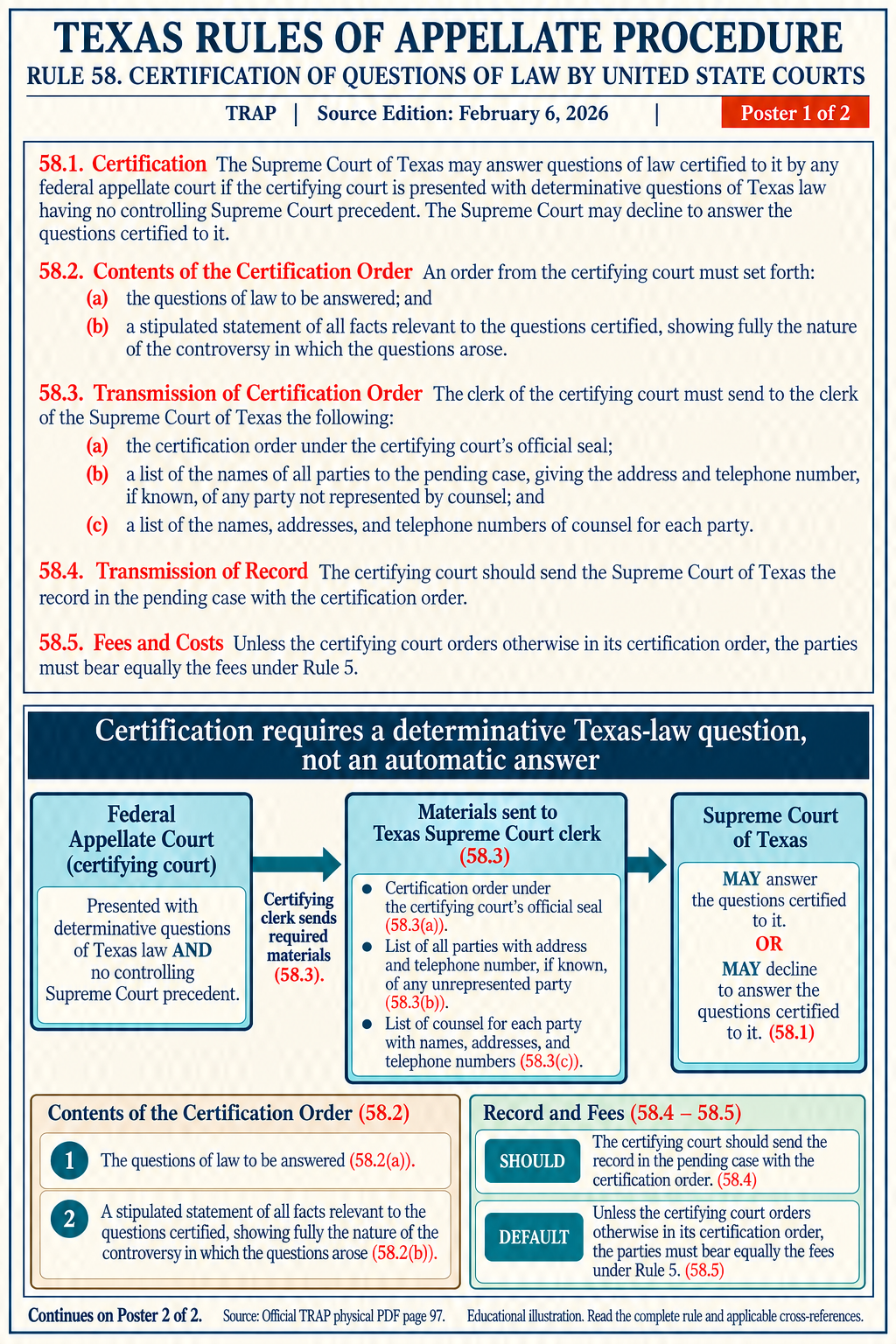
Read assigned text for Rule 58 poster 1
Assigned rule text
58.1. Certification The Supreme Court of Texas may answer questions of law certified to it by any federal appellate court if the certifying court is presented with determinative questions of Texas law having no controlling Supreme Court precedent. The Supreme Court may decline to answer the questions certified to it.
58.2. Contents of the Certification Order An order from the certifying court must set forth:
(a) the questions of law to be answered; and
(b) a stipulated statement of all facts relevant to the questions certified, showing fully the nature of the controversy in which the questions arose.
58.3. Transmission of Certification Order The clerk of the certifying court must send to the clerk of the Supreme Court of Texas the following:
(a) the certification order under the certifying court’s official seal;
(b) a list of the names of all parties to the pending case, giving the address and telephone number, if known, of any party not represented by counsel; and
(c) a list of the names, addresses, and telephone numbers of counsel for each party.
58.4. Transmission of Record The certifying court should send the Supreme Court of Texas the record in the pending case with the certification order.
58.5. Fees and Costs Unless the certifying court orders otherwise in its certification order, the parties must bear equally the fees under Rule 5.
Continues on poster 2 of 2. Read the complete series with the official rulebook.
Rule 58. Certification Of Questions Of Law By United State Courts — poster 2Poster 2 of 2
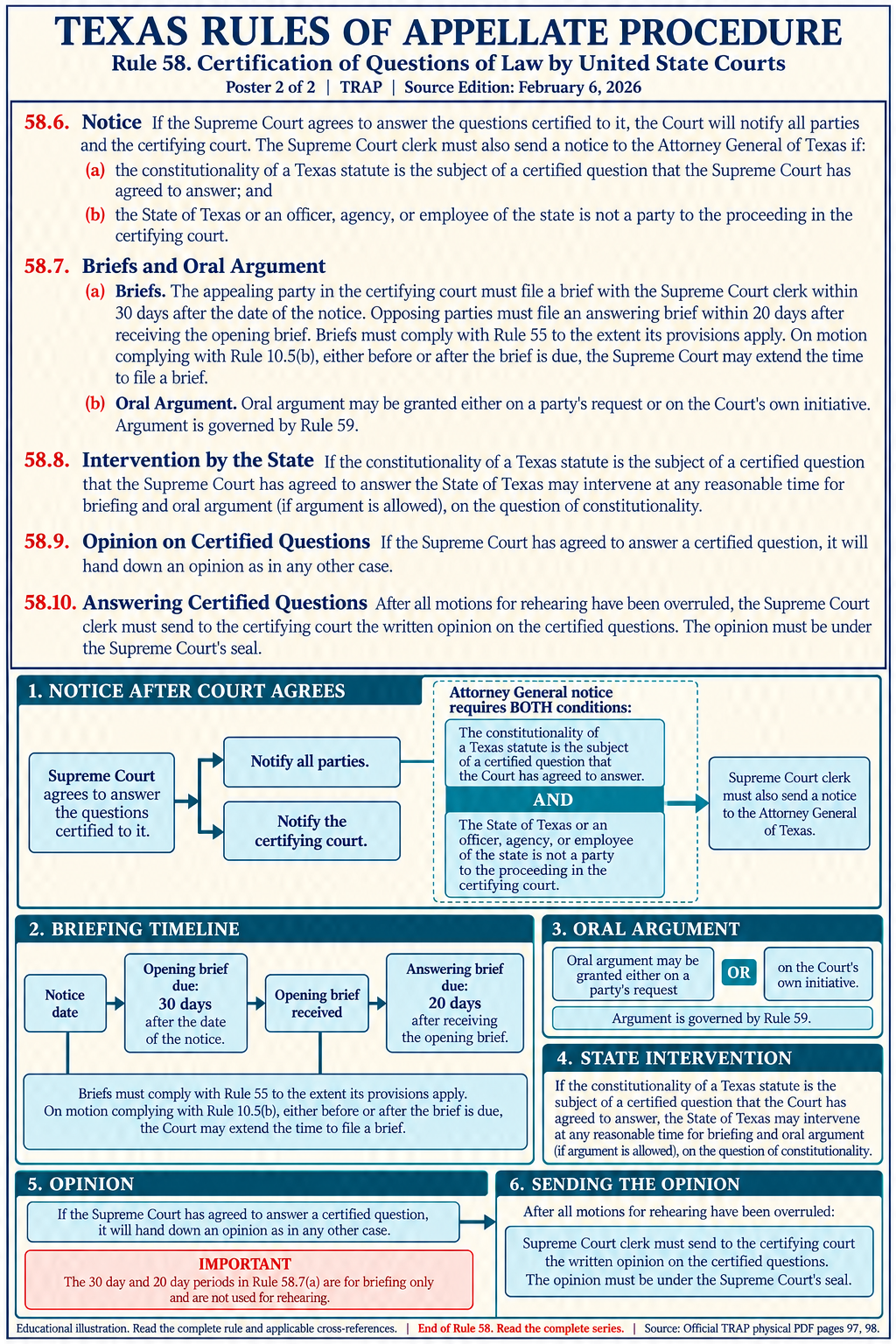
Read assigned text for Rule 58 poster 2
Assigned rule text
58.6. Notice If the Supreme Court agrees to answer the questions certified to it, the Court will notify all parties and the certifying court. The Supreme Court clerk must also send a notice to the Attorney General of Texas if:
(a) the constitutionality of a Texas statute is the subject of a certified question that the Supreme Court has agreed to answer; and
(b) the State of Texas or an officer, agency, or employee of the state is not a party to the proceeding in the certifying court.
58.7. Briefs and Oral Argument
(a) Briefs. The appealing party in the certifying court must file a brief with the Supreme Court clerk within 30 days after the date of the notice. Opposing parties must file an answering brief within 20 days after receiving the opening brief. Briefs must comply with Rule 55 to the extent its provisions apply. On motion complying with Rule 10.5(b), either before or after the brief is due, the Supreme Court may extend the time to file a brief.
(b) Oral Argument. Oral argument may be granted either on a party's request or on the Court's own initiative. Argument is governed by Rule 59.
58.8. Intervention by the State If the constitutionality of a Texas statute is the subject of a certified question that the Supreme Court has agreed to answer the State of Texas may intervene at any reasonable time for briefing and oral argument (if argument is allowed), on the question of constitutionality.
58.9. Opinion on Certified Questions If the Supreme Court has agreed to answer a certified question, it will hand down an opinion as in any other case.
58.10. Answering Certified Questions After all motions for rehearing have been overruled, the Supreme Court clerk must send to the certifying court the written opinion on the certified questions. The opinion must be under the Supreme Court's seal.
Continued from poster 1 of 2. Read the complete series with the official rulebook.
Rule 59. Submission And Argument
Rule 59. Submission And Argument — poster 1Poster 1 of 1
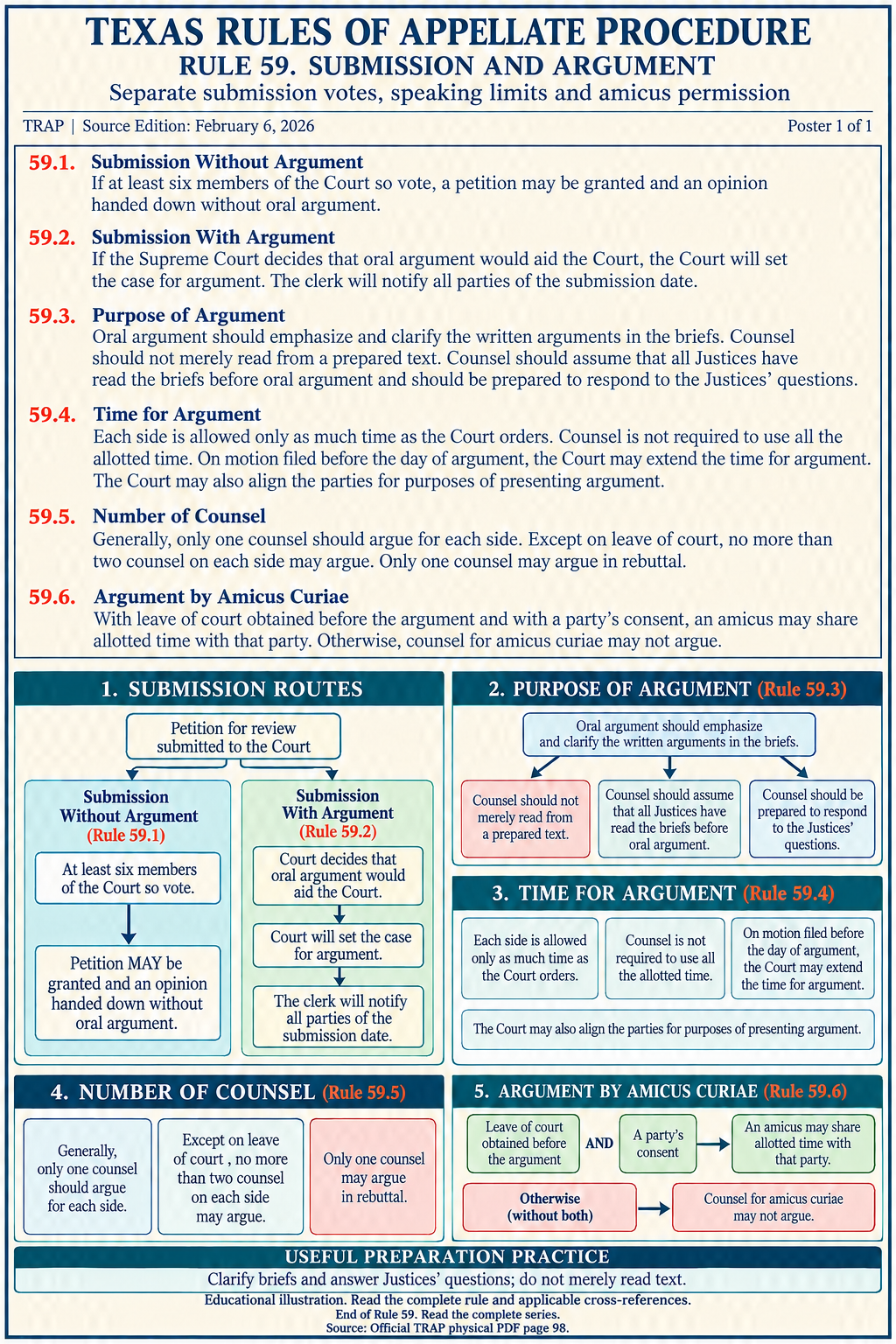
Read assigned text for Rule 59 poster 1
Assigned rule text
59.1. Submission Without Argument If at least six members of the Court so vote, a petition may be granted and an opinion handed down without oral argument.
59.2. Submission With Argument If the Supreme Court decides that oral argument would aid the Court, the Court will set the case for argument. The clerk will notify all parties of the submission date.
59.3. Purpose of Argument Oral argument should emphasize and clarify the written arguments in the briefs. Counsel should not merely read from a prepared text. Counsel should assume that all Justices have read the briefs before oral argument and should be prepared to respond to the Justices’ questions.
59.4. Time for Argument Each side is allowed only as much time as the Court orders. Counsel is not required to use all the allotted time. On motion filed before the day of argument, the Court may extend the time for argument. The Court may also align the parties for purposes of presenting argument.
59.5. Number of Counsel Generally, only one counsel should argue for each side. Except on leave of court , no more than two counsel on each side may argue. Only one counsel may argue in rebuttal.
59.6. Argument by Amicus Curiae With leave of court obtained before the argument and with a party's consent, an amicus may share allotted time with that party. Otherwise, counsel for amicus curiae may not argue.
Read the complete series with the official rulebook.
Rule 60. Judgments In The Supreme Court
Rule 60. Judgments In The Supreme Court — poster 1Poster 1 of 2
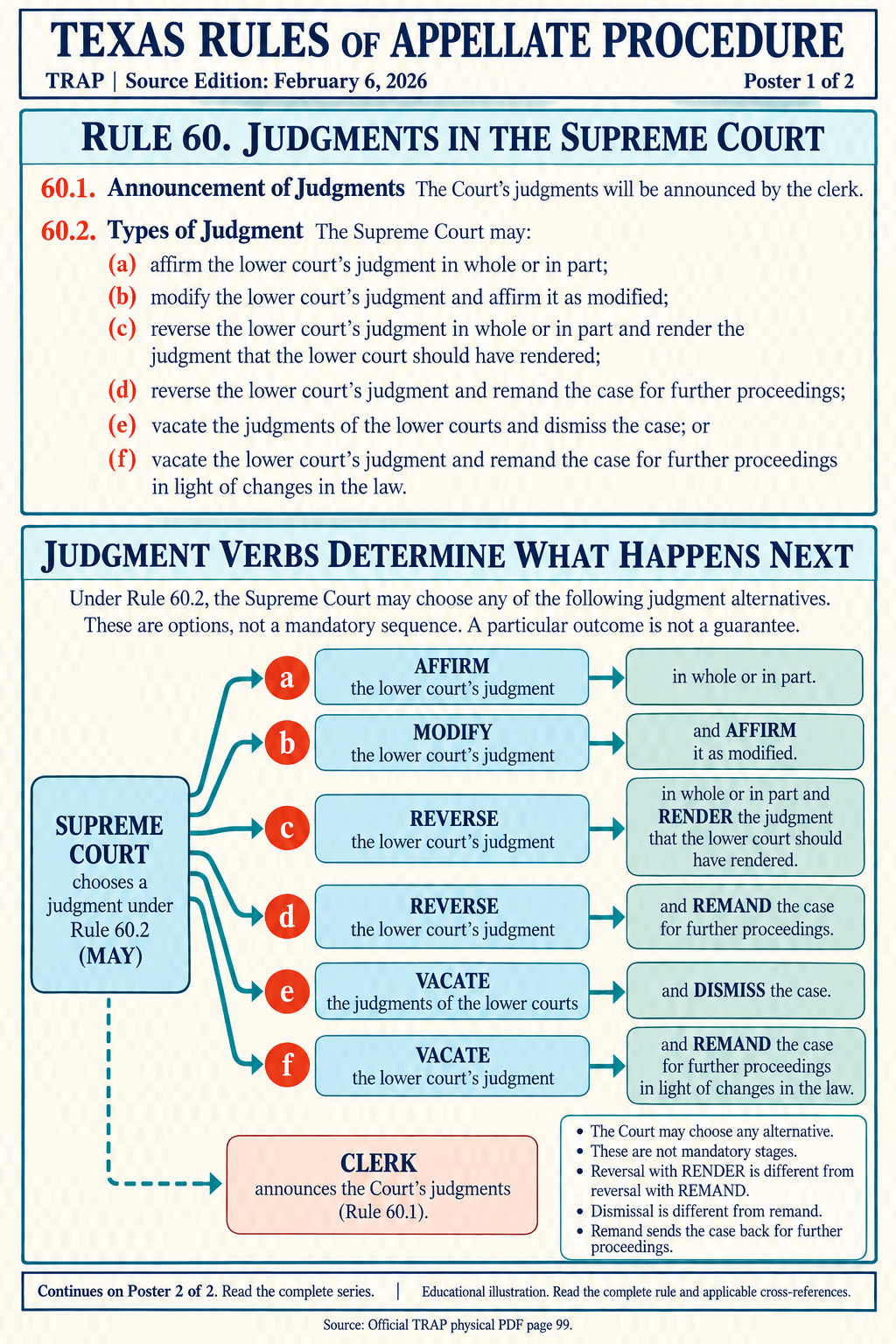
Read assigned text for Rule 60 poster 1
Assigned rule text
60.1. Announcement of Judgments The Court's judgments will be announced by the clerk.
60.2. Types of Judgment The Supreme Court may:
(a) affirm the lower court’s judgment in whole or in part;
(b) modify the lower court’s judgment and affirm it as modified;
(c) reverse the lower court’s judgment in whole or in part and render the judgment that the lower court should have rendered;
(d) reverse the lower court’s judgment and remand the case for further proceedings;
(e) vacate the judgments of the lower courts and dismiss the case; or
(f) vacate the lower court’s judgment and remand the case for further proceedings in light of changes in the law.
Continues on poster 2 of 2. Read the complete series with the official rulebook.
Rule 60. Judgments In The Supreme Court — poster 2Poster 2 of 2
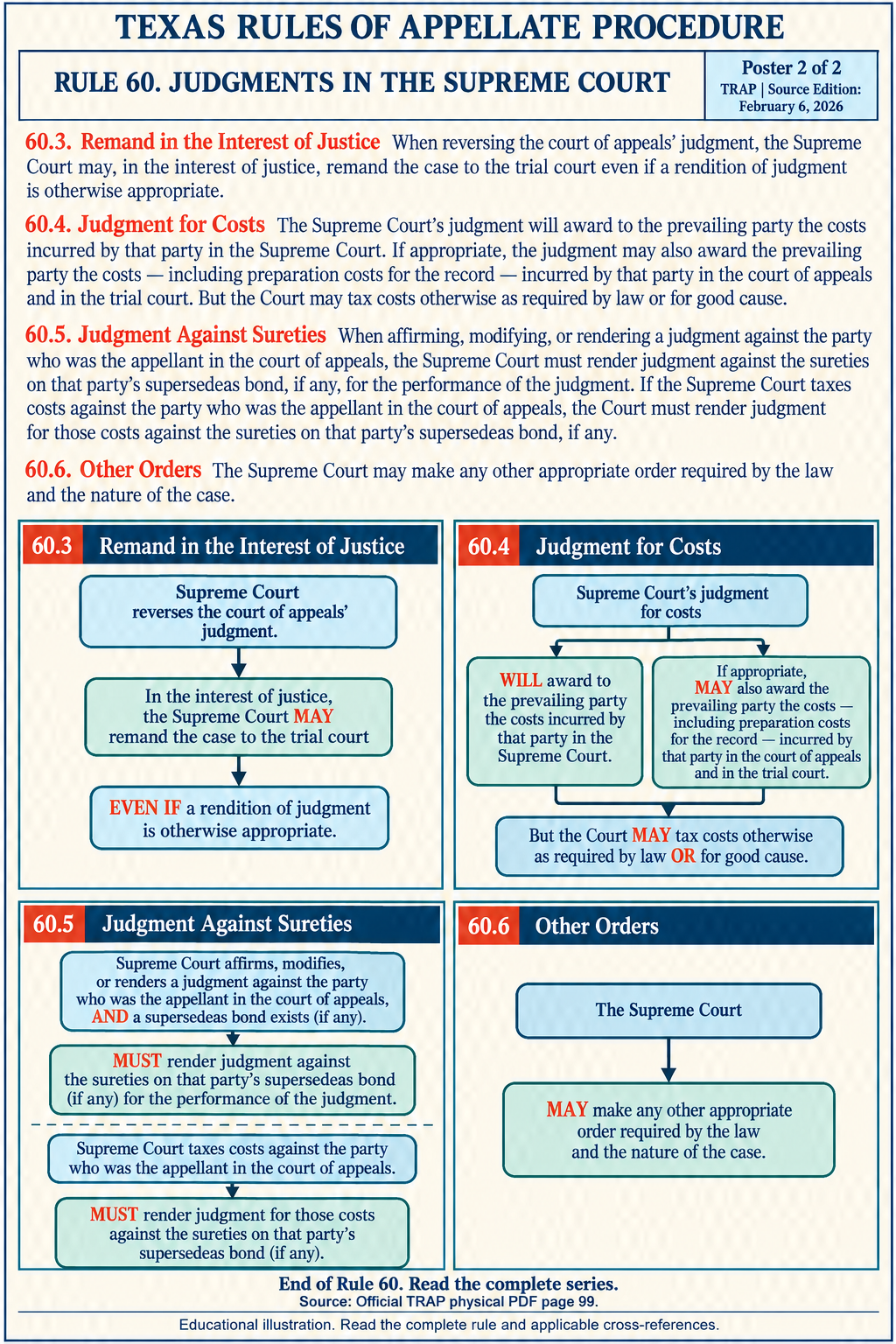
Read assigned text for Rule 60 poster 2
Assigned rule text
60.3. Remand in the Interest of Justice When reversing the court of appeals' judgment, the Supreme Court may, in the interest of justice, remand the case to the trial court even if a rendition of judgment is otherwise appropriate.
60.4. Judgment for Costs The Supreme Court’s judgment will award to the prevailing party the costs incurred by that party in the Supreme Court. If appropriate, the judgment may also award the prevailing party the costs — including preparation costs for the record — incurred by that party in the court of appeals and in the trial court. But the Court may tax costs otherwise as required by law or for good cause.
60.5. Judgment Against Sureties When affirming, modifying, or rendering a judgment against the party who was the appellant in the court of appeals, the Supreme Court must render judgment against the sureties on that party's supersedeas bond, if any, for the performance of the judgment. If the Supreme Court taxes costs against the party who was the appellant in the court of appeals, the Court must render judgment for those costs against the sureties on that party's supersedeas bond, if any.
60.6. Other Orders The Supreme Court may make any other appropriate order required by the law and the nature of the case.
Continued from poster 1 of 2. Read the complete series with the official rulebook.
FEES IN CIVIL CASES
FEES IN CIVIL CASES — poster 1Poster 1 of 1
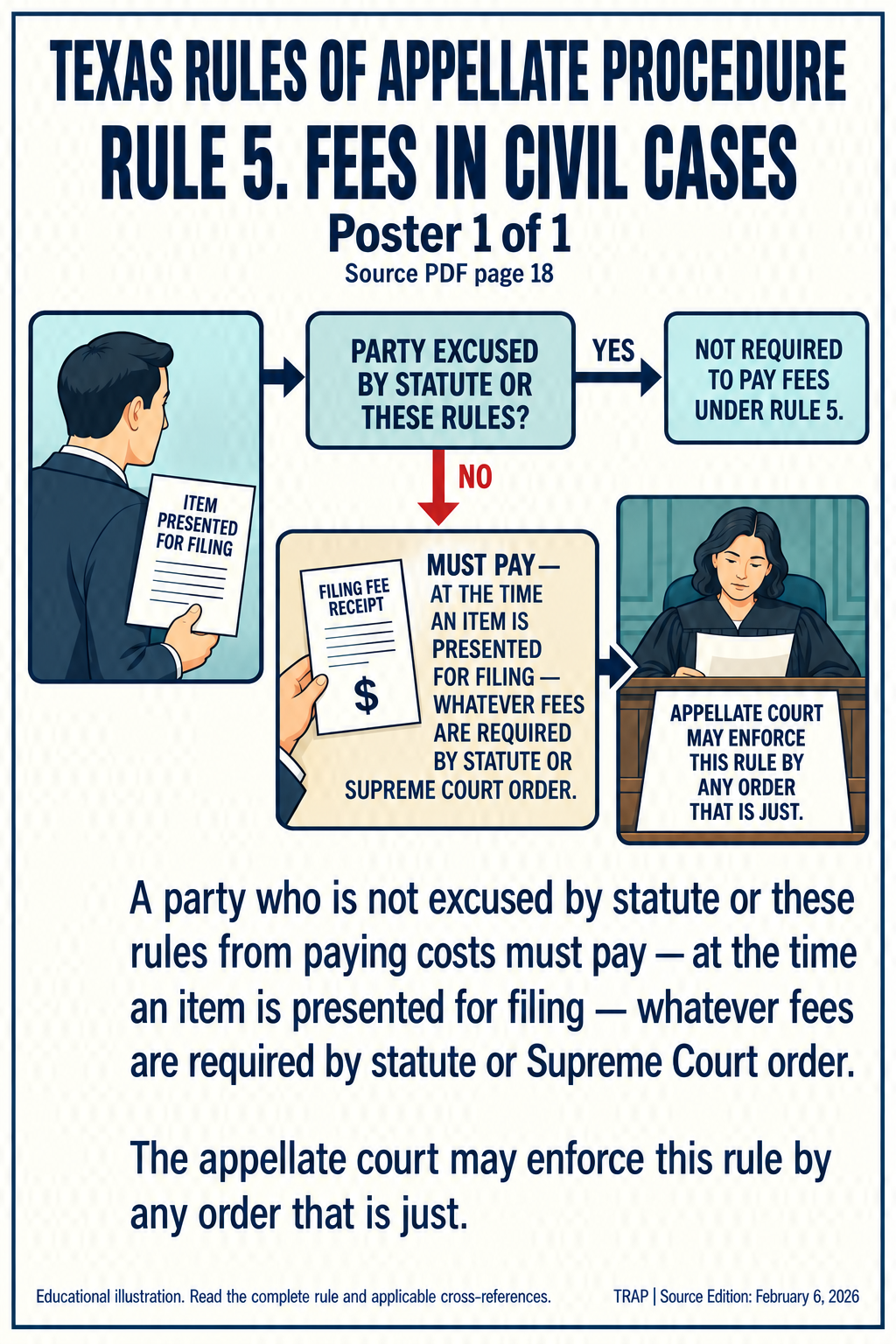
Read assigned source text
A party who is not excused by statute or these rules from paying costs must pay — at the time an item is presented for filing — whatever fees are required by statute or Supreme Court order. The appellate court may enforce this rule by any order that is just.